39 farmers take their flood losses to a German court
Thirty-nine farmers from Pakistan's Sindh province are seeking partial compensation from German energy company RWE and cement producer Heidelberg Materials after the 2022 floods destroyed homes, crops and livestock. Their lawsuit, filed in Heidelberg on December 22, 2025, puts losses exceeding €1 million at the centre of a legal fight over who should pay for damage linked to global warming.
Contents
- 39 farmers take their flood losses to a German court
- What the floods left behind in Sindh
- How the legal action developed
- How emissions become a claim for compensation
- Why these two companies were chosen
- What the earlier RWE case changed
- The companies say lawful emissions cannot bring retrospective liability
- Putting the farmers' losses beside Pakistan's national bill
- A compensation case alongside an unfinished recovery
- Key Points
The European Center for Constitutional and Human Rights (ECCHR), which supports the farmers, set out the filing date, legal grounds and losses in its January 20 statement. Many claimants lost two complete growing seasons of rice and wheat, leaving families without the harvests they depended on for food and income.
The farmers argue that emissions associated with the two companies contributed to climate change, which intensified the extreme rainfall that devastated their communities. They are pursuing the companies in Germany, where both are headquartered, rather than over any particular industrial operation in Pakistan.
RWE and Heidelberg Materials reject the claims as unfounded. Both argue that their operations complied with German law and oppose imposing liability retrospectively for emissions permitted and regulated by the state.
The case is under review in Heidelberg, with civil proceedings expected to take years. No hearing date or final compensation amount is given. The farmers seek a share of their losses from the companies, rather than payment for the entire national disaster.
What the floods left behind in Sindh
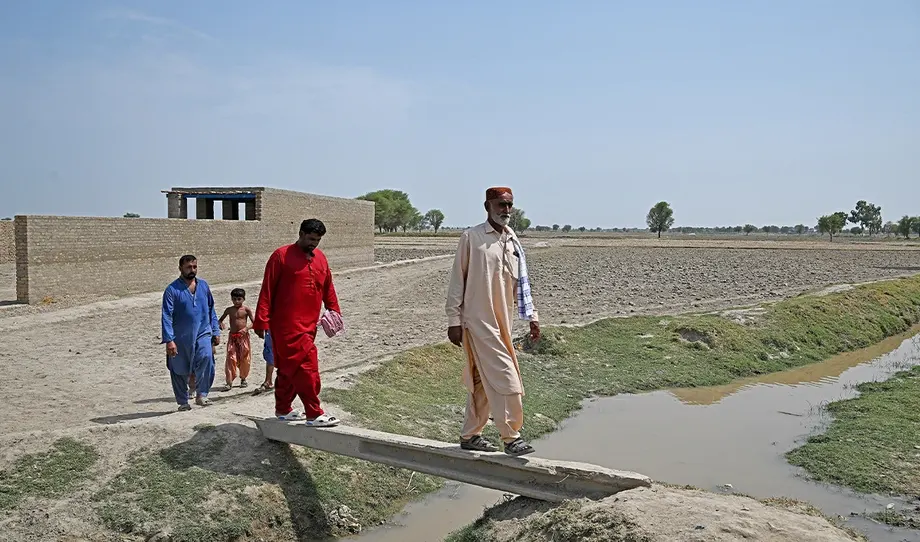
Abdul Hafeez Khoso, a farmer and teacher from the Jacobabad area, lives in a village of about 800 people surrounded by rice fields. He travelled to Germany for the legal effort and recalled industrial areas far larger than his community.
Khoso described the destruction that drove him to join the case:
The year 2022 was an apocalyptic scene -- not even our elders had ever witnessed such weather.
Munawar Khatoon, a landowner in Usman Samtio, said floodwater submerged seeds and wiped out the family's main source of income. For her, the loss extends beyond the ruined crop to the fear that returns with each rainy season.
Khatoon described that continuing anxiety:
We worry about how the next generation will manage to live if this continues.
Abdul Khalique Laghari, a farmer in Dadu district, estimates that he lost $14,000 in assets, including his house, livestock and crops across 40 acres, or about 16 hectares. He said creditors still call his family in the mornings, years after the flood.
Laghari explained the financial pressure:
To this day, we are unable to repay our debt.
For families dependent on farming, losing successive harvests means losing the money needed to buy seed, maintain land and repay borrowing. Damaged houses and missing livestock add further costs before the next crop can produce any income.
How the legal action developed
The farmers first sought a response outside court. According to ECCHR, they formally notified both companies on October 28, 2025, of their intention to seek compensation and invited them into dialogue and mediation. Mediation is an attempt to resolve a dispute through discussion rather than a court judgment.
ECCHR says the companies declined to engage in that process, after which the farmers filed their claim. The legal team includes Roda Verheyen and John Peters of the Hamburg law firm Günther Partnerschaft.
The main steps span more than three years:
- Summer 2022: Extreme rainfall and flooding destroyed homes, farmland and livelihoods across Pakistan.
- May 2025: A German court rejected a Peruvian farmer's claim against RWE while accepting that major emitters could, in principle, face liability for climate damage abroad.
- October 28, 2025: The Pakistani farmers formally notified RWE and Heidelberg Materials and invited dialogue and mediation.
- December 22, 2025: Thirty-nine farmers filed their lawsuit in Heidelberg.
- January 20, 2026: ECCHR published details of the claim and its legal basis.
How emissions become a claim for compensation
The farmers rely on two provisions of the German Civil Code, known by its German abbreviation, BGB. Section 906 concerns interference with property, while Section 823 concerns liability for unlawfully causing harm. Their lawyers are asking the court to apply those provisions to losses caused through a warming climate.
The argument connects several steps: the companies produced emissions, those emissions contributed to global warming, warming increased the likelihood or intensity of extreme rainfall, and that rainfall damaged the farmers' property and livelihoods.
Climate attribution research examines how human activity changes the likelihood or strength of an extreme weather event. Scientists compare the climate as it is today with a climate without the warming caused by human emissions. ECCHR says research found that human activity substantially increased both the likelihood and intensity of the extreme rainfall in Pakistan in 2022.
The farmers plan to use research on rainfall alongside evidence of their individual losses. That makes records of flooded fields, missing harvests, damaged homes and lost livestock central to the case, alongside evidence about emissions.
Verheyen, a lawyer involved in both the Pakistani and Peruvian cases, says the new claim also alleges wrongful conduct by companies that knew about climate risks. She described the argument this way:
Large companies knew about the general impacts of climate change since the 1960s.
She argues that the companies should have taken greater care to reduce their emissions. The court will have to assess that allegation alongside the companies' position that their activities were lawful.
Why these two companies were chosen
RWE is a major electricity producer based in Essen. Heidelberg Materials, headquartered in Heidelberg, is one of the world's largest building materials manufacturers. The farmers' claim targets their contribution to global emissions through fossil fuels and cement production.
The plaintiffs estimate that RWE accounted for 0.68 percent of global industrial greenhouse gas emissions since 1965 and Heidelberg Materials for at least 0.12 percent. Those figures were attributed at the notification stage to calculations by the Climate Accountability Institute that had not yet been published.
Added together, the claimed shares amount to 0.80 percent of global industrial emissions over that period. RWE's estimated share is about 5.7 times Heidelberg Materials' share. Those are the plaintiffs' estimates; the court's task includes deciding whether and how a company's contribution translates into responsibility for particular losses.
The request for partial compensation follows that approach. Rather than arguing that either business caused the entire flood, the farmers seek to assign each company a portion of responsibility for damage linked to climate change.
ECCHR legal director Miriam Saage-Maab says the case could help define how responsibility for climate harm is calculated, with possible relevance to negotiations over climate finance as well as court claims. Climate finance refers to money used to cut emissions, prepare for climate impacts or respond to damage.
What the earlier RWE case changed
Saúl Luciano Lliuya, a Peruvian farmer and mountain guide, brought a case against RWE in 2015 over the danger of flooding from a glacial lake above his home. The German court dismissed his compensation claim in May 2025 because he could not demonstrate the required flood risk to his property.
The court nevertheless accepted that companies could, in principle, be liable under German civil law for specific climate damage abroad associated with their emissions. That legal opening is what the Pakistani farmers hope to build on.
The Sindh case concerns destruction that has already happened: houses damaged, livestock lost and harvests wiped out. The lawyers therefore plan to present evidence of actual losses, rather than concentrate on the likelihood of a future disaster threatening a particular home.
ECCHR also points to a Swiss decision allowing a climate claim against cement company Holcim to proceed. That case involves residents of the Indonesian island of Pulau Pari. Typhoon survivors in the Philippines have also announced plans to sue Shell in Britain.
These cases share an effort to bring claims against major emitters in the countries where the companies are based. Each still depends on the law of the court hearing it and the evidence connecting the defendant to the harm claimed.
The companies say lawful emissions cannot bring retrospective liability
Heidelberg Materials says its operations complied with German law and argues that companies should not face different standards applied retrospectively. It initially confirmed receiving the legal notice and said it was reviewing it, before rejecting the claims as unfounded.
RWE describes the Pakistani case as an attempt to move climate policy disputes into German courtrooms. In its statement, the company set out its objection to civil liability for emissions authorised by the state:
It would be a contradiction in terms if the state allowed CO2 emissions, regulated them by law and even demanded them in some cases, but at the same time allowed retroactive civil liability for them.
RWE has also argued that litigation of this kind harms Germany as an industrial location by weakening companies' confidence that compliance with national law protects them from claims elsewhere.
The farmers' position is that companies can still bear responsibility for harm caused by their emissions, including damage thousands of kilometres away. The dispute brings two issues before the court: whether the alleged contribution to the losses can be demonstrated and whether German civil law requires compensation in these circumstances.
Putting the farmers' losses beside Pakistan's national bill
The 2022 floods affected roughly a third of Pakistan, killed about 1,700 people and affected more than 30 million residents. More than a million homes were damaged or destroyed, while extensive farmland went underwater.
Pakistan's Ministry of Planning, Development and Special Initiatives led the official Post-Disaster Needs Assessment, published on October 28, 2022. It received support from the Asian Development Bank, European Union, United Nations agencies and World Bank, with technical support from the United Nations Development Programme.
The assessment put damage above $14.9 billion and economic losses at about $15.2 billion, a combined total exceeding $30.1 billion. Damage covers destroyed or harmed assets, such as houses and infrastructure. Economic losses cover interrupted activity and income, such as harvests that could no longer be sold. A later estimate placed the disaster's cost at $40 billion.
The official assessment also calculated at least $16.3 billion in rehabilitation and reconstruction needs. That figure concerns the cost of rebuilding with better protection against future disasters. It excluded further new investment beyond affected assets needed to help Pakistan adapt to climate change.
The World Bank's main assessment report states that Pakistan contributes less than one percent of global greenhouse gas emissions. It also records that federal and provincial authorities had been coordinating relief efforts since June 2022.
A compensation case alongside an unfinished recovery
HANDS Welfare Foundation helped mobilise communities for the lawsuit. Other supporting organisations include ECCHR, medico international and Pakistan's National Trade Union Federation (NTUF). The union is gathering and translating testimony and evidence for the lawyers in Germany.
NTUF previously helped survivors and relatives pursue a German case involving retailer KiK after a 2012 garment factory fire in Karachi killed more than 250 workers. That claim was dismissed on procedural grounds, while KiK paid compensation through a separate process. The experience gave the union practical knowledge of organising a legal effort across borders.
For the farmers, compensation would have immediate uses. Gul Hasan Babar, a retired teacher and farmer among the claimants, says money could help people still living in tents rebuild homes and allow farmers to buy supplies to restore land damaged by flooding.
Hammad Naqi Khan, head of WWF-Pakistan, argues that pursuing major global emitters must be accompanied by stronger preparation at home. He has called for better local governance and support for farmers, fishing communities and people living in mountain areas to cope with climate risks.
The Heidelberg case places individual losses before a court, while Pakistan's wider recovery requires rebuilding homes, restoring agriculture and preparing communities for further extreme weather. For the 39 farmers, the immediate objective is a contribution towards damage that has continued to shape their lives long after the floodwater receded.
Key Points
- Thirty-nine Sindh farmers filed a lawsuit against RWE and Heidelberg Materials in Heidelberg on December 22, 2025.
- They seek partial compensation for flood losses exceeding €1 million, including homes, livestock and successive harvests.
- The claim relies on Sections 906 and 823 of the German Civil Code and evidence linking warming to extreme rainfall.
- A May 2025 German ruling accepted that major emitters could, in principle, face liability for climate damage abroad.
- Both companies reject the claims and oppose retrospective liability for emissions permitted under German law.
- Pakistan's official assessment put damage and economic losses above $30.1 billion and reconstruction needs at least $16.3 billion.
- The civil proceedings are expected to take years.