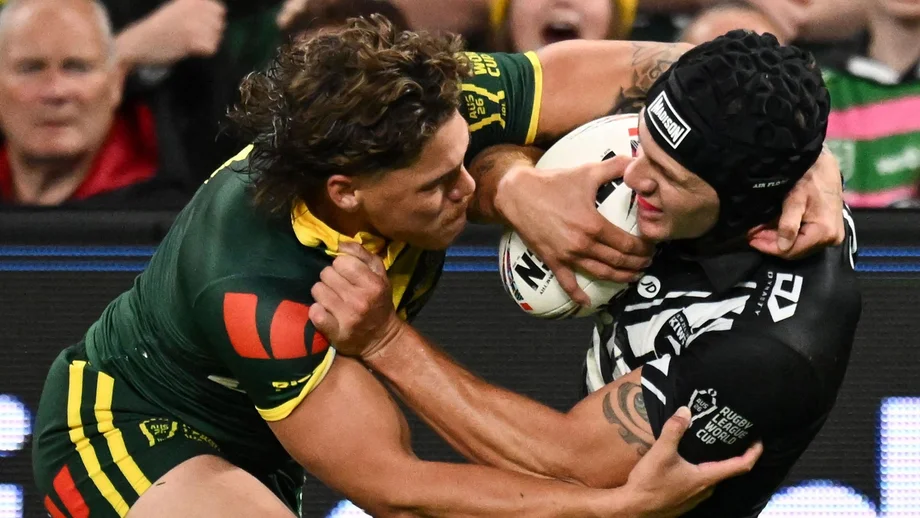
Eight tries send Australia back to the final
Reece Walsh scored three tries as Australia defeated Samoa 44-12 in Sydney on November 8, reaching the men's Rugby League World Cup final and setting up a November 15 showdown with New Zealand in Brisbane. The Kangaroos scored five unanswered tries before halftime, turning an early 2-0 deficit into a commanding 26-2 lead.
Contents
- Eight tries send Australia back to the final
- How Samoa's early lead disappeared
- A disallowed try and a decisive finish to the half
- Walsh answers his own mistake
- Why Australia kept winning possession
- Two video decisions fuel Samoa's frustration
- A celebration with a personal reason
- New Zealand brings a familiar final test
- Australia's women also book a New Zealand final
- Key Points
The National Rugby League's official match account recorded 41,259 spectators at Allianz Stadium, also known as Sydney Football Stadium. Attendance was also put at 41,529. A large Samoan following brought noise and colour, but Australia's control of possession and quick responses to setbacks decided the contest.
Australia now has six wins from six Test matches against Samoa. This victory also extended its World Cup winning streak to 22 matches and kept its pursuit of a fourth consecutive title alive. The Kangaroos have scored 170 points across four matches in this tournament, an average of 42.5 per game.
New Zealand, which defeated Tonga 34-10 in the other semifinal, presents a familiar challenge. The teams opened this tournament with Australia's narrow 24-22 victory on October 15. Their next meeting will decide the trophy at Brisbane's Lang Park, also known as Suncorp Stadium.
How Samoa's early lead disappeared
Stephen Crichton's penalty goal in the fifth minute gave Samoa the first points after Australia was caught offside. Within two minutes, however, a Crichton handling error near his own line handed the Kangaroos an attacking scrum, and Tom Dearden seized the opportunity.
Dearden shaped to pass, then ran through the gap between Jazz Tevaga and Francis Manuleleua. His dummy, a movement designed to make defenders expect a pass, opened the route to Australia's first try.
Jacob Preston followed in the 14th minute after Keaon Koloamatangi drove close to the line and released the ball to Harry Grant. Grant found Cameron Munster, whose short pass sent Preston through the defence. Australia was building its attacks through several players rather than relying on one runner.
Spencer Leniu's handling mistake in the 24th minute gave Australia another opportunity near Samoa's line. Dearden and Kotoni Staggs helped move the ball to Tom Trbojevic, who finished for his eighth try of the tournament. The Kangaroos were 16-2 ahead, with Samoa spending increasingly long periods defending.
A disallowed try and a decisive finish to the half
Samoa appeared to have found a route back around the half hour when Manuleleua challenged Walsh for a high kick from Jarome Luai. The ball fell to Crichton, who crossed the line, prompting celebrations that ended when the video officials intervened.
The bunker, rugby league's video review system, ruled that Manuleleua had knocked the ball forward during the contest. A knock on occurs when a player loses the ball forward from the hand or arm. The decision erased the try and returned possession to Australia.
Walsh scored about two minutes later, accelerating through a gap between Ronald Volkman and Crichton on Australia's left. His first try took the score to 20-2 and turned a moment of Samoan hope into another Australian breakthrough.
Cameron Murray then drew three defenders before passing to Preston, who sent Bradman Best over for his first Test try. Leniu was sent to the sin bin for dissent toward referee Adam Gee after the score. Samoa reached halftime trailing 26-2 and temporarily reduced from 13 players to 12.
The most important stages of the match came in a clear sequence:
- Fifth minute: Crichton's penalty put Samoa 2-0 ahead.
- Seventh to 24th minutes: Dearden, Preston and Trbojevic scored to establish Australia's lead.
- About the half hour: Crichton's apparent try was disallowed before Walsh scored at the other end.
- Before halftime: Best crossed and Leniu was sin binned, leaving Samoa 24 points behind.
- Second half: Samoa scored twice, but Walsh completed his hat-trick and Jack Bostock added Australia's eighth try.
Walsh answers his own mistake
Walsh gave Samoa an opening early in the second half when he dropped a high kick from Volkman. Crichton gathered the loose ball and scored, bringing Samoa back to 26-8.
Three minutes later, Walsh restored Australia's advantage. Taking a short pass from Grant, he drove through Crichton's tackle to claim his second try. Munster's conversion made it 32-8, immediately undoing Samoa's progress on the scoreboard.
Izack Tago scored in the left corner in the 61st minute after passing from Volkman, Luai and Hamiso Tabuai-Fidow. Australia again answered with a Walsh try, this time finishing a move that began inside its own half and involved Trbojevic, Dearden and Munster.
Bostock completed the scoring with eight minutes remaining, claiming his seventh try of the tournament. Walsh's three tries accounted for 12 points before conversions, matching Samoa's entire score.
Walsh's attacking performance came after an interrupted preparation. An ankle injury had kept him out of matches for eight weeks before the tournament. He has since become central to Australia's attack, including a long scoring run and a crucial tackle against New Zealand in the opening game.
Why Australia kept winning possession
Australia completed nearly 90% of its sets and restricted Samoa to one line break. In rugby league, a team normally has six tackles to advance before possession changes. Completing a set usually means reaching the final tackle and making a useful kick rather than losing the ball through an error.
Samoa conceded a combined 12 penalties and set restarts. A restart gives the attacking side a fresh tackle count, forcing defenders to keep working without getting the ball back. Australia also received four more penalties than Samoa.
Those interruptions repeatedly gave the Kangaroos extra possession and better attacking positions. During the final 19 minutes of the first half, Samoa reached its kick just twice. The pressure fed a cycle of defending, fatigue and further mistakes.
Munster and Grant directed much of Australia's play, while Dearden threatened the defensive line with his running. Pat Carrigan and Tino Fa'asuamaleaui helped the forwards withstand Samoa's physical opening. Leniu, by contrast, lost the ball on his first carry and again on his first touch after returning from the sin bin.
Australia captain Isaah Yeo said the performance reflected the team's progress through the tournament and its response to the pressure of a semifinal.
"I thought it was probably the best we'd started this campaign so far," Yeo said.
Yeo described the victory as a step toward the level Australia needs in the final.
I feel like we've been building each week and that was a real step in the right direction.
Two video decisions fuel Samoa's frustration
Samoa had two tries disallowed, with the first ruling against Manuleleua drawing particular criticism. Sydney Roosters coach Trent Robinson, speaking on commentary, disagreed with the decision that the ball had travelled forward.
"It's clearly a knock back," Robinson said.
Tabuai-Fidow was denied a second half try after Manuleleua was judged to have obstructed Liam Martin. Obstruction occurs when a player illegally blocks a defender from reaching an opponent. Gee's decision was supported by video official Chris Butler.
Shaun Johnson, the former New Zealand international, criticised both the on field decisions and the video review process. He acknowledged Australia's performance while expressing frustration with the officiating.
"I don't want to take anything away from what the Aussies produced but I can't help but have this frustration around how the game was officiated," Johnson said.
Samoa coach Ben Gardiner said Australia "got the home ground calls", but he also identified shortcomings his own team needed to address. His players struggled to recover after penalties and missed too many tackles.
Gardiner described how one setback repeatedly led to another, leaving Samoa unable to regain control.
On the back of some of the penalties that were given, we just didn't react very well. There was one thing into another and then a try. It made it difficult to be able to fight back from that.
A celebration with a personal reason
Walsh celebrated his first try with a backflip, losing a boot in the process before sitting down to put it back on. Australia coach Kevin Walters said during halftime that there would be no further backflips after the break.
Walters later explained that Walsh had made a promise to children who were ill. The celebration had a purpose beyond entertaining the crowd.
He did it for some sick kids. They all asked him to do a backflip if he scored a try, so you can't really be against that when he's putting a smile on kids' faces.
Walters also backed his fullback after the dropped high ball that led to Crichton's try. Walsh's immediate scoring response illustrated why the coach has placed him at the centre of Australia's attack, despite the errors that accompanied his performance.
New Zealand brings a familiar final test
Australia and New Zealand will meet in a men's World Cup final for the first time since 2013. They also contested the 2000 and 2008 deciders, with New Zealand winning 34-20 in Brisbane in 2008.
That remains Australia's most recent World Cup defeat. The Kangaroos have won the three tournaments since, while Samoa's campaign has now ended against Australia in consecutive World Cups, following a 30-10 defeat in the 2022 final.
The October 15 meeting offers a much closer recent comparison than the semifinal score. Australia beat New Zealand by only two points, 24-22. New Zealand fullback Kalyn Ponga played on for about 20 minutes with a broken arm in that game, then returned for the semifinal victory over Tonga and produced a performance that earned him the player of the match award.
Walters acknowledged Ponga's quality while keeping his attention on Australia's preparation.
For the players, it's been about what we can do as a team. If we get that right, I'm happy with that.
For Australia, the semifinal supplied a practical formula for November 15: retain possession, make opponents defend for long periods and answer their scores quickly. New Zealand's narrow opening defeat gives the final a different starting point from Samoa's struggle to stay close.
Australia's women also book a New Zealand final
Australia's women defeated Fiji 30-14 in the preceding match at the same stadium, securing another final against New Zealand. Abbi Church scored four tries as the Jillaroos survived a difficult contest before pulling away.
The result keeps the Australian women in contention for a fourth successive world title, matching the men's ambition. Brisbane will therefore host two Australia versus New Zealand finals on November 15, with the Jillaroos facing the Kiwi Ferns and the Kangaroos meeting the Kiwis.
For Samoa, the men's defeat ends the attempt to reach a second consecutive final. Captain Junior Paulo credited Australia while expressing disappointment at how the evening had unfolded.
That's a credit to the Aussie boys for turning up the way they did and putting on their performance. It was always going to be tough.
Key Points
- Australia beat Samoa 44-12 after leading 26-2 at halftime in Sydney.
- Reece Walsh scored his first international hat-trick as Australia finished with eight tries.
- Samoa had two tries disallowed and Spencer Leniu was sin binned for dissent.
- Australia extended its World Cup winning streak to 22 matches and remained unbeaten in six Tests against Samoa.
- The men's final against New Zealand is scheduled for November 15 in Brisbane.
- Australia's women beat Fiji 30-14, with four tries from Abbi Church, to set up a final against New Zealand.