Sandbags first as Colombo prepares for pilotless flights
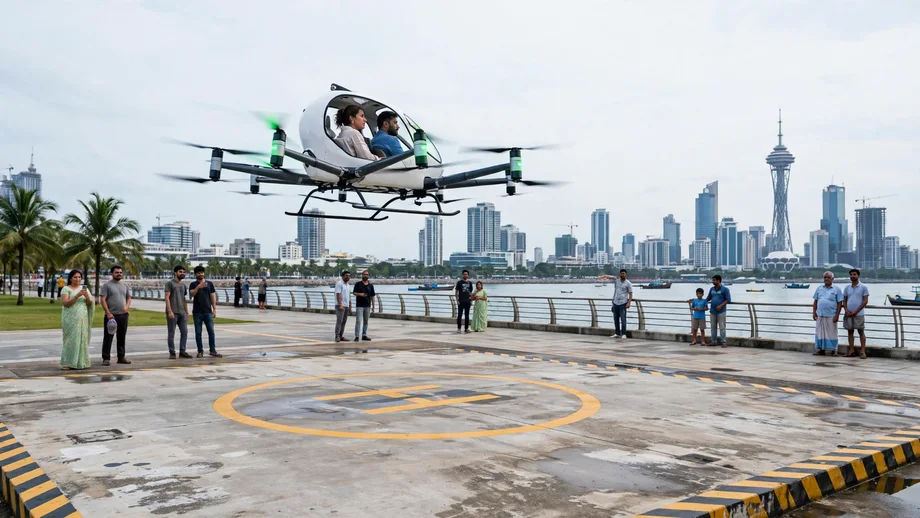
Sri Lanka plans to demonstrate a fully electric passenger drone at Colombo Port City on November 11, 2026, with sandbags occupying the places intended for passengers during initial trials. The aircraft is designed to carry two people over about 25 kilometres, but the immediate task is to test its performance under controlled conditions.
Contents
- Sandbags first as Colombo prepares for pilotless flights
- What will happen during the trials?
- A changing timetable from arrival to commercial flights
- How the electric aircraft works
- What safety approval still requires
- Which journeys are being considered?
- What might a ticket cost?
- Port City needs more than a landing pad
- Emergency flights and larger aircraft are longer term plans
- Key Points
Captain Daminda Rambukwella, director general of the Civil Aviation Authority of Sri Lanka (CAASL), said human passengers would not take part at this stage. The designated testing area at Port City will allow officials to examine the aircraft and its operating arrangements before considering permission to carry paying customers.
Ports and Civil Aviation Minister Anura Karunatilake hopes commercial flights can begin within two to three months if the trials succeed. His proposed timetable depends on further technical assessments, safety requirements and regulatory arrangements. No confirmed date for the start of ticket sales has been announced.
China's EHang is leading the initiative, with the Sri Lankan government providing policy support, infrastructure assistance and regulatory coordination. Tourism is the first intended market, including aerial sightseeing around Colombo for foreign visitors and local travellers.
The November demonstration follows an earlier plan for a maiden flight by the end of October. Sri Lanka's earlier October flight target accompanied the arrival of the country's first passenger drone and preparations for an operating zone at Port City.
For prospective passengers, the next step is therefore a demonstration rather than an airport transfer or a sightseeing booking. The authorities must first establish how the aircraft, ground teams and airspace controls will work together in Sri Lanka.
What will happen during the trials?
Rambukwella said preliminary flights had already taken place at Port City on November 8 ahead of the planned official demonstration. Sandbags will simulate the weight of passengers so technical teams can assess how the aircraft performs while carrying a load.
The CAASL director general described the initial testing arrangements:
"We will initially use sandbags for the test trials. Several tests have already been conducted, and we are now working towards the next stage of the demonstration," Rambukwella said.
Port City was selected partly because other areas of Colombo have airspace restrictions, particularly around important government installations. Testing in a designated area gives aviation and security authorities a controlled setting in which to assess operations.
Karunatilake said the project had obtained the necessary approvals from the Ministry of Defence, CAASL and other relevant institutions for its preliminary activities. CAASL is also developing the safety and regulatory requirements needed for operational use.
A changing timetable from arrival to commercial flights
Sri Lanka's plans have progressed through several proposed dates. Deputy Minister of Ports and Civil Aviation Ruwan Kodithuwakku initially described September testing, with commercial operations targeted within six months of completing the first trials. Karunatilake's more recent ambition is two to three months after successful November trials, while Rambukwella has also discussed commercial operations beginning next year.
The main milestones are:
- August 19, 2026: EHang's announced programme set a proposed four month timetable for initial commercial operations within a designated testing zone, subject to assessments and approvals.
- By October 18: CAASL had announced the arrival of the first passenger drone, with a maiden flight planned by the end of October.
- October 19: Rambukwella described a possible first flight on October 30 or 31, or during the first week of November.
- October 22: The Ministry of Defence announced plans for a demonstration centred on Port City on November 11.
- November 8: Preliminary trials took place at Port City, according to Rambukwella.
- November 11: The official demonstration is scheduled to take place.
- November 28: A second aircraft shipment is expected under the earlier delivery plan.
Karunatilake, the minister responsible for ports and civil aviation, set out the conditional commercial target:
"We expect to begin the initial flight operations on November 11. If the project is successful, we hope to commence commercial operations within the next two to three months," the Minister said.
How the electric aircraft works
EHang's aircraft belongs to a category called electric vertical takeoff and landing, usually shortened to eVTOL. Electric motors and propellers allow it to rise and descend vertically, so it does not need a conventional runway.
The aircraft intended for the initial project has two passenger seats and operates without a pilot onboard. Automated flight controls handle navigation, supported by monitoring and management systems on the ground. Pilotless flying still requires people and procedures to oversee operations.
EHang's EH216-S matches the general description of the aircraft, although the exact model for the Colombo demonstration has not been publicly confirmed in the announcement described by the Defence Ministry. EHang lists a maximum design speed of 130 kilometres per hour and a design range of up to 30 kilometres for that model. Rambukwella has given an operational estimate of about 25 kilometres for the Sri Lankan project.
CAASL's arrival announcement also described an aircraft capable of flying continuously for about 30 minutes. Flight duration measures time in the air, while range measures distance. Route planning must account for the intended journey, operating conditions and the energy needed to complete it safely.
Battery power means the aircraft produces no exhaust emissions during flight. Electricity is required to recharge it, and the emissions associated with that electricity depend on how it is generated.
What safety approval still requires
CAASL is working on rules for Advanced Air Mobility, the broader category covering these new forms of aerial transport. Its discussions have included aircraft certification, licensing, infrastructure, security, operational oversight and integration with existing air traffic.
Rambukwella said the EHang aircraft had received type certification from the Civil Aviation Administration of China. Type certification is a regulator's acceptance that an aircraft design meets specified standards. He said Sri Lanka was developing implementing standards and requirements using that certification.
In his earlier October account, Rambukwella also referred to completed regulatory procedures under relevant US certification standards. The local process still includes operational assessments and the finalisation of rules for the proposed service.
Authorities are examining a framework for managing traffic at low altitudes. This would govern where aircraft can fly, how their movements are coordinated and how they fit alongside other aviation activity. EHang has proposed a regulatory sandbox, a designated setting where officials can assess the technology and its procedures under defined conditions.
International experts are expected to assess implementation. Rambukwella said the initiative reached Sri Lanka through the International Civil Aviation Organization's regional office following discussions with Regional Director Tao Ma, and the government accepted the proposal.
Which journeys are being considered?
Colombo sightseeing is the clearest initial commercial focus. Karunatilake said local and foreign tourists would be offered aerial views of the city and surrounding areas if the project advances successfully.
Authorities have also discussed routes between Katunayake, where Bandaranaike International Airport is located, and Port City, along with connections between Colombo and destinations on the southern coast. Sigiriya, Pidurangala and Jaffna feature in wider tourism expansion plans.
The aircraft's estimated range gives the first services a relatively small operating area. A route of about 25 kilometres could serve a selected local connection or sightseeing circuit. Flights around distant tourism destinations would require arrangements at those locations, including landing facilities, charging and approved operating areas.
The earlier operating concept described journeys of about 20 kilometres at intervals of 30 minutes. With two seats, one aircraft departing twice an hour could offer four passenger departures per hour, before allowing for charging, maintenance or other interruptions. The initial project is therefore aimed at a small number of travellers rather than large volumes of commuters.
Kodithuwakku said the first two months of the pilot would be used to assess operations and develop suitable routes. Choosing a route involves more than finding a short distance on a map: the aircraft also needs approved airspace and suitable places to take off and land.
What might a ticket cost?
Rambukwella has discussed an indicative price of around US$50 per passenger for a journey of approximately 25 kilometres. He said it could be cheaper than conventional helicopter transport, while stressing that the figure was not a confirmed commercial fare. Another estimate put a proposed airport to Colombo trip at US$20 to US$30.
The eventual price will matter particularly for airport transfers. Travellers would need to weigh the fare against the time spent reaching the departure point, boarding, flying and continuing from the landing site to their destination. A short flight is only one part of that journey.
Tourism flights have a different purpose. Their attraction would be the aerial experience itself, rather than simply avoiding traffic. The government's initial emphasis on sightseeing gives the project a potential market while authorities develop the arrangements needed for regular transport.
Port City needs more than a landing pad
Port City has been designated as the main operational hub. The first aircraft arrived at Bandaranaike International Airport from Thailand under the EHang brand, according to Rambukwella. Sri Lanka's participation is also linked to EHang's Global Fast Track Program, which is intended to accelerate the introduction of its aircraft into international markets.
The proposed ground facilities are known as vertiports. They provide places for vertical takeoffs and landings, along with charging, passenger handling and supporting operations. Limited space requirements are one reason officials see the technology as attractive, although each site still needs protected ground areas and clear flight paths.
Earlier plans described flight altitudes of 400 to 500 feet, supported by monitoring in real time. At those heights, the project would depend on carefully selected routes and coordination with security and aviation authorities. Port City's designated zone is intended to provide a manageable starting point.
The government has promised infrastructure assistance alongside policy support. Those preparations must connect the aircraft to a functioning service: passengers need somewhere to board, batteries need charging, and operators need maintenance and oversight arrangements between flights.
Emergency flights and larger aircraft are longer term plans
The ministries involved are also considering uses beyond tourism. These include emergency medical transport, disaster response, cargo delivery to remote areas and maritime or naval requirements. Such missions would need operating arrangements suited to the places and tasks involved.
Authorities have discussed bringing in aircraft carrying four to six passengers next year. Discussions have also covered possible passenger drone manufacturing in Sri Lanka. These proposals extend beyond the immediate two seat demonstration at Port City.
The November trials give Sri Lanka a concrete starting point: an aircraft already in the country, a selected testing area and technical work underway. Progress towards a passenger service will depend on the results of those tests and completion of the local safety and operating framework.
Key Points
- An official passenger drone demonstration is planned at Colombo Port City on November 11, 2026.
- Initial trials will use sandbags to simulate passengers; people will not be carried at this stage.
- The fully electric, autonomous aircraft is designed for two passengers, with an estimated operational range of about 25 kilometres.
- The minister hopes commercial operations can begin within two to three months if trials succeed and requirements are met.
- Colombo sightseeing is the initial focus, with airport connections and flights around other tourist destinations under consideration.
- CAASL is developing operating rules and air traffic arrangements. Fares remain estimates.