Nearly two dollars in concessional loans for every dollar in grants
Nepal was allocated about $3.19 billion in international climate finance between 2016 and 2023, but most of that support came with an obligation to repay. Concessional loans accounted for 63.28% of the total, compared with 30.36% in grants, according to the Prakriti Resources Centre (PRC).
Contents
- Nearly two dollars in concessional loans for every dollar in grants
- Why the terms of finance matter
- Development banks dominate the financing
- Adaptation takes the largest share, mostly through debt
- Funding fluctuated sharply between years
- Energy leads while forests receive a small share
- Loss and damage has no separate allocation
- The 2035 plan requires far more funding
- A strategy must connect projects with funders
- Key Points
The centre's climate finance study, Nepal's Climate Finance Landscape: Mapping International Climate Finance Flow Post-Paris Agreement (2016-2023), puts concessional lending at about $2.02 billion and grants at roughly $970 million. That means Nepal received allocations of slightly more than two dollars in concessional loans for each dollar in grants.
The financing mix matters because much of the money supports adaptation: protecting people, farms, water supplies and infrastructure from climate hazards. Flood protection and early warning systems can save lives and prevent expensive damage, yet they generally do not collect revenue that a government can use to repay a loan.
PRC's findings bring together three connected problems: dependence on lenders, uneven funding between sectors and years, and national climate plans whose financial requirements far exceed the resources allocated so far. The government's response is that grants must support essential public protection, while domestic budgets, private investment and borrowing also have roles.
The study describes approximately $3.19 billion in allocations over eight years. Its central policy concern is the quality of that finance: how much must be repaid, on what terms, and whether the money reaches activities that Nepal considers most urgent.
Why the terms of finance matter
Concessional loans offer more favourable terms than ordinary borrowing, such as lower interest rates or longer repayment periods. Grants do not have to be repaid. Non-concessional loans and equity, which involves an ownership investment, accounted for a smaller part of the total in the study covering 2016 to 2023.
PRC recommends assessing interest rates, repayment periods and the degree of financial support within a loan, alongside the amount allocated. Two financing packages with the same headline value can place different demands on future public budgets.
Researcher Yamkumari Uchhai said adaptation needs grants because many activities do not produce direct financial returns. Restoring an ecosystem or protecting a settlement from floods brings public benefits, but those benefits do not necessarily create income for loan repayments.
Maheshwar Dhakal, who heads the government's climate change and management division, supports grants for adaptation connected to lives, health, education and community resilience. He also identifies hydropower, major infrastructure and other productive sectors as areas where concessional loans and private capital can contribute. The practical choice is therefore which type of finance fits each project.
Development banks dominate the financing
Multilateral development banks, institutions backed by multiple governments, accounted for 66.83% of Nepal's international climate finance allocations during 2016 to 2023. Bilateral development partners, meaning support provided directly by individual countries, supplied 25.96%. Dedicated climate funds, including the Green Climate Fund and Global Environment Facility, contributed 5.04%.
Development banks mainly provided concessional loans. Bilateral partners and dedicated climate funds supplied relatively more grants. Nepal's dependence on development banks therefore helps explain why borrowing represents such a large share of its climate finance.
A second PRC publication, its development bank financing analysis, examines allocations and commitments from those banks over the longer period of 2013 to 2023. It records approximately $3.16 billion, using the Organisation for Economic Co-operation and Development's Climate-Related Development Finance, Recipient Perspective dataset.
The World Bank provided $1,775.8 million, or 56.1% of that bank financing. The Asian Development Bank supplied $878.3 million, or 27.7%; the European Investment Bank $461.5 million, or 14.6%; and the Asian Infrastructure Investment Bank $50 million, or 1.6%.
These totals cover different periods and groups of contributors: the $3.19 billion study covers international climate finance from 2016 to 2023, while the $3.16 billion analysis covers development banks from 2013 to 2023. Each offers a different view of Nepal's financing relationships.
Adaptation takes the largest share, mostly through debt
Adaptation received 56.79% of allocations in the study covering 2016 to 2023, while mitigation received 42.36%. Adaptation means preparing for climate impacts, such as floods or water shortages. Mitigation means reducing the emissions that drive climate change. Activities serving both purposes received less than 1%.
The longer development bank analysis shows how heavily adaptation depended on loans. Of $1,704.1 million allocated to adaptation between 2013 and 2023, $1,608.2 million came through concessional loans, $87.8 million through non-concessional loans and just $8.1 million through grants.
Those figures put grants at about 0.5% of the banks' adaptation financing. Concessional loans made up approximately 94.4%. For communities depending on publicly funded flood protection or reliable water supplies, the financing structure leaves government budgets responsible for repayment even when a project produces no direct income.
Across all climate activities in the development bank analysis, concessional loans accounted for $2,506.5 million, or 79.2%. Non-concessional loans represented $610.1 million, or 19.3%, while grants amounted to $49 million, or 1.5%.
Mitigation received $1,459.8 million from the banks, with $896.7 million in concessional loans, $522.3 million in non-concessional loans and $40.8 million in grants. Activities combining adaptation and mitigation received $1.7 million. These figures make the financing challenge especially concrete: even the bank funding aimed at coping with climate impacts was almost entirely repayable.
Funding fluctuated sharply between years
Nepal's adaptation finance varied widely during the period examined. The study records a large allocation in 2020, a steep fall in 2021 and a much smaller amount in 2023 than at the 2020 peak.
- 2016: The study's period begins, covering international climate finance following the Paris Agreement.
- 2020: Adaptation finance reached approximately $610 million.
- 2021: Adaptation finance fell to approximately $64.5 million.
- 2023: Adaptation finance stood at approximately $105.1 million, at the end of the study period.
- 2035: Nepal's third Nationally Determined Contribution sets the implementation horizon for its stated $73.74 billion financing requirement.
The fall in adaptation finance from 2020 to 2021 was about 89%. Although the 2023 amount was higher than in 2021, it remained far below the 2020 level. PRC recommends financing organised around sustained programmes and results, helping Nepal plan work that needs support over several years.
The development bank series also shows large annual swings, across all climate themes. Allocations and commitments reached $790.9 million in 2020, fell to $58.1 million in 2021 and recovered to $310.3 million in 2022 before declining to $117.8 million in 2023.
Energy leads while forests receive a small share
Energy and water resources received $982.91 million during 2016 to 2023, the largest sector allocation identified in the study. Industry, transport and physical infrastructure followed with $574.92 million, while disaster risk reduction and management received $519.60 million.
These three categories together accounted for approximately $2.08 billion, or about 65% of the $3.19 billion total. Their concentration shows how much of Nepal's climate finance has been directed toward infrastructure, energy, water and disaster management.
Agriculture and food security received $265.66 million. Health, drinking water and sanitation received $217.45 million. Forests, biodiversity and watershed conservation received $36.22 million, approximately 1.1% of the total. The energy and water category received about 27 times as much as forests, biodiversity and watershed conservation.
PRC recorded no climate finance for tourism or natural and cultural heritage, despite climate disasters damaging these sectors. Its recommendations call for greater access to grants for agriculture, water resources, health, forests, biodiversity and adaptation that uses ecosystems to protect communities.
Water resources appear within the largest combined allocation category and among the recommended priorities for grants. The recommendation concerns the type and purpose of support as well as its size, particularly where water projects protect public welfare rather than generate revenue.
Loss and damage has no separate allocation
The study found no separate financial allocation for loss and damage. This term refers to harm caused by climate impacts, including damage that efforts to prepare for hazards cannot prevent.
Adaptation and recovery address different needs. A flood warning system helps people prepare before a disaster. Rebuilding homes, restoring services and supporting livelihoods after destruction require money once losses have occurred. Uchhai called for financing needs and sources to be tracked separately for mitigation, adaptation, and loss and damage.
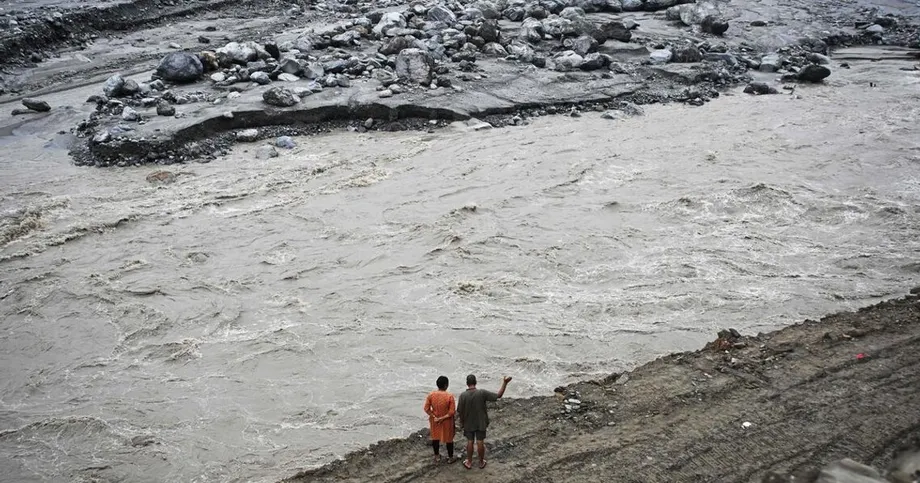
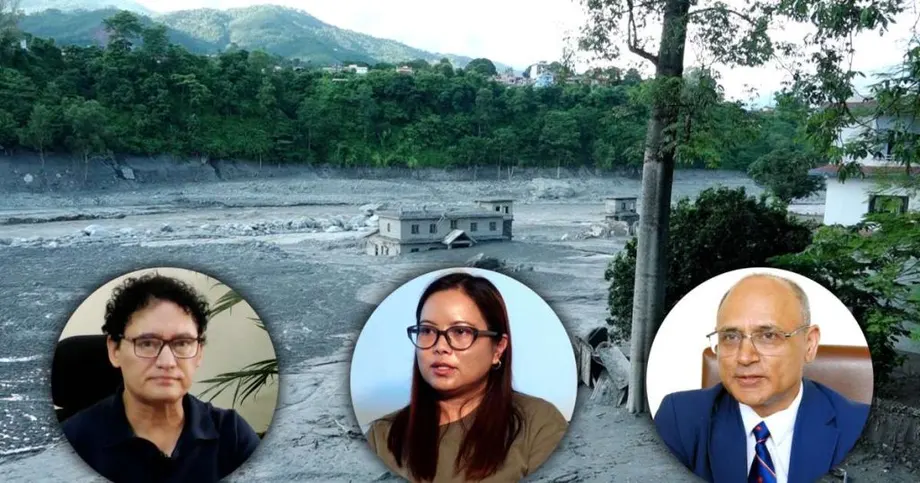
An estimated $4.7 billion reconstruction and recovery requirement following the Bhotekoshi floods illustrates the scale of disaster costs cited in the discussion. That estimate exceeds the entire $3.19 billion in international climate finance allocated over the eight years by about $1.51 billion, or roughly 47%.
For Nepal, a financing system needs to show both what is being spent to reduce future damage and what resources are available when communities have already suffered losses. Separate accounting would make those needs easier to identify and budget for.
The 2035 plan requires far more funding
Nepal estimates that implementing its third Nationally Determined Contribution, or NDC, will require $73.74 billion by 2035. An NDC is a country's climate action plan under the Paris Agreement. More than $62.92 billion of Nepal's stated requirement is expected from international support.
That international component represents more than 85% of the total estimated cost. Adaptation needs alone are estimated at $18 billion to $20 billion, several times the international climate finance allocated across all themes during 2016 to 2023.
Dhakal said the NDC and National Adaptation Plan describe Nepal's needs and development vision. The government's approach includes international assistance, domestic budgets, private investment and infrastructure capable of attracting finance, rather than relying on grants alone.
He also identified forest conservation, food security, tourism based on nature and protected areas as potential fields for investment compatible with climate goals. His position places grants alongside other financing sources, with the choice depending on the public benefits and earning potential of the activity.
A strategy must connect projects with funders
Climate finance expert Raju Pandit Chhetri said Nepal needs to identify how much each sector requires and which institutions it should approach. Submitting a national funding requirement needs to be followed by detailed work with bilateral partners, development banks and climate funds.
Chhetri said the analysis of sectors, financial instruments and major contributors can guide that strategy. He called for coordination between government agencies and development partners so responsibilities for adaptation, mitigation, grants and concessional lending are clear.
PRC recommends aligning budgets and projects with the NDC and National Adaptation Plan, prioritising sectors receiving little finance and establishing a national system to track flows. It also calls on development partners to disclose the grant value of their support and use more consistent reporting methods.
Dhakal's call for a clearer definition of climate finance connects directly with those recommendations. Counting all development spending as climate finance makes it harder to identify the resources directed toward climate objectives. A unified system would help Nepal distinguish ordinary development assistance from spending intended to reduce emissions, prepare for hazards or address losses.
No quantified mobilisation plan or deadline for closing the financing gap was set out in the recommendations. The next task identified by PRC and Chhetri is practical: match priority projects with suitable sources of money, specify repayment obligations and track whether support reaches the sectors and communities for which it is intended.
Key Points
- Nepal was allocated about $3.19 billion in international climate finance during 2016 to 2023.
- Concessional loans accounted for 63.28% of allocations, compared with 30.36% in grants.
- Development banks provided 66.83% of the total, helping explain the large role of loans.
- Adaptation received 56.79%, but financing varied sharply between years and relied heavily on borrowing.
- Energy and water resources received $982.91 million; forests, biodiversity and watershed conservation received $36.22 million.
- No separate allocation for loss and damage was recorded.
- Nepal estimates it needs $73.74 billion for its third NDC by 2035, with more than $62.92 billion expected internationally.
- PRC recommends greater access to grants, support for underfunded sectors and a national climate finance tracking system.