A bathroom experiment earns a NT$400,000 scholarship
Xu Yi-chen raised more than 100 cockroaches at home and carried out much of her research in the family bathroom. Her question was unusual: would an insect keep trying to clean a body part after that part had been removed?
Contents
- A bathroom experiment earns a NT$400,000 scholarship
- What the cockroaches kept doing
- How movement can continue without the head
- Why the research invokes phantom limbs
- The student behind the unusual experiment
- Brine shrimp reveal changes at the water surface
- Could the shrimp study help fish farmers?
- Other students investigated train wind and fog collection
- Teachers and schools share recognition
- Key Points
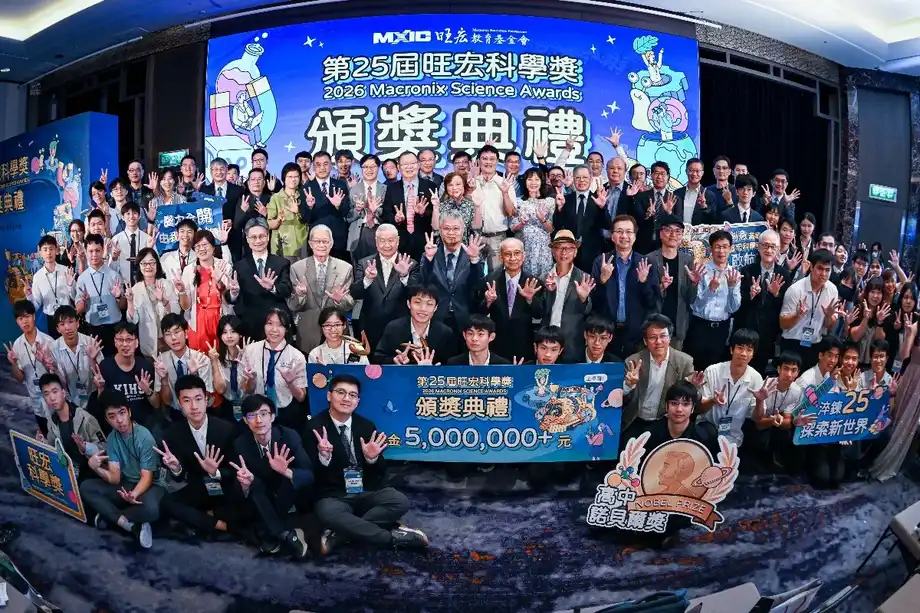
The Taipei Municipal Zhongshan Girls High School student found that cockroaches without heads or antennae still made coordinated grooming movements toward the places where those parts had been. Her observations earned one of two gold medals at the 25th Macronix Science Award, presented on November 7, 2026, along with a NT$400,000 scholarship.
The other gold medal went to Chiayi Senior High School students Xu Weicheng and Tu Chenghong, who investigated how swimming brine shrimp change the shape of the water surface. Their project began with live food for guppies and developed into research that could help monitor conditions in aquaculture.
The two winning entries emerged from more than 800 teams representing 168 schools. Together, they show how close observation of familiar animals can lead to questions about two very different systems: the nerves that coordinate movement and the forces that shape moving water.
What the cockroaches kept doing
Xu studied American cockroaches, using video recordings and quantitative analysis of their movements to build a movement model. Recording the insects allowed her to examine how their actions changed, rather than relying only on what she could catch by watching them directly.
Cockroaches regularly groom themselves to keep their bodies clean. Xu observed that, after removal of the head or antennae, the insects could still direct grooming movements toward the missing parts. Headless cockroaches also arched their backs and moved their hind legs forward toward the former position of the head.
Those actions interested her because they involved coordination. Several parts of the body were moving in a pattern associated with cleaning a particular location. Xu interpreted the behavior as drawing on earlier sensory experience, with the nervous system retaining information about where a body part had been.
Her project, titled "Do Headless Cockroaches Still Have Phantom Limbs? Exploring Properties of the Neural Matrix Theory Through Cockroach Grooming Behavior," used that behavior to investigate how an animal's nervous system stores and carries out movement patterns.
How movement can continue without the head
Xu's explanation centered on structures called thoracic ganglia. A ganglion is a cluster of nerve cells; the thoracic ganglia are located in the insect's thorax, the middle region of its body where its legs attach.
An insect's nervous system distributes some control functions among these clusters. The brain ganglia in the head therefore work alongside nerve centers elsewhere in the body. Xu's observations led her to infer that part of the machinery directing grooming lies in the thoracic ganglia.
She described that machinery as a central pattern generator. In simple terms, this is a network of nerve cells that can organize a repeated sequence of movements. Instead of requiring a fresh instruction for every individual leg movement, the network can help produce a coordinated pattern.
The headless insects' back arching and forward leg movements led Xu to propose that some grooming patterns can begin without the brain ganglia. Her conclusion concerns how control of those movements is distributed through the cockroach's nervous system.
Why the research invokes phantom limbs
Phantom limb experiences in people involve sensations associated with a limb that is no longer present. Xu applied the comparison to an observable action: a cockroach grooming a location where a body part had been.
Her interpretation also involved proprioception, the sense that helps an animal track the position of its body parts. A person uses this sense when moving an arm without looking at it. For a cockroach, information about leg and body position helps coordinate grooming.
Xu inferred that the thoracic ganglia retained spatial relationships associated with this sense. In accessible terms, the nerve network appeared to keep a working map of the body, including locations toward which grooming movements could still be directed.
She connected that interpretation to neural matrix theory, which describes how networks of nerve cells contribute to an internal representation of the body. The available account described video recording and quantitative analysis but did not provide the full experimental methods, total sample size, number of insects in each experimental group, controls or statistical results.
The student behind the unusual experiment
Xu carried out most of the experiments in her home bathroom, where raising and observing so many cockroaches became part of daily life. She described the research period as a fond memory and said she hoped to pursue more fundamental research.
Xu, the Zhongshan Girls High School gold medalist, expressed affection for her research animals with a short description, translated from Chinese:
Very cute.
She was less enthusiastic about their smell. Her comments gave a personal dimension to work built around detailed observation of animals that many people prefer to avoid.
The scientific task was to turn those observations into something that could be examined systematically. Video recording and measurement of movement provided the bridge between noticing an unexpected action and proposing an explanation for the nerve circuits behind it.
Brine shrimp reveal changes at the water surface
For Chiayi students Xu Weicheng and Tu Chenghong, the starting point was feeding young guppies. Brine shrimp used as live feed gathered beneath a light after being poured into a fish tank, prompting the students to investigate their movement toward illumination.
This response is called phototaxis, meaning movement toward or away from light. The team examined how groups of shrimp swimming toward a light source moved the surrounding water and changed its surface.
Using a microscope, the students observed water flow and deformation of the meniscus. A meniscus is the curved surface of a liquid, familiar as the slight rise or dip visible where water meets the side of a container.
The students found a relationship between the animals' activity and the surface shape. They also reported that brighter light and greater numbers of shrimp were associated with less downward pressure on the water surface.
Tu said lower temperatures reduced the shrimp's activity, which in turn changed the meniscus. The project connected three things that could be observed together: environmental conditions, animal movement and the shape of the water above them.
Could the shrimp study help fish farmers?
The Chiayi team hopes its findings can support aquaculture monitoring. The proposed approach would use changes at the water surface as a signal that the animals' surroundings need attention.
For a farmer, the practical value would be an earlier warning of unfavorable growing conditions. The project pointed toward monitoring changes in water quality or unusual dissolved oxygen levels, the oxygen in water that aquatic animals use to breathe.
The temperature experiment provides a concrete example of the proposed chain of events: cooler conditions reduce shrimp activity, altered swimming changes water movement, and the surface takes on a different shape. A monitoring system built around that relationship would aim to make a small biological response easier to notice.
Both gold medal projects therefore used movement as information. Xu studied leg movements to investigate nervous control, while the Chiayi students studied swimming and water movement to investigate the animals' environment. Each winning entry received a NT$400,000 scholarship, bringing the two gold awards to NT$800,000 in total.
Other students investigated train wind and fog collection
Li Meng-che, a student at the Affiliated Senior High School of National Taiwan Normal University, drew inspiration from the wind he felt while commuting by metro. His project examined the tunnel piston effect, in which a moving train pushes air through a confined tunnel.
Working with teacher Li Po-han, he sought permission from Taipei's metro authorities and measured airflow and wind speed. He proposed using a vertical wind turbine to capture some of that energy. His preliminary estimate put the potential output at one station at enough electricity to fully charge 300 portable power banks a day, and the project received an excellence award.
A silver medal went to a Hualien Senior High School team that combined ideas from bumps on a fog collecting insect's back and grooves in ferns. The students used 3D printing to make a collection panel designed to catch droplets from fog.
The team reported better water collection in its experiments than with a commercial fog collection mesh. Like the train wind project, the work took a physical effect the students could observe and explored a practical use for it.
Teachers and schools share recognition
Four institutions received school awards: Hualien Senior High School, the Affiliated Senior High School of National Taiwan Normal University, Lishan Senior High School and Chiayi Senior High School. Their trophies were created by artist Hu Tung-min.
Special contribution awards for teachers went to Wu Shu-hsu, Yang Chen-tse and Li Po-han. Li had guided 122 student teams into the competition and received the recognition for a second time, illustrating the sustained teaching work behind individual student projects.
Education Deputy Minister Liu Guowei said participation this year extended beyond general senior high schools to technical high schools and overseas Taiwanese schools. He described the competition as a place for students to demonstrate research ability and for universities to identify talent.
Liu also connected science education with Taiwan's efforts to retain talented young people. He called for cooperation among government, universities and industry to improve opportunities from study and research through employment and entrepreneurship.
National Science and Technology Council Minister Wu Cheng-wen delivered recorded remarks encouraging practical experimentation and creativity. Macronix Education Foundation chairman Wu Minqiu said the foundation would continue supporting science talent, and expressed the hope that semiconductor technology could contribute to medical products that protect and help people.
Key Points
- Xu Yi-chen won a gold medal at the 25th Macronix Science Award for studying grooming movements in cockroaches after removal of heads or antennae.
- Her observations led her to propose that thoracic nerve networks retain spatial information and help coordinate grooming without the brain ganglia.
- Chiayi students Xu Weicheng and Tu Chenghong shared the other gold medal for research linking brine shrimp swimming to changes in the water surface.
- Each winning entry received NT$400,000 at the November 7, 2026 ceremony.
- More than 800 teams from 168 schools participated. Other recognized projects explored electricity generation from metro airflow and water collection from fog.