Two election registers give conflicting answers
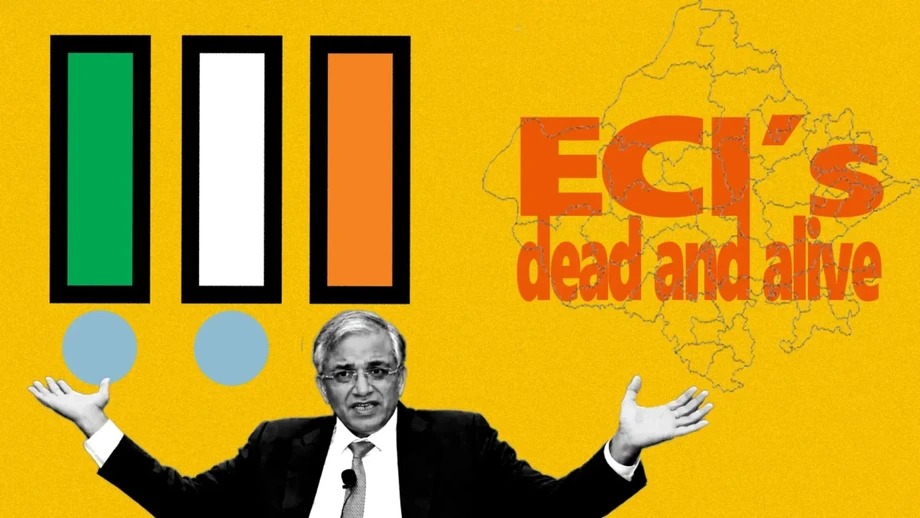
A comparison of Rajasthan's electoral databases has identified 182,440 people listed as dead by the Election Commission of India (ECI) who remained registered as eligible voters for panchayat elections. The two authorities completed their revisions just four days apart in February 2026, making the disagreement especially striking.
Contents
- Two election registers give conflicting answers
- Why the four-day gap matters
- How the 182,440 matches were identified
- Garhi and Sirohi record thousands of conflicting entries
- The wider revision removed millions of names
- Officials denied the discrepancy; critics sought checks
- A restoration directive covers seven other jurisdictions
- Key Points
The ECI classified about 875,000 people as dead during its Special Intensive Revision (SIR), conducted between October 2025 and February 2026. Roughly 20.9% of those names, or about one in five, also appeared on the Rajasthan State Election Commission's (SEC) panchayat electoral rolls as eligible voters.
The findings, published on November 7, 2026, expose a concrete problem for residents whose records conflict: a living person could remain eligible to choose village representatives while being excluded from the register used to elect members of Parliament and the state assembly, unless their ECI registration has since been restored.
Physical verification is still needed to establish which register is correct for each person. The comparison checked electoral records and a sample of entries through a state commission portal; it did not include visits to establish whether the people concerned were alive.
Detailed questions sent to the ECI and Rajasthan SEC remained unanswered at publication. Neither commission had explained why the same voter identifiers appeared under incompatible statuses in records revised during almost the same period.
Why the four-day gap matters
The ECI and Rajasthan SEC maintain separate electoral registers for different elections. The ECI handles parliamentary and assembly elections, while the state commission manages panchayat and municipal elections. A panchayat is a body of elected representatives responsible for local government in rural areas.
Separate registers serve those different responsibilities, but the underlying fact of whether a person is alive should be consistent. Here, both authorities were revising their records during overlapping months, rather than comparing an old register with a much newer one.
The SEC announced its panchayat revision in December 2025. Its draft register appeared after the ECI had identified voters for removal under categories covering absence, relocation, death and duplicate registration. The ECI completed its exercise on February 21, 2026; the SEC finished four days later, on February 25.
The main dates show how closely the exercises overlapped:
- October 2025: The ECI's Special Intensive Revision began in Rajasthan.
- December 2025: The Rajasthan SEC announced its panchayat electoral roll revision.
- February 21, 2026: The ECI completed its revision and published its final register.
- February 25, 2026: The SEC completed its parallel exercise.
- October 2026: Electoral databases were downloaded for comparison after voting had begun in the panchayat election, held in four phases.
- November 7, 2026: The findings were published.
The short interval makes an explanation of the verification process particularly important. Both authorities were assessing many of the same residents within the same broad period, yet their records disagreed about a basic condition of eligibility.
How the 182,440 matches were identified
The comparison began with the ECI's Absent, Shifted, Dead and Duplicate list, known as ASDD. Those categories record different reasons for removing an entry. Someone recorded as permanently relocated has a different administrative status from someone recorded as deceased.
Voter identification details, including Electors Photo Identity Card (EPIC) numbers, were matched against the panchayat register. An EPIC number identifies an electoral record and allows a more precise comparison than a name alone, especially where several residents share the same name.
The matching exercise identified 182,440 records classified as dead by the ECI that also appeared as eligible entries in the panchayat database. A sample was then checked through an SEC portal that displays voter details when an EPIC number is entered.
The October download came after polling had begun. Electoral registers are locked before voting, so the panchayat entries were connected to a register already being used for an election, rather than simply an early draft awaiting corrections.
The ECI had also made changes after its draft stage and continued monthly updates following the SIR. Those changes were described as small, but the comparison could not trace subsequent corrections fully because the commission had not clarified whether a person restored after being classified as dead would retain the same voter identifier. The number of affected people whose ECI registration had already been corrected was therefore unresolved.
Garhi and Sirohi record thousands of conflicting entries
Garhi assembly constituency had the largest identified number of conflicting records: 4,889 people classified as dead by the ECI appeared as eligible voters on the panchayat register. Sirohi had another 4,624.
Together, the two constituencies accounted for 9,513 entries, about 5.2% of the statewide total of 182,440. The figures show that the disagreement involved thousands of records within individual constituencies, as well as a large total across Rajasthan.
Shalu Doliya, aged 26 and registered in Ajmer's Kishangarh assembly constituency, was among the people identified. Her record appeared in the ECI's deceased category while she remained listed for panchayat voting. Seema Devi, identified as being from Udaipur's Malvi constituency, was another named example.
For a living resident in that position, the consequences are practical. Their name may be accepted for the village election but absent from the register needed for a parliamentary or assembly election. Resolving the conflict requires the responsible authority to check and correct the registration.
The named cases also show why contacting residents matters. A database can reveal the disagreement and identify the records requiring attention; checking the person and the evidence behind each entry is the next step needed to resolve it.
The wider revision removed millions of names
The ECI's revision changed Rajasthan's electorate on a much larger scale than the deceased category alone. Figures accompanying the final register put the electorate at about 51.5 million, down from approximately 54.6 million before the exercise.
The net deletion total is given as approximately 3.231 million in the investigation, while the tally accompanying the final electorate figures puts it at about 3.136 million. The difference is 95,000 names. An explanation reconciling those totals was not given.
Net deletion means the reduction remaining after removals and additions are counted together. It is different from the total number of entries removed during a revision, because new registrations or restored names can offset some removals.
The ASDD categories also matter when examining those figures. Permanent migration was cited as a reason for many removals. The 182,440 figure concerns the narrower deceased category, where the ECI's classification directly conflicts with continued eligibility on another electoral register.
An earlier study by the People's Union for Civil Liberties (PUCL) found more than 2.6 million names deleted during the SIR still appearing on the SEC's 2026 local body lists. That broader comparison covered deleted entries across categories. The latest matching exercise concentrates attention on people classified specifically as dead.
The two findings put different parts of the same administrative problem into view: how separate election authorities check residents, record reasons for removal and keep their registers consistent when their revision exercises overlap.
Officials denied the discrepancy; critics sought checks
Three booth level officers were approached about the conflicting records. These officers carry out electoral work in assigned polling areas and help maintain voter information. One did not speak.
An officer involved in the ECI's SIR denied that anyone classified as dead remained active on the panchayat register. An officer for Lotiyana Gram Panchayat also denied that voters had been deleted. The matched entries contradicted those denials, while detailed questions to the two commissions remained unanswered.
Activist Yogendra Yadav called for physical verification of the 182,440 names. He said confirmation of even a fraction of the cases would amount to a scandal, placing the demand for checks at the centre of his response.
Congress leader Jairam Ramesh accused the ECI of misconduct, describing its actions in these words:
a toxic combination of malfeasance and mischief
Journalist Ravish Kumar used the word "fraud" and demanded dismissals extending from computer operators to the chief election commissioner and the other two commissioners. The Indian Youth Congress also criticised the deletions and directly addressed Chief Election Commissioner Gyanesh Kumar.
Congress figures in Rajasthan have alleged wrongful deletions, pressure on booth level officers and selective targeting during the SIR. The commissions had not provided a response explaining the matching records or addressing those accusations at the time of publication.
A restoration directive covers seven other jurisdictions
The ECI also issued a letter dated November 6 directing additional measures to restore eligible electors who had been issued enumeration forms but were excluded from draft electoral rolls after being classified as absent, shifted, dead or duplicate because their forms had not been received. Accepted applicants will receive the same EPIC number they held before the SIR.
The directive covers Delhi, Maharashtra, Haryana, Andhra Pradesh, Jharkhand, Telangana and Nagaland. Rajasthan is outside that list, so the specified procedure leaves the Rajasthan cases requiring their own explanation and action.
The Commission directed authorities to display booth-wise lists of excluded electors again at polling stations, Panchayat Bhawans, urban local body offices, offices of Block Development Officers and other designated authorities. Readable PDF versions must also appear on the respective Chief Electoral Officers' websites, with the probable reasons for non-inclusion.
Affected electors may submit completed enumeration forms to the Electoral Registration Officer (ERO) or Assistant Electoral Registration Officer (AERO) responsible for their current place of ordinary residence. Partially filled forms can be generated afresh through the ERO dashboard on ECINET. Electors can also download or complete their forms through the ECI website or ECINET application using their pre-SIR EPIC number.
District Election Officers and EROs have been asked to contact affected electors through Booth Level Officers (BLOs) and deliver forms physically or through WhatsApp, email and SMS where contact details are available. BLOs must coordinate with political parties' Booth Level Agents to trace electors through house-to-house visits, enquiries with neighbours, family members and Resident Welfare Associations, and available telephone numbers.
Electors still living at their existing address can submit a completed and signed enumeration form with an Annexure-B statement explaining why they could not submit it earlier. They may deliver the documents to the ERO, AERO or BLO personally or through family members. An online submission facility with electronic signatures will also be made available on ECINET.
Those who have moved within the same state do not need to file Form 8. They can submit an enumeration form and a signed Annexure-C statement giving their new address and assembly constituency, with proof of residence, to the ERO or AERO of the constituency to which they have moved. They may contact their new BLO through the "Book a call with BLO" facility on the ECI website and ECINET application. For homeless electors without documentary proof of residence, a BLO's field verification report will meet that requirement.
EROs will examine the forms under Rule 21(1) of the Registration of Electors Rules, 1960, verifying eligibility, ordinary residence and other relevant details, with field verification where necessary. Accepted forms will be kept separately for inclusion in the final rolls under the prescribed procedure, and the electors will be reassigned their pre-SIR EPIC numbers.
Electors who have already submitted Form 6 during the SIR do not need to submit another enumeration form or statement. Their applications will be processed under the ECI's clarification issued on November 3.
The Commission also directed publicity through newspapers, official websites, social media, public announcements and other available channels, with particular attention to areas inhabited by homeless people, including loudspeaker announcements. Authorities must establish monitoring to ensure eligible electors have an opportunity for inclusion while preventing duplicate enrolments. Chief Electoral Officers were asked to implement the measures immediately and submit an action-taken report at the earliest.
Keeping the same identifier can help connect a restored registration to its earlier record. The directive specifies this for accepted applicants in the seven listed jurisdictions. In Rajasthan, uncertainty about identifiers was one reason the comparison could not fully follow changes after the revision.
The immediate task is to reconcile the conflicting entries: establish each person's correct status, explain the evidence used for deletion and identify any subsequent restoration. Residents also need an accurate entry on the register for the election in which they intend to vote. A panchayat registration and an ECI registration serve different ballots.
Key Points
- 182,440 people classified as dead by the ECI appeared as eligible voters on Rajasthan's panchayat electoral rolls.
- The figure equals about 20.9% of the roughly 875,000 people classified as dead during the ECI revision.
- The ECI completed its revision on February 21, 2026; the Rajasthan SEC finished four days later.
- Garhi recorded 4,889 conflicting entries and Sirohi recorded 4,624.
- The comparison used voter identifiers and portal checks of a sample; physical verification is needed to resolve individual cases.
- The ECI and Rajasthan SEC had not answered detailed questions at publication.
- The ECI's November 6 directive provides restoration through enumeration forms and eligibility and residence checks, with accepted applicants retaining their pre-SIR EPIC numbers, in seven other jurisdictions, excluding Rajasthan.