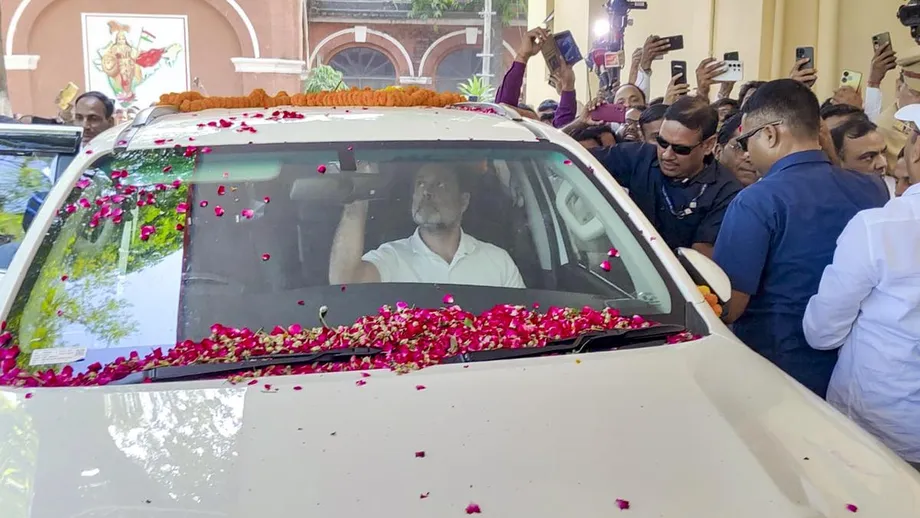
Sultanpur court clears Gandhi after eight years
A special court in Sultanpur, Uttar Pradesh, acquitted Rahul Gandhi on October 26, 2026, in a criminal defamation case over remarks about Amit Shah during the 2018 Karnataka election campaign. Additional Chief Judicial Magistrate Shubham Verma delivered the verdict with Gandhi present in court.
Contents
The court held that the Bharatiya Janata Party leader who brought the complaint was not an aggrieved person and that Gandhi's remarks were not defamatory. Those findings addressed both who could bring the complaint and whether the words amounted to criminal defamation.
Gandhi, the Leader of Opposition in the Lok Sabha and MP for Raebareli, had denied the charges throughout the proceedings. His defence said the remarks had been taken out of context and that the complaint was motivated by political hostility.
Congress supporters outside the courthouse celebrated with drums, slogans and fireworks after the decision. Gandhi had reached Sultanpur despite a collision involving vehicles accompanying his journey from Lucknow earlier that morning. Police said he was safe and no serious injuries were reported.
What the 2018 complaint concerned
The dispute began with remarks attributed to Gandhi in Bengaluru on May 8, 2018, during campaigning for the Karnataka Assembly election. Shah, now Union home minister, was then the BJP's national president.
Vijay Mishra, a local BJP leader and former chairman of the Sultanpur District Cooperative Bank, filed the complaint on August 4, 2018. He alleged that Gandhi's comments damaged Shah's reputation. Santosh Kumar Pandey represented the complainant as his lawyer, although one description of the case identified Pandey himself as the complainant.
The complaint attributed the following words to Gandhi, who was criticising the BJP's claims about honesty in politics:
"People in India forget that the president of BJP is a murder accused. That's the truth. The party that talks about honesty, decency, has a person who has been accused of murder as president".
The remarks concerned allegations linking Shah to the 2005 killing of Sohrabuddin Sheikh. A special Central Bureau of Investigation court discharged Shah from that case in 2014, four years before the Karnataka campaign. Discharge means the court ended the prosecution against him at that stage.
The setting of Gandhi's remarks was described as a Bengaluru press conference and as an election rally. The complaint centred on his words about Shah during the Karnataka campaign and whether they caused reputational harm punishable under criminal law.
Why the court's findings matter
Mishra brought the complaint under Sections 499 and 500 of the Indian Penal Code. Section 499 defined criminal defamation, while Section 500 provided its punishment. In simple terms, the case asked whether Gandhi had made a statement about another person that unlawfully damaged that person's reputation.
The finding that Mishra was not an aggrieved person concerned his legal basis for bringing the case. An aggrieved person is someone whom the law recognises as having suffered the relevant harm. Here, the remarks concerned Shah, while Mishra filed the complaint.
Judge Verma also found that the remarks were not defamatory. Together, the two findings explain the central grounds of the acquittal: the complainant's position and the legal assessment of the words themselves.
The court was also reported to have cautioned against bringing cases involving prominent leaders that waste judicial time. The precise wording of that observation and the full explanation of three points mentioned in descriptions of the judgment were not available. No date for an appeal or announcement of an appeal was given.
Gandhi's defence team included senior advocate R. S. Cheema. His lawyers argued that the remarks belonged to political debate, had been presented without their context and were not made with an intention to defame Shah.
How the case moved through court
The proceedings stretched from the complaint in August 2018 to the verdict in October 2026, a little more than eight years. Court appearances, witness testimony and a dispute over comparing a voice recording all formed part of that period.
The main stages were:
- May 8, 2018: Gandhi made the disputed remarks during the Karnataka election campaign in Bengaluru.
- August 4, 2018: Vijay Mishra filed the criminal defamation complaint in Sultanpur.
- November 27, 2023: The special MP-MLA court summoned Gandhi to face the proceedings.
- February 20, 2024: Gandhi appeared before the court and received bail. A shorter account placed his bail appearance in 2023.
- July 26, 2024: Gandhi's statement was recorded. Mishra testified on October 9 that year.
- February 28 and December 8, 2025: The court recorded testimony from witnesses Anil Mishra and Ramchandra Dubey, respectively.
- February 20, 2026: Gandhi's statement was recorded again.
- May 2, 2026: The trial court rejected a request to compare voice samples. The Allahabad High Court rejected the challenge on September 10.
- October 2026: Final arguments took place. The hearing's conclusion was dated October 12, with completion of arguments also dated October 13.
- October 26, 2026: Judge Verma acquitted Gandhi, who attended in person.
The verdict had earlier been expected on October 13 before being scheduled for October 26. Gandhi's attendance followed the court's direction that he appear personally for the decision.
The dispute over recorded evidence
A CD said to contain video and audio of Gandhi's remarks featured in the evidence discussed during the case. Mishra and two witnesses were examined as the complainant sought to establish what had been said and support his allegation of defamation.
Mishra also sought a comparison involving Gandhi's voice sample. Such a comparison would involve examining a recording alongside a sample of a person's voice to help assess who was speaking.
The request was made during the 2026 proceedings and rejected by the trial court on May 2. The sessions court also rejected the request, and the Allahabad High Court dismissed the subsequent challenge on September 10.
Gandhi continued to reject the allegation that he had intended to damage Shah's reputation. He described the prosecution as an attempt to target him for political reasons. Mishra maintained that the remarks were objectionable and defamatory.
The acquittal followed the examination of witnesses and arguments from both sides. The reported findings focused on the complainant's status and the nature of Gandhi's remarks.
Congress celebrates the decision
Congress workers gathered outside the Sultanpur court celebrated as news of the acquittal emerged. Supporters beat drums, shouted slogans in Gandhi's support and set off fireworks after a case that had required repeated appearances over several years.
Kunwar Singh Nishad, chairman of the Uttar Pradesh Congress Committee's media department, described the outcome as relief for Gandhi:
A defamation lawsuit related to a remark made in Bengaluru during the 2018 Karnataka Assembly elections. Judge Shubham Verma of the special MP-MLA court in Sultanpur dismissed the case, granting relief to Rahul Gandhi,
Congress leader Aradhana Mishra said the ruling renewed public confidence in the judiciary and accused the BJP of trying to discredit the party through false allegations. That accusation was the Congress response to the verdict.
Neither Gandhi nor Shah gave an immediate personal response to the acquittal. Gandhi had also left Lucknow airport for Sultanpur without speaking to reporters earlier in the day.
Police investigate the convoy collision
Gandhi's journey to court produced a separate police investigation after vehicles accompanying the trip collided on the Purvanchal Expressway at about 10:15 a.m. He had arrived at Lucknow's Chaudhary Charan Singh International Airport before travelling by road to Sultanpur.
A police officer said a private vehicle belonging to local Congress leaders, travelling at the front of the convoy, braked suddenly and vehicles behind it collided. The reason for the braking had not been established.
Three vehicles were reported damaged. Other descriptions said four or five vehicles and an ambulance were involved. Gandhi remained safe and reached court in time, while police said there were no major injuries.
Uttar Pradesh Police constituted a Special Investigation Team, or SIT, on October 26, 2026, on the directions of Director General of Police Rajeev Krishna to examine the collision. An SIT is a group of officers assigned to investigate a particular incident.
Inspector General of Police, Lucknow Range, Kiran S. was named to lead the team, with Sultanpur Additional Superintendent of Police Brij Narayan Singh and Deputy Superintendent of Police (Traffic), Sultanpur, Ram Krishna Chaturvedi as members.
A police statement said the team was instructed to conduct a comprehensive probe into the circumstances and causes of the crash and determine whether there was any negligence or lapse in security, escort arrangements or traffic management. It was also asked to suggest measures to prevent similar incidents and submit a detailed report promptly to police headquarters. No specific reporting deadline was announced.
Gandhi and Congress had not filed a complaint about the collision. Police nevertheless began the inquiry into the circumstances of the incident and any possible lapses.
Other defamation cases continue
The Sultanpur acquittal ends the trial over Gandhi's remarks during the 2018 Karnataka campaign. Gandhi continues to face other defamation proceedings in several states, including a separate complaint involving comments about Shah.
That complaint was filed in Ahmedabad by BJP member Krishnavadan Brahmbhatt in May 2019. It concerns Gandhi allegedly calling Shah a murder accused during a rally in Jabalpur on April 23, 2019. The Gujarat High Court has stayed that trial, meaning it has been paused by court order.
Gandhi's most consequential recent defamation case concerned his remarks about the Modi surname during the 2019 election campaign. A Surat court convicted him on March 23, 2023, and imposed a prison sentence of two years. He was disqualified from the Lok Sabha the following day.
The Supreme Court later stayed the conviction, observing that the trial court had not adequately explained its decision to impose the maximum sentence of two years. Gandhi's parliamentary membership was restored on August 7, 2023.
Other proceedings concern remarks about V. D. Savarkar, the Rashtriya Swayamsevak Sangh, the Rafale fighter jet deal and the Modi surname. Cases in Pune, Thane, Haridwar, Ranchi, Patna and Bhiwandi remain at different stages, while some proceedings in Mumbai have been deferred pending a challenge before the Bombay High Court.
Gandhi has publicly presented the cases against him as part of political confrontation. During a protest earlier in October, he said 45 first information reports had been registered against him and that he wanted the number to reach 100. An FIR is a police record that starts an investigation; the defamation proceedings described here include complaints filed directly before courts.
Key Points
- Judge Shubham Verma acquitted Rahul Gandhi in Sultanpur on October 26, 2026.
- The case concerned remarks about Amit Shah during the 2018 Karnataka election campaign.
- The court held that the complainant was not an aggrieved person and that Gandhi's remarks were not defamatory.
- BJP leader Vijay Mishra filed the complaint on August 4, 2018.
- Congress supporters celebrated outside the court after the verdict.
- Gandhi was safe after a collision involving vehicles travelling with his convoy. Uttar Pradesh Police constituted an SIT on October 26, 2026, on DGP Rajeev Krishna's directions to investigate.
- Separate defamation proceedings against Gandhi continue in other courts.