Schoolgirl steps into path of turning autonomous vehicle
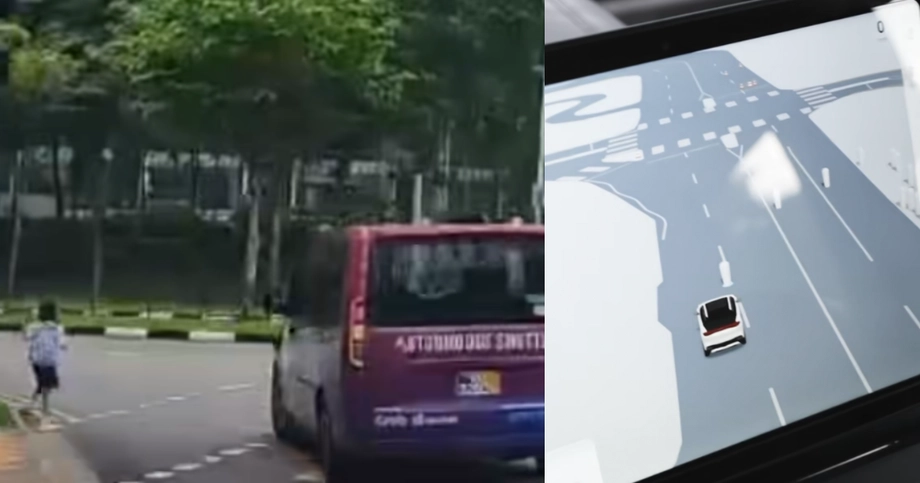
Singapore's Land Transport Authority (LTA) has directed Grab to pause autonomous vehicle testing at certain junctions after a vehicle making a left turn nearly hit a schoolgirl at Punggol Field Walk. The incident happened at about 8.11am on Thursday, November 5, while the vehicle was testing a new route for an expanded transport service.
Contents
- Schoolgirl steps into path of turning autonomous vehicle
- What happened at the crossing?
- What the vehicle detected and how it reacted
- Why both signals could be green
- What LTA has ordered Grab to pause
- How the incident fits into Punggol's rollout
- A growing fleet and an earlier nearby collision
- The sequence of events
- Key Points
LTA said preliminary vehicle data showed that the autonomous vehicle had detected the girl and a woman accompanying her and was continuously tracking their movements. When the girl began crossing, the vehicle started braking and steering right. The safety operator on board then took control, continued braking and steered away from her.
The authority was informed of the incident on November 5 and confirmed on November 6 that it was investigating. Its direction pauses testing at junctions involving this type of situation, rather than announcing a suspension of every Grab autonomous shuttle operation.
The encounter comes as Grab prepares to offer more flexible journeys within Punggol, with wider public expansion expected in the fourth quarter of 2026. It puts a concrete safety issue at the centre of that expansion: how a vehicle responds when a pedestrian who has been standing still suddenly starts crossing its path.
What happened at the crossing?
A video lasting 36 seconds, posted by the Facebook page SG Road Vigilante on the night of November 5, showed the vehicle waiting at the junction with its left indicator on. The girl and a woman were standing near the kerb.
When the traffic signal for vehicles turned green, the Grab vehicle began turning left. About two seconds later, the girl stepped into the road. The pedestrian signal was also green and was blinking as she began crossing.
The girl stopped as the vehicle approached. The woman called out and pulled her back, while the vehicle appeared to slow before passing in front of them and moving away. After traffic stopped, the woman crossed with the girl, with an arm around her shoulders.
The footage attracted more than 260,000 views and 1,000 reactions. Some commenters focused on the girl's decision to step forward, while others questioned whether the vehicle reacted quickly enough. LTA's investigation centres on the vehicle's response and whether it needs adjustment.
What the vehicle detected and how it reacted
LTA's preliminary account provides information that is difficult to judge from a roadside video: the vehicle had already detected both pedestrians before the girl stepped into the road. Detection means the system had registered their presence; tracking means it was following their positions as the situation developed.
The authority described what the vehicle's data showed:
Preliminary data indicates that the vehicle had detected the two pedestrians, and was continuously tracking the pedestrians' movements.
LTA said the pedestrians were initially stationary. After the child started crossing, the vehicle initiated braking and steered to the right. The operator then took over and continued both actions.
For a reader, the essential issue is the sequence between seeing a person and choosing a safe movement. An automated vehicle must detect someone near a crossing, anticipate that the person may move, and select its speed and direction accordingly. Here, LTA has described detection, an automated response and a human intervention. Investigators are reviewing how that response should work in similar circumstances.
Why both signals could be green
The vehicle was making a discretionary left turn. At this type of junction, a green signal allows traffic to move, but turning vehicles may still encounter pedestrians crossing the road they are entering. Drivers must account for those pedestrians rather than treating the green light as an empty path through the turn.
The girl's pedestrian signal was green but blinking. A blinking green pedestrian signal indicates that the crossing phase is nearing its end. The encounter therefore involved two movements meeting at the same place: a vehicle turning into the road and a child stepping off the kerb.
LTA reminded pedestrians to wait for approaching traffic to stop completely before crossing. For the autonomous vehicle, the practical challenge was to manage the crossing safely while people remained close enough to enter its path.
The vehicle's initial observation that the pedestrians were standing still matters because their positions changed after it began turning. A safe response depends on how much room and time remain when that movement happens, as well as when braking starts.
What LTA has ordered Grab to pause
LTA has instructed Grab to stop testing at such junctions until the investigation is complete. The authority also said it would consider whether the vehicle's response to these situations should change.
LTA set out the direction in its statement:
LTA has directed Grab to pause testing at such junctions until investigations are completed, and we will review whether the response to such scenarios should be adjusted.
The authority has not given a completion date, identified every affected junction or specified a technical change. Its stated action targets the testing scenario involved in the encounter.
Grab said it was reviewing the incident with LTA and WeRide, its autonomous driving technology partner. A company spokesperson described the joint review:
Safety is our top priority. We are aware of this incident and are closely reviewing it together with the Land Transport Authority (LTA) and our partner WeRide.
The safety operator's intervention is part of the incident under review. Although the vehicle was operating autonomously, a person was on board and able to take control of braking and steering.
How the incident fits into Punggol's rollout
Grab's autonomous shuttle services have been available to the public since April 1. Its two Punggol routes connect Matilda Court with Oasis Terraces and Matilda Court with Punggol Coast Mall. The company uses vehicles developed by WeRide.
ComfortDelGro operates a third autonomous shuttle route in Punggol using vehicles from Pony.ai. LTA's direction following this incident concerns Grab's testing at the relevant junctions.
Grab initially offered free public rides in April, then introduced a flat fare of S$4 per person in the middle of the year. For residents using the service, the rollout has already moved from free trials to paid journeys between neighbourhood destinations.
The vehicle involved in the near-miss was testing a new route ahead of an enhanced service offering travel between selected locations within Punggol. In July, Grab had announced plans to trial bookings between specific pickup and drop-off points along its existing routes.
That approach gives passengers more choice about where to board and leave than a service organised only around a fixed journey. Additional service points are planned in the coming months, and expansion to the wider public is expected in the fourth quarter of 2026.
A growing fleet and an earlier nearby collision
Grab announced in September that it planned to increase its autonomous fleet from 10 to 50 vehicles over six months and extend services beyond Punggol. The starting fleet was also described as 11 vehicles in another account of the expansion plan. Both figures point to a substantial planned increase, with the September figure representing a fleet five times its initial size.
Punggol Field Walk is also near the site of a January incident in which an autonomous vehicle collided with a road divider. The latest encounter concerns a different immediate danger: a turning vehicle coming close to a child at a pedestrian crossing.
The expansion plans make the response to ordinary street movements especially consequential. More vehicles and more boarding locations mean more journeys through junctions where pedestrians can change direction or begin crossing after standing still.
LTA's review therefore addresses a specific part of the service's operation before testing continues at the affected junctions: how the vehicle should respond when someone near its turning path starts to move.
The sequence of events
Punggol's autonomous shuttle rollout and the investigation have developed across several months:
- January: An autonomous vehicle collided with a road divider near the location of the latest incident.
- April 1: Grab's autonomous shuttle services became available to the public, initially with free rides.
- Middle of the year: Grab began charging a flat fare of S$4 per person.
- July: Grab announced plans to trial bookings between selected pickup and drop-off points along existing routes.
- September: Grab announced plans to grow its autonomous fleet to 50 vehicles over six months.
- November 5, about 8.11am: The near-miss occurred at Punggol Field Walk. LTA was informed that day.
- November 6: LTA confirmed its investigation and the direction to pause testing at such junctions.
- Fourth quarter of 2026: Wider public expansion of the enhanced Punggol service is expected.
The immediate decision is to pause the relevant testing while LTA examines the encounter. Grab and WeRide are reviewing it with the authority as the company continues preparing for a broader service.
Key Points
- A Grab autonomous vehicle nearly hit a schoolgirl while turning left at Punggol Field Walk on November 5.
- LTA said the vehicle detected two pedestrians, began braking and steered right when the girl started crossing.
- The safety operator took control and continued braking and steering away.
- Grab must pause testing at such junctions until LTA completes its investigation.
- The vehicle was testing a new route ahead of expanded travel services within Punggol.
- Grab operates two public autonomous shuttle routes in Punggol and plans to expand its fleet to 50 vehicles.