One payment for three months of support
Indonesia's Ministry of Manpower has announced a Rp900,000 wage subsidy for eligible workers, with distribution planned for November through December 2026 through designated banks and PT Pos Indonesia. Workers do not need to register themselves: selection will draw on employment and wage records held by BPJS Ketenagakerjaan, the country's employment social security agency.
Contents
- One payment for three months of support
- What the regulation changes
- Who qualifies for the assistance?
- Why the wage ceiling can exceed Rp3.5 million
- Why employment records matter
- Freelancers fall into a different category
- When will the money arrive?
- Bank transfers and post office collection
- How to check safely without registering
- Key Points
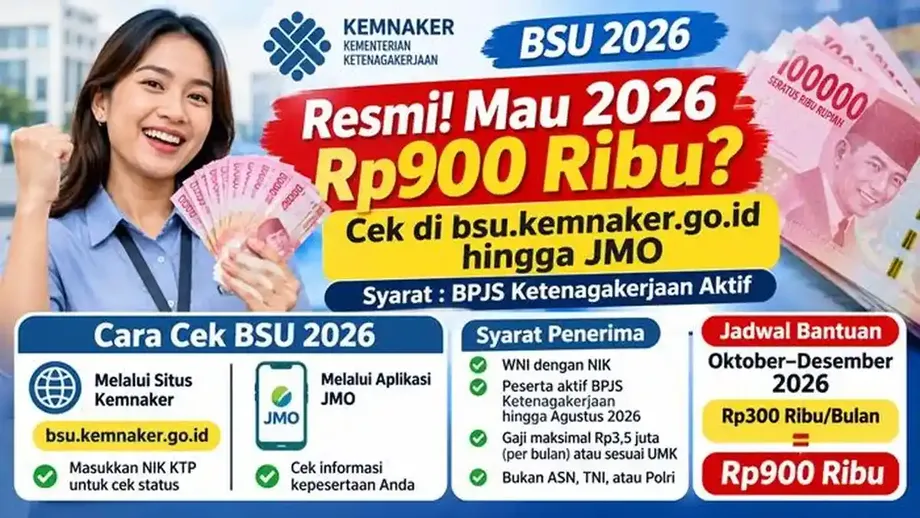
The assistance, known as Bantuan Subsidi Upah (BSU), amounts to Rp300,000 a month for October, November and December, paid together in a single transfer. The ministry identifies Minister of Manpower Regulation No. 16 of 2026 and its technical guidelines as the legal basis for the scheme.
Eligibility depends on several conditions working together. Recipients must be Indonesian citizens with a national identity number, have active BPJS Ketenagakerjaan membership through August 2026 in the category for workers receiving wages, and meet the applicable earnings limit. Civil servants, military personnel and police officers are excluded.
The standard wage ceiling is Rp3.5 million a month, although a higher local minimum wage can raise that limit. Workers who were not receiving assistance under the Family Hope Program, known as PKH, before BSU distribution receive priority.
Coordinating Minister for Economic Affairs Airlangga Hartarto's initial announcement targeted about 13.3 million workers. At Rp900,000 each, payments to that many people would total Rp11.97 trillion, consistent with the projected budget of nearly Rp12 trillion. The target describes the planned reach; the final recipients will be selected through checks of individual records.
What the regulation changes
Regulation No. 16 of 2026 is described as the second amendment to Minister of Manpower Regulation No. 10 of 2022, which governs government assistance in the form of wage subsidies. It was signed and promulgated in Jakarta on October 28, 2026, taking effect upon promulgation.
Manpower Minister Yassierli said the policy aims to help workers maintain their purchasing power and keep economic activity moving. Purchasing power means how much people can buy with the money they have, including necessities such as food and transport.
Yassierli explained the purpose of the assistance in a ministry statement:
The government wants to ensure this policy helps workers meet their living needs. That is why the assistance is provided in accordance with the established requirements and regulation.
Public information about the scheme contains a material contradiction. The ministry's announcement identifies the October 28 regulation and the eligibility rules, while information published on November 6 still described the requirements and payment timetable as awaiting an official announcement. Workers should use the ministry's current instructions when checking their own position, especially as recipient verification and payment arrangements are completed.
Who qualifies for the assistance?
BSU targets workers receiving wages from an employer. Within BPJS Ketenagakerjaan, this is the Penerima Upah category, usually shortened to PU. Having an active account is one requirement among several, so a worker's citizenship, wage, membership category and other conditions must also be checked.
The announced requirements are:
- Indonesian citizenship, supported by a valid national identity number, or NIK.
- Active BPJS Ketenagakerjaan membership in the PU category through August 2026.
- Monthly wages within the Rp3.5 million ceiling or the applicable adjusted minimum wage ceiling.
- Employment outside the excluded civil service, military and police categories.
- Priority for workers who were not receiving PKH before BSU distribution.
PKH is a separate government social assistance program for eligible families. The BSU wording gives priority to workers outside that program, making the PKH condition part of the selection process alongside employment and wage information.
Workers who received BSU in an earlier year will still need to satisfy the conditions for 2026 and appear in the current recipient selection. Their earlier payment history does not replace the checks required for this round.
Why the wage ceiling can exceed Rp3.5 million
The ministry uses Rp3.5 million a month as the standard earnings ceiling, with an adjustment for places where the applicable minimum wage is higher. This matters because minimum wages vary across Indonesia, and workers with similar jobs can face different local wage standards.
Where a regency or city sets a minimum wage, known as UMK, above Rp3.5 million, the eligibility ceiling follows that local amount and is rounded upward to the next full Rp100,000. Where there is no UMK, the provincial minimum wage, or UMP, applies using the same rounding method.
For example, a local minimum wage of Rp3,701,709 produces an eligibility ceiling of Rp3.8 million after rounding. That is Rp300,000 above the standard Rp3.5 million ceiling. A worker in that area earning Rp3.8 million could therefore satisfy the wage condition, provided the remaining requirements are met.
The wage figure used for this assessment is the latest amount the employer reported to BPJS Ketenagakerjaan. It includes basic pay and fixed allowances. Workers need to consider that recorded figure when assessing whether their earnings fall within the relevant limit.
Why employment records matter
Employers have a central role because the government will use their submissions to identify potential recipients. A worker's identity, membership status and reported wages need to be accurate so that the agencies and payment institutions can match the records.
Indah Anggoro Putri, the ministry's director general for industrial relations development and workers' social security, has urged employers to submit accurate information and ensure that proposed recipients meet the requirements. The ministry's guidance puts responsibility on companies to check those details before administrative problems arise during transfers.
Workers can review their BPJS Ketenagakerjaan membership information through Jamsostek Mobile, known as JMO, and raise discrepancies with their employer or human resources department. Any correction should reflect their actual employment circumstances and wages.
The August 2026 membership cutoff is especially relevant to people who joined BPJS Ketenagakerjaan later. Current membership alone will not satisfy a requirement tied to an earlier month. The preparation process includes checks involving BPJS Ketenagakerjaan, the ministry and the institutions distributing the money.
Freelancers fall into a different category
Freelancers and other independent workers registered under BPJS Ketenagakerjaan's Bukan Penerima Upah category, or BPU, fall outside the announced BSU membership criteria. BPU covers people working independently rather than receiving wages from an employer.
Examples include independent freelancers, motorcycle taxi drivers working through online platforms, and entrepreneurs registered in that category. The relevant detail is their BPJS membership classification: the subsidy targets PU workers.
For households with several earners, each person's circumstances therefore matter. A salaried employee may meet the membership condition while another household member working independently under BPU falls outside it. Each potential recipient must also satisfy the wage and other requirements.
When will the money arrive?
The three months covered by the assistance are October, November and December 2026, while the announced distribution window is November through December. Recipients are due one Rp900,000 payment rather than three separate monthly transfers.
The main dates and preparation stages are:
- August 2026: the cutoff month for the required active BPJS Ketenagakerjaan membership.
- October 28, 2026: the stated signing and promulgation date of Regulation No. 16 of 2026.
- October 29, 2026: the ministry outlined the planned November–December distribution window.
- October 31, 2026: preparation updates described work on recipient data, budget requirements and implementation arrangements.
- November 5, 2026: Indah reiterated the Rp900,000 payment and the eligibility requirements through the ministry's press office.
- November–December 2026: the planned period for distributing the assistance.
As of November 6, exact payment dates, the order of recipient batches, the official 2026 status checking procedure and detailed Pospay arrangements had not been announced. Workers therefore need to await the instructions relevant to their assigned payment channel.
Bank transfers and post office collection
The distribution network includes Bank Mandiri, Bank Rakyat Indonesia (BRI), Bank Negara Indonesia (BNI), Bank Tabungan Negara (BTN), Bank Syariah Indonesia (BSI), and PT Pos Indonesia. Workers assigned to bank payments are advised to keep their accounts active to reduce the chance of transfer problems.
PT Pos Indonesia provides another route for distributing the assistance. In previous BSU rounds, some recipients used its Pospay application to verify their identity and obtain a QR code, which post office staff scanned when the money was collected.
Earlier collection procedures involved an original identity card, known as KTP, a family card, or KK, and a QR invitation or verification code. The documents and steps required for 2026 will depend on the collection instructions issued for this round.
A worker assigned to a bank transfer will follow the banking arrangements, while someone assigned to post office collection will follow the postal instructions. Each recipient needs to check the designated route and collection notice before travelling or preparing documents.
How to check safely without registering
The Ministry of Manpower directs workers to bsu.kemnaker.go.id for BSU information and to its service center on 1500 630. Since workers do not need to submit an independent registration, selection will depend on the administrative records and verification process.
Previous rounds used the ministry website, BPJS Ketenagakerjaan services, JMO and Pospay for different parts of membership checking, recipient information or payment verification. Workers should follow the instructions issued specifically for the 2026 program, including the year shown on any result page.
A NIK is the 16 digit national identity number used to match a person with official records. Indah has urged the public to follow government channels and avoid providing personal information through unverified links claiming to offer BSU access.
Workers should keep passwords, banking credentials and one time verification codes private. A message promising immediate access to the subsidy is a reason to check the ministry's information directly before sharing any details.
Accurate records also matter after payment. The announced scheme requires recipients found to be ineligible to return the assistance to the State Treasury. For workers and employers, checking identity, membership and wage information early can help prevent both payment delays and later repayment problems.
Key Points
- Eligible workers are due Rp900,000 in one payment, covering Rp300,000 a month for October through December 2026.
- Distribution is planned for November–December through designated banks and PT Pos Indonesia.
- Workers do not need to register independently; selection uses employment and wage records.
- The standard monthly wage ceiling is Rp3.5 million, with adjustments for higher applicable local minimum wages.
- Active BPJS Ketenagakerjaan membership in the PU category through August 2026 is required; BPU participants fall outside the announced criteria.
- The initial target is about 13.3 million workers, equivalent to Rp11.97 trillion in assistance at the stated payment amount.
- Workers can monitor bsu.kemnaker.go.id or contact 1500 630 for official instructions.