Data centers are reshaping AMD's business
AMD expects revenue to grow more than 80% in 2027 as artificial intelligence spending drives demand for both its AI accelerators and the server processors that help run increasingly complex AI services. The forecast follows third quarter revenue of $13.377 billion, up 45% from a year earlier, and record data center sales of $8.55 billion.
Contents
- Data centers are reshaping AMD's business
- What the latest results show
- Why AI agents need more than GPUs
- Helios brings the contest to complete systems
- The milestones behind the 2027 forecast
- Supply depends on several factories moving together
- Taiwan's opportunity reaches beyond wafer production
- PCs and gaming face a different market
- Investors price in a much larger AI business
- Key Points
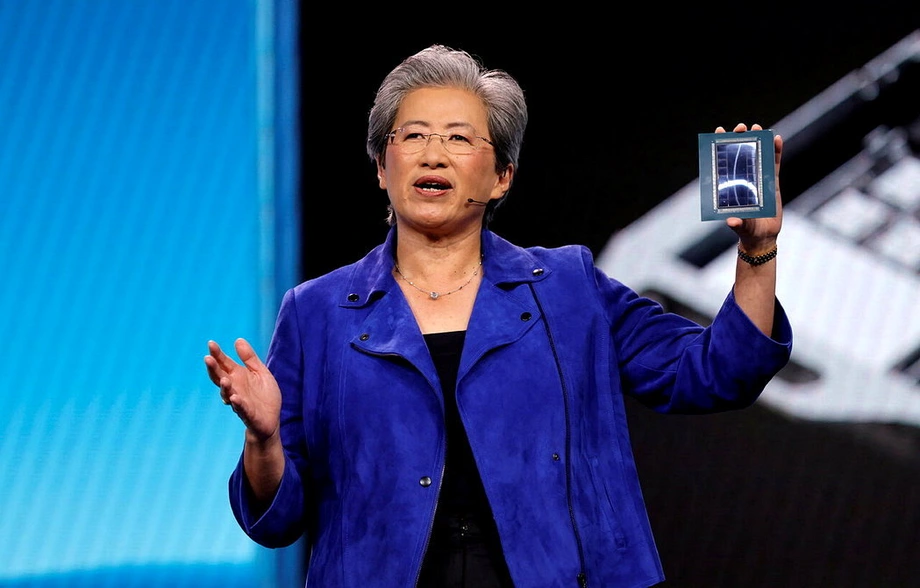
Chief Executive Lisa Su outlined the stronger outlook after AMD released its results on November 3, 2026. The company expects fourth quarter revenue of $17 billion, plus or minus 3%, and forecasts that data center AI revenue will overtake server CPU revenue for the first time during that quarter.
AMD's argument extends beyond selling more chips to train AI models. Su says AI agents, software that can carry out tasks such as writing code, analyzing data and coordinating work across applications, are creating another source of demand for central processing units, or CPUs.
AMD now expects its server CPU revenue to roughly double in 2027, raising an earlier growth expectation of more than 70%. Data centers could account for about 80% of company revenue next year, compared with approximately 64% in the latest quarter.
The opportunity reaches deep into Taiwan's electronics industry, from chip manufacturing and advanced packaging to testing, server assembly, cooling and storage. Delivering that growth will require several parts of the supply chain to expand together, while rising component prices are already putting pressure on consumer computers.
What the latest results show
AMD's third quarter revenue rose 16% from the preceding quarter and exceeded an analyst estimate of about $13.1 billion. Net income under generally accepted accounting principles, or GAAP, was $2.428 billion, with diluted earnings of $1.46 per share.
Adjusted earnings, which exclude certain expenses, reached $2.09 per share, up 74% from a year earlier and above the expected $1.97. Adjusted operating income increased 75% to about $3.9 billion. The adjusted and GAAP figures use different accounting treatments, giving readers two views of profitability.
Data center revenue climbed 97% from a year earlier to $8.55 billion, beating the expected $8.20 billion by $350 million, or about 4.3%. Demand for EPYC server processors and Instinct AI accelerators drove the increase.
Data centers supplied 64% of AMD's revenue, compared with 47% a year earlier, a rise of 17 percentage points. In practical terms, almost two dollars out of every three dollars AMD earned during the quarter came from this business.
AMD's fourth quarter guidance implies revenue between $16.49 billion and $17.51 billion. The $17 billion midpoint would represent approximately 27% growth from the third quarter and exceeds analyst expectations of roughly $16.3 billion.
Why AI agents need more than GPUs
AI accelerators, commonly built around graphics processing units, or GPUs, perform many calculations at once. That makes them useful for training AI models and generating responses. CPUs handle a broader range of computing work, including managing applications, moving information and coordinating tasks.
An AI agent may need to do much more than answer a question. A request to fix a software problem could involve reading files, running tests, retrieving information and using several programs. The AI model supplies decisions or instructions, while other computing systems execute and organize the work.
Su expects wider deployment of these agents to increase demand for both CPUs and GPUs. AMD consequently sees server processors becoming a larger AI opportunity alongside its accelerator business.
The revised CPU forecast gives that argument a measurable target: roughly 100% revenue growth in 2027, compared with the earlier expectation of more than 70%. Customers will need to move from trials to substantial deployments for that demand to develop at the pace AMD anticipates.
Helios brings the contest to complete systems
AMD's Helios platform packages computing resources into complete server racks rather than leaving customers to assemble a system around individual chips. Its flagship configuration combines MI455X accelerators with the next generation Venice server processor.
Chief Financial Officer Jean Hu said the third quarter included the first revenue generating shipments of MI455 accelerators and Helios racks. AMD expects a substantial increase in shipments during the fourth quarter and further expansion through 2027.
Meta, Microsoft, OpenAI and Oracle have been identified as recipients of MI455X shipments, while Anthropic is also among the companies associated with Helios deployments. Early Helios systems are undergoing testing at Meta, placing customer validation alongside the start of commercial shipments. Venice processors have reportedly attracted adoption across more than 240 platforms.
Helios puts AMD into more direct competition with Nvidia's Grace Blackwell and Vera Rubin systems. Customers buying at this scale weigh the cost of running an entire installation, including hardware, power and operation, as well as the performance of individual chips. AMD remains well behind Nvidia in AI accelerators, making successful system deliveries a central part of its expansion.
The milestones behind the 2027 forecast
AMD's timetable combines products already beginning to generate revenue with forecasts for much larger volumes. The key milestones are:
- Second half of 2026: new Microsoft and Anthropic agreements support expectations for faster growth in data center AI chips and systems.
- Third quarter of 2026: initial revenue generating shipments of MI455 accelerators and Helios racks begin, while data center revenue reaches $8.55 billion.
- November 3, 2026: AMD releases its quarterly results and raises expectations for growth in 2027.
- November 4, 2026: Su discusses supply constraints and preparations for expansion during an online investor meeting.
- Fourth quarter of 2026: AMD expects AI accelerator revenue to exceed server CPU revenue and total company revenue to reach about $17 billion.
- 2027: AMD targets total revenue growth above 80%, roughly double the server CPU revenue and a data center contribution of about 80% of sales.
Hu also indicated that fourth quarter data center revenue could rise about 50% from the preceding quarter. Applied to the third quarter's $8.55 billion, that would mean approximately $12.8 billion, illustrating how heavily the near term growth plan depends on data centers.
Supply depends on several factories moving together
Su says demand for some advanced computing products exceeds supply. AMD is coordinating access to wafers, substrates, advanced packaging, memory and other components to support its delivery plans.
Each has a different job. Wafers are the discs on which chips are manufactured. Substrates connect packaged chips to circuit boards. Advanced packaging places multiple chips close together so they can exchange information quickly, while memory holds the data those chips need.
A shortage at any one stage can delay a finished product, even when the processor itself is ready. Su has stressed that adding capacity in a single manufacturing process is insufficient; manufacturing, packaging, testing and materials must expand together.
Asked about rising component costs, Su described arrangements covering parts of AMD's purchasing and sales relationships. She said the company has secured:
long-term agreements with some of our suppliers as well as some of our customers
AMD is also discussing how to share higher costs with customers. Memory is a particular concern, including high bandwidth memory, or HBM, which places memory close to an accelerator to feed it large amounts of data quickly. Cost increases also extend to other components.
Taiwan's opportunity reaches beyond wafer production
TSMC is central to AMD's next generation products through its advanced manufacturing processes, including 2 nanometer technology, and its CoWoS packaging technology. CoWoS connects processors and memory within a tightly integrated package, helping support the large data flows required by AI systems.
ASE Technology Holding, its ASE semiconductor business and Siliconware Precision Industries are also involved in developing and validating the next generation of packaging connections with AMD. Their work includes technology that uses tiny bridges to connect chips within a package.
Powertech Technology has worked with AMD on a panel based bridge connection technology and is pursuing validation of fan out panel level packaging products for a target of mass production in 2027. Its advanced packaging operation in Hsinchu is expected to be the main production base.
ASE Technology Holding expects revenue from its leading edge advanced packaging and testing business, known as LEAP, to double to as much as $8 billion in 2027. It also projects more than $1 billion from its advanced packaging operations covering the full production process. Powertech says advanced packaging already contributes more than 30% of group revenue.
Other potential beneficiaries include substrate makers Unimicron, Nan Ya PCB and Kinsus; testing company King Yuan Electronics; and test interface supplier WinWay. Kinsus supplies ABF substrates, King Yuan provides finished chip testing for AMD AI platforms, and WinWay supplies coaxial test sockets.
Server manufacturers Hon Hai and Quanta, cooling component supplier Jentech and storage controller maker Phison are among the wider Taiwanese businesses positioned to benefit from AI infrastructure demand. Outside Taiwan, partners and potential beneficiaries include Cerebras, Supermicro, Dell, Samsung and Micron. The value and timing of additional AMD orders for these companies have not been disclosed.
PCs and gaming face a different market
AMD's client and gaming division generated $3.722 billion in third quarter revenue, down 8% from a year earlier. Inside that total, the two businesses moved in opposite directions.
Client revenue, mainly associated with PC processors, increased 7% to $2.949 billion. Gaming revenue fell 40% to $773 million, reflecting weaker sales of chips used in consoles and graphics products. Gaming therefore accounted for much of the combined division's decline.
Su has included a decline of at least 10% in global PC shipments in AMD's planning assumptions for 2027. Higher memory and component prices raise the cost of complete computers, making purchases harder for customers with tight budgets. AMD plans to focus on commercial and premium products as it seeks to perform better than the broader market.
Profit margins also deserve attention. AMD forecasts an adjusted fourth quarter gross margin of about 55%, down from 56% in the third quarter. Gross margin is the share of revenue remaining after the direct cost of products sold. The forecast pairs rapid sales growth with a slightly smaller share retained at that stage.
Investors price in a much larger AI business
AMD shares rose as much as 8% in trading after the results, with the stock already having more than doubled during 2026. The reaction followed concerns about the cost of AI infrastructure and a cautious outlook from Intel.
Su's forecast for revenue growth above 80% in 2027 exceeds analyst expectations of approximately 75% to 77%. An investment assessment placed AMD at around 39 times expected 2027 earnings, a valuation that makes the pace of future profit growth particularly relevant. Higher earnings forecasts would lower that multiple at an unchanged share price.
Two business risks stand out: AI agents may generate less CPU demand than AMD expects, and cloud companies may adopt more custom processors based on Arm designs. Supply delays or rising costs could also affect how quickly growing demand becomes revenue and profit.
AMD is expanding its technology ambitions through acquisitions as well. It agreed in September to buy World Labs, the company founded by AI researcher Fei-Fei Li, for $8.2 billion in stock. World Labs develops AI technology for building models of three dimensional environments. AMD has also announced a purchase of inference chip company Taalas, extending its interest in hardware used to run trained AI models.
The immediate commercial test is more concrete: deliver the fourth quarter shipment increase, keep component supplies moving and turn customer deployment plans into sustained sales. AMD's forecast combines a fast growing accelerator business with a renewed CPU opportunity, even as the consumer side of computing faces weaker demand.
Key Points
- AMD reported third quarter revenue of $13.377 billion, up 45%, and data center revenue of $8.55 billion, up 97%.
- Fourth quarter revenue guidance is $17 billion, plus or minus 3%, with an adjusted gross margin of about 55%.
- AMD expects company revenue to grow more than 80% in 2027 and server CPU revenue to roughly double.
- AI accelerator revenue is expected to overtake server CPU revenue in the fourth quarter as Helios shipments increase.
- Supply expansion depends on wafers, substrates, packaging, memory and testing, creating opportunities across Taiwan's semiconductor industry.
- AMD is planning for a decline of at least 10% in global PC shipments in 2027, while its latest gaming revenue fell 40%.