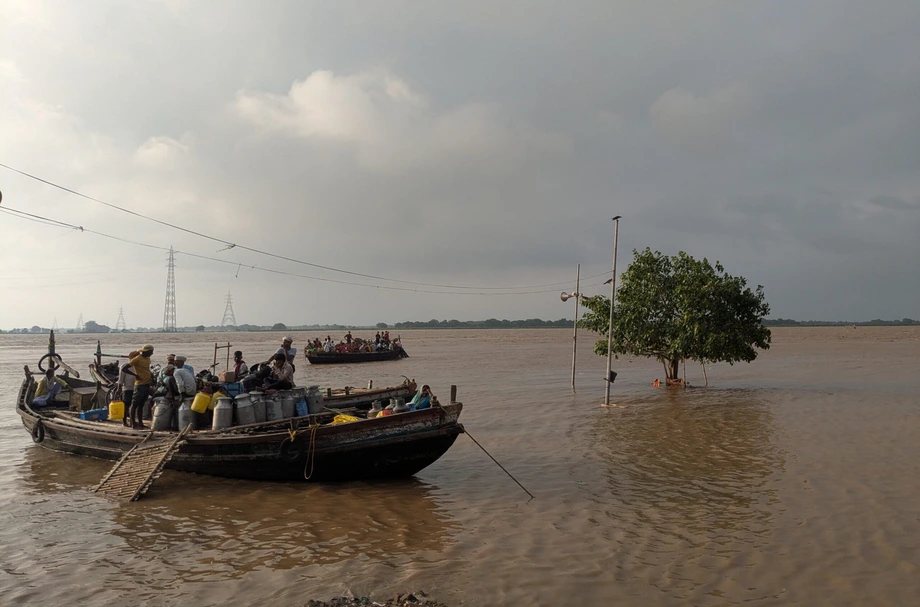
A December deadline with consequences for farms and rivers
India and Bangladesh face a December 12, 2026 deadline to replace or renew their Ganga water treaty, with Dhaka seeking stronger protection against dry season shortages and Indian states demanding that their own water needs shape the agreement. The treaty has no automatic extension clause, putting pressure on negotiations before the next allocation season begins on January 1, 2027.
Contents
- A December deadline with consequences for farms and rivers
- How the sharing formula works
- Why Bangladesh wants a guarantee
- Technical contact continues amid a diplomatic gap
- Bihar and West Bengal press their requirements
- Sediment connects upstream flooding with delta survival
- What shortages mean for Bangladesh
- A river needs more than a minimum number
- The dates shaping the negotiations
- Key Points
The stakes reach beyond the water released at Farakka Barrage in West Bengal. Bangladesh approved a $2.8 billion Padma Barrage project in May, while its Ganges-Kobadak Irrigation Project now covers a reported 550 square kilometres against a designed area of 955 square kilometres. Bihar, meanwhile, wants assured supplies for drinking water, farming and industry, alongside action on sediment and flooding.
Signed on December 12, 1996 by Indian Prime Minister H. D. Deve Gowda and Bangladesh Prime Minister Sheikh Hasina, the treaty divides available Ganga flows during the dry season from January 1 to May 31. The river is known in Bangladesh as the Padma.
Bangladesh State Minister for Foreign Affairs Shama Obaed Islam has expressed hope that an agreement can be reached while promising to pursue the country's water requirements.
We believe and hope that the treaty, which expires this year, will be renewed. We hope India will make the right decision.
Dhaka's central demand concerns what happens when the river runs low. India must weigh that request against growing domestic demand and the practical difficulty of promising water during a severe shortage. Both governments also have to negotiate through relations strained by Hasina's removal from power in August 2024 and her subsequent refuge in India.
How the sharing formula works
Farakka is the measuring and allocation point for the treaty. A cusec means one cubic foot of water flowing past a point each second. It measures the rate of flow, rather than the total amount stored in a reservoir.
The Observer Research Foundation's assessment of the treaty describes three allocation bands, applied in periods of ten days:
- At 70,000 cusecs or less, India and Bangladesh divide the available flow equally.
- Between 70,000 and 75,000 cusecs, Bangladesh receives 35,000 cusecs and India receives the remainder.
- Above 75,000 cusecs, India receives 40,000 cusecs and Bangladesh receives the remainder.
For example, an available flow of 60,000 cusecs produces a basic allocation of 30,000 cusecs to each country. At 80,000 cusecs, each receives 40,000. Special provisions during the critical period from March 11 to May 10 give each country 35,000 cusecs in alternating periods of ten days.
Article II requires immediate government consultations if total flow at Farakka falls below 50,000 cusecs during any period of ten days. The governments must then agree on emergency adjustments guided by equity, fair play and avoiding harm to either side.
The last scheduled allocation season within the treaty's 30 years ended on May 31, 2026, the foundation notes. December 12 marks the end of the treaty's legal term, making an agreement before the following January especially important for water planning.
Why Bangladesh wants a guarantee
Bangladesh Water Resources Minister Shahiduddin Chowdhury Anee has placed a minimum guarantee near the centre of Dhaka's negotiating priorities. His aim is to secure more predictable supplies when reduced river flows put crops, drinking water and ecosystems under pressure.
Anee explained the government's position after a seminar organised by the Bangladesh Institute of International and Strategic Studies.
Restoring the guarantee clause, as in the 1977 agreement, is one of Bangladesh's top priorities in the new treaty.
The National University of Singapore's Institute of South Asian Studies, in its study of renewal prospects, explains that the 1977 agreement protected Bangladesh with a floor of 80 percent of its scheduled allocation during specified periods of low flow. Bangladesh agreed to remove that provision in a 1982 memorandum of understanding.
The 1996 treaty instead combines its allocation formula, alternating critical season assurances and emergency consultations below 50,000 cusecs. Dhaka wants a stronger mechanism for handling shortages, rather than relying mainly on negotiations after flows become critically low.
India faces a competing concern: an unconditional minimum release could concentrate the burden of an exceptional drought on its own users. ORF Vice President for Development Studies Nilanjan Ghosh argues that any guarantee must reflect actual availability and a fair division of drought risk.
A possible compromise discussed in policy proposals would combine a minimum share with explicit rules for sharing exceptional shortages. No final guarantee formula, treaty duration or signing date has been announced. Although a substantially revised agreement and a shorter term are reportedly under consideration, Shama has said Bangladesh's negotiating committee will determine whether to seek renewal or a new arrangement.
Technical contact continues amid a diplomatic gap
Prime Minister Tarique Rahman has formed a committee to conduct negotiations. Shama said the water resources minister and the government's finance adviser are leading the process, with Foreign Ministry representation. Prime ministerial adviser Rashed Al Mahmud Titumir heads a technical committee on water sharing.
Bangladesh has said India has not responded to its requests to negotiate renewal, including notifications sent since June. India's Ministry of External Affairs has said river matters belong within the Joint Rivers Commission, and spokesperson Randhir Jaiswal said in September that technical meetings on the treaty had continued. Shama has also confirmed contact at working levels while saying formal discussions will follow.
The Joint Rivers Commission, established in 1972, provides the bilateral channel for cooperation on the 54 rivers shared by the countries. Its last confirmed meeting at ministerial level was in 2022, following a gap of 12 years. Technical talks took place in May 2026.
During the May meetings in Kolkata, a Bangladesh delegation led by Joint Rivers Commission member Md Anwar Qadir also visited the joint flow measurement location at Farakka. Existing technical cooperation therefore offers a channel for negotiating the treaty, even as political agreement remains unfinished.
Water disputes are also drawing domestic pressure in Bangladesh. At an October 30 rally in Dhaka, National Citizen Party convener Nahid Islam threatened protests unless a renewed agreement protected Bangladesh's fair share. Such demands leave Rahman's government facing scrutiny over both the volume of water secured and the strength of the safeguards attached to it.
Bihar and West Bengal press their requirements
Bihar Chief Minister Samrat Choudhary has said the state does not oppose Bangladesh receiving its share, but wants its own requirements fully considered before renewal or a new pact. At a New Delhi event in early November, he called for assured water for agriculture, drinking supplies, industry and economic development.
Choudhary said Bihar's present opportunity to draw Ganga water was limited to July through October. Bihar's Ganga water supply scheme, inaugurated in 2022, is permitted to withdraw water during those monsoon months for storage and drinking supplies to Gaya and Rajgir.
Bihar has sought 2,000 cusecs during the lean season for drinking and industrial use, while an internal committee reportedly recommended 900 cusecs. The recommendation amounts to 45 percent of the state's demand, leaving a gap of 1,100 cusecs.
Janata Dal (United), an ally of Prime Minister Narendra Modi's government, has pressed for fresh negotiations. Party president Sanjay Kumar Jha has argued that an agreement must incorporate Bihar's future water security and development requirements.
West Bengal has different but equally direct interests. Farakka was built to divert water into the Bhagirathi-Hooghly system to support navigation and the Kolkata port. Drinking supplies, irrigation, industrial activity, the Kolkata-Haldia port system and freshwater reaching the Indian Sundarbans all feature in the state's concerns.
India's negotiating task therefore includes reaching a domestic understanding about water use upstream of Farakka. Sunil Kumar Chaudhary, a former professor at Tilka Manjhi Bhagalpur University who has studied Ganga ecology, has called for an assessment of Bihar's needs through 2050 before setting an assured allocation.
Sediment connects upstream flooding with delta survival
Bihar's demands also concern sediment, the sand, silt and soil carried by a river. When sediment settles in channels, it can change their depth and the routes water takes. Farther downstream, sediment helps replenish floodplains and build delta land.
A 2018 IIT Kanpur study covering 580 kilometres from Buxar to Farakka estimated that the barrage may trap 156 million tonnes of sediment annually. IIT Kanpur earth sciences professor Rajiv Sinha has called for Bihar to participate as a stakeholder and for sediment management to be included in the treaty.
Bihar has linked Farakka to sediment accumulation, flooding and erosion. India's Central Water Commission, however, has put the maximum reach of the barrage's backwater effect at about 42 kilometres. Assessing flood conditions farther upstream requires examining tributary flows, channel changes, embankments and sediment movement across the basin.
In West Bengal's Malda district, erosion and the narrowing land between the Ganga and Fulhar rivers have prompted concern about changes in river routes, settlements and transport links. Bangladesh faces its own combination of low dry season flows and destructive monsoon erosion. In Chapainawabganj, the Water Development Board says the river has widened by about three kilometres in recent years.
Ghosh's ORF analysis also identifies sediment delivery as central to the Bengal Delta's survival, alongside rising seas, subsidence and coastal erosion. It calls for rigorous sediment accounting to identify the contribution of Farakka and other interventions. Measuring how much sediment enters, settles within and leaves different river sections would help turn competing claims into practical management decisions.
What shortages mean for Bangladesh
The Ganges-Kobadak Irrigation Project offers a measure of the pressure on Bangladesh's agricultural water supplies. Its reported coverage of 550 square kilometres is 405 square kilometres below its designed 955 square kilometres, a reduction of about 42 percent.
Freshwater carried through distributaries such as the Gorai also helps restrain saltwater intrusion in the southwest and supports the Sundarbans. Reduced supplies affect irrigation, fisheries, navigation and groundwater recharge. For households, saltier water can mean fewer suitable drinking sources and greater difficulty growing crops.
In the Barind region, Bikash Soren, a Protestant priest aged 72, recalled boats passing his village throughout the year and described the change he now observes.
For almost three months a year, you hardly see the river flowing.
Bangladesh's approved Padma Barrage project is intended to ease shortages and includes a planned hydropower plant of 113 megawatts. Its usefulness will depend on dependable upstream supplies and how the structure manages the river.
Md Ataur Rahman, a professor of water resources engineering at Bangladesh University of Engineering and Technology, identifies three conditions for success: reliable Ganga flows, scientific sediment management and protection of downstream environmental flows. Those conditions connect the project's engineering design directly to the treaty negotiations.
A river needs more than a minimum number
The 1996 framework uses historical flow patterns from 1949 to 1988. Proposals for a successor agreement call for recent, jointly verified measurements to reflect changing rainfall, temperatures, water withdrawals and groundwater conditions.
Environmental flows would add another layer to those calculations. The term means the amount, timing, duration and quality of water needed to sustain a river's plants, animals and connected habitats. Seasonal pulses also carry sediment and connect rivers with floodplains.
Measurements at different locations matter too. The ORF assessment found that, during the period it examined, dry season flows at Bangladesh's Hardinge Bridge were generally higher than releases at Farakka. Tributaries including the Mahananda and possible groundwater exchanges were offered as explanations. Joint monitoring along the river would help planners account for those contributions when assessing local needs.
Policy proposals include publishing daily and ten day flow data, establishing clearer drought procedures, creating a permanent scientific panel under the Joint Rivers Commission and reviewing climate conditions every five years. A transparent dispute settlement process would also address concerns about the treaty's lack of an arbitration clause.
Some proposals would bring Nepal into wider discussions because tributaries such as the Gandak and Kosi contribute to Ganga flows. India favours separate bilateral arrangements with its neighbours. A temporary arrangement has also been proposed if a comprehensive successor treaty cannot be completed by December 12.
The dates shaping the negotiations
The dispute has moved through construction, international diplomacy and several different sharing arrangements. Bangladesh raised the issue at the United Nations in 1976, when the General Assembly issued a consensus statement before the 1977 agreement.
- 1975: Farakka Barrage began operating.
- November 5, 1977: India and Bangladesh signed an agreement containing an 80 percent minimum allocation protection for Bangladesh.
- 1982: Bangladesh agreed to remove that guarantee provision under a memorandum of understanding.
- December 12, 1996: The prime ministers signed the current treaty for 30 years.
- May 2026: Technical meetings and a joint measurement site visit took place; Bangladesh approved the Padma Barrage project.
- May 31, 2026: The current treaty's final scheduled dry season allocation period ended.
- December 12, 2026: The treaty's term expires.
Political engagement remains part of the negotiating environment. Modi invited Rahman to India after Rahman took office in February, but a proposed August visit did not happen, and Rahman declined an invitation to the September BRICS summit. Bangladesh's extradition request for Hasina and objections to her political statements from India continue to strain ties.
A successor agreement would have to connect three decisions: how to divide available water, how to share an exceptional shortage and how to maintain the river system supporting both countries. January's return to dry season allocations gives those decisions an immediate practical deadline.
Key Points
- The Ganga treaty expires on December 12, 2026, with no automatic extension clause.
- Bangladesh wants stronger protection for its dry season share, drawing on the 1977 guarantee.
- India must account for water demands in Bihar and West Bengal alongside its commitments to Bangladesh.
- Technical contact has continued, while formal terms for a successor agreement remain unsettled.
- Sediment, salinity, environmental flows and reliable measurements are central to proposals for a broader agreement.
- Bangladesh's $2.8 billion Padma Barrage project depends on reliable flows and sound sediment management.