Two New Wells Feed Gas Into the Luzon Power Supply
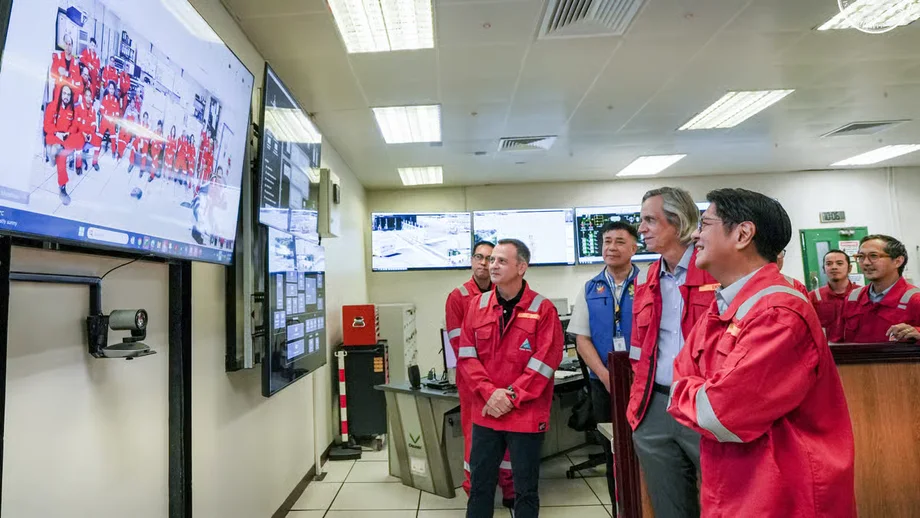
President Ferdinand Marcos Jr. led the ceremonial first delivery of natural gas from two new Malampaya wells on November 5, 2026, marking a nearly $1 billion expansion that operator Prime Energy says could extend the field's productive life by about six years.
Contents
- Two New Wells Feed Gas Into the Luzon Power Supply
- What Marcos Said About Electricity Prices
- From Drilling to the November Ceremony
- How Much Gas Has Been Added?
- Why the Existing Infrastructure Matters
- A Domestic Resource in an Import Dependent Economy
- The Contractors and Skills Behind the Project
- Batangas Looks to Investment and Jobs
- New Contracts and Priority for Philippine Gas
- Key Points
The ceremony took place at the Malampaya Onshore Gas Plant in Tabangao Ambulong, Batangas City. Gas from the Malampaya East-1 and Camago-3 wells travels from offshore Palawan through the existing transmission system to Batangas, where power plants use it to generate electricity for the Luzon grid.
Prime Energy estimates that the project added 222 billion cubic feet of recoverable natural gas reserves. The company says the additional gas could generate approximately 31.46 billion kilowatt-hours of electricity, equivalent to the annual consumption of 13.11 million Filipino households.
The delivery comes as the Philippines seeks to reduce its exposure to fuel prices and supply disruptions abroad. Imported sources accounted for 52 percent of the country's total primary energy supply in 2025, according to government figures cited at the milestone. That measure covers energy used across the economy, rather than electricity alone.
Malampaya already supplies gas to power plants serving about one-fifth of Luzon's electricity needs. The new wells give those plants an additional domestic fuel source, while integration into the existing production system and increases in output will continue over the coming months.
What Marcos Said About Electricity Prices
Marcos presented the new gas supply as a way to make electricity more reliable and improve competition amid rising power rates. He said using more Philippine gas would reduce exposure to unpredictable international fuel prices.
The President explained the expected benefit in his remarks at the Batangas ceremony:
Maximizing the use of Malampaya gas could contribute to more competitive power rates because we are relying less on imported energy sources that are subject to volatile international energy prices.
For electricity consumers, the immediate change is an additional source of fuel for power generation. The announcement gave no amount or timetable for a reduction in household electricity bills.
Gas availability and electricity prices are connected through the power plants that burn the fuel. More domestic gas can give those plants another supply option, supporting the President's aim of reducing reliance on energy bought abroad.
From Drilling to the November Ceremony
Malampaya Phase 4 involved drilling and testing two wells, then linking them to infrastructure already serving the field. The work brought offshore drilling back to the Philippines after a gap of roughly a decade.
The main stages leading to the first gas ceremony were:
- First quarter of 2026: Malampaya East-1 and Camago-3 were drilled and tested.
- June 2026: Both wells were connected to the existing Malampaya subsea production system.
- November 5, 2026: Marcos and Prime Energy Chairman Enrique Razon witnessed the ceremonial first flow at the Batangas plant.
- Following months: Integration and increases in production are expected to continue.
Prime Energy said the project reached its first gas milestone 27 months after the final investment decision, the point at which the developer committed to funding and carrying out the work. That was about five months earlier than its original schedule, suggesting an initial planned duration of approximately 32 months.
The November event marked the arrival of gas from the new wells into the operating system. The continuing work will bring their production into the field's regular operations.
How Much Gas Has Been Added?
Prime Energy and the Malampaya consortium put the additional recoverable reserves at an estimated 222 billion cubic feet. Recoverable reserves are the portion of underground gas expected to be brought to the surface, rather than all the gas that may be present beneath the seabed.
A lower figure of approximately 41.46 billion cubic feet of recoverable reserves was also cited in descriptions of the November ceremony. The reason for the difference was not explained. Prime Energy's stated estimate for the project is 222 billion cubic feet.
The electricity estimate attached to the development is approximately 31.46 billion kilowatt-hours. A kilowatt-hour is a unit of energy used on electricity bills: a device drawing one kilowatt uses one kilowatt-hour when it runs for an hour.
Dividing the projected electricity output by the stated 13.11 million households gives about 2,400 kilowatt-hours per household for a year, or roughly 200 per month. That calculation explains the household comparison used to describe the size of the resource.
The gas is expected to be produced over several years. Its projected contribution depends on how much is drawn from the wells and used by power plants over that period.
Why the Existing Infrastructure Matters
Phase 4 connects the two new wells to Malampaya's existing offshore production platform through equipment installed beneath the sea. The gas then moves through the established transmission infrastructure from offshore Palawan to Batangas.
At the Batangas end, power plants burn the gas to produce electricity for Luzon. The offshore wells, production facilities, transmission system and power plants form a connected chain, with each stage needed to turn gas beneath the seabed into electricity for consumers.
Prime Energy's investment of nearly $1 billion covered the two wells in deep water and the subsea infrastructure linking them to the production platform. The development builds on the route and facilities that have carried Malampaya gas since commercial operations began in 2001.
Initial well tests indicate that the additional supply could extend the field's productive life by about six years. The duration will depend on future gas offtake, meaning the amount purchased and taken from the system. Faster use draws down the resource sooner; slower use stretches it over a longer period.
A Domestic Resource in an Import Dependent Economy
The Philippines obtained 52 percent of its total primary energy supply from imported sources in 2025. Domestic sources therefore accounted for the remaining 48 percent, leaving imports ahead by four percentage points.
Marcos linked that dependence to exposure to geopolitical tensions, interruptions in supply and sudden movements in international prices. He said a growing economy would need more energy to support factories and other activity.
The President described the limits of relying on supplies from abroad:
We cannot fully rely on other countries to provide these resources all of the time.
Malampaya's contribution is concentrated in gas supplied to electricity generation. Its power customers serve about one-fifth, or roughly 20 percent, of Luzon's electricity needs, making the field an established part of the island's energy system.
Marcos also called for further development of renewable energy alongside domestic resource exploration. His stated approach combines additional Philippine gas production with efforts to expand other local energy sources.
The Contractors and Skills Behind the Project
Prime Energy Resources Development B.V., the project operator, said Phase 4 relied on a supply chain spanning 17 countries. Those named included Germany, the United Kingdom, Norway, the Netherlands, the United States, Japan, South Korea, Australia, Singapore, Malaysia and the Philippines.
The work required specialised equipment, manufactured components and technical personnel. Items supplied or refurbished included valves, cables, generators, pipelines, subsea systems and equipment fitted at the tops of wells.
Philippine fabrication and manufacturing businesses also supported the development. Prime Energy credited coordination among contractors and suppliers for completing the work within 27 months despite the complexity of construction in deep water.
Marcos said the project had benefits beyond its gas output, including employment and the development of technical skills. The President described those benefits during the ceremony:
Beyond energy security, this project boosts employment, develops Filipino technical expertise, and contributes to government revenues.
Batangas Looks to Investment and Jobs
Batangas hosts the onshore plant receiving Malampaya gas and the power plants that turn it into electricity. Governor Vilma Santos-Recto said the expanded supply could help attract investors and support livelihoods in the province.
Santos-Recto linked investment to opportunities for residents:
So, more investors in, definitely more job opportunities and good livelihood for our constituents.
Her comments set out the province's hopes for activity beyond the construction project itself. The operating gas facilities and power plants give Batangas a continuing role in delivering energy from offshore Palawan to electricity users in Luzon.
Malampaya also provides revenue to the national government. Prime Energy said Service Contract No. 38, the contract under which the project operates, has generated more than $14 billion in government revenue since production began in 2001.
New Contracts and Priority for Philippine Gas
Marcos cited 14 new petroleum service contracts covering opportunities in oil, natural gas and native hydrogen. Native hydrogen means hydrogen occurring naturally underground, rather than hydrogen manufactured using electricity or other fuels.
The government has also granted special allowances to contractors working in new exploration areas, frontier locations and remote gas developments. These measures are intended to encourage investment in places where finding and developing resources can be difficult.
Another initiative, the Philippine Gradiometry and Seismic Survey Project, is intended to identify possible exploration opportunities. Gravity measurements and seismic surveys help map underground structures so developers can assess where resources may be located.
Marcos also cited the Philippine Natural Gas Industry Development Act, which prioritises procurement and use of indigenous natural gas over imported natural gas by power plants that burn gas. That policy gives domestic production a preferred place in the market as the new wells begin supplying fuel.
Phase 4 gives the government a completed development to point to alongside those exploration measures. The next operational step is the continuing integration of the wells and increases in production over the coming months.
Key Points
- Marcos led the ceremonial first delivery from Malampaya East-1 and Camago-3 in Batangas City on November 5, 2026.
- Prime Energy estimates additional recoverable reserves at 222 billion cubic feet and potential electricity generation at 31.46 billion kilowatt-hours.
- The nearly $1 billion project reached first gas in 27 months, about five months ahead of schedule.
- The wells could extend Malampaya production by about six years, depending on gas use.
- Imported sources supplied 52 percent of Philippine primary energy in 2025.
- Integration and increases in production will continue over the coming months.