From a Beijing parade to regular military drills
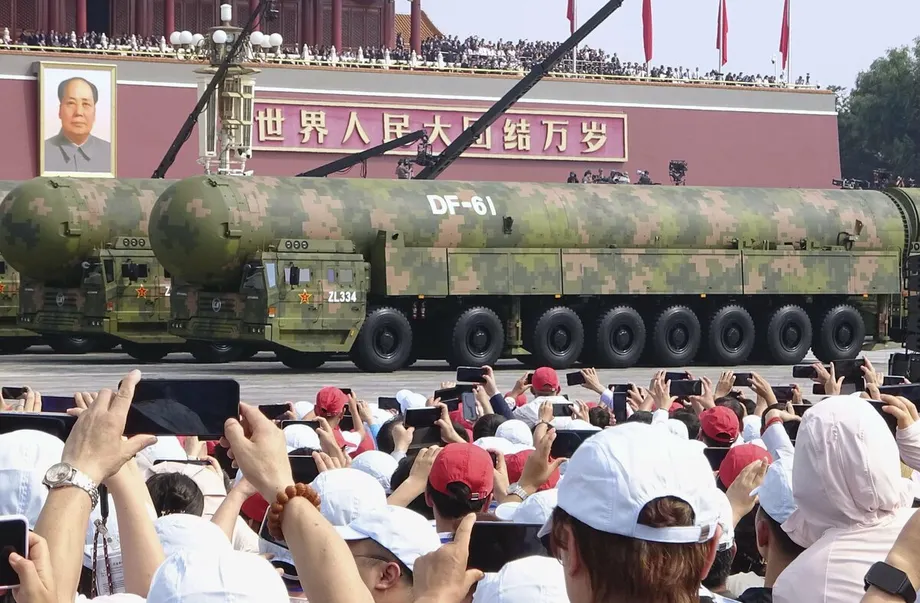
China's DF-61 intercontinental ballistic missile has entered routine training with the People's Liberation Army Rocket Force, moving a weapon first displayed publicly on September 3, 2025, into exercises involving movement in the field, changes of launch position and launch procedures.
Contents
- From a Beijing parade to regular military drills
- What routine training involves
- A mobile launcher and an estimated longer reach
- Why mobility matters to China's counterstrike force
- The timeline puts the public debut in perspective
- The parade showed several nuclear delivery systems
- A larger arsenal behind the new missile
- The strategic message extends beyond the launcher
- Key Points
Chinese state television said Thursday that the missile had been put into service. Military commentator Shao Yongling described its progression from a public debut to regular training as faster than the usual process through which an intercontinental missile becomes ready for combat.
The development gives a more concrete picture of a weapon whose operational status was still uncertain when images of its launch vehicles emerged before the Beijing parade. It also places the DF-61 within a broader expansion of China's nuclear forces, involving mobile missiles, underground silos, submarines and aircraft.
An intercontinental ballistic missile, or ICBM, is a missile designed to carry a warhead across continents. It rises high above the atmosphere before its warhead returns toward its target. In China's arsenal, such weapons form part of its nuclear deterrent: the ability to threaten a devastating response intended to discourage an attack.
The DF-61 matters because China's land forces have long been central to that deterrent. A missile that can move between positions gives military commanders more options for keeping weapons available after an enemy attack. Routine training allows crews to practise the many steps needed to operate that system outside a ceremonial setting.
What routine training involves
Shao said the DF-61 was participating in realistic training tasks, including movement through the field, transfers between positions and launch procedures. Those activities involve both the missile and the people, vehicles and communications equipment supporting it.
A mobile missile unit must receive orders, move its equipment, establish a suitable position and complete launch preparations. Practising those steps repeatedly helps crews work together under changing conditions, rather than handling the missile only at a fixed base.
Shao attributed the speed of the transition to work completed before the public unveiling. In her assessment, the missile had already passed through development, design finalisation, trial deployment and reliability checks before appearing in Tiananmen Square.
She also said the DF-61 was compatible with existing command, communications and support networks. That would allow units to draw on equipment and training methods already used by the Rocket Force, reducing the amount of new infrastructure and instruction needed when receiving the weapon.
The account describes training and service entry without giving the number of DF-61 missiles deployed, their bases, a detailed readiness level or a date for a training launch. Its technical specifications, including an officially confirmed range and warhead load, also remain undisclosed.
A mobile launcher and an estimated longer reach
The DF-61 appeared at the September parade on a vehicle with 16 wheels. The Center for Strategic and International Studies describes it as a mobile ICBM in its nuclear parade analysis. The vehicle is a transporter erector launcher, meaning it carries the missile, raises it into position and provides the platform for launch.
The DF-41, an earlier Chinese ICBM, also uses a launcher with 16 wheels. It has an estimated range of 12,000 to 15,000 kilometres and reportedly began entering operational service in 2017, before its public appearance at a parade in 2019.
The DF-61 has been described as an upgrade to the DF-41, with improved guidance and an estimated maximum range of 18,000 kilometres. Those remain published assessments of the new weapon. At that estimated distance, its maximum reach would be 3,000 kilometres greater than the upper estimate for the DF-41.
The DF-41 is assessed as capable of carrying up to 10 multiple independently targetable reentry vehicles, usually called MIRVs. These are separate warheads carried by one missile that can be directed toward different targets. Public information about the DF-61 remains much thinner, so its payload cannot yet be described with the same detail.
Why mobility matters to China's counterstrike force
Shao described the DF-61 as strengthening China's land nuclear counterstrike capability, particularly its ability to survive an attack and get warheads through enemy defences. These are related but different military tasks.
Survival concerns what happens before a missile launches. A launcher that moves between locations can be harder to find and target than a weapon kept at a known position. Training in movement and changes of position therefore has a direct connection to the role China assigns to its mobile nuclear missiles.
Penetration concerns what happens after launch: whether a warhead can reach its target despite defensive systems attempting to intercept it. Shao credited the new missile with stronger performance in this area, while providing no technical explanation of the equipment responsible.
For the Rocket Force, reliable communications are also essential. A surviving launcher needs to receive and act on authorised orders. Shao's description of compatibility with existing command networks therefore addresses a practical part of bringing a new missile into service, alongside its range or size.
The timeline puts the public debut in perspective
The DF-61's emergence has unfolded through several distinct stages. Its appearance at a parade made the weapon visible internationally; the latest training account describes its place within military units.
- Before 2000: Development of the DF-41 is understood to have begun.
- 2017: The DF-41 reportedly began entering operational service.
- 2019: China publicly displayed the DF-41 at a major military parade.
- September 2, 2025: Images of launch vehicles carrying canisters marked DF-61 circulated before the Beijing parade, while the missile's service status was uncertain.
- September 3, 2025: The DF-61 made its formal public debut at the parade marking 80 years since the end of World War II and Japan's surrender.
- Thursday's announcement: Chinese state television described the DF-61 as in service and participating in routine Rocket Force training.
The DF-41's history helps explain Shao's account of the DF-61. A public unveiling can come after years of development and even after service entry. Shao's explanation is that much of the work needed to prepare the DF-61 had already taken place before spectators first saw it.
The parade showed several nuclear delivery systems
The September 3 parade placed the DF-61 alongside two other land ICBMs, the DF-31BJ and DF-5C. CSIS identified the DF-31BJ as a variant designed for underground silos, adding a different deployment method to the mobile DF-31 family.
The DF-5C is a missile using liquid fuel that can carry heavy nuclear payloads to the continental United States. Other DF-5 variants have previously been identified by the Pentagon as capable of carrying multiple independently targetable warheads.
China also displayed the JL-3 missile launched from submarines and the JingLei-1 missile carried by the H-6N bomber. CSIS described the event as China's first public display of a complete nuclear triad, the term for nuclear delivery systems operating from land, sea and air.
The JL-3 has a possible range exceeding 5,400 nautical miles, or about 10,000 kilometres, according to the assessment cited by CSIS. That reach could allow it to threaten the continental United States from waters close to China. The country has six operational JIN-class submarines, each able to carry up to 12 ballistic missiles.
CSIS also pointed to weapons absent from the parade, including the DF-27, which was tested in 2023 and was believed to have entered deployment in 2024. The selection of weapons on display put particular attention on systems capable of reaching the United States.
A larger arsenal behind the new missile
CSIS estimated China's nuclear arsenal at about 600 weapons in 2025, compared with 300 in 2020. Those figures indicate a doubling in five years. The Pentagon's December 2024 assessment used an earlier reference date, estimating that China had already surpassed 600 operational nuclear warheads by the middle of 2024.
The Pentagon projected more than 1,000 operational Chinese nuclear warheads by 2030. Taking 600 as a comparison point, that would mean an increase of more than 400 warheads, or more than two thirds.
The US Department of Defense described the direction of China's nuclear development in its December 2024 report to Congress:
The PRC is developing new intercontinental ballistic missiles (ICBMs) that will significantly improve its nuclear-capable missile forces and will require increased nuclear warhead production.
China's construction of large missile silo fields in western regions is another part of that expansion. The DF-61 adds a mobile system to a force that is also investing in fixed launch sites, with different deployment methods creating different demands for personnel, protection and command systems.
The strategic message extends beyond the launcher
CSIS authors Joseph Rodgers, deputy director of the Project on Nuclear Issues, and Heather Williams, the project's director, interpreted the parade's concentration on weapons able to reach the United States as a deterrent message to Washington, including over possible intervention in a Taiwan conflict.
Their analysis connects two developments: a growing stockpile and a wider range of delivery systems. More warheads increase the size of the force, while mobile launchers, silos, submarines and bombers give military planners different ways to deploy it.
Rodgers and Williams also urged the United States to keep open opportunities for arms control and discussions aimed at reducing nuclear risks. For governments across Asia, the DF-61's arrival in regular training makes China's expansion more tangible: a weapon recently seen on parade is now being incorporated into the recurring work of a military force.
The immediate development is therefore operational as well as symbolic. China is presenting the DF-61 as equipment its crews now train to use, while outside assessments place it within a nuclear arsenal growing in both size and variety.
Key Points
- China says the DF-61 has entered service and routine Rocket Force training involving field movement, changes of position and launch procedures.
- The missile made its public debut on September 3, 2025, on a launcher with 16 wheels.
- Military commentator Shao Yongling attributed its rapid transition to earlier development and compatibility with existing support networks.
- Its estimated range of up to 18,000 kilometres has not been officially confirmed.
- The parade also displayed nuclear delivery systems operating from silos, submarines and aircraft.
- The Pentagon estimated more than 600 operational Chinese nuclear warheads by the middle of 2024 and projected more than 1,000 by 2030.