A small polling gain meets a much bigger political ambition
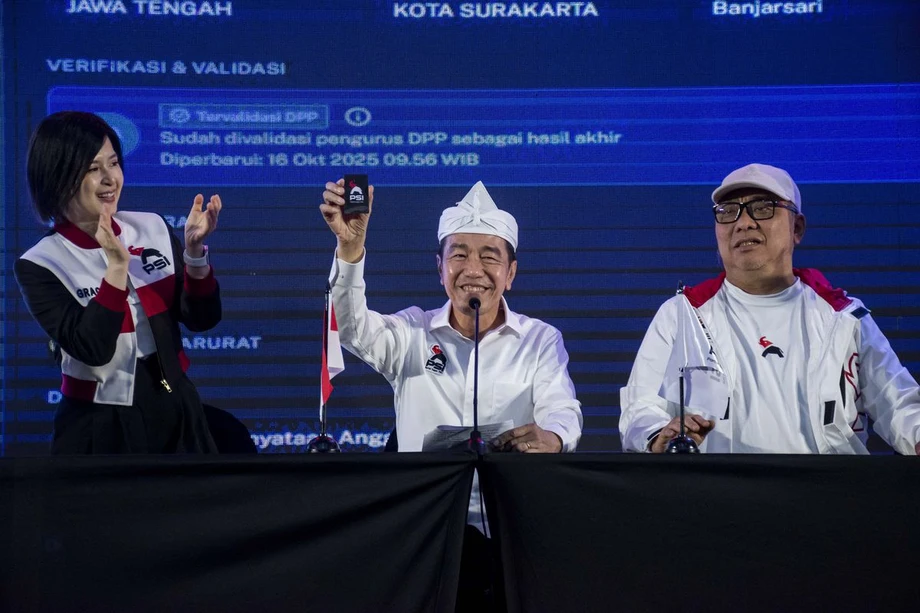
The Indonesian Solidarity Party (PSI) rose from 2.3% to 2.9% in two Poltracking Indonesia surveys conducted in August and September to October 2026, a modest movement for a party seeking its first seats in Indonesia's national House of Representatives in 2029. Its most prominent supporter, former president Joko Widodo, publicly displayed his PSI membership number in Bandung on September 22.
Contents
- A small polling gain meets a much bigger political ambition
- What the surveys actually measured
- Two elections show the scale of PSI's task
- Jokowi wants a party network reaching villages
- Central Java becomes the most concrete test
- Why voters may choose candidates before parties
- Gibran's prospects depend on more than popularity
- The education dispute moves into parliamentary politics
- Parliamentary action requires agreement across parties
- Key Points
Jokowi's involvement brings together three political ambitions: getting PSI into the national legislature, expanding the party led by his youngest son, Kaesang Pangarep, and strengthening the political network around his elder son, Vice President Gibran Rakabuming Raka. Each ambition depends on different people and institutions, from village organisers to leaders of larger parties.
PSI's position is especially sensitive because its strongest family connection sits inside the presidency while the party itself remains outside the national parliament. Gibran faces growing political pressure over his educational documentation, with lawmakers discussing parliamentary scrutiny and possible constitutional proceedings.
The electoral numbers show both opportunity and distance. PSI won 2.81% of valid votes in the 2024 legislative election, below the 4% threshold applied for entry into the House. Its latest cited polling figure, 2.9%, leaves it seeking a broader base while Gerindra, President Prabowo Subianto's party, remains far ahead.
For voters, the central issue is concrete: whether Jokowi's personal following can become an organisation capable of winning seats, serving communities and giving his political allies a stronger voice when parties negotiate the next presidential ticket.
What the surveys actually measured
Poltracking Indonesia's August survey release provides the clearest methodological foundation. Interviewers questioned 1,220 respondents in person across all 38 provinces from August 14 to 20, 2026. The organisation stated a margin of error of plus or minus 2.9 percentage points at a 95% confidence level.
The survey used several stages of random selection, with provincial coverage proportional to the 2024 voter register and stratification by gender. Poltracking researcher Yoki Alvetro released the findings on September 23.
In a simulated ballot listing 18 parties, Gerindra received 23.2%, PDI Perjuangan (PDIP) 11.6% and Golkar 10.4%. PKB followed at 6.2%, the Democratic Party at 6.1%, NasDem at 4.4%, PAN at 3.4%, PKS at 3.3%, PSI at 2.3% and PPP at 1.9%.
The later survey, conducted from September 30 to October 7, put PSI at 2.9%, ahead of PAN and PPP and one percentage point behind NasDem. Gerindra remained first at 22.9%, followed by PDIP at 13.4% and Golkar at 9.1%. Another 24.2% answered that they did not know or gave no answer.
PSI's increase was 0.6 percentage points. Interpreting movement of that size requires information about sampling uncertainty across both surveys; the later survey's sample size and margin of error were not specified in the account of its findings. The August poll's stated margin of error gives readers a useful measure of how much uncertainty can surround a survey estimate.
Two elections show the scale of PSI's task
PSI entered electoral competition after its establishment in late 2014. In 2019, it won 2,650,361 votes, or 1.89% of valid votes nationally. In 2024, it received 4,260,169 votes, or 2.81%.
The party gained 1,609,808 votes between those elections, an increase of about 61%. Its national vote share rose by 0.92 percentage points. Despite that growth, PSI remained outside the House because its share fell short of the 4% parliamentary threshold used in those contests.
A parliamentary threshold is a minimum national vote share a party must reach to take part in the allocation of House seats. Provincial legislatures are separate contests, which explains how PSI can hold seats in Central Java while lacking representation in the national House.
Measured against the same 4% benchmark, PSI's 2024 result was 1.19 percentage points short, while its latest cited poll was 1.1 points below. The rules governing the 2029 contest will determine the eventual target, making the earlier threshold a useful reference for the size of the party's electoral challenge.
Jokowi wants a party network reaching villages
Jokowi publicly pledged support for PSI at its July 2025 congress in Surakarta, also known as Solo. Kaesang was returned as party chairman for the 2025 to 2030 term, placing the former president's political project under his youngest son's leadership.
Jokowi's instructions at the congress focused on organisation rather than publicity alone. He called for party structures to be completed across provinces, districts, cities and villages, setting a deadline before the next national election campaign reaches its final stages.
The former president told congress participants:
Therefore, I urge that we work hard together so that the party structure in all regions can be completed soon. At the very least by the end of 2027,
Lili Romli, a senior political researcher at the National Research and Innovation Agency (BRIN), said Jokowi's popularity could help PSI. She also stressed that public response and regular work in communities would shape the result.
Explaining why the former president's backing carried both opportunities and risks, Lili said:
However, it might not be automatic or a given. It depends on the public response, whether it's positive or negative. If it's negative, it will certainly be a challenge for Jokowi and the PSI,
Political analyst Saiful Huda Ems offered a more sceptical assessment on November 3, 2026. He argued that PSI lacked enough figures experienced in managing a large party and questioned the electoral strength of politicians moving into its ranks. Those are assessments of the party's capacity, while its election results provide the measurable record of its progress so far.
Central Java becomes the most concrete test
Kaesang has set PSI a target of 17 seats in the Central Java provincial legislature in 2029. The party won two seats there in 2024, compared with PDIP's 33.
Reaching 17 would require PSI to add 15 seats and increase its representation to 8.5 times its 2024 level. That makes Central Java a demanding test of whether Jokowi's following and PSI's local organisation can shift an established balance of power.
Lili predicted a contest between PSI and PDIP in the province, where Jokowi's supporters form an important political constituency. The competition also carries a personal history: PDIP was the party through which Jokowi built his earlier political career.
Djarot Saiful Hidayat, PDIP's central executive responsible for ideology and cadre development, responded on October 30 by warning against abuse of state power. He alleged that police had been mobilised during the 2024 election to pressure regional leaders, village heads and party organisations, and urged future competitors to compete through programmes in communities.
Djarot also described PDIP members moving to PSI as a process separating loyal members from political opportunists. His response shows that the contest extends beyond winning undecided voters: the parties are also competing over organisers, local relationships and the people who can turn support into votes.
Why voters may choose candidates before parties
Poltracking's August findings help explain Jokowi's insistence on building local structures. Asked about legislative elections, 53.3% of respondents said they were more inclined to choose an individual candidate, compared with 24.7% who preferred choosing a party.
Only 12.3% said they felt close to a political party, while 66.8% said they did not. Some 57.6% said they did not know the national House member representing their area; 26.2% said they did.
For PSI, those figures point towards a practical recruitment task. Recognisable candidates and organisers who maintain contact with residents may be as consequential as a national endorsement. Lili's call for regular community service fits that pattern.
Poltracking also found limits to the connection between presidential and legislative preferences. Some 44.6% said a party's support for a presidential ticket did not influence their choice of party, compared with 32.8% who said it did. Voters can therefore support a political figure while making a different choice on the legislative ballot.
Public knowledge of parliamentary entry rules was also limited: 17.7% said they knew about the 4% threshold, while 64.7% said they did not. PSI's campaign must operate in an electorate where many people prioritise candidates and have little familiarity with the national rules that determine party representation.
Gibran's prospects depend on more than popularity
Nasarudin, executive director of NSL Political Consultant and Strategic Campaign, identified three assets for Gibran ahead of 2029: electoral appeal, PSI's support and Jokowi's volunteer networks. Volunteer representative David Pajung expressed optimism on February 7, 2026, that Gibran would again accompany the incumbent president.
The vice presidential position, however, is also a negotiation among parties with ambitions of their own. Nasarudin used William Riker's 1962 book, The Theory of Political Coalitions, to explain why political partners weigh the votes a candidate brings against the positions and influence they must share.
The Democratic Party has an interest in the prospects of its chairman, Agus Harimurti Yudhoyono (AHY). Nasarudin argued that good relations between Jokowi and former president Susilo Bambang Yudhoyono could help communication, while decisions about a presidential ticket would still involve the party's own leadership interests.
PDIP has a different political history with Gibran. It backed Ganjar Pranowo and Mahfud MD in 2024, while Gibran ran alongside Prabowo. Nasarudin also discussed how a possible presidential nomination threshold of zero would give PDIP greater room to select a ticket independently.
PSI's pursuit of House seats therefore matters beyond its own survival. A larger legislative presence would give the party more representatives inside institutions where political agreements are made, alongside the personal networks already associated with Jokowi.
The education dispute moves into parliamentary politics
PKS received the civil society group Gerakan Merebut Kembali Kedaulatan Rakyat on October 29, 2026. Former deputy justice minister Denny Indrayana urged the party to pursue constitutional action concerning Gibran's educational documentation. PKS said it would forward the group's demands to its House faction and communicate with other parties.
Denny subsequently said the Supreme Court had granted H.M. Subhan Palal's appeal concerning a letter recognising Gibran's overseas education. The case was identified as Decision No. 742 K/TUN/2026, concerning equivalency letter No. 9149/D.D1/KS/2019.
The Constitutional Court was also described in the political debate as having found no evidence of a qualification equivalent to an Indonesian senior secondary diploma. The Supreme Court cancelled a planned explanatory press conference on November 2 because its legal and public relations bureau had not received the complete decision. The full judicial reasoning and administrative follow up therefore remained unresolved in the public discussion described at that point.
The principal dates trace how PSI's electoral effort and the pressure on Gibran developed alongside each other:
- July 2025: Jokowi publicly backed PSI and called for party structures to be completed by the end of 2027.
- August 14 to 20, 2026: Poltracking measured PSI support at 2.3%.
- September 22, 2026: Jokowi displayed his PSI membership number in Bandung.
- September 30 to October 7, 2026: A later Poltracking survey put PSI at 2.9%.
- October 29, 2026: PKS received activists seeking action over Gibran's qualifications.
- November 2 to 3, 2026: Discussion intensified over the Supreme Court decision and parliamentary oversight powers.
Parliamentary action requires agreement across parties
Lawmakers have discussed two principal instruments: an inquiry, known as hak angket, and the right to express an opinion, known as hak menyatakan pendapat. An inquiry investigates a matter; an expression of opinion sets out the House's formal position and can form part of constitutional proceedings involving a president or vice president.
Parameter Politik Indonesia executive director Adi Prayitno said proposing an inquiry requires at least 25 House members from more than one faction, followed by approval in a plenary session. Political analyst Agung Baskoro cited 53 PKS seats and 110 PDIP seats, a combined 163, as a potential starting base for parliamentary cooperation.
PKB lawmaker Muhammad Khozin said parliament's oversight rights could be exercised separately. Brawijaya University legal scholar Aan Eko Widiarto likewise said an expression of opinion could proceed without a prior inquiry. He described a process requiring supporting evidence, substantial House approval, Constitutional Court examination and an eventual decision by the People's Consultative Assembly (MPR).
Gerindra spokesperson Sugiat Santoso called for the responsible ministry and institutions to explain the administrative follow up openly. PDIP lawmaker Deddy Yevri Sitorus urged constitutional proceedings, while Golkar deputy chairman Ahmad Doli Kurnia argued that an expression of opinion was the relevant route if lawmakers sought removal from office.
PKB chairman Muhaimin Iskandar had earlier welcomed Jokowi's return to active party politics, and deputy chairman Cucun Ahmad Syamsurijal defended every citizen's right to join a party. Those welcoming remarks sit alongside a later debate in which individual politicians and factions must decide their response to Gibran's case.
Agung warned that an unsuccessful effort could generate public sympathy for Gibran, benefiting him, PSI and Jokowi. For PSI, the immediate organisational deadline remains the end of 2027. Its wider ambition depends on turning national attention into candidates, local structures and enough votes to enter the House in 2029.
Key Points
- PSI rose from 2.3% to 2.9% in the two cited Poltracking surveys, while Gerindra retained a large lead.
- PSI won 2.81% of valid votes in 2024 and remained outside the national House.
- Jokowi wants PSI's organisation completed down to village level by the end of 2027.
- Kaesang targets 17 Central Java legislative seats in 2029, compared with two won in 2024.
- Gibran's prospects involve PSI, Jokowi's volunteers and negotiations with larger parties.
- Parliamentary action over Gibran's educational documentation depends on evidence, agreement across factions and constitutional procedures.