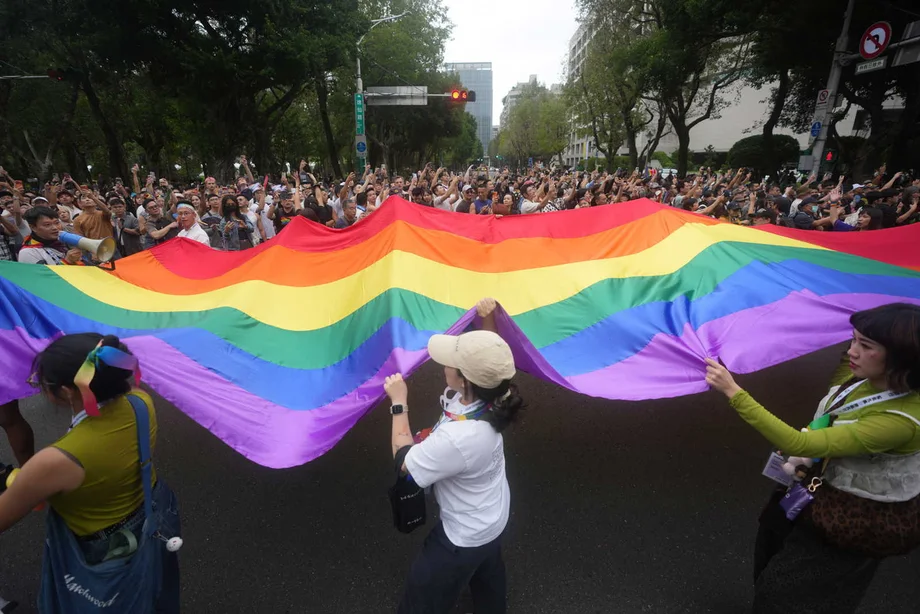
A celebration of freedom, with a demand for safety
President Lai Ching-te called for dignity, privacy and equal treatment as Taiwan marked its 24th Pride parade in Taipei on October 31, 2026, weeks after police took 51 people from a gay bar to a police station. The raid at Commander D made the conduct of public authorities a central concern at one of Asia's largest LGBTQ+ gatherings.
Contents
- A celebration of freedom, with a demand for safety
- Lai puts listening at the centre of equality
- What happened at Commander D?
- Discipline, an apology and demands for binding rules
- Why the raid reopened older fears
- Marriage equality has changed lives, but acceptance varies
- Trans marchers call for recognition beyond two categories
- Taipei's visibility draws people from across borders
- Political promises face a concrete test
- Key Points
The Taiwan Rainbow Civil Action Association put attendance at more than 170,000, while other estimates placed the crowd at around 150,000. More than 180 groups registered for the event, which followed two routes from Taipei City Hall before returning to the same venue.
Rainbow flags, Halloween costumes and international visitors filled the streets under the theme Our Voices, Our Journey. Behind the celebrations was a concrete demand: that the freedom to marry, won in 2019, be matched by respectful treatment in bars, family homes and encounters with police.
Lai, writing on Facebook ahead of the parade, said government must protect everyone's dignity regardless of gender, sexual orientation or gender identity. He connected that responsibility directly to law enforcement, saying officials should follow the law, respect privacy and ensure that nobody feels frightened or targeted because of who they are.
Lai puts listening at the centre of equality
Lai described freedom as requiring both the opportunity to speak and a willingness to hear other people's experiences. He acknowledged the prejudice and harassment many LGBTQ+ people face while growing up, and expressed concern that recent controversy over policing could damage the understanding built through years of advocacy.
The president recalled the campaign that secured marriage equality and said the work must continue in everyday life.
Seven years ago, Taiwan became the first in Asia to legalize same-sex marriage, the result of years of advocacy that secured loving couples the right to marry and start a family.
Lai said the government had a duty to protect equal opportunities and people's freedom to pursue happiness. His message placed the treatment of individuals by public officials alongside the legal recognition of their relationships.
Charlie Wu, spokesperson for the Taiwan Rainbow Civil Action Association, explained the parade theme as an invitation to learn through listening to people with different life experiences. Organisers also linked that message to political polarisation and international opposition to diversity, equity and inclusion policies, which seek to make institutions more accessible and fair.
What happened at Commander D?
Police searched Commander D, a gay BDSM bar in Taipei's Ximending district, on October 3. BDSM refers to consensual practices involving bondage, discipline, dominance, submission or controlled pain. Officers took 51 people to a police station for statements; a Chinese language account also cited a figure of 58.
The patrons were subsequently released. The person responsible for the venue was referred to prosecutors over suspected public indecency. Police Commissioner Lin Yen-tien said officers acted lawfully under a warrant issued by a court following complaints about suspected public morality offences.
Ten LGBTQIA+ and gender equality organisations challenged the way the search was conducted. In a joint statement, they said witnesses described officers ordering patrons to squat, preventing them from talking or using phones, and refusing to show the search warrant to people being searched.
The organisations also alleged degrading treatment of people with disabilities. Video circulated online showing an officer asking a patron who uses a wheelchair an invasive question about how disabled people have sex. Witnesses alleged excessive force and other procedural breaches.
The complaints focused on what happened to people during the operation: how officers spoke to them, restricted their movement and handled their privacy. For patrons who had not disclosed their sexuality to relatives or employers, exposure of their presence at a gay venue could also carry personal consequences.
Discipline, an apology and demands for binding rules
Taipei police disciplined six officers after reviewing their conduct. Four received reprimands for inappropriate language. The lead investigator and precinct chief were disciplined over failures to intervene or supervise.
Mayor Chiang Wan-an apologised to those affected. The city promised new guidelines and further diversity and cultural awareness training, and said rules would be developed with community input. Prosecutors were investigating the incident, according to the city government; no completion date or final prosecutorial decision was announced.
Chiang faced shouts of "don't raid gay bars" when he arrived near the end of the Pride parade. Addressing the controversy, the mayor promised an investigation and disciplinary action.
I already said this earlier: I apologize for the impact on those affected," Chiang said. "So on this matter, we will conduct a rigorous investigation and impose immediate discipline.
Tai Yu-hsun, also known as Simon Tai, chair of the Taiwan Rainbow Civil Action Association, called for a transparent investigation and binding policing guidelines. The distinction matters in practice: training teaches officers how to behave, while binding rules set requirements against which their actions can be assessed.
The coalition of 10 organisations sought an independent investigation, preservation of police records and disclosure where legally permitted. It also called for specific rules governing police entry into LGBTQ+ spaces, stronger safeguards for marginalised people within police accountability procedures, and an end to stigmatising portrayals of queer venues and sexuality.
Why the raid reopened older fears
Tai said the October 3 search revived memories of state oppression of LGBTQ+ spaces. Concern had already grown after a gay bathhouse closed in April following police raids and inspections.
The debate also reached back to a 2004 police raid on a private gathering in Taipei's Nong'an Street, when about 92 gay men were taken away. Accounts of that incident describe attendees undergoing blood tests and 28 people living with HIV being referred over suspected intentional transmission. Those cases were later dropped for insufficient evidence.
Current criticism has focused on several different legal powers: Criminal Code Article 231, concerning profiting from arranging or providing a place for sexual acts; Social Order Maintenance Act Article 83, concerning certain conduct in places open to the public; and child protection rules restricting minors from entering sexual venues. The debate concerns which powers applied to the operator, which applied to customers, and how police exercised them.
The sequence leading into Pride placed those questions beside a large public celebration:
- April 2026: A gay bathhouse closed after police raids and inspections.
- October 3: Police searched Commander D and took patrons to a police station.
- After the raid: Protests followed, six officers were disciplined and the city apologised.
- October 30: An estimated 3,800 people joined the eighth Taiwan Trans March.
- October 31: Taiwan Pride brought a large crowd through central Taipei.
- November 28: Taiwan is scheduled to hold local elections.
Marriage equality has changed lives, but acceptance varies
Taiwan legalised marriage between people of the same sex in 2019 after years of campaigning, public debate and a 2017 constitutional ruling requiring legal protection for their right to marry. Nepal and Thailand followed with marriage recognition in 2023 and 2025, respectively.
A survey cited during Pride coverage put support for marriage equality at 54%, compared with 42% around the time it became law. That is an increase of 12 percentage points. The figures indicate growing acceptance, while participants' experiences show how differently that acceptance can develop within individual families.
Billie Chang, a student attending the parade, said she came out seven years ago and still lacked her parents' support.
My parents are still not supportive. They don't want to talk about it.
Chang said her parents had learned not to interfere in her personal life, but she avoided displaying a rainbow flag at home. At Pride, she wore one around her shoulders.
A participant surnamed Jian, 29, described a different family milestone. After attending the parade for 10 consecutive years, he joined with his mother for the first time. He said he wanted to show her the journey he had taken and the people who had supported him.
Tai, the organiser's chair, said marriage equality had not ended everyday prejudice. He urged people to listen across differences rather than reduce others to labels, connecting the parade's theme to experiences such as Chang's and Jian's.
Trans marchers call for recognition beyond two categories
The eighth Taiwan Trans March took place on Friday evening, October 30, drawing an estimated 3,800 people. Organised by the Taiwan Tongzhi Hotline Association, it used the theme Crossing Boundaries, Standing Together.
The march called for people to move beyond rigid expectations that everyone must fit neatly into male or female roles. It also sought closer understanding between transgender people and the wider community. Gender identity means a person's own sense of their gender, which can differ from the sex recorded when they were born.
A Pride participant using the nickname Jeff said people who express their gender differently still encounter strange looks, particularly transgender people and people who wear clothing associated with another gender. Jeff described the parade as a place to express that identity freely.
The consecutive marches gave transgender participants both a dedicated gathering and a place within the larger Pride event. Their demands concerned daily visibility and treatment, alongside the broader calls for equality and respectful policing.
Taipei's visibility draws people from across borders
Jonel Malinao, a Filipino working in Taiwan, attended his first Pride march in Taipei. His experience reflected the event's role as a gathering for people who live in Taiwan as well as visitors from elsewhere in Asia and beyond.
I am happy to join this kind of parade, especially here in Taiwan, Taipei," Malinao said. "This is my first ever pride march and celebrating who and what we are.
Romee, a bisexual participant, travelled from the Netherlands with her aunt. She expressed concern about growing conservatism at home and said she hoped to learn from Pride in Asia.
Australian visitor Daniel Witthaus described the emotional experience of marching through a major international city. He also recalled seeing local queer people holding hands in public during visits over roughly a decade. His friend Andrew Stewart, who lives in Taipei, described the city's queer visibility as a reason people travel from around the region.
Witthaus said police were cooperative during the parade. Stewart regarded the Commander D raid as outside the norm, while also describing pressure on queer venues as wealthier residents move into their neighbourhoods. Those observations placed the controversy within a city where public visibility and disputes over community spaces exist side by side.
The City Hall plaza hosted almost 100 market stalls, with more than a third representing Taiwanese and Asian nongovernmental organisations. Student groups, charities, companies and political delegations joined the procession, giving participants opportunities to meet organisations working on the issues raised in the streets.
Political promises face a concrete test
Vice President Hsiao Bi-khim led the Democratic Progressive Party delegation, affirming government support for LGBTQ+ rights. DPP legislator and Taipei mayoral candidate Puma Shen attended another part of the rally.
Representatives of at least seven political parties participated. They included the Chinese Nationalist Party's youth wing, the Taiwan People's Party, the Social Democratic Party, the New Power Party and the Taiwan Statebuilding Party. Chiang, Taipei's mayor, belongs to the Chinese Nationalist Party.
The parade coincided with a Taipei mayoral election debate, with local elections scheduled for November 28. For participants concerned about policing, the campaign offered a chance to judge politicians against specific commitments: a transparent investigation, enforceable rules and respectful treatment inside community venues.
Drag performer Hana Booboo connected that responsibility to democratic participation. Speaking about voting, making choices and attending Pride, the performer said those actions should tell public servants "what kind of life we want to live."
Lai's message and the marchers' demands converged on the same practical issue. Legal equality gives couples rights to marry and build families. Daily security also depends on whether a person can enter a community space, express their identity or deal with an officer without humiliation or fear.
Key Points
- President Lai called for dignity, privacy and equal treatment during Taiwan's 24th Pride celebration on October 31, 2026.
- The organiser reported more than 170,000 participants, while other estimates put attendance around 150,000.
- An October 3 search of Commander D led to 51 patrons being taken to a police station and prompted protests over police conduct.
- Six officers were disciplined, Mayor Chiang apologised, and the city promised guidelines and training.
- Rights organisations want an independent investigation, access to police records where lawful and binding safeguards for LGBTQ+ spaces.
- About 3,800 people attended the Taiwan Trans March the previous evening.
- Local elections are scheduled for November 28, with police accountability among the concerns voiced at Pride.