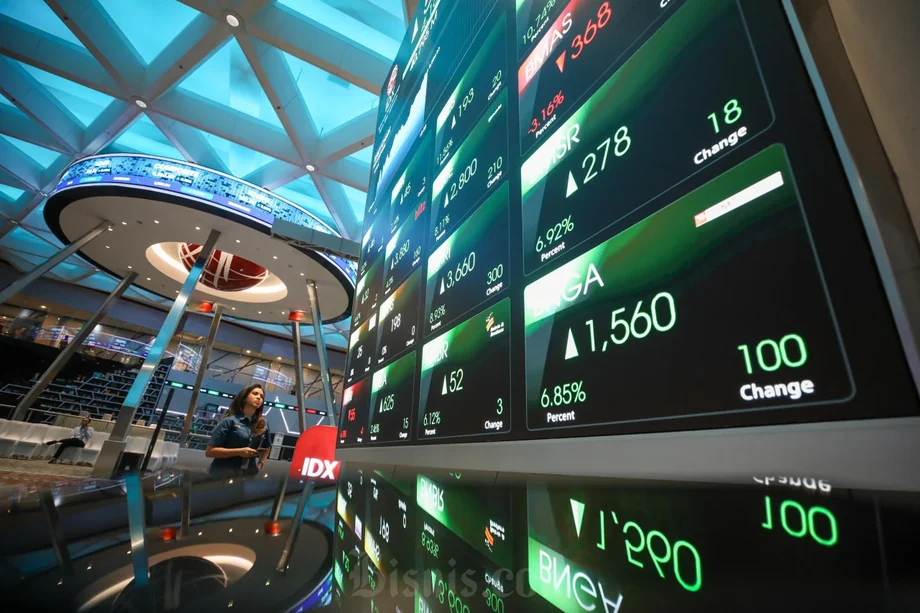
State companies help push Jakarta stocks above 5,000
Indonesia's benchmark stock index rose 149.56 points, or 3.04%, to 5,069.33 at 9:21 a.m. Jakarta time on Thursday, November 5, 2026, with major state companies helping drive the rebound. Bank Rakyat Indonesia, Telkom Indonesia, Bank Mandiri and Bank Negara Indonesia together contributed 38.60 index points in a later snapshot at 9:37 a.m.
Contents
- State companies help push Jakarta stocks above 5,000
- Which state companies supplied the biggest lift?
- How the morning advance unfolded
- More shares rose than fell
- New index rules give major banks more influence
- A rebound after banks led earlier losses
- Oil falls while the rupiah strengthens
- Growth data and regulatory updates come next
- Dividend figures add another comparison for bank investors
- Key Points
The Jakarta Composite Index, known locally as the IHSG, opened at 4,998.34 and reached an early high of 5,072.05. By 9:21 a.m., trading had reached 54.98 million lots worth Rp2.246 trillion, putting the benchmark close to its highest level of the morning.
The rally arrived three days after a change to index eligibility gave large banks and other widely held companies more influence over the benchmark. Technology and basic materials also rose sharply, while the rupiah strengthened alongside stocks.
Investors were approaching several scheduled announcements, including Indonesia's third quarter economic growth figures at 11 a.m. The early rally also followed a fall of more than 8% in international oil prices on November 4.
Which state companies supplied the biggest lift?
Refinitiv data at 9:37 a.m. put Bank Rakyat Indonesia, traded under the ticker BBRI, first among state companies supporting the index. Its shares stood at Rp2,760 and contributed 14.95 points to the IHSG.
Telkom Indonesia, or TLKM, followed with a contribution of 10.82 points at a share price of Rp2,010. Bank Mandiri, or BMRI, added 7.92 points at Rp3,670, while Bank Negara Indonesia, or BBNI, contributed 4.91 points at Rp3,280. Both banks were among the index's ten biggest positive contributors.
The three state banks supplied a combined 27.78 points, while Telkom supplied the remaining 10.82 points in that group. An index contribution measures how much a company's price movement adds to or subtracts from the benchmark. Companies with larger index weights have more influence, so a modest price move in a major bank can matter more than a much larger move in a small company.
Bank Central Asia, or BBCA, and Amman Mineral Internasional, or AMMN, were also among the morning's named positive contributors. State companies therefore played a central role in a rally that extended to other large businesses.
How the morning advance unfolded
The IHSG began at 4,998.34, up 78.57 points, or 1.60%, from the previous close. It then moved above 5,000 within the opening minutes and traded around 5,050 to 5,070 later in the morning.
The main trading snapshots, all in Jakarta time, show how quickly the advance developed:
- November 2: New eligibility rules took effect, excluding shares designated as having highly concentrated ownership from the IHSG.
- November 3: The benchmark closed at 4,904.29 after falling 3.78%.
- November 5, opening: The index began at 4,998.34, with an early low of 4,995.46.
- November 5, 9 a.m.: The IHSG reached 5,034.20, up 2.33%.
- November 5, 9:01 a.m.: RTI recorded 5,046.86, up 127.10 points, or 2.58%.
- November 5, 9:21 a.m.: The index reached 5,069.33, up 3.04%, after touching 5,072.05.
An early broadcast snapshot also placed the index at 5,025, up 2.15%. The figures capture a fast moving opening period. The last benchmark reading covered here is from the morning session; the closing result was still pending.
More shares rose than fell
RTI recorded 370 advancing shares, 89 declining shares and 124 unchanged at 9:01 a.m. That amounted to slightly more than four rising stocks for every falling stock, showing that gains spread beyond the biggest index contributors.
Trading at that point totalled 1.75 billion shares worth Rp614.12 billion across 60,480 transactions. By 9:21 a.m., reported turnover had climbed to Rp2.246 trillion, roughly 3.7 times the earlier value.
Indonesia's standard share lot contains 100 shares. The reported volume of 54.98 million lots at 9:21 a.m. therefore represented about 5.498 billion shares. The difference between lots and individual shares matters when comparing trading figures.
Technology rose about 5%, basic materials gained 4.8% and financial shares advanced 2.3% in the later morning sector snapshot. At the opening, the corresponding gains had been 5.5%, 4.02% and 2.2%, showing technology easing slightly while materials and financials strengthened.
The market still had pockets of selling. Apollo Global Interactive, Adaro Andalan Indonesia, MNC Digital Entertainment, Medco Energi Internasional and Multi Medika Internasional were among the shares weighing on the benchmark. Amman Mineral appeared among negative contributors at the opening before joining the positive contributors later.
New index rules give major banks more influence
The Indonesia Stock Exchange changed IHSG eligibility on November 2 to exclude shares classified as having high shareholding concentration, or HSC. The designation concerns companies where a limited group of investors controls a large proportion of shares.
The exchange's October announcement, described in the HSC exclusion plan, covered 80 stocks estimated to represent about 18% of the benchmark's previous weight. Jason Gozali, head of research at Pluang Maju Sekuritas, put the number excluded when the change took effect at 81.
Removing that group redistributed index weight among the companies that remained. Gozali estimated that shares outside the HSC category received about 25% more weight, with BBRI, BMRI, Telkom and Astra International receiving the largest increases in absolute terms.
BBRI reached the maximum individual weight of 9%, while BMRI rose to 6.95%. Together, those two banks accounted for 15.95% of the benchmark under the figures Gozali gave.
At an index level near 5,000, a simultaneous 1% rise in both shares would add roughly eight points, matching Gozali's estimate. The same larger weights also increase their influence when prices fall. The revised composition therefore helps explain why movements in major banks now have such a visible effect on the headline index.
A rebound after banks led earlier losses
November 5's advance reversed the direction seen during the November 3 selloff, when the IHSG lost 192.54 points to close at 4,904.29. BBRI alone took 26.58 points off the benchmark that day.
BBRI, BBCA, Amman Mineral, Bank Mandiri and Telkom together accounted for 71.49 points of that earlier decline, about 37% of the total loss. Several of the same companies were helping lift the market on Thursday, illustrating how strongly a relatively small group of large shares can shape the index.
The change in market breadth was also pronounced. On November 3, RTI recorded 624 falling stocks against 57 rising stocks at the close, nearly 11 decliners for every advancer. Thursday's 9:01 a.m. snapshot instead showed 370 rising and 89 falling.
Thursday's level of 5,069.33 was 165.04 points, or about 3.37%, above Tuesday's close. That comparison spans two trading days; Thursday's reported daily gain of 3.04% used Wednesday's close as its starting point.
Pressure had already been evident during the October 29 retreat, when the index fell 2.55% by late morning and 597 shares declined against 102 advances. Thursday brought a much broader improvement in the opening session.
Oil falls while the rupiah strengthens
Brent crude fell 8.7% to US$94.62 a barrel on November 4, while US West Texas Intermediate dropped 8.3% to US$88.12. Both recorded their lowest closing prices since August 31.
The fall accompanied expectations that Democratic control of both chambers of the US Congress following the midterm elections would increase pressure on President Donald Trump over the war involving the United States, Israel and Iran. Investors were weighing the possibility of negotiations reducing disruptions to oil supplies.
Indonesia imports more oil than it exports, so cheaper crude can reduce the country's import bill and ease fuel cost pressures. The effect on individual companies varies: transport businesses and other fuel users face different consequences from oil producers.
The rupiah strengthened 0.52% to Rp18,060 per US dollar in an early market snapshot. A stronger rupiah reduces the local currency cost of purchases priced in dollars, including imported goods and some corporate debt payments.
Other Asian markets moved in different directions. Hong Kong's Hang Seng rose 2.60%, while Japan's Nikkei fell 0.40% and the Shanghai Composite slipped 0.10%. Jakarta's advance therefore occurred alongside a strong Hong Kong session and modest declines in Japan and mainland China.
Growth data and regulatory updates come next
Statistics Indonesia, known as BPS, was scheduled to release third quarter gross domestic product figures at 11 a.m. on November 5. A consensus of 15 institutions projected growth of 5.20% from a year earlier and 1.33% from the preceding quarter.
Gross domestic product measures the value of goods and services produced in an economy. The annual comparison shows how activity changed from the same quarter of 2025, while the quarterly comparison tracks the change from the second quarter of 2026.
The Financial Services Authority, or OJK, also planned a briefing by its board of commissioners on current financial sector conditions. Banking health and capital market developments were among the issues investors were watching, alongside discussion of plans to expand assistance through BPJS Kesehatan, Indonesia's public health insurance programme.
Euro area producer price figures for September were scheduled for 5 p.m. Jakarta time. Producer prices had risen 8.2% annually in August, compared with 5.8% in July. These prices track costs at the production stage, which can later feed into the prices households pay.
US figures also formed part of the international backdrop. The September trade deficit narrowed to US$105 billion from US$105.7 billion in August, while exports rose 1.9% to US$321.5 billion. Private employers added 86,000 jobs in October, above expectations of 69,000, although professional and business services lost 27,000 jobs.
Dividend figures add another comparison for bank investors
Gozali also pointed to the dividend income offered by major banks. Using closing prices on October 28 and dividends paid during the preceding 12 months, he calculated a dividend yield of 14.1% for Bank Mandiri and 11.9% for BBRI.
A dividend yield expresses annual cash dividends as a percentage of the share price used in the calculation. Against the government bond yield of about 7.4% cited for debt maturing in ten years, the bank figures were higher by 6.7 percentage points and 4.5 percentage points, respectively.
Dividends depend on company earnings and decisions about distributing profits, while share prices change throughout trading. Those October 28 calculations give a dated comparison of cash income alongside the more immediate story of rising bank weights and Thursday's price movements.
For investors following the IHSG, the next concrete test was the 11 a.m. GDP release, followed by regulatory updates and the rest of the trading session. Major banks had helped carry the benchmark back above 5,000, with their increased index weights giving those movements greater force.
Key Points
- The IHSG rose 3.04% to 5,069.33 at 9:21 a.m. Jakarta time on November 5.
- BBRI, Telkom, Bank Mandiri and BNI contributed a combined 38.60 index points in the 9:37 a.m. snapshot.
- RTI recorded 370 rising stocks and 89 falling stocks at 9:01 a.m.
- New eligibility rules took effect on November 2, increasing the influence of major companies remaining in the index.
- Brent crude fell 8.7% on November 4, while the rupiah strengthened in early Thursday trading.
- Indonesia's third quarter GDP release was scheduled for 11 a.m., with consensus growth of 5.20% from a year earlier.