Billions in the fund, unpaid rent on the ground
Nepal's Prime Minister's Office says Rs 18.31 billion had been collected in its disaster relief fund by Kartik 13, yet only Rs 1 billion had been transferred from that fund to the National Disaster Risk Reduction and Management Authority. Families displaced by the Bhotekoshi and Trishuli floods were still waiting for a promised monthly housing payment of Rs 15,000.
Contents
- Billions in the fund, unpaid rent on the ground
- What the different money totals mean
- Families borrow rooms while assistance waits
- How the housing payment is supposed to work
- Registration is blocking the route to payment
- Emergency cash has reached some households
- Rescue bills and empty temporary shelters
- Parliament seeks a traceable spending record
- Recovery costs extend far beyond immediate relief
- What the fund can pay for, and what comes next
- Key Points
The authority says it has released Rs 370 million to 15 affected local governments and security agencies. Its spokesperson, Ram Bahadur KC, says the main obstacle to paying housing assistance is unfinished registration and verification of affected families, followed by missing formal requests for money from local governments.
The result is a relief operation moving at two speeds: billions of rupees are held centrally, while families struggle to secure rooms, pay landlords and restart work. Parliamentary scrutiny is now focusing on how much money reached each municipality and ward, and what it paid for.
The flood assessment identifies August 26, 2026, as the disaster date. A Cabinet decision on Bhadra 25 promised monthly rent assistance for displaced families for up to six months. The payment was still pending for people interviewed roughly two months after the floods.
What the different money totals mean
The Prime Minister's Office recorded the Rs 1 billion transfer on Bhadra 16. Against the Rs 18.31 billion collected, that leaves Rs 17.31 billion without a further transfer recorded in that account. The authority's subsequent release of Rs 370 million represents 37 percent of the Rs 1 billion allocation.
Other official statements describe balances with a different scope. Prime Minister's Office Secretary Narayan Prasad Sharma Duwadi told a parliamentary committee that the Prime Minister's Natural Disaster Relief Fund and the Prime Minister's Relief Fund together held Rs 18,280,532,593. National Planning Commission Vice Chairman Gunakar Bhatta also cited a balance of about Rs 18.28 billion.
KC said the disaster authority already held Rs 7 billion before receiving the additional Rs 1 billion. An official at the Prime Minister's Office put the disaster relief fund's balance before the floods at Rs 2.17 billion. Both institutions therefore had resources beyond the latest donations.
Finance Minister Swarnim Wagle said Rs 10 billion had accumulated within eight days of the disaster. Nvidia founder and chief executive Jensen Huang was identified as the largest donor, contributing $10 million. Citizens, organisations and international donors also contributed.
The fund's operating committee says further allocations depend on requests from the authority. KC, speaking for the authority, said additional money had been promised when required.
"We have been assured that additional funds will be released as soon as they are needed," KC said.
Families borrow rooms while assistance waits
Meera Nagarkoti, 50, of Bidur Municipality Ward 4, was renting a room near the district administration office for Rs 2,500 a month for her family of four. Her husband had been unable to move his left arm and leg for three months. She described struggling to pay rent, cover treatment and keep the family fed while repeatedly visiting the ward office to register for relief.
Manoj Lama, 61, also from Ward 4, spent about 27 or 28 days in a holding centre before renting a room after hearing about the government's monthly payment. He said he had received none of that assistance and had started labouring, earning Rs 700 to Rs 800 on days when work was available. His rent remained unpaid.
In Bidur Ward 1, Januka Mijar lost both her rented room and the building where she operated a shop selling madal drums. She said she had received utensils and food but no other government assistance. Money to reopen the shop would help restore the income she lost along with her accommodation.
For these residents, the delay affects several needs at once. Paying rent competes with buying food and medicine, while losing a shop or tools makes it harder to earn enough to manage without assistance.
How the housing payment is supposed to work
The Cabinet's Bhadra 25 decision provides Rs 15,000 a month for a family of up to four people, plus Rs 2,000 for each additional member. Assistance is intended to last up to six months while families arrange temporary accommodation.
A qualifying family of four would therefore receive up to Rs 90,000 over six months. A family of six would receive Rs 19,000 a month, or up to Rs 114,000 over the same period. Those calculations show why missing several payments can leave a substantial hole in a household budget.
KC said payments would be calculated from the flood date and deposited directly into bank accounts once local governments verified beneficiaries and entered their details into the Reconstruction Management Information System, known as RMIS. This is the online register used to record affected households and process assistance.
The Temporary Housing Construction Grant Standards, 2081, require affected families to build temporary or intermediate accommodation within six months, according to the authority. The rent assistance is intended to cover that period. Officials have given no firm date for completing payments to all eligible families.
Registration is blocking the route to payment
Local governments must identify affected households, check their documents, confirm eligibility and enter the information into RMIS before requesting funds. Bidur Deputy Mayor Prabha Bogati said the federal government had sent the necessary forms and procedures only recently, delaying local work.
Bidur's preliminary figures show 1,786 homes completely destroyed and 2,657 land parcels damaged. The municipality decided to request Rs 30 million for an initial allocation, but Bogati said the money had not arrived in its bank account.
Ward 1 Secretary Bishnu Gajurel described an office with one computer and two staff members handling more than 450 households whose homes were completely destroyed. Staff must check citizenship documents, land records, insurance papers and recommendations, collect fingerprints and enter details online while maintaining ordinary public services.
Bogati set a target of sending completed records through the municipal and district process by the following Monday or Tuesday. Gajurel said verification in a heavily affected ward could take more than 15 to 20 days. Flood damage to offices and records, displaced residents living elsewhere, and incomplete information about tenants and landless households have complicated the task.
The authority has sent teams to train local staff in Rasuwa, Nuwakot and Dhading to use RMIS. KC also cited difficulties checking household size. In practical terms, money can remain available at the centre while the records needed to authorise each payment are unfinished locally.
Emergency cash has reached some households
The Prime Minister's Office said 4,108 households in Rasuwa, Nuwakot and Dhading had received Rs 45,000 each by Asoj 28 through assistance funded by the World Food Programme. That amounts to Rs 184.86 million across those households.
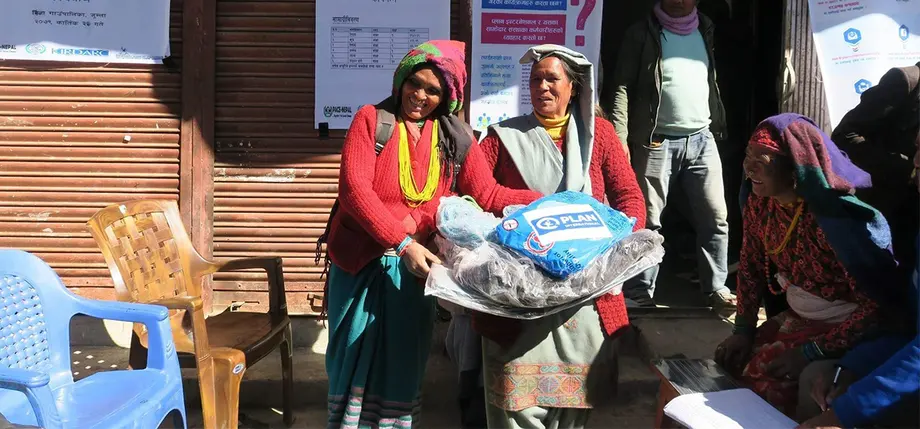
Other emergency distributions included Rs 15,000 per family from the Red Cross in Bidur Ward 5, Rs 15,000 from Plan International in Wards 1 and 7, and Rs 45,000 from the World Food Programme in Ward 5. Bogati said the municipality had authorised partner organisations to provide cash while government funding was delayed.
The emergency payments and the promised monthly rent assistance operate as separate forms of support. KC said assistance already supplied by partner organisations would be reconciled against government grants. For families, the practical issue is how those earlier payments will affect the amount still due under the housing programme.
The government directed development partners providing cash to follow the Disaster Sensitive Social Protection and Relief Distribution Standards, 2081. The payment records matter because a household may have received emergency cash while still awaiting the monthly housing assistance.
Rescue bills and empty temporary shelters
The authority reported 11 holding centres accommodating 425 people: 67 in Nuwakot, 229 in Rasuwa and 129 in Dhading. Local governments and nongovernmental organisations were managing the centres and paying their operating costs.
Another 50 temporary housing units had been completed in Bidur before Dashain with funding from international nongovernmental organisations. The Department of Urban Development and Building Construction arranged land and designs. Department officials said no displaced families had moved in at the time, with some citing an inconvenient location.
Helicopter search and rescue generated an estimated Rs 260 million in costs. Private operators submitted bills totalling Rs 130 million for 2,794 flights. The Nepal Army conducted another 2,068 flights, with its costs provisionally estimated at Rs 130 million while its bill was still awaited.
The authority reported 1,457 deaths and 5,285 people missing. Alongside emergency shelter and rescue expenses, officials have had to manage identification, family assistance and the administrative consequences of people remaining missing.
Parliament seeks a traceable spending record
The parliamentary special committee studying disasters in the Bhotekoshi and Kaligandaki corridors has called for publication of the funds received, donation sources, allocations, expenditure and amounts reaching individual municipalities and wards. Committee Chairman Krishna Prasad Paudel also requested details of relief and compensation delivered locally.
Finance Secretary Ghanshyam Upadhyaya told the committee that Rs 242 million had reached affected local governments through the disaster authority. KC's Rs 370 million figure covered releases to both local governments and security agencies, a broader group of recipients.
Upadhyaya also described approval to provide funding of Rs 2.54 billion for security institutions: Rs 970 million for Nepal Police, Rs 660 million for the Armed Police Force and Rs 910 million for the Nepal Army. He said Rs 260.535 million had been released for police, armed police, the army and prisons. Funding approval sets an authorised amount; a release is the subsequent movement of money.
The Prime Minister's Office said it would extract donation source details from its spreadsheets for the committee. Publishing those records alongside local spending would let residents follow the route from a central donation to an allocation, a municipal receipt and a household payment.
Nepali Congress opposition leader Bhishma Raj Angdembe accused the government of neglecting flood survivors despite the money raised. After meeting the speaker, he questioned where the assistance had gone and called for Parliament to meet soon.
Recovery costs extend far beyond immediate relief
A preliminary National Planning Commission assessment estimated private losses from the August 26 floods at Rs 79.17 billion. It listed about Rs 69 billion in household losses and Rs 9.69 billion in business losses. Fifty eight field teams conducted digital surveys across 15 local governments.
The assessment covered 6,817 families, 32,872 people and 499 businesses in Dhading, Gorkha, Nuwakot and Rasuwa, with 2,989 homes completely destroyed. The Cabinet's assistance decision used a broader count of 7,570 damaged private homes across Rasuwa, Nuwakot, Dhading, Gorkha and Chitwan.
Residential land losses were valued at Rs 13.26 billion and damaged or destroyed houses at Rs 11.95 billion. Another 507.97 hectares of private land belonging to 3,610 families sustained damage valued at Rs 35.44 billion. Crop losses affecting 2,951 families exceeded Rs 232 million, while damaged vehicles were valued at Rs 1.24 billion.
For the wider disaster recovery effort discussed by the parliamentary committee, Upadhyaya cited preliminary losses of Rs 408.29 billion and reconstruction needs of Rs 723.31 billion. The roughly Rs 18.28 billion held in the two prime ministerial funds equals about 2.5 percent of that reconstruction estimate.
The disaster council approved reconstruction projects worth Rs 225.7708 billion. Ministries were preparing priorities and procurement proposals for Finance Ministry agreement. Upadhyaya said reconstruction would draw on the regular budget and ministry resources, while the prime ministerial disaster fund would support immediate rescue and relief. The government also decided to provide affected businesses with concessions involving taxes, insurance, loans and interest.
What the fund can pay for, and what comes next
The Prime Minister's Disaster Relief Fund Operation Regulations, 2063, allow spending on rescue, temporary camps, food, clothing, medicines, educational supplies, treatment, funeral assistance, temporary housing, rehabilitation and repairs to homes or tools used for work. They also permit disaster preparedness and measures addressing waste and pollution caused by disasters.
The rules prohibit using the fund for employee salaries, allowances, benefits or travel expenses. Donations, gifts, prizes and financial assistance unrelated to natural disasters are also prohibited. The permitted uses give officials several ways to address urgent needs once requests and beneficiary records are ready.
The main steps described by officials are:
- August 26, 2026: Floods struck the Bhotekoshi and Trishuli river system.
- Bhadra 16: Rs 1 billion was transferred from the prime ministerial disaster fund to the disaster authority.
- Bhadra 25: The Cabinet approved monthly housing assistance for displaced families.
- Asoj 28: The Prime Minister's Office recorded emergency payments of Rs 45,000 each to 4,108 households.
- Kartik 13: The Prime Minister's Office reported Rs 18.31 billion collected in the disaster relief fund.
Local registration, formal funding requests and the publication of detailed spending records are now the immediate tasks. For displaced residents, their completion determines when a relief announcement becomes money available for rent, food and recovery.
Key Points
- The Prime Minister's Office recorded Rs 18.31 billion collected and a Rs 1 billion transfer to the disaster authority.
- The authority says it released Rs 370 million to local governments and security agencies.
- Promised housing assistance starts at Rs 15,000 a month for families of up to four, for up to six months.
- Unfinished household verification, damaged records and limited local staffing are delaying payments.
- Emergency cash from aid organisations has reached some families while monthly housing assistance remains pending.
- A parliamentary committee wants donation sources and spending published down to municipality and ward level.