Singapore production puts UMC in the optical chip spotlight
United Microelectronics Corp. (UMC) has reportedly secured orders for as many as 10,000 photonic integrated circuit wafers from optical module supplier InnoLight and photonics designer Saili, whose investors include Tencent's venture investment arm. Production is slated for UMC's Singapore factory, with additional orders possible as customers expand their supply of chips for fast connections between computing systems.
Contents
- Singapore production puts UMC in the optical chip spotlight
- What the two customers bring
- Why these chips matter for AI networks
- A manufacturing contest beyond the smallest circuitry
- Seven times the wafer price changes the revenue equation
- Two technology routes support the expansion
- Capacity plans stretch to 2030
- What changes for UMC and its customers
- Key Points
Industry estimates put the selling price of some advanced photonic integrated circuit products at about seven times that of conventional CMOS wafers. UMC has declined to comment on specific customers or orders, and the price estimate has not been confirmed by the company. Delivery schedules and the financial value of the reported orders have not been disclosed.
The development brings together two forces shaping UMC's optical communications business: growing demand for faster data movement in artificial intelligence systems, and the company's effort to use established manufacturing processes to make more valuable specialist products. Its opportunity lies in producing chips that handle light, alongside the electrical signals familiar to conventional semiconductor factories.
UMC and Singapore's SILITH announced in July that the first production batches of 12 inch silicon photonics wafers had been delivered from Singapore. The move from development to production took 18 months, and the products passed qualification by a major cloud customer. That gives the reported orders a manufacturing foundation beyond a technology development program.
What the two customers bring
InnoLight is a leading supplier of optical transceiver modules for data centers, with a business serving major cloud computing providers in North America and the AI market. These modules send and receive data using light. The company is expanding its work on products operating at 800 gigabits per second and 1.6 terabits per second, usually shortened to 800G and 1.6T.
Saili focuses on silicon photonics chip design and uses Singapore's SILITH to develop its international business. Its PIC products operating at 100G and 200G per channel have accumulated shipments of more than 8 million chips. Saili is also working with UMC on technology supporting 400G per channel.
The customer relationships connect UMC to different parts of the optical supply chain. InnoLight makes modules that become part of data center networks, while Saili designs the photonic chips used within optical systems. UMC provides the manufacturing platform on which those designs become physical chips.
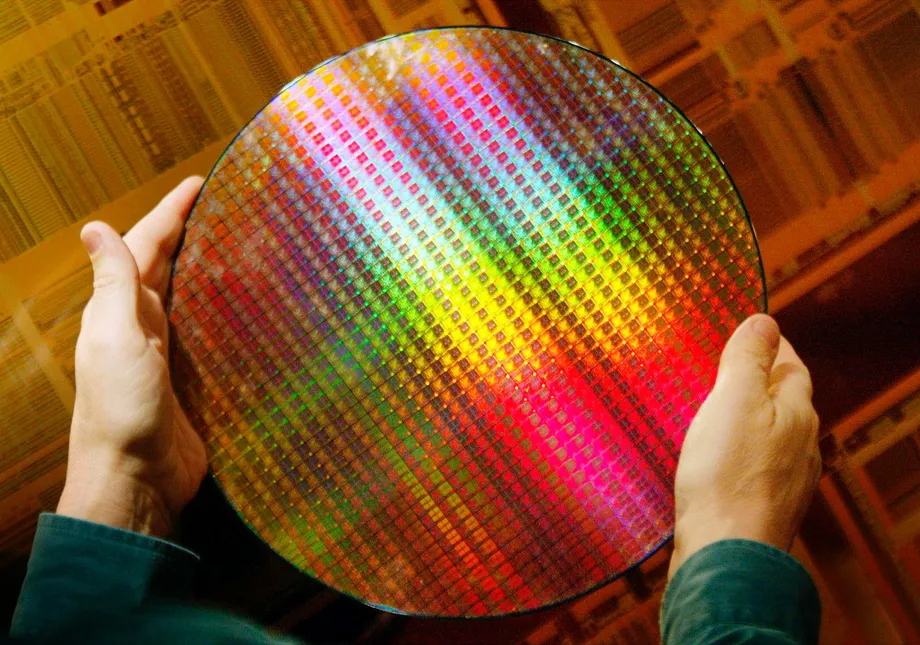
The reported initial volume of up to 10,000 refers to wafers, while Saili's cumulative shipment figure refers to individual chips. A wafer is a circular slice of semiconductor material containing many chips, which are later separated. Without chip dimensions and production yields, the wafer order cannot be converted into a reliable number of finished devices.
Why these chips matter for AI networks
Photonic integrated circuits, or PICs, combine functions that guide, control or detect light on a chip. In optical communications, they help connect the electrical activity inside computing equipment with the light signals used to carry data through optical fibers.
A conventional electronic chip moves and processes electrical signals. A photonic chip also needs structures such as waveguides, which direct light along a chosen path, and modulators, which change light so that it carries information. Bringing those functions together requires specialist manufacturing steps and careful control of materials and dimensions.
AI computing systems need fast connections because large amounts of data must move between processors and across data centers. Optical modules are advancing from 800G toward 1.6T and eventually 3.2T. At their stated rates, 1.6T represents twice the capacity of 800G, while 3.2T represents four times that capacity.
Saili and UMC's work on 400G per channel addresses another level of that progression. A channel is an individual data path within a communications system. Raising its speed can help designers build faster optical products, although the total speed of a finished module also depends on how its channels are arranged.
A manufacturing contest beyond the smallest circuitry
UMC is pursuing these products through mature semiconductor processes and specialist optical manufacturing. The business rewards the ability to produce reliable optical structures at scale, giving the company a route into AI infrastructure that differs from making the most advanced computing processors.
Tower Semiconductor and GlobalFoundries already provide silicon photonics manufacturing platforms. Industry accounts describe their capacity as fully booked, helping explain why optical chip customers are seeking additional manufacturing partners. No utilization figures or delivery waiting times were disclosed.
TSMC also offers relevant technology, using advanced processes that carry higher costs for items such as photomasks. Photomasks are the templates used to transfer circuit patterns onto wafers. For an optical chip designer, those development expenses sit alongside the price of manufacturing each wafer.
UMC's proposed advantage combines established processes, optical manufacturing expertise and production on 12 inch wafers. Larger wafers can support greater production scale and lower the manufacturing cost per chip when yields and factory operations are well controlled. Process consistency also matters because customers need chips from different production batches to behave predictably.
Seven times the wafer price changes the revenue equation
The estimated price premium is the most striking financial feature of the reported business. Some advanced PIC wafers are said to sell for about seven times the price of ordinary CMOS wafers. CMOS is the widely used manufacturing approach behind many electronic chips.
For UMC, a larger share of products sold at higher prices could raise its average selling price, often called ASP. That measure is the average revenue received for a unit sold. A company can increase it by changing the mix of products it makes, even without raising the price of every existing product.
Profit will also depend on the cost of producing the optical wafers, the number of usable chips they contain, development expenses and how much factory capacity customers ultimately use. PIC production involves demanding optical structures and integration steps, making production yield a central operating consideration. Yield means the share of manufactured chips that meet the required specifications.
UMC's investment case therefore extends beyond the headline price multiple. Repeat orders, stable yields and sustained use of the production lines would turn an attractive selling price into a more durable business. The initial order volume and the prospect of further purchases indicate the commercial opportunity, while the planned capacity expansion shows the scale UMC is preparing to pursue.
Two technology routes support the expansion
UMC's optical communications effort includes silicon photonics PICs, thin film lithium niobate technology and advanced packaging. Its Singapore factory forms the center of the 12 inch silicon photonics platform.
The second route draws on UMC's wholly owned optoelectronics subsidiary, Lian Ying Optoelectronics, and cooperation with international partners. The subsidiary brings experience in optoelectronic components and manufacturing wafers made with specialist materials. That gives the group an existing base of knowledge for work beyond conventional electronic chips.
Thin film lithium niobate, often shortened to TFLN, uses a thin layer of a material whose optical properties respond to an electric field. That makes it useful for controlling light in communications devices. Its development broadens UMC's technology choices alongside the silicon photonics platform already producing wafers.
Advanced packaging is another part of the strategy because optical and electronic components must connect effectively within a usable product. UMC's approach brings manufacturing processes, specialist materials and component integration into the same business effort, with different technologies serving different design needs.
Capacity plans stretch to 2030
UMC has announced an expansion of silicon photonics capacity in its Singapore P4 area and begun planning new P7 and P8 facilities in southern Taiwan. Its stated long term PIC capacity target is 18,000 wafers a month, with equipment installation expected to begin at the end of 2028 and full scale targeted for 2030.
The reported initial orders of up to 10,000 wafers are equivalent to about 56% of that future monthly capacity target. The comparison shows the size of the planned production base; the orders themselves have no disclosed delivery period. At a steady 18,000 wafers a month, the target would correspond to 216,000 wafers over a full year.
The main milestones are:
- July, with the year unspecified: UMC and SILITH announced delivery of the first production batches of 12 inch silicon photonics wafers from Singapore, following 18 months of development.
- End of 2028: Equipment installation is expected to begin under the longer term expansion plan.
- 2030: PIC production capacity is targeted to reach its full planned scale of 18,000 wafers a month.
Major customers are reportedly already discussing future capacity allocations. Reserving production space early can help them plan their own product launches and supply commitments, while giving UMC a clearer view of demand before the new facilities reach full operation.
What changes for UMC and its customers
UMC gains a potential source of growth based on specialist manufacturing and higher value products. The Singapore production milestone, Saili's existing chip shipments and the reported InnoLight business connect its technology development to customers already participating in the market for fast optical communications.
Optical chip designers gain another manufacturing option as they work toward faster channels and modules. For module suppliers serving cloud companies, access to sufficient wafer capacity becomes part of meeting demand for faster data center connections. UMC's expansion timetable places its larger capacity commitment several years beyond the initial production achievement.
The immediate commercial focus is the reported Singapore orders. The longer commitment is to build a repeatable manufacturing business across silicon photonics, specialist optical materials and packaging. Whether that produces a substantial earnings contribution will depend on the volume shipped, manufacturing costs and the product mix UMC achieves as capacity grows.
Key Points
- UMC reportedly secured initial PIC orders totaling up to 10,000 wafers from InnoLight and Saili for production in Singapore.
- UMC declined to comment on specific customers or orders; the estimated price of seven times conventional CMOS wafers remains unconfirmed.
- UMC and SILITH announced initial production wafer deliveries after an 18 month development period.
- Saili's 100G and 200G products have shipped more than 8 million chips, and it is developing 400G per channel technology with UMC.
- UMC's longer term PIC capacity target is 18,000 wafers a month, with equipment installation expected from the end of 2028 and full scale targeted for 2030.