Phone alerts and encryption upgrades target two different threats
Singapore is developing an AI scam detection model for Android phones while setting out a longer transition to encryption designed to withstand future quantum computers. The measures announced at Singapore International Cyber Week on October 14, 2026, combine immediate protection against manipulation with preparations for a threat that could take years to emerge.
Contents
- Phone alerts and encryption upgrades target two different threats
- How the phone model decides when to warn
- Keeping private chats on the device
- Local deception remains costly despite falling losses
- Why Singapore wants defences to connect
- Fairwind targets weaknesses in essential systems
- Quantum risks require preparation before a breakthrough
- Critical infrastructure has a 2031 target
- A seed grant moves migration into practical trials
- Key Points
The Government Technology Agency of Singapore (GovTech) is working with Google DeepMind on a model that analyses conversations directly on a user's device and warns of potential scams without sending private messages to external servers. Separately, owners of critical information infrastructure are expected to complete their quantum security migration by 2031, with broader guidance planned to help other organisations work towards 2035.
The scale of fraud gives the phone project urgency. Google DeepMind's scam detection announcement says scams account for more than half of Singapore's reported crimes and more than S$4 billion in losses since 2019. Social engineering, in which criminals persuade people to hand over money or sensitive information through convincing exchanges, accounts for up to 80% of losses.
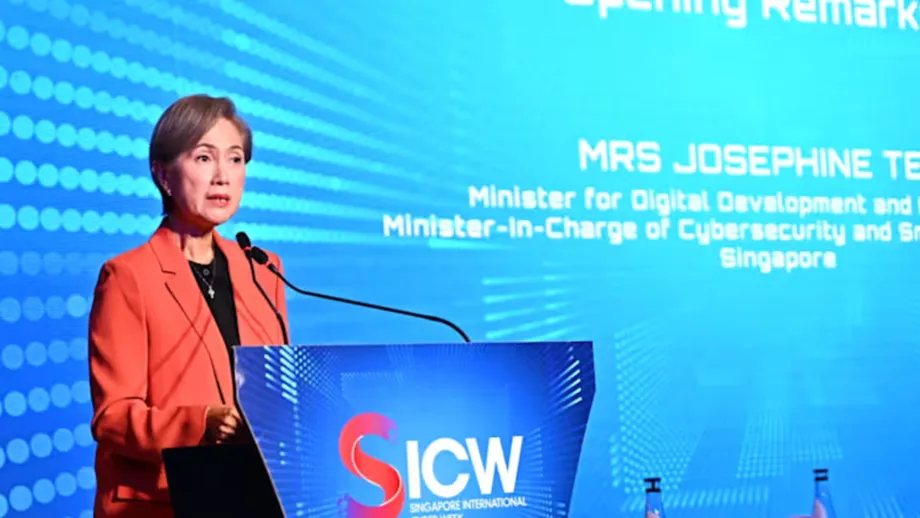
Josephine Teo, Minister for Digital Development and Information and Minister in Charge of Cybersecurity and the Smart Nation Group, said early detection could protect users without removing the privacy of their conversations.
"If our devices can recognise signs of manipulation early, we can help potential victims avoid financial or credential loss, while keeping their personal messages on their devices," she said.
The announcements address different weaknesses. The scam model aims to recognise deception while a conversation is happening. The quantum programme seeks to replace vulnerable cryptography before sufficiently powerful quantum computers can threaten it.
How the phone model decides when to warn
Google DeepMind says the system uses its lightweight Gemma model, adapted to recognise scam conversations common in Singapore. Rather than relying only on suspicious links or known malicious websites, it looks for conversational patterns that suggest someone is being manipulated.
The design has two stages. First, a small classifier screens incoming messages for possible threats while using minimal power. If it flags an exchange, the adapted Gemma model evaluates a larger snapshot of the conversation to decide whether the warning is justified or the initial suspicion was a false alarm.
This division matters because phones have limited battery power and computing capacity. A classifier is a model that sorts information into categories. Using a smaller one for the first check means the more demanding contextual analysis does not have to run on every message.
When the system detects manipulation, it displays a warning on the device asking the user to pause before sharing sensitive information or transferring funds. Its described function is to interrupt a potentially harmful decision, rather than automatically block a payment or guarantee that a conversation is safe.
The planned model is intended to analyse text exchanges on messaging apps such as WhatsApp and Telegram. Google has not announced a release date, installation instructions or whether it will become a default Android feature. The announcement also does not provide measured detection accuracy, false alarm rates or battery consumption figures, leaving those practical questions unanswered.
Keeping private chats on the device
The privacy approach rests on where the analysis happens. Traditional detection can involve sending messages to a remote server for inspection. Here, the model processes conversation data locally, so the private exchange does not need to leave the phone for a scam assessment.
That approach is relevant to messaging services using encryption that allows only the communicating parties to read a conversation. Instead of requiring a platform to inspect those messages on its servers, the proposed protection operates where the user can already read them: on the device.
Google DeepMind says access to conversations will require user consent and that neither Google nor the Singapore Government will be able to access users' conversations through deployment of the model. These are statements about the proposed design, not an announcement that the feature is already available to everyone.
Mark Chen, GovTech's director of trust and safety, described the collaboration as an effort to detect targeted scams without surrendering privacy.
Fighting scams shouldn't mean sacrificing personal privacy. Working with Google DeepMind, we're bringing advanced AI protection directly onto citizens' devices. This allows us to catch highly targeted, local scam attempts in real time while keeping personal communications completely private.
Google DeepMind also distinguishes between training the model and using it. Training took place inside GovTech's managed Google Cloud Platform environment, with the data kept isolated. It says training excluded private or personally identifiable information and instead used anonymised datasets derived from scam reports and intelligence feeds.
Local deception remains costly despite falling losses
The model's training includes impersonation of public institutions, banks and local figures, alongside regional scam schemes. Google DeepMind says generic models can struggle with these local forms of deception, making adaptation necessary to distinguish ordinary social conversation from pressure to surrender money or credentials.
Testing used synthetic dialogues and local collections of language data, including conversations designed to reflect local speech patterns. Google says training will continue as scam tactics change. This is intended to keep the model relevant as criminals alter their scripts, rather than relying indefinitely on a fixed list of known approaches.
Teo illustrated the danger with a local professional who transferred nearly S$5 million after attending a fabricated virtual meeting that appeared to include Prime Minister Lawrence Wong and other senior officials. According to her account, criminals used deepfake technology to make the meeting convincing and presented the payment as support for a meaningful global cause.
A deepfake is synthetic audio or video that imitates a real person. The case shows why familiarity alone can be an unreliable signal of trust. It does not, however, establish that the proposed text analysis model would detect a fabricated video meeting.
Police figures put scam losses in the first six months of 2026 at S$410.6 million across 16,821 cases. Cases were down 14.4% from the same period a year earlier, while losses fell 17.9%. The losses still averaged roughly S$24,410 per reported case, calculated by dividing S$410.6 million by 16,821. That average does not show how losses were distributed, but it underlines the financial scale of the remaining problem.
Why Singapore wants defences to connect
The phone model is one part of a wider response. Teo described a scam journey that can begin on social media, move to a messaging service, continue through a phone call and end with a transfer through a financial institution. Each organisation may see a warning sign without seeing the full sequence.
Teo said stronger detection within individual organisations would not be enough unless those defences could trigger action elsewhere.
It is therefore not enough to make every organisation better at stopping scams. We must also connect our defences so that a single signal detected on one part of the ecosystem can trigger action elsewhere.
Singapore already uses AI to examine threats beyond private conversations. GovTech and the Singapore Police Force's Scam Analytics and Tactical Intervention System (SATIS) scans and assesses more than 600,000 websites daily, processing each in seconds. It disrupts around 20,000 malicious websites a month and has expanded to cover suspicious mobile numbers and online platforms.
The two systems serve different purposes. SATIS targets infrastructure used by scammers; the phone model seeks signs of persuasion inside a conversation. Together, they illustrate the difference between removing a malicious destination and warning someone before they act on a convincing message. No detailed mechanism for connecting the new phone alerts to other organisations has been announced.
Cooperation also extends beyond Singapore. An ASEAN guide on scam policies and best practices, initiated by Singapore, was approved by member states earlier in 2026. Teo's broader argument was that neither governments acting alone nor individual countries can fully counter threats that move across services and borders.
Fairwind targets weaknesses in essential systems
Google separately announced on October 14 that Singapore would participate in its Fairwind programme, giving the Government access to advanced AI cybersecurity tools to find, verify and fix vulnerabilities.
Google says these tools can shorten work that takes weeks to minutes. The stated aim is to patch weaknesses before attackers exploit them, reducing the risk of disruption to essential systems and services.
Fairwind and the scam detection model tackle different problems. Fairwind concerns weaknesses in software and systems. The phone model concerns attempts to deceive a person through conversation, even when the messaging software itself is operating as intended.
The claimed speed improvement has not been accompanied by detailed results for Singapore's systems. It describes the programme's intended capability, rather than a measured reduction across government operations. Both initiatives nevertheless reflect the same policy choice: use AI for defence instead of abandoning it because criminals can also use it.
Quantum risks require preparation before a breakthrough
The quantum measures focus on cryptography, the mathematical techniques that protect information and help establish whether digital communications and transactions can be trusted. A sufficiently powerful quantum computer could break some of the methods currently used to secure financial transactions, sensitive communications and digital systems.
Quantum computing uses principles of quantum physics to perform calculations in ways that differ from conventional computers. The security concern is not that every form of encryption has already become unsafe, but that some widely used methods could become vulnerable once machines reach the necessary capability.
Teo said the timing was uncertain, while explaining why organisations should prepare now.
"We do not know when this will happen. But we know we must prepare for it. Bad actors are already motivated to steal sensitive encrypted data while waiting for quantum computers to decrypt them in future," she said.
That creates a present risk for information that must stay confidential for many years. An attacker could collect encrypted data today and retain it until future technology makes decryption possible. The useful life of a secret therefore matters alongside the current strength of its protection.
Migration can take large organisations several years. They must assess risks, prioritise data and systems, identify vulnerable encryption, coordinate with suppliers, test alternatives and make changes progressively. Waiting for a confirmed quantum breakthrough could leave too little time to complete that work.
Critical infrastructure has a 2031 target
The Cyber Security Agency of Singapore (CSA) issued migration milestone guidance in June for owners of critical information infrastructure. These are computer systems supporting essential services, and their owners are expected to complete the transition by 2031.
The identified sectors include energy, water, banking and finance, healthcare, transport, infocomm, media, security and emergency services, and government. A failure in these systems could affect services well beyond the organisation operating them, which explains their priority in the migration programme.
Singapore also plans guidance to help other organisations work towards migration by 2035. Teo identified organisations holding information that must remain confidential for many years, as well as providers of critical services such as communications and digital transactions, as relevant examples.
The two targets should not be treated as identical requirements. The 2031 expectation is tied to CSA's guidance for critical infrastructure owners. The 2035 date is the broader migration goal for other organisations under guidance that Singapore plans to issue. Neither date is a prediction of when quantum computers will break existing cryptography.
A seed grant moves migration into practical trials
A new quantum security kickstarter grant will provide funding for a limited period to help organisations move from planning to implementation. Its purpose is to expose practical difficulties, test solutions in real operating environments and build experience before wider deployment.
The grant is open to all organisations, with priority for critical information infrastructure owners. Funded pilots can last up to six months and can be conducted internally or with solution providers. The programme is described as running from November 1 until October 31, 2027; the opening year is not explicitly stated in the grant details.
Priority projects include migrating an entire application or system and identifying and inventorying cryptography. An inventory means establishing where cryptographic methods are used, so an organisation can determine what needs replacement and which suppliers or systems are involved.
The announced sequence is:
- June 2026: CSA issued migration milestone guidance for critical information infrastructure owners.
- October 14, 2026: The phone scam model, broader quantum migration plans and Google's cybersecurity cooperation were announced during Singapore International Cyber Week.
- November 1: The stated opening date for the quantum security grant programme.
- October 31, 2027: The stated end of the grant programme, with individual funded pilots lasting up to six months.
- 2031: Expected completion of migration for critical information infrastructure owners.
- 2035: The broader migration goal for other organisations under planned guidance.
No grant funding amounts are specified in the announcement. The Android model also has no announced release date. For now, the immediate next steps are further details on installing and using the scam protection, alongside practical pilots to prepare organisations for the encryption transition.
Key Points
- GovTech and Google DeepMind are developing an Android scam detection model that analyses conversations locally and warns users of manipulation.
- The design requires user consent and is intended to keep private conversations on the device.
- Singapore recorded S$410.6 million in scam losses across 16,821 cases in the first half of 2026, despite declines from a year earlier.
- Google's Fairwind programme will give Singapore access to AI tools intended to find, verify and fix cybersecurity vulnerabilities faster.
- Critical information infrastructure owners are expected to complete quantum security migration by 2031, with a broader goal of 2035 for other organisations.
- A new grant will support practical quantum security pilots lasting up to six months, with priority for critical infrastructure owners.