A familiar nonstick material enters the AI hardware race
Nvidia's search for faster connections inside AI systems is drawing attention to polytetrafluoroethylene, or PTFE, the material best known through the Teflon brand. Its appeal is electrical: PTFE can help signals travel across a circuit board while losing less energy than they would through conventional insulating materials.
Contents
- A familiar nonstick material enters the AI hardware race
- Why Nvidia wants signals to travel farther
- The property that helps in a pan complicates a board
- Taiwan's caution meets China's investment
- Taiflex and E Ink prepare a route into production
- More layers mean more material, not just more orders
- PTFE is one option in a wider materials contest
- Customers are paying to secure future capacity
- New factories will still need qualified materials
- Key Points
The challenge is turning that advantage into reliable boards containing dozens of layers. PTFE resists sticking to other materials, is relatively soft and requires difficult processing. Those properties have split manufacturers between caution and investment, with Chinese suppliers pursuing opportunities and Taiwanese companies weighing competing materials and manufacturing costs.
Nvidia showed a new NVLink switch board at an Open Compute Project summit in early October that industry participants believe may use PTFE. Potential applications include switches for Rubin Ultra and future orthogonal midplanes, connection boards that join other boards arranged at right angles. A confirmed production timetable and final material specifications have not been disclosed.
The contest extends beyond a single resin. Copper foil, fiberglass cloth, pressing equipment and factory capacity are all under pressure as AI servers require more complex boards. Customers are seeking capacity commitments covering 2027 through 2030, while some equipment deliveries can take 30 months.
Why Nvidia wants signals to travel farther
AI processors must exchange enormous amounts of information to work together. A printed circuit board, or PCB, carries components and provides paths for electrical signals and power. As transmission approaches 200 gigabits per second per lane, keeping those signals intact becomes increasingly difficult.
PTFE has very low dielectric loss, meaning less signal energy is absorbed by the insulating material around a copper path. It already appears in demanding applications including military radar, satellites and radar used in advanced driver assistance systems. Extending its use to complex AI server boards would bring that electrical advantage into a much larger manufacturing challenge.
Nvidia wants to enable fast signal exchange directly across boards, according to industry accounts, potentially replacing some complex copper cable connections. Longer copper paths place greater demands on the surrounding material because signal loss accumulates as the signal travels.
Co-packaged optics, which brings optical connections close to computing or switching chips, is another route to faster communication. Before that technology is ready for the applications under discussion, improving the board material offers a more immediate design option. The practical question is whether manufacturers can deliver the required electrical performance at an acceptable cost and production volume.
The property that helps in a pan complicates a board
Copper clad laminate, or CCL, is a basic building material for circuit boards. It typically combines copper foil with resin and fiberglass reinforcement. Manufacturers process and join these materials into the layered structure that carries a server's electrical connections.
Conventional resin systems, including epoxy, polyphenylene oxide and hydrocarbon resins, can bond during heating and become rigid after curing. That makes subsequent drilling, plating and assembly comparatively manageable. PTFE's resistance to adhesion creates a more difficult task: layers must remain firmly joined through manufacturing and operation.
PTFE also lacks the rigidity needed to serve alone throughout the thick, complex boards used in AI servers. Manufacturers generally consider hybrid structures that combine PTFE with more rigid materials. Such designs seek to put the lowest loss material where signals most need it while retaining mechanical strength elsewhere.
Processing can require major factory changes. Industry estimates put the lamination temperature for some multilayer PTFE boards at about 300 degrees Celsius. Ordinary PCB production lines may lack suitable equipment, meaning a material change can require new machinery, revised recipes and changes across several suppliers.
Taiwan's caution meets China's investment
Unimicron chairman Tung Ting-yu has said Nvidia approached the company about PTFE development three years earlier. His account frames Nvidia's initial interest partly as a response to shortages of advanced laminate, and he has questioned whether PTFE will become a mainstream circuit board material.
Pu Deyu, head of overseas electronics and communications research at GF Securities, takes a different view. He argues that the need comes from product design: even advanced M9 material may struggle to provide sufficient transmission performance in boards with more than 70 layers. He also sees future computing applications in space as strengthening demand for PTFE.
The manufacturers associated with Nvidia's PTFE work are predominantly Chinese, apart from one American board maker, according to industry accounts. They include laminate supplier Shengyi Technology and PCB manufacturer Victory Giant Technology, which has invested heavily in equipment intended to serve Nvidia.
Taiwan's listed participants include Taiflex, a maker of flexible copper clad laminate, and flexible circuit manufacturer Flexium. Neither is a leading supplier of AI server PCBs. Their involvement shows that the opportunity reaches beyond the established producers of rigid server boards, even as commercial scale remains a central challenge.
Taiflex and E Ink prepare a route into production
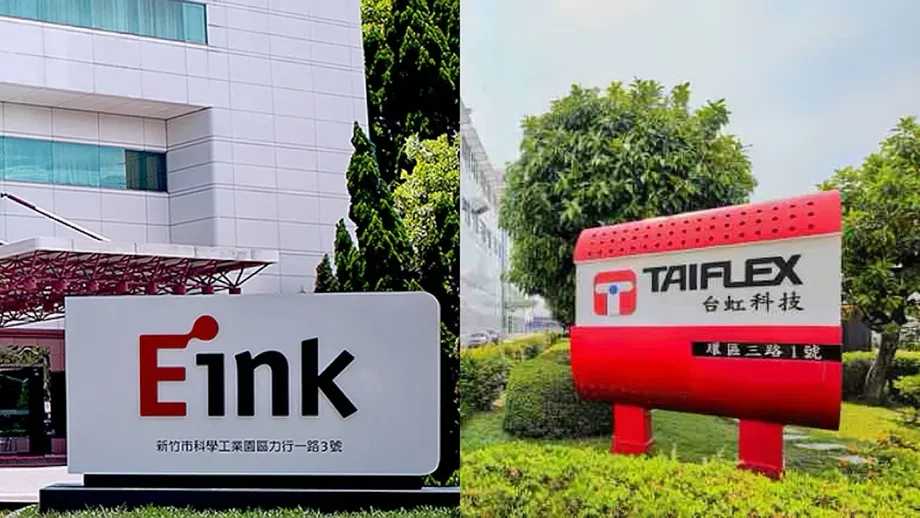
Taiflex's board approved a memorandum of understanding with E Ink on October 28 to develop PTFE materials. The plan would combine Taiflex's materials with trial production and verification at E Ink's Hsinchu and Guanyin sites in Taiwan.
Taiflex would provide key materials and develop PTFE laminate for fast signal transmission. E Ink would contribute materials research, surface treatment and manufacturing management. Surface treatment is particularly relevant to a material whose resistance to bonding makes fabrication difficult.
Taiflex chairman Chen Yung-heng has said the company has invested in copper clad laminate and advanced electronic materials for years, including PTFE technology and products. The proposed cooperation connects that development work with facilities where manufacturing processes can be tested.
The partnership still requires review by E Ink's board. Commercial terms and execution details remain unsettled, and any subsequent contract manufacturing would depend on progress. The two facilities are planned testing locations rather than confirmed sites for commercial PTFE production.
E Ink and its materials subsidiary together held about 9% of Taiflex at the time described. E Ink chairman Johnson Lee has said investment in Taiflex began about four years earlier. The companies' closer operational relationship developed through several steps:
- April 2: Chen Yung-heng became Taiflex chairman.
- May 27: E Ink secured four Taiflex board seats in a board election.
- July 29: Johnson Lee became Taiflex vice chairman.
- October 28: Taiflex's board approved the proposed PTFE cooperation.
More layers mean more material, not just more orders
AI servers are increasing demand for laminate partly because their boards contain more layers. Conventional server boards might have about 16 to 20 layers, while AI server boards now reach 30 to 40 or more. Comparing 20 layers with 40 illustrates the change: twice as many layers must be built into each board, although actual material consumption also depends on its size and design.
Laminate delivery times have stretched from roughly two to four weeks to three months or half a year. Some advanced fiberglass cloth is being supplied through allocations, limiting how much individual customers can obtain even when they want to order more.
Fiberglass production is also becoming slower as requirements become more demanding. Suppliers are shifting capacity from conventional electronic glass cloth to products with better electrical properties. Moving from thicker cloth to thinner versions can reduce production capacity by 50% to 70%, according to industry estimates.
Morgan Stanley identifies four near term constraints: PTFE processing, tight supplies of thin E-glass, long delivery times for EPM lamination presses and glass substrates that it expects will need another two to three years to reach commercialization. These constraints affect different stages of production, making a rapid increase in finished board supply difficult.
PTFE is one option in a wider materials contest
Taiwanese laminate makers are exploring hydrocarbon resins, combinations of hydrocarbon resin and PTFE, and benzocyclobutene, known as BCB, according to Morgan Stanley. The choice depends on electrical performance, ease of processing, cost and the ability to deliver consistent material in large quantities.
Quartz cloth, often called Q cloth, is another candidate for demanding applications. It has favorable electrical properties but can cost 50 to 70 times as much as ordinary fiberglass cloth. Its hardness and brittleness also complicate drilling.
A drill bit that can make about 2,000 to 3,000 holes in a conventional fiberglass board may need replacement after roughly 200 holes in a board using quartz cloth. Those figures imply about 10 to 15 times as many holes between replacements for the conventional material, adding a substantial manufacturing cost to the quartz option.
Manufacturers are introducing techniques such as picosecond lasers and ultrasonic drilling to address processing problems. Customers can also use mixed material designs, placing advanced M9 or M10 laminate in demanding signal layers and less expensive material elsewhere.
Elite Material chairman Tung Ting-yu has said M9 is already in mass production, M10 is expected to increase production the following year, and M11 is under development. Copper foil is changing too: smoother surfaces help reduce losses as signals move along copper paths. Resin selection is therefore only one part of the electrical design.
Customers are paying to secure future capacity
Goldman Sachs says customers are supporting capacity investments for 2027 through 2030 using long term agreements, expansion subsidies, advance payments or incentives. Elite Material, Zhen Ding Technology and copper foil producer Co-Tech have received such requests. Some suppliers prefer to retain flexibility rather than accept every proposed arrangement.
The financing reflects lengthy waits for both materials and machines. Unimicron chairman and chief strategy officer Chien Shan-chieh has said delivery times have lengthened for about 80% of equipment, with certain critical machines taking as long as 30 months. He estimates that shortages of key materials could reach 20% to 40% of requirements in 2027.
Nvidia is also seeking more capacity for chip substrates, the finely wired structures that connect chips to the rest of a system. It reportedly plans to expand related capacity to 2.5 times its current level within three years and has provided billions of US dollars in capacity prepayments to Japan's IBIDEN.
Substrates and server PCBs serve different roles, but both are drawing investment from the same expansion of AI hardware. Customers are committing money earlier because factory construction, equipment installation and product qualification take much longer than placing a purchase order.
New factories will still need qualified materials
Co-Tech plans to invest NT$8 billion to NT$10 billion in a Malaysian plant with planned capacity of 30,000 tonnes, targeting advanced HVLP4 copper foil. HVLP5 products have also been submitted as samples. Taiwan Union Technology's first two factory phases in Thailand are planned to provide combined monthly capacity of 1.2 million laminate sheets, with land reserved for a third phase.
Raw material shortages remain a major concern despite those expansion plans. ITEQ chairman Chen Chin-tsai has identified insufficient materials as the company's biggest challenge. General manager Tsai Hsin-min has said fiberglass cloth prices are rising almost monthly and supply may begin to ease only in the second half of 2027 or in 2028.
End customers are also taking greater control over material selection. After qualifying a material, they can require PCB manufacturers to use that specific product. Suppliers consequently compete on reliable quality and repeatable production as well as on the lowest signal loss.
Nvidia's PTFE push brings those requirements together. A material that allows faster connections must also survive pressing, drilling, plating and assembly across many layers. Chinese investment, Taiwanese alternatives and the Taiflex partnership represent different efforts to meet that same practical requirement: deliver boards that work consistently in large numbers.
Key Points
- Nvidia is exploring PTFE for demanding AI connections because it loses less signal energy than conventional insulating materials.
- PTFE's resistance to adhesion, softness and processing requirements complicate production of boards with many layers.
- Chinese suppliers are investing, while Taiwanese manufacturers are pursuing PTFE partnerships and alternative materials.
- Taiflex's proposed cooperation with E Ink targets testing at two Taiwanese sites, with approvals and commercial terms still pending.
- Laminate delivery times have stretched to three months or half a year as fiberglass, copper foil and equipment supplies tighten.
- Customers are supporting capacity for 2027 through 2030, while manufacturers must balance electrical performance, cost and dependable production.