Drones, missiles and a demand for technological superiority
North Korean leader Kim Jong Un called for faster development of drones and artificial intelligence at an October 29 weapons exhibition, where demonstrations combined unmanned aircraft, cruise missiles and a battalion of 600 mm multiple rocket launchers. South Korea's military detected more than 10 short range ballistic missiles launched from the Wonsan area that day, flying about 250 kilometres.
Contents
- Drones, missiles and a demand for technological superiority
- What Kim ordered scientists and commanders to do
- What the exhibition and demonstrations included
- What South Korea detected near Wonsan
- Why the 600 mm launcher drew attention
- Island strikes and mock allied targets
- How the drone programme reached this point
- Russia adds a battlefield context
- A military audience and a public message
- Key Points
North Korea's October 30 announcement described the event as Unmanned Aerial Technology Development 2026. It said attack drones and missiles struck an island target with 100% accuracy, and described the first firing demonstration before a crowd of a precision 600 mm rocket launcher nicknamed Sniper.
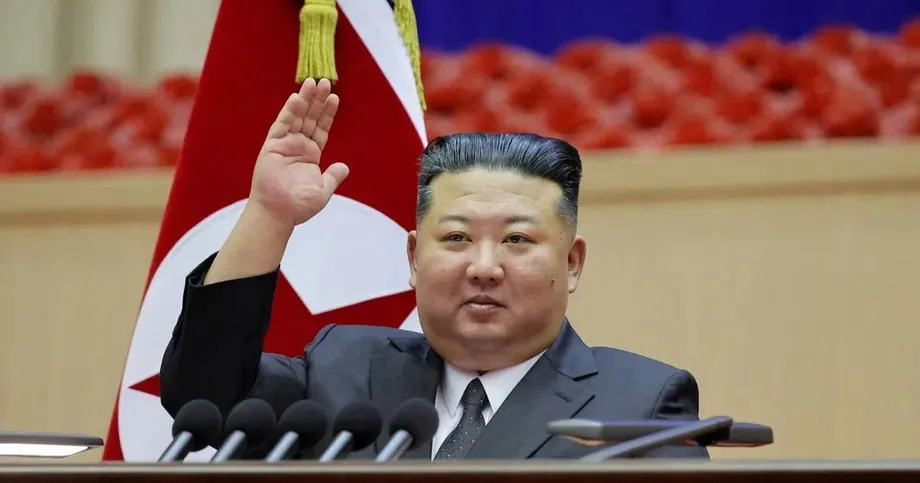
Kim's central instruction went beyond building more aircraft without pilots. He called for improving their core technology, adding AI to unmanned weapons and increasing their ability to carry out military missions. He presented superiority in drone technology as an essential response to changes in modern warfare.
The exhibition brought together weapons developers, military commanders, researchers and senior political officials. Its combination of drones and heavy firepower also carried a concrete message for South Korea: photographs showed attacks on mock targets resembling South Korean frontline positions and equipment used by South Korean and American ground forces.
The demonstrations took place against the continuing military standoff across the heavily fortified Korean border. They connected Kim's industrial ambitions with weapons intended for battlefield use, while giving commanders and scientists a shared set of priorities: more capable drones, greater use of AI and stronger coordination with other strike systems.
What Kim ordered scientists and commanders to do
Kim described unmanned weapons as increasingly central to warfare and called for their technological development to remain a top priority in military modernisation. His instructions covered both the machines themselves and their operational capabilities, meaning how effectively the military can use them to carry out missions.
AI is software that can recognise patterns and help make decisions. In a drone, it can support tasks such as interpreting camera images, navigating or following an object. The precise functions North Korea has built into the aircraft displayed at this event were not publicly detailed, nor were production targets, budgets or a timetable for the new expansion.
Kim also urged the scientific community to produce advances in drones and defence AI alongside the country's nuclear and conventional weapons programmes. Conventional weapons use explosives and other means of destruction rather than nuclear reactions.
Kim, North Korea's leader and chairman of its State Affairs Commission, framed the weapons programme as a means of protecting the country. In a statement translated from Korean, he said:
Strength is peace, and peace is guaranteed only by strength.
His instructions placed universities, scientific institutions and the defence industry within the same effort. Researchers and teachers from military education institutions and major universities attended alongside division and brigade commanders, linking technical development with the officers expected to use the equipment.
What the exhibition and demonstrations included
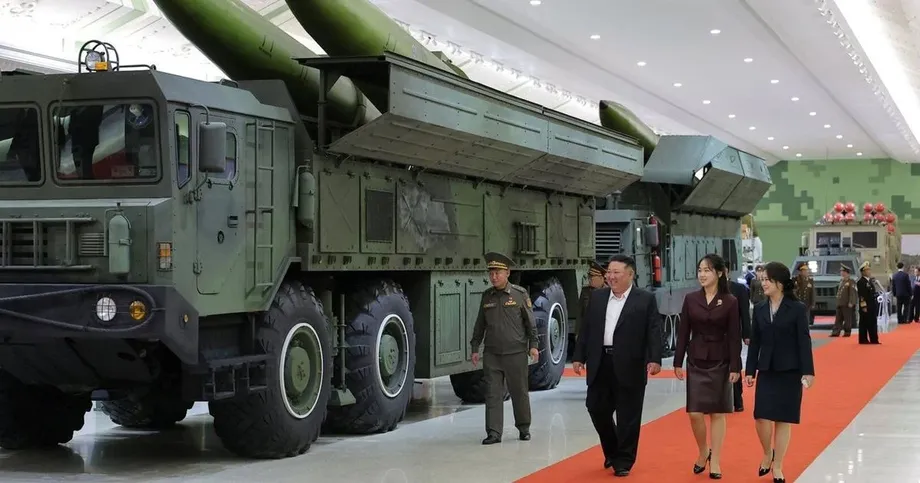
North Korea displayed strategic and tactical multipurpose drones, suicide attack drones and other unmanned combat systems. Strategic systems generally support broader military objectives, while tactical systems serve more immediate battlefield missions. Multipurpose aircraft can perform different tasks, including reconnaissance and attack.
Suicide attack drones strike by crashing into their targets with an explosive payload. Other aircraft shown at the event launched missiles, allowing the drone to act as a weapons platform rather than being destroyed in the attack. The demonstrations also included tactical cruise missiles and firing by a 600 mm rocket artillery battalion.
Shin Jong-woo, secretary general of the Korea Defense and Security Forum, assessed that more than 30 types of drones were exhibited. He identified designs intended to reduce detection by radar and first person view attack drones among the aircraft newly shown. First person view systems allow an operator to see through a camera mounted on the aircraft.
Shin also identified what he described as the first public demonstration of an air to ground tactical cruise missile launch. A cruise missile uses powered flight to travel through the atmosphere towards its target, while a ballistic missile follows a trajectory shaped largely by gravity after its powered phase.
The range of equipment was a central feature of the exhibition. North Korea was showing aircraft intended to find targets, aircraft carrying weapons, drones designed for a single attack and ground launchers capable of firing heavy projectiles in large numbers.
What South Korea detected near Wonsan
South Korea's Joint Chiefs of Staff said North Korea launched more than 10 short range ballistic missiles from the Wonsan area towards the sea east of the peninsula at about 12:30 p.m. on October 29. It put their flight distance at approximately 250 kilometres and said South Korean and American authorities were conducting detailed analysis.
The military said the allies had monitored preparations and detected and tracked the missiles after launch. The weapons were assessed as likely to have come from the KN-25, North Korea's 600 mm multiple rocket launcher system.
Shin's examination of the published imagery put the simultaneous firing at 15 projectiles. South Korea's military gave the broader count of more than 10 launches. These figures describe a concentrated burst of fire rather than an isolated missile test.
North Korea did not identify the exhibition venue in its announcement. Buildings and other structures led observers to identify Wonsan Kalma airfield as the likely location, while Yang Moo-jin, a chair professor at the University of North Korean Studies, suggested the Wonsan Kalma coastal tourism area. Wonsan was also the launch area identified by South Korea's military.
Why the 600 mm launcher drew attention
The Sniper nickname highlighted North Korea's claim of precision for its large rocket artillery. The 600 mm measurement refers to the weapon's calibre, or diameter. Multiple rocket launchers can fire several projectiles in rapid succession, placing several targets or a broad area under attack.
North Korea described this event as the first time the launcher bearing that nickname had demonstrated its firing before a crowd. The KN-25 system itself was already known. South Korea classifies its projectiles as short range ballistic missiles, while North Korea describes the system as super large rocket artillery.
North Korea claims the KN-25 can carry its Hwasan-31 tactical nuclear warhead. A tactical nuclear weapon is intended for military targets within a theatre of conflict, rather than distant strategic targets. The October 29 demonstrations were described as weapons firing exercises, with the nuclear capability raised as part of North Korea's wider claims about the system.
The roughly 250 kilometre flight distance reported by South Korea gives a concrete measure of the launches detected that day. Combined with the concentrated firing, it helps explain why the artillery display received attention alongside Kim's push for drones.
Island strikes and mock allied targets
North Korea claimed that suicide attack drones, air to ground missiles fired from multipurpose drones and cruise missiles struck an island target with 100% accuracy. It also said the demonstrations had satisfactorily verified the reliability and effectiveness of the major weapons systems.
Published images showed targets resembling South Korean frontline guard posts. Shin identified other mock targets representing radar used to locate enemy artillery, South Korean K9 self propelled guns and American M1 Abrams tanks.
Those choices made the intended military message specific. Guard posts monitor frontline areas. Artillery locating radar helps defenders find the source of incoming fire. K9 guns and Abrams tanks represent substantial ground combat power. Shin interpreted the display as a warning that North Korean drones could attack South Korean forward facilities and American ground forces during a conflict.
Lim Eul-chul, a professor at Kyungnam University's Institute for Far Eastern Studies, viewed the combined drone and rocket demonstrations as a display of the ability to mount several kinds of attack together. He linked that approach to North Korea's acceptance of lessons from modern warfare, especially the growing role of unmanned weapons.
For military planners, the practical concern is the mixture of threats. A drone, a cruise missile and a ballistic projectile have different flight patterns and operating characteristics. Using several types together requires defenders to track and respond to different threats at the same time.
How the drone programme reached this point
Kim's October instructions followed a series of public steps involving drone production and AI. The progression moved from an order to manufacture attack drones in large quantities towards testing aircraft with AI and giving the technology a higher place in military planning.
- November 2024: Kim ordered mass production of suicide attack drones.
- March 2025: Kim oversaw tests of drones described as incorporating AI.
- September 2025: Kim identified AI as a top priority for weapons modernisation.
- October 29: Kim attended Unmanned Aerial Technology Development 2026 and watched demonstrations combining drones, missiles and rocket artillery.
- October 30: North Korea announced the exhibition and Kim's instructions for further expansion.
The earlier milestones help explain the latest emphasis on operational capability. Producing an aircraft is one part of a military programme. Training personnel, using information from reconnaissance and coordinating attacks with other weapons are also necessary to put it into service.
The exhibition presented a broad selection of equipment to commanders from across the armed forces. That audience gave the event a practical role alongside its public display of military strength.
Russia adds a battlefield context
South Korean intelligence has said North Korea sent more than 16,000 troops to Russia from October 2024 to support Russian military operations. The deployment has provided experience in drone warfare, electronic warfare and operations involving different military units.
Electronic warfare involves using or disrupting signals, including those needed for communication and navigation. Such experience is relevant to drones because many depend on radio links or satellite navigation to reach a target and receive instructions.
Lim connected North Korea's growing focus on unmanned weapons with the prominence of drones in the war in Ukraine. His assessment places the exhibition within a wider military effort to combine reconnaissance, attack drones and heavy firepower.
Kim's public instructions focused on domestic scientific work and an independent defence industry. His demand for stronger technology and operational performance makes battlefield experience relevant to the direction of that work, alongside aircraft manufacturing.
A military audience and a public message
Kim was accompanied by his wife, Ri Sol Ju, and daughter Ju Ae. Senior participants included defence industry officials, military commanders, Foreign Minister Choe Son Hui and veteran military figure Ri Pyong Chol. Party secretary Jo Chun Ryong delivered remarks introducing the exhibition and its newly developed aircraft.
The audience extended well beyond a small group of weapons specialists. Division and brigade commanders, military researchers, university staff and senior government figures attended. North Korea also released 47 photographs, giving the event a substantial public presentation.
Lim interpreted the display as serving domestic political purposes as well as military ones: presenting weapons development as a leadership achievement and describing military expansion as protection for the population. Yang also raised the possibility of a diplomatic purpose, pointing to the foreign minister's attendance and the potential use of the Wonsan area for talks.
The concrete development was Kim's renewed instruction to expand drone technology and make AI a priority, backed by a demonstration of several kinds of weapons. For South Korea, the immediate response was tracking and analysing the launches. For North Korea's scientists and commanders, the stated task was to turn the displayed systems into a larger and more capable unmanned force.
Key Points
- Kim Jong Un attended an October 29 drone exhibition and called for faster development of unmanned weapons and defence AI.
- Demonstrations combined suicide attack drones, multipurpose drones, cruise missiles and 600 mm rocket artillery.
- South Korea detected more than 10 short range ballistic missiles launched near Wonsan, flying about 250 kilometres.
- North Korea claimed 100% accuracy against an island target and publicly demonstrated a launcher nicknamed Sniper.
- Published imagery included mock targets resembling South Korean and American military equipment and positions.
- The exhibition followed drone production and AI milestones announced in November 2024, March 2025 and September 2025.