A deeper slide puts recovery forecasts to the test
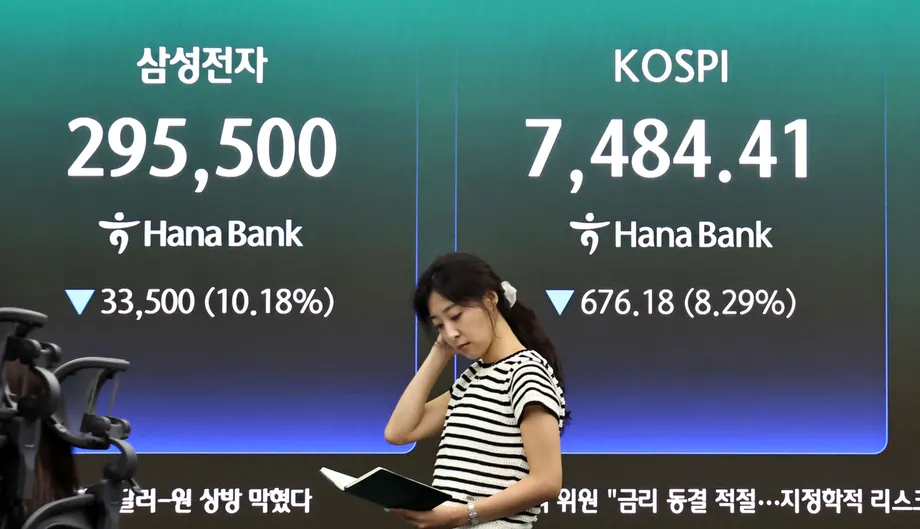
South Korea's KOSPI fell to 5,626.02 by 11:20 a.m. on October 30, 2026, down 5.25% on the day and about 38% below its June 22 peak of 9,114.55. The latest losses sharpened a divide between falling share prices and brokerage forecasts that still see room for a substantial recovery in 2027.
Contents
- A deeper slide puts recovery forecasts to the test
- October's rebound gives way to another selloff
- What the trading restriction meant
- How far brokerages think the index can recover
- The semiconductor profit puzzle
- Why the timing forecasts disagree
- Foreign selling meets a thinner market
- Shareholder returns could help, but chips dominate
- Sector choices reflect different risks
- Key Points
The Korea Exchange activated a five minute restriction on program selling at 10:04 a.m., as losses in semiconductor shares accelerated. Samsung Electronics fell 6.03% and SK Hynix dropped 8.65%, placing the companies central to the recovery argument at the center of the latest retreat.
Brokerage forecasts for next year range from a lower boundary of 5,000 to an upper boundary of 10,000, with Yuanta Securities outlining an optimistic scenario of 12,000. Those projections depend heavily on whether semiconductor companies can keep earning unusually large profits and whether foreign investors return after sustained selling.
The attraction is price. Hanwha Investment & Securities puts the KOSPI's forward price to earnings ratio in the 4 times range, its lowest since 2010. That means investors are paying roughly four won for each won of earnings companies are expected to produce over the coming year.
The concern is how long those earnings will last. A low ratio makes shares look inexpensive when profit forecasts hold up. If profits subsequently shrink, the same share price becomes more expensive relative to what companies earn. Much of the disagreement among brokerages comes down to that calculation.
October's rebound gives way to another selloff
The October 30 decline followed losses on Wall Street after disappointing quarterly results from Alphabet, Google's parent company. Concerns about its free cash flow, the cash left after operating expenses and investment spending, renewed doubts about the financial returns from artificial intelligence investment.
South Korea's market had already swung sharply during the week. The main developments were:
- June 22: The KOSPI reached 9,114.55, its peak before the prolonged decline.
- October 26: The index closed at 5,469.47, down 1.46%, as daily trading activity sank to its lowest level of the year.
- October 28: A rise of more than 6%, helped by SK Hynix's 100 trillion won shareholder return program, carried the index back above 6,000.
- October 29: The KOSPI closed at 5,937.66, down 1.24%, as Samsung Electronics' shareholder return measures disappointed investors.
- October 30: The index opened 2.99% lower at 5,760.53 and extended its decline to 5,626.02 by 11:20 a.m.
The October 29 close was almost 35% below the June peak. The following morning's losses pushed that decline to about 38%, showing how quickly the starting point for any recovery forecast was changing. An October 30 closing figure was not available.
South Korea had already experienced a severe reversal earlier in the year. During the March market crash, the KOSPI fell 12.06% in one session as war involving the United States, Israel and Iran drove investors away from Asian equities. October's immediate pressure centered on technology earnings and the durability of AI investment.
What the trading restriction meant
The Korea Exchange's October 30 intervention followed a 5.12% fall in the KOSPI 200 Futures Index to 887.92. The sell side sidecar mechanism activates when that futures index falls at least 5% for one minute or longer.
A futures contract lets investors trade exposure to an index at an agreed price for a future date. Large movements in futures can feed into automated share orders. The sidecar briefly restricts program selling to slow that transmission, while ordinary share trading continues.
The measure had last been activated on October 15, 11 trading sessions earlier. The KOSDAQ, which has a heavy concentration of technology companies, was also under pressure, falling 3.32% to 728.25 at 10:08 a.m.
Losses extended beyond chips. Hyundai Motor fell 3.76% after lowering its annual sales target and investment plans. Hanwha Aerospace dropped 12.24% after weaker than expected third quarter earnings tied to delayed deliveries of K9 self propelled howitzers to Poland. Investors were responding to company earnings problems as well as the broader AI retreat.
How far brokerages think the index can recover
Yuanta Securities has the widest optimistic range among the domestic forecasts, projecting 6,000 to 10,000 for 2027 and a best case level of 12,000. Hanwha Investment & Securities forecasts 6,000 to 9,300, with a target of 8,500.
Other firms are more restrained. Daishin Securities sees an upper level of 8,200, while Kiwoom Securities forecasts 5,100 to 8,100. Shinhan Securities projects 5,000 to 8,000 and places fair value near 7,000. iM Securities sets its base case upper boundary at 7,500.
Measured against the October 29 close of 5,937.66, Shinhan's approximate fair value of 7,000 would mean an increase of about 18%, while Hanwha's 8,500 target would mean about 43%. Conversely, a fall to 5,000 would represent a further decline of roughly 16%. Even forecasts built around recovery leave considerable room for losses.
Forecast periods also matter. Goldman Sachs cut its target for the following 12 months by 25%, from 12,000 to 9,000. For the final quarter of 2026, DB Securities forecasts 5,000 to 7,300 and Yuanta projects 6,000 to 7,500. Those shorter ranges address the immediate adjustment rather than the full course of 2027.
The semiconductor profit puzzle
Shinhan Securities analyst Noh Dong-gil's outlook for 2027 puts the disagreement between earnings and valuations in concrete terms. Since the June share price peak, projected combined operating profit for Samsung Electronics and SK Hynix in 2028 rose from 837 trillion won to 1,058 trillion won, an increase of about 26%.
Over the same period, Shinhan's combined valuation figure for the companies fell from 4,194 trillion won to 2,222 trillion won, a decline of about 47%. Investors were assigning less value to the businesses even as estimates of future profits increased.
Noh's calculation, using average earnings forecasts and a 10% cost of capital, suggests current prices recognize about 1.9 years of excess profits. Cost of capital means the return investors require for supplying money to a business. Excess profit is what the company earns above that requirement.
The central issue is whether strong earnings continue into 2028 and beyond. New semiconductor production capacity in 2028 could increase supply and change memory prices. Evidence that profits remain high for longer would give investors reason to value more years of earnings.
KB Securities estimates forward price to earnings ratios for 2027 of 3.3 times for Samsung Electronics and 2.7 times for SK Hynix, compared with 7 to 8 times for Micron and SanDisk. The Korean companies therefore trade at less than half those comparison multiples. Whether that gap narrows depends on confidence in future profits as well as their current size.
Why the timing forecasts disagree
Yuanta expects a weaker market first and a stronger market later, supported by further earnings growth at leading AI and semiconductor companies, recovering valuations and improving investor flows. Hanwha also expects a relatively strong market, with chips leading in the first half and gains spreading to other industries in the second.
Hanwha places much of the expected rally in the final quarter of 2026 and the first quarter of 2027. It points to negotiations over long term memory supply agreements and next year's prices for high bandwidth memory, the specialized memory used alongside powerful AI processors.
Daishin expects the reverse pattern: an early recovery as low valuations attract buyers, followed by a weaker second half as export and earnings growth slow and inflation pressure rises. It recommends reducing equity exposure from the third quarter of 2027.
Shinhan anticipates sideways trading and possible tests of previous lows through the end of 2026, followed by purchases in stages during the first quarter and a recovery in the market trend during the second. Its study of 24 previous breaks below the KOSPI's 200 day moving average found that 15 produced a lower low between trading days 21 and 60. That history helps explain its caution about chasing an initial rebound.
Kiwoom sees valuation discounts easing after the second quarter of 2027 if concerns about interest rates and oil prices subside and earnings durability becomes clearer. The firms agree more readily on the possibility of recovery than on when investors would benefit from it.
Foreign selling meets a thinner market
Foreign investors' net selling through the middle of the month amounted to about 4% of average annual KOSPI market capitalization, approaching the 4.56% recorded during the 2008 financial crisis. Shinhan's separate measure, covering the latest 12 months, also put net selling above 4% of market capitalization.
Trading activity has contracted alongside the decline. Average daily trading value fell from 50.3471 trillion won in June to 21.3604 trillion won in September and 19.021 trillion won in October through October 26. The October figure was about 62% below June's level.
On October 26 alone, trading value was 12.9911 trillion won and volume was 202.29 million shares, both the lowest of the year. A thinner market gives large orders fewer opposing buyers or sellers, making the return of sustained buying particularly relevant to a recovery.
Hyundai Motor Securities expects foreign flows to improve from the middle to latter part of November, after the US midterm elections and an anticipated Anthropic initial public offering. It sees scope for a rally toward the end of 2026 and a recovery early in 2027.
Shinhan identifies another potential brake around 6,600 to 7,000: individual investors who bought in that area may sell as prices approach their purchase levels. Such selling could absorb some of the demand behind a rebound.
Shareholder returns could help, but chips dominate
Shinhan forecasts a KOSPI shareholder return yield of 4.1% in 2027, compared with recent figures of 3.2% for Japan and 2.4% for the United States. This measure relates money returned to shareholders through dividends and share repurchases to market value.
Removing Samsung Electronics and SK Hynix reduces the projected Korean figure to 2.1%. The difference shows how heavily the market's expected cash returns depend on its two semiconductor leaders.
Shinhan also projects share cancellations of 97 trillion won in 2027, compared with 94 trillion won in 2026. Cancelling repurchased shares reduces the number outstanding, increasing the remaining investors' proportional ownership. The firm expects more activity to involve newly purchased shares rather than the cancellation of shares companies already hold.
iM Securities argues that earnings growth alone may not produce a matching share price rise. It cites past upcycles in which Samsung Electronics' earnings per share increased fourteenfold while its share price rose fourfold. Its recovery case also requires stronger shareholder returns and a greater presence of companies successfully adopting AI.
Sector choices reflect different risks
Kiwoom recommends semiconductors, IT hardware, machinery, banks and holding companies, with construction, shipbuilding, biotechnology and autos as alternatives. Its approach spreads exposure beyond the chip companies whose earnings dominate the index outlook.
Shinhan favors semiconductors in the first half, then a selective move toward other industries as earnings forecasts improve. It identifies banks for dividends and share cancellations, electricity distribution and cable companies linked to AI power infrastructure, and selected beauty, biotechnology and energy storage businesses.
Daishin's preference for insurance, dividend shares and consumer staples reflects its expectation of slower earnings growth and higher costs in the second half. These businesses may appeal to investors seeking steadier income or demand when growth becomes less reliable.
The coming checkpoints are concrete: memory contract negotiations toward the end of 2026, foreign investor flows in November, and confirmation of earnings and shareholder returns as 2027 begins. The recovery forecasts ultimately depend on companies turning projected profits into lasting earnings and cash that reaches shareholders.
Key Points
- The KOSPI fell 5.25% to 5,626.02 by late morning on October 30, about 38% below its June peak.
- The Korea Exchange briefly restricted program selling after a sharp fall in KOSPI 200 futures.
- Domestic brokerage ranges for 2027 extend from 5,000 to 10,000, with Yuanta outlining an optimistic scenario of 12,000.
- Low forward earnings multiples support the recovery argument, while the durability of semiconductor profits remains central to valuations.
- October's average daily trading value through October 26 was about 62% below June's level.
- Brokerages disagree on timing, with some expecting gains to strengthen later in 2027 and others anticipating a weaker second half.