Taiwan's selloff spreads beyond the biggest technology stocks
Taiwan's benchmark stock index fell as much as 1,642.07 points on October 30, 2026, reaching 44,726.26 as disappointing US technology earnings deepened concerns about how quickly investment in artificial intelligence will generate profits. An estimate based on that decline put the loss in listed company market value at NT$5.38 trillion.
Contents
- Taiwan's selloff spreads beyond the biggest technology stocks
- How the decline unfolded
- Why US earnings shook Taiwan's AI trade
- NT$5.38 trillion in market value at stake
- TSMC and Delta pull the benchmark lower
- MediaTek falls before its afternoon briefing
- Circuit boards and expensive shares take heavy losses
- Shipping and selected chip designers resist the selling
- What investors will watch next
- Key Points
The Taiwan Stock Exchange weighted index dropped below both 46,000 and 45,000 during the morning. At about 10:35 a.m., it stood at 44,923.70, down 1,444.63 points, or approximately 3.12%, from the previous close of 46,368.33. The deepest decline was about 3.54%.
Delta Electronics fell to its daily lower trading limit, while Taiwan Semiconductor Manufacturing Co. (TSMC), MediaTek and a broad range of circuit board, cooling and semiconductor companies weakened. Smaller companies suffered even more: the Taipei Exchange index, which tracks stocks traded outside the main exchange, lost 5.53% at the same morning checkpoint.
Shipping companies and telecommunications stocks provided some resistance. Evergreen Marine rose nearly 3%, while Chunghwa Telecom traded around its record high. Those gains offered limited relief against selling across more than 1,100 stocks.
The figures describe trading during the session. A closing index level and final market value loss were not yet available, and MediaTek's investor briefing later that afternoon remained a key scheduled event.
How the decline unfolded
Taiwan entered Friday's session after all four major US stock indexes fell on Thursday, October 29. Taiwan index futures then lost 643 points in overnight trading, closing at 45,926 and signaling pressure before the cash market opened.
- October 29: Taiwan's benchmark closed at 46,368.33. In the United States, technology shares helped pull the major indexes lower.
- Overnight: Taiwan index futures fell 643 points to 45,926.
- October 30 opening: The benchmark opened at 46,139.79, down 228.54 points.
- By 9:39 a.m.: Declining stocks outnumbered advancing stocks by 1,129 to 126, with another 48 unchanged.
- During the morning: The index reached 44,726.26, a decline of 1,642.07 points.
- About 10:35 a.m.: The benchmark traded at 44,923.70, still down 1,444.63 points.
The morning low exceeded the 1,467 point intraday decline recorded on July 7 by 175.07 points. In percentage terms, Friday's maximum decline was roughly seven times its opening loss of about 0.49%, showing how quickly selling intensified after trading began.
Why US earnings shook Taiwan's AI trade
Alphabet, Google's parent company, and Amazon released results that heightened investor concern about the returns from AI spending. Intel's outlook for the fourth quarter also fell well short of market expectations, and its shares at one point dropped more than 21% in trading after regular US market hours.
AI investment involves large spending on computing chips, servers, networking equipment, electricity systems and cooling. Investors are watching whether the companies paying for that equipment can turn the spending into enough additional revenue and profit. Taiwan supplies many of the components used in those systems, making its stock market sensitive to changes in expectations for US technology companies.
The US declines were concentrated more heavily in technology. The Nasdaq Composite lost 365.12 points, or 1.38%, and the Philadelphia Semiconductor Index fell 165.80 points, or 1.42%. The Dow Jones Industrial Average slipped 132.54 points, or 0.25%, while the S&P 500 declined 23.59 points, or 0.30%.
Nvidia fell 0.8%, and TSMC's American depositary receipts, securities that allow its shares to trade in the United States, lost 1.75%. Japanese and South Korean stocks also weakened as the selling spread through Asian technology markets.
NT$5.38 trillion in market value at stake
Taiwan's listed companies had a combined market value of NT$151.79 trillion at the previous close. Applying the benchmark's maximum percentage decline produced an estimated value of about NT$146.41 trillion, a reduction of NT$5.38 trillion.
Market value means the combined value of companies' shares at prevailing prices. When share prices fall, the value of investors' holdings falls with them. The estimate therefore describes a reduction in the value attached to listed businesses, rather than money being withdrawn from company bank accounts.
At 9:39 a.m., nearly nine stocks were falling for every stock rising, based on the 1,129 decliners and 126 gainers. Three stocks were at their upper daily trading limit and three at their lower limit at that particular checkpoint. More individual companies reached their lower limits as the morning developed.
Electronics shares fell 3.53% at about 10:35 a.m., compared with 1.67% for financial shares. The smaller company index's 5.53% decline was about 1.8 times the benchmark's 3.12% loss at that time, illustrating how widely the pressure extended beyond the largest listed companies.
TSMC and Delta pull the benchmark lower
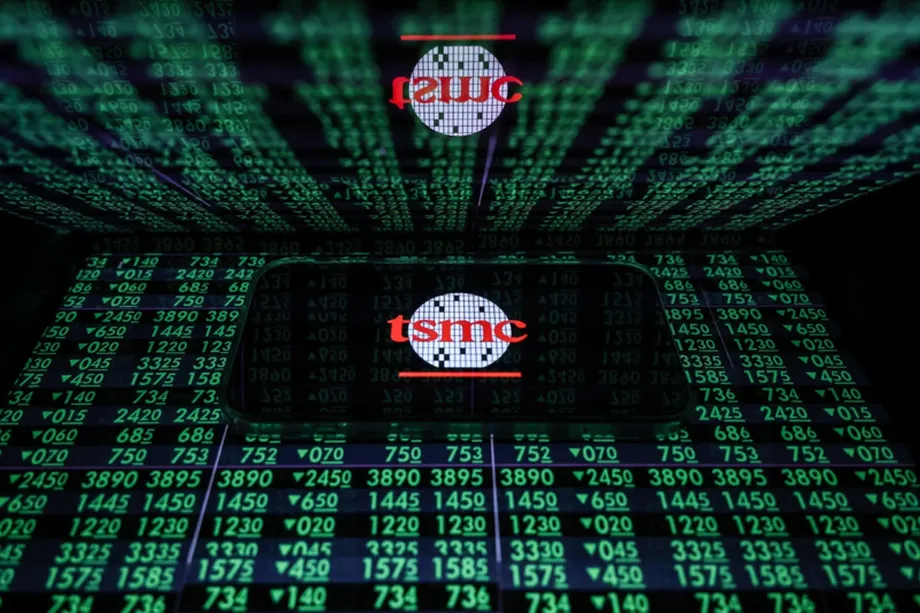
TSMC opened at NT$2,380, down NT$35, and later reached NT$2,360, a fall of NT$55, or about 2.28%. At another morning checkpoint, it traded at NT$2,370, down NT$45. Its decline was estimated to account for more than 300 points of the benchmark's fall.
Large companies have more influence on a weighted index because their market values carry greater weight in the calculation. That helps explain why even a relatively modest percentage decline in TSMC can remove hundreds of index points.
Delta Electronics reached its lower daily trading limit at NT$1,335, with an estimated impact of about 105 index points. Compared with its high of NT$2,585 earlier in the year, that price represented a decline of approximately 48.4%. Chroma ATE, another company that had held an investor briefing the previous day, also reached its lower limit, at NT$1,755, down about 37.2% from its annual high of NT$2,795.
Hon Hai Precision Industry, also known as Foxconn, opened at NT$245 and fell as low as NT$240, down NT$8 from the previous close. Yageo fell more than 9%, while United Microelectronics Corp. (UMC) lost more than 6% at a morning checkpoint.
UMC had already suffered heavy selling on October 29, opening at NT$122 and reaching its lower daily limit at 12:29 p.m., where it remained through the close. That session's volume reached about 337,000 standard trading lots, equivalent to approximately 337 million shares.
MediaTek falls before its afternoon briefing
MediaTek opened at NT$3,820, down NT$225, and reached NT$3,805 during the morning. That low represented a decline of NT$240, or approximately 5.93%, from its previous close of NT$4,045.
The company had reached a record intraday high of NT$5,480 on September 22. By Friday's low, its shares had fallen NT$1,675, or about 30.6%, in a little over a month. For an investor who bought a standard lot of 1,000 shares at that peak, the reduction in the holding's value would be NT$1.675 million before transaction costs.
Wang Chun-sheng, an analyst at Lunyuan Investment Consulting, described the selling before MediaTek's afternoon investor briefing as a contest between expectations and concerns. He identified custom AI chips, smartphone chip demand and the company's business outlook as the main issues investors were watching.
Custom chips are often called application specific integrated circuits, or ASICs. They are designed for particular tasks or customers. For MediaTek, investors wanted to hear how that business and its established smartphone operations might contribute to future growth.
Circuit boards and expensive shares take heavy losses
Circuit board suppliers were among the weakest groups. Unimicron, Kinsus and Zhen Ding Technology fell, while Iteq and Elite Material lost about 8% at a morning checkpoint. Gold Circuit Electronics dropped about 9% and also touched its lower daily limit during the session. Taiwan Union Technology reached its lower limit as it faced pressure around the NT$1,000 share price threshold.
Nine shares in the market's expensive stock group touched their lower trading limits during the morning: Delta Electronics, Chroma ATE, LandMark Optoelectronics, Accton Technology, Auras Technology, Taiwan Union Technology, Innovative Service Technology, All Ring Tech and Gold Circuit Electronics.
Taiwan investors commonly group shares priced at NT$1,000 or more into a closely watched category. Unimicron's fall below that threshold reduced the number in the group to 46. The price threshold describes the cost of one share; companies with fewer shares can have a high share price without being among the market's largest businesses.
Aspeed Technology fell nearly 7%, while King Slide continued lower after dropping below NT$10,000. WinWay Technology reached NT$4,290, compared with its April peak of NT$11,490, a decline of approximately 62.7%. MPI overtook it as the highest priced stock among suppliers of semiconductor testing interfaces.
Weakness extended to display manufacturers Innolux and AUO, both down more than 9%, and memory producers Nanya Technology and Winbond. Cooling supplier Auras reached its lower trading limit. Optical component makers Genius Electronic Optical and Largan Precision fell more than 5% in early trading.
Shipping and selected chip designers resist the selling
Evergreen Marine rose nearly 3%, while Yang Ming Marine Transport and Wan Hai Lines gained more than 1%. Telecommunications shares were relatively steady, with Chunghwa Telecom trading around its record high.
Global Unichip provided a technology exception, rising more than 1.5% during the session. Its September revenue marked a fourth consecutive monthly record, and third quarter revenue reached NT$18.75 billion, up 34.9% from the preceding quarter and 117.7% from a year earlier.
The company's business benefited from increased orders from customers developing central processing units, or CPUs, and sufficient wafer production capacity. CPUs are processors that handle a wide range of computing tasks. Global Unichip develops custom chips for customers rather than selling the same processor design to every buyer.
Jentech, Asia Vital Components and FormFactor's Taiwanese peer Chunghwa Precision Test Tech also moved into positive territory during the session after earlier weakness in parts of the cooling and testing sectors. IC designers Realtek and Prolific Technology gained as well. The movements showed that investors were still buying selected technology businesses even as the broader group fell.
What investors will watch next
MediaTek's afternoon briefing was the nearest scheduled opportunity for investors to assess demand and company expectations. Global Unichip's development pipeline also drew attention, including preparations involving technology and intellectual property for a 2 nanometer manufacturing platform and expectations for customer production increases in 2027.
Cheng Li-cheng, senior executive vice president and spokesperson at Cathay Securities Investment Trust, said he remained positive about AI investment over the longer term and had not seen a major change in business fundamentals. He identified the continuation of AI capital spending and a positive industry outlook as matters to monitor. Capital spending means money used to buy or build assets such as data centers and production equipment.
Cheng also expected market volatility to ease somewhat after November's US midterm elections. His portfolio comments favored a core of funds tracking market value and technology indexes, supplemented by actively managed funds. Those comments reflected his investment approach rather than a promise about market performance.
Securities analyst Chang Chen-hao took a more cautious near term view. He cited disappointing US earnings and forecasts, concerns about December interest rates, selling by institutional and other investors, and a decline in margin borrowing that he considered insufficient. Margin borrowing allows investors to buy shares with borrowed money, increasing both potential gains and losses.
Chang said the index needed to recover its quarterly moving average quickly in the following week to avoid a longer period of consolidation. A moving average smooths prices over a period to show their recent direction. Friday's benchmark also fell below its half year moving average, another reference point watched by traders. His concern was that continued selling and borrowing pressures could prolong the decline even where company valuations had become more attractive.
Key Points
- Taiwan's benchmark fell as much as 1,642.07 points, or about 3.54%, to 44,726.26 on October 30.
- At about 10:35 a.m., the index remained down 1,444.63 points at 44,923.70.
- An estimate based on the maximum decline put the reduction in listed company market value at NT$5.38 trillion.
- Disappointing US technology earnings and concern about returns from AI investment weighed on chipmakers and equipment suppliers.
- Delta Electronics reached its lower daily limit, while MediaTek fell as much as 5.93% before its afternoon investor briefing.
- Smaller companies suffered a steeper decline than the main benchmark, while shipping, telecommunications and selected chip designers resisted the selling.