A faster economy, with uneven rewards
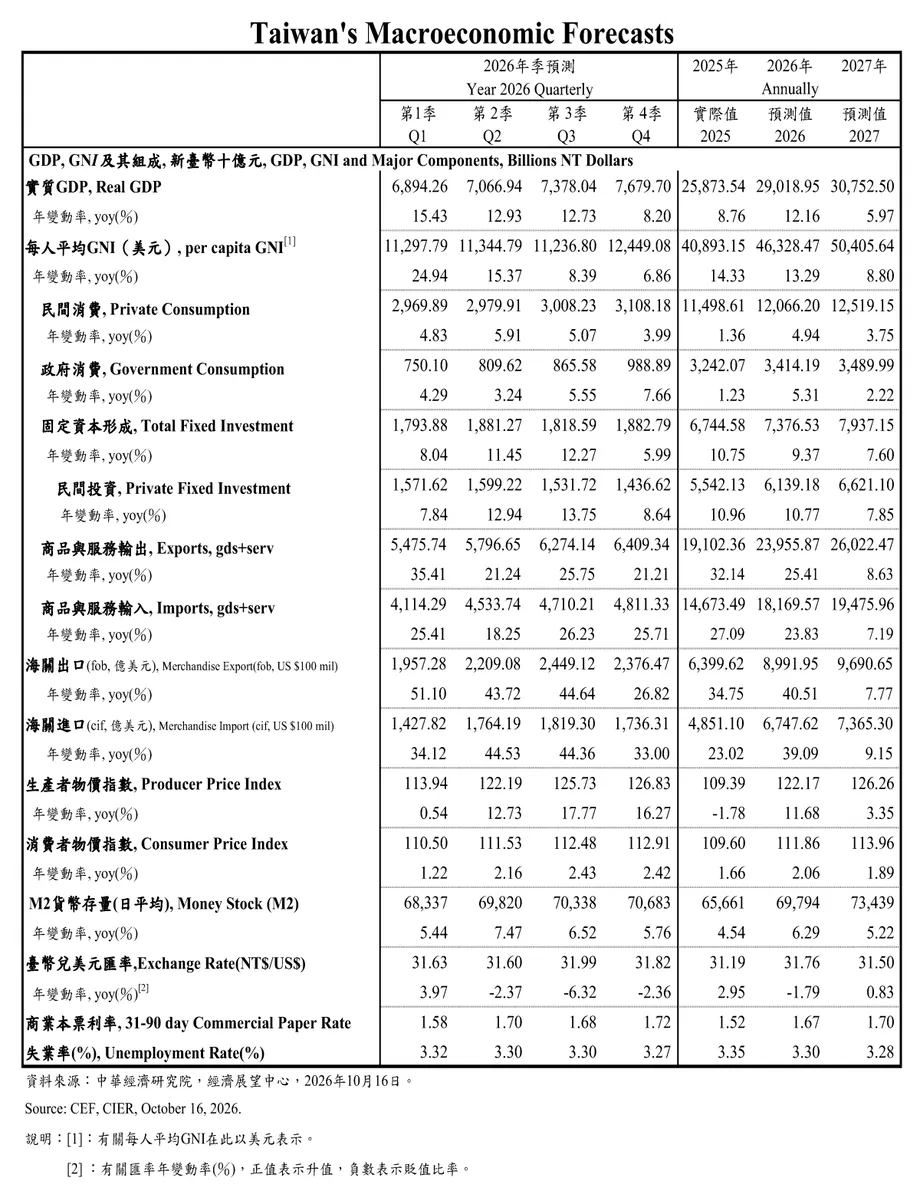
Taiwan's economy is forecast to grow 12.16% in 2026, the Chung-Hua Institution for Economic Research said on October 16, raising its estimate for the third time as artificial intelligence demand drives exports, factory expansion and spending at home. The new projection is 1.81 percentage points above its July forecast of 10.35% and would exceed the 8.76% expansion recorded in 2025.
Contents
- A faster economy, with uneven rewards
- How the forecast changed
- Why growth slows toward December
- AI orders feed spending at home
- Exports approach a new scale
- Why households may feel less prosperous
- Energy costs squeeze purchasing power
- Taiwan stands apart from slower global growth
- What could slow the investment boom
- A slower expansion forecast for 2027
- Key Points
CIER's October forecast statement says monthly exports have exceeded US$80 billion since August and projects annual exports above US$900 billion. Domestic demand is expected to generate 6.63 percentage points of economic growth, with net overseas demand adding 5.53 points.
CIER President Lien Hsien-ming described the strength on both sides of the economy:
This is a very strong year, with both domestic and external demand performing very well,
The institute describes the forecast as the highest growth since 1988. The historical comparison accompanying the announcement places the last higher annual rate in 1987, when Taiwan grew 12.75%, making the projected expansion the fastest in 39 years.
Taiwan's boom nevertheless reaches workers and businesses unevenly. Semiconductor and information technology industries dominate exports and investment but employ a relatively small share of workers. CIER officials say rising share prices have also outpaced the wage gains experienced by ordinary households, while energy and other costs are pushing inflation higher.
How the forecast changed
CIER's October revision rests largely on stronger expectations for domestic demand. Its forecast for the fourth quarter also rose to 8.20%, from 6.04% in July, showing that the institute expects more momentum at the end of the year than it previously anticipated.
The main milestones show how expectations have risen across several forecasting institutions:
- April 2026: The International Monetary Fund forecast Taiwan's annual growth at 5.2%.
- July 2026: CIER projected growth of 10.35%.
- August 2026: Taiwan's Directorate General of Budget, Accounting and Statistics forecast growth of 11.05%.
- October 12, 2026: The IMF raised its projection to 10.7% in its World Economic Outlook.
- October 16, 2026: CIER increased its forecast to 12.16% and raised its 2027 estimate to 5.97%.
CIER's latest estimate is 1.46 percentage points above the IMF projection and 1.11 points above the government forecast released in August. Each figure is a forecast of annual growth, with CIER now taking the most optimistic position among those three institutions.
Why growth slows toward December
Taiwan recorded growth of 15.43% in the first quarter and 12.93% in the second, according to government figures cited by CIER. The institute estimates third quarter growth at 12.73% and forecasts 8.20% for the final three months.
CIER's quarterly economic forecast explains that the final quarter faces a particularly strong comparison: Taiwan's economy expanded 12.95% in the same period of 2025. Annual growth measures how much larger the economy is than a year earlier, so an already large starting point makes another very high percentage increase harder to achieve.
The projected slowdown therefore reflects both the economic cycle and this higher comparison base. Growth would still exceed 10% in each of the first three quarters and remain above 8% in the fourth.
AI orders feed spending at home
Domestic demand is forecast to account for about 55% of Taiwan's growth, compared with roughly 45% from net overseas demand. Private consumption is expected to contribute 2.20 percentage points and investment 2.15 points within the domestic total.
Private consumption is projected to grow 4.94%, compared with 1.36% in 2025, an acceleration of 3.58 percentage points. CIER expects stronger household spending alongside a modest improvement in employment: average unemployment is forecast at 3.30%, down from 3.35% last year.
Investment connects overseas AI demand to activity inside Taiwan. Global cloud service providers, which operate the computing infrastructure used for AI services, continue to expand capital spending. Taiwanese suppliers respond by buying equipment and increasing production capacity.
CIER forecasts fixed capital formation to rise 9.37%, with private investment growing 10.77%. Fixed capital formation means spending on assets used for production over time, such as factories, machinery and infrastructure. Traditional industries are also investing in automation, smarter production systems and power infrastructure upgrades.
Capital equipment imports rose 47.6% in the third quarter, a sign of the scale of demand for machinery. The investment cycle reaches beyond chip production into the equipment and infrastructure needed to support larger industrial operations.
Exports approach a new scale
CIER forecasts customs exports to grow 40.51% in US dollar terms and imports to increase 39.09% in 2026. The projected merchandise trade surplus is about US$224.4 billion, up 44.93% from 2025. A trade surplus is the amount by which the value of goods sold abroad exceeds the value bought from overseas.
Strong demand for chips, electronics and information and communications products is driving the expansion. Both exports and imports of products associated with AI are growing at double digit rates, according to CIER.
The institute separately forecasts exports of goods and services in the national accounts to grow 25.41%, with imports rising 23.83%. Customs figures track merchandise crossing the border, while national accounts measure trade within the framework used to calculate gross domestic product. The measures have different coverage and accounting methods.
Imports matter because Taiwanese businesses buy equipment and inputs from abroad while expanding production. Net external demand, the contribution after imports are deducted, is forecast to add 5.53 percentage points to GDP growth.
Why households may feel less prosperous
Electronic components and information and communications products together account for about 80% of Taiwan's exports, according to economic ministry statistics cited during discussion of the forecast. The same two industries generate more than 70% of private manufacturing investment.
Semiconductor and information and communications industries, however, employ only about 8% of Taiwan's workers. Most people work elsewhere, including traditional industries and services, where the gains from AI demand can be less direct.
Taiwan Semiconductor Manufacturing Co. alone represents more than 40% of the Taipei stock market's total value. That concentration helps explain why a powerful rise in the market can coexist with more restrained income gains for many households.
Lien said the connection between rising share prices and wages was stronger during Taiwan's earlier period of rapid growth. This year, ordinary people's wages and investment income have not kept pace with the stock market.
CIER forecasting center director Su-Ling Peng said employee wages after inflation had been falling compared with a year earlier since April, while consumer confidence had declined. DBS Group senior economist Ma Tie Ying nevertheless saw share market gains supporting consumption through a wealth effect: people whose investments rise in value may feel able to spend more. She judged the gap between stronger and weaker parts of the economy to have narrowed, although disparities remained.
Energy costs squeeze purchasing power
CIER forecasts consumer price inflation of 2.06% for 2026, up from 1.66% in 2025 and slightly above its July estimate of 2.02%. Inflation is expected to reach 2.42% in the fourth quarter.
High international energy prices, weather conditions, labor shortages and wage increases that raise service costs are all adding pressure. The institute says government price stabilization measures have softened the effects of expensive energy, but higher costs still spread through transport, production and other prices. It expects Taiwan's inflation to remain relatively stable compared with other economies.
National Central University economics professor Yao Jui said inflation had exceeded a 2% warning threshold for five consecutive months despite official support for oil, electricity and gas prices. She warned that prices based fully on market energy costs would produce higher inflation if subsidies could no longer be maintained.
Businesses face a sharper increase in prices at the production stage. CIER forecasts the producer price index to rise 11.68% in 2026, reversing a decline of 1.78% in 2025. This index measures prices received by producers rather than the prices households pay in shops. Energy and commodity costs are major pressures behind the increase.
Middle East conflict adds another risk. Disruption affecting energy facilities or shipping routes such as the Strait of Hormuz and the Red Sea could increase oil, freight and insurance costs, reaching Taiwanese firms through their supply chains.
Taiwan stands apart from slower global growth
CIER cites S&P Global's September projection that world growth will slow to 2.41% in 2026 from 2.90% in 2025. Taiwan's much stronger forecast reflects its concentrated role in the hardware required for AI expansion.
The IMF's October outlook also shows a wide regional gap. Its 10.7% forecast for Taiwan compares with 0.7% for Japan, 3.3% for South Korea, 5.0% for Singapore and 3.8% for Hong Kong. It projects growth of 4.5% for China and 2.3% for the United States. Taiwan is the only advanced economy the IMF expects to record double digit growth this year.
According to the IMF, Taiwan and South Korea account for 62% of net trade in computing hardware associated with AI. The concentration places both economies near the center of spending on advanced chips and computing infrastructure.
The IMF projects Taiwan's current account surplus at 22.0% of GDP. The current account includes trade in goods and services as well as income and transfers between economies. Semiconductor Industry Association economist Emma Rafaelof has called for cooperation between the United States, Taiwan and other economies to support continued AI expansion.
What could slow the investment boom
Ma said AI investment, pricing and token usage still point to strong demand. Tokens are the small units of text or other information that AI systems process, so spending on them can help track use of AI services. She cautioned that maintaining exceptionally rapid investment growth becomes harder as the amount already being spent grows.
CIER identifies financing as another concern. Higher interest rates over longer borrowing periods can make large projects more expensive, while heavy capital spending puts pressure on companies' free cash flow, the money left after operating costs and investment. Growing technology sector debt could also affect bond and share markets.
Data center construction creates demands for electricity, water and cybersecurity. Smaller Taiwanese companies have more limited funds than major technology businesses, leaving them more exposed to higher borrowing costs. CIER also lists monetary policy, financial market movements, domestic investment, geopolitical tensions and relations across the Taiwan Strait among the risks.
Yao said the durability of the AI boom depends on productivity gains and corporate profits. She also pointed to the safety of AI agents, systems that can carry out tasks with some independence, including the risk of unauthorized actions or attacks. Stronger US restrictions on AI development and investment could affect Taiwanese export orders, she said.
A slower expansion forecast for 2027
CIER raised its 2027 GDP growth forecast to 5.97%, from 3.71% in July. That would be 6.19 percentage points below its projection for 2026, while still representing continued expansion.
The institute forecasts private consumption growth of 3.75%, fixed capital formation growth of 7.60% and private investment growth of 7.85%. Customs exports and imports are projected to increase 7.77% and 9.15%, respectively, much slower than the rates forecast for 2026.
Consumer price inflation is expected to ease to 1.89%, with average unemployment edging down to 3.28%. For households, that combination would mean slower price increases alongside a slightly stronger employment picture. For businesses, the outlook points to continued demand with a more moderate pace of expansion.
Key Points
- CIER raised Taiwan's 2026 GDP growth forecast to 12.16%, from 10.35% in July.
- Domestic demand is expected to contribute 6.63 percentage points, with net overseas demand adding 5.53 points.
- Annual exports are projected above US$900 billion, supported by AI hardware demand.
- Private investment is forecast to grow 10.77% and private consumption 4.94%.
- Technology industries dominate exports and investment, while gains in wages and household income remain uneven.
- Consumer price inflation is forecast at 2.06% in 2026, easing to 1.89% in 2027.
- CIER expects GDP growth to moderate to 5.97% in 2027.