A new aviation role for China's amphibious fleet
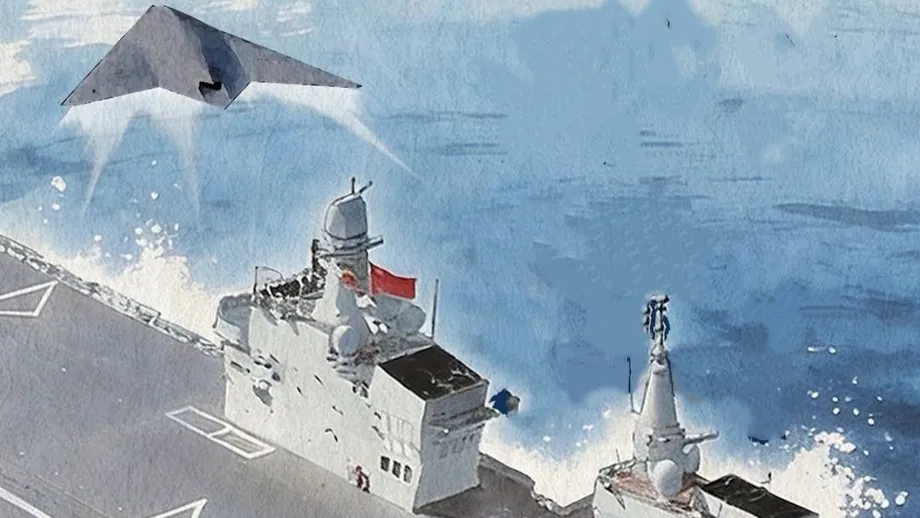
China's navy says its first shipborne stealth reconnaissance and strike drone, the GJ-21, has completed its first takeoff and landing aboard the Sichuan, the country's first Type 076 amphibious assault ship. The announcement on October 30, 2026, connects two closely watched military projects: a combat drone adapted for operations at sea and a ship equipped with an electromagnetic catapult.
Contents
- A new aviation role for China's amphibious fleet
- What the navy announced
- How the Sichuan supports fixed wing drones
- From construction to the reported flight
- What is known about the GJ-21
- What this could change for an amphibious force
- Why earlier American drone flights matter
- The MQ-25 and possible Fujian connection
- Key Points
The Sichuan, hull number 51, was launched on December 27, 2024, and began sea trials in November 2025. China's Ministry of National Defense published an official flight announcement describing the operation as a breakthrough in the development of amphibious assault ships. The vessel is designed to carry fixed wing drones, helicopters and equipment for landing forces ashore.
A navy source quoted in the ministry's announcement described the capability China says it has acquired:
the capability to operate fixed-wing stealth drones from large maritime combat platforms
The practical change is that a ship built to support amphibious operations could also send out an aircraft to gather intelligence or attack targets, then recover it for another mission. That would give the force another aviation option alongside helicopters and landing equipment.
China released no official photograph or video of the actual flight operation with the announcement. The reported milestone therefore rests on the navy's statement, following months of imagery showing aircraft development, deck preparations and tests of the ship's launch equipment.
What the navy announced
The ministry's statement says the GJ-21 "has recently completed its first takeoff and landing operation" aboard the Sichuan. October 30 is the announcement date; the exact flight date, number of flights and detailed launch and recovery methods were not disclosed. Aircraft performance figures, routine operating arrangements and an official commissioning date for the ship also remain unpublished.
Some descriptions of the trial identify an electromagnetic catapult launch and an arrested landing. The ministry's wording is narrower: it announces a takeoff and landing, while separately listing the ship's electromagnetic catapult and arresting equipment. Those technical details matter because they describe how a conventional aircraft could operate from a relatively short flight deck.
The official announcement also says the Sichuan has regularly conducted various sea trials according to schedule since its first sea trial in November 2025, completing equipment debugging and testing of its overall operating stability. In plain language, engineers have been checking whether its machinery, electrical equipment and other systems work properly together at sea.
The immediate milestone is the transition from preparations involving equipment and aircraft models to an officially announced flight operation. Building a regular aviation capability also requires crews to launch, recover, move, maintain and prepare aircraft repeatedly while the ship continues its other duties.
How the Sichuan supports fixed wing drones
The Sichuan has a full length flight deck and two separate island structures above it. The ministry gives its displacement when fully loaded as more than 40,000 tonnes; outside estimates put it at about 50,000 tonnes. Displacement is the weight of water a floating ship pushes aside, which equals the ship's weight.
The vessel was independently designed and built by China and named after Sichuan Province in southwestern China. Construction reporting places the start of hull assembly at Shanghai's Hudong-Zhonghua shipyard in October 2023, about 14 months before its launch.
An electromagnetic catapult uses a moving magnetic field to accelerate an aircraft along the deck until it has enough speed to fly. An arresting system slows a returning aircraft over a short distance, typically when its tailhook catches a cable stretched across the landing area. These systems let aircraft use a deck far shorter than a runway ashore.
The ministry also identifies automated landing guidance and an integrated electric power system. Landing guidance helps direct an aircraft toward a moving deck. The electric system supplies the ship's equipment, including machinery with substantial power demands. Detailed public estimates of its generators and launch capacity remain outside assessments rather than specifications in the announcement.
From construction to the reported flight
The Sichuan's development has unfolded through several visible stages. Photographs during construction suggested the presence of a catapult before official imagery confirmed it. Later preparations involved test loads, an aircraft model and observations of the GJ-21's naval equipment.
- October 2023: Reported start of hull construction at Hudong-Zhonghua in Shanghai.
- December 27, 2024: The Sichuan was launched and named.
- September 3, 2025: The GJ-21 was publicly identified at the military parade in Beijing.
- November 14 to 16, 2025: The Sichuan conducted its first sea trial, including checks of its power and electrical systems.
- Early 2026: An aircraft model was used for loading and deck handling trials aboard the ship.
- April 2026: Flight imagery showed a GJ-21 with landing gear and a catapult launch bar.
- August 2026: Electromagnetic catapult tests using vehicles as test loads were reported.
- October 30, 2026: The navy announced the GJ-21's first takeoff and landing aboard the Sichuan.
Chinese military aviation researcher Andreas Rupprecht also described reports of several GJ-21 aircraft undergoing simulated electromagnetic launches and arrested landings at the navy's Huangdicun facility by late 2025. Testing ashore allows engineers and crews to work on launch and recovery procedures before adding the movement and limited space of a ship.
What is known about the GJ-21
The GJ-21 is widely described as a naval derivative of the GJ-11, the flying wing combat drone publicly unveiled in 2019. Its tailless shape blends the wings and central body rather than using the upright tail surfaces familiar on many aircraft.
Outside assessments identify folding wings, strengthened landing gear, a launch bar and an arresting hook as adaptations for naval use. Folding wings help conserve deck and hangar space. Strong landing gear must withstand demanding recoveries, while the launch bar connects an aircraft to the catapult mechanism.
China describes the GJ-21 as a stealth reconnaissance and strike aircraft. Reconnaissance means collecting information, such as locating ships or observing activity ashore. Strike means attacking a target. Combining the two roles could allow an aircraft to find a target and participate in an attack during the same mission.
Stealth design aims to reduce the distance at which radar can detect an aircraft. Mission results also depend on the drone's sensors, communications, weapons and the defenses it encounters. Public imagery shows aspects of its shape and equipment, while the navy's announcement concentrates on the shipboard flight milestone.
What this could change for an amphibious force
The Sichuan is intended to combine aviation with the movement of troops and equipment toward shore. A recoverable reconnaissance and strike drone could give its commander another way to watch maritime approaches, inspect a landing area or attack selected targets.
An aircraft operating from the ship could return there for fuel, maintenance and preparation for another mission. That creates a different operating pattern from a drone that must return to an airfield ashore. The ship carries its aviation support with it as the force moves.
Space remains a practical constraint. Outside projections suggest a total air group of 30 to 40 aircraft, including helicopters and unmanned aircraft. The eventual mix would share hangar space, maintenance areas, ammunition storage and deck access with the ship's amphibious tasks.
Aircraft handling will also shape the pace of operations. Crews must move returning aircraft away from the landing area, position others for launch and keep routes clear. A reported single catapult makes its availability and the arrangement of aircraft on deck important parts of that process.
Why earlier American drone flights matter
Chinese military analyst Song Zongping described the GJ-21 operation as a "global first" and compared it with the US Navy's X-47B experimental program. The most useful comparison is specific: China is pursuing a large stealth combat drone aboard an amphibious assault ship equipped for catapult launches and arrested recoveries.
Unmanned aircraft have operated from ships before. Pioneer drones made arrested landings aboard USS New Orleans in 1992. The X-47B completed an autonomous landing aboard a US aircraft carrier in 2013, and its demonstration program concluded in 2015.
The X-47B flights explored how an unmanned aircraft could operate in the demanding environment of a carrier deck. The GJ-21 announcement concerns a different aircraft and ship combination, with China presenting the drone as a reconnaissance and attack platform.
The Sichuan also differs from American amphibious assault ships, which operate helicopters, tiltrotor aircraft and, on suitable vessels, F-35B fighters. The F-35B can take off over a short distance and land vertically. The Type 076 instead adds equipment for launching and recovering conventional fixed wing drones.
The MQ-25 and possible Fujian connection
The US Navy's current MQ-25 Stingray program has a different primary job: refueling other aircraft in flight. Carrying extra fuel to aircraft already airborne can help them remain on station longer or reach farther from their carrier. Maritime intelligence, surveillance and reconnaissance is a secondary role.
The American program is also intended to build experience with unmanned carrier aviation, supporting later efforts involving Collaborative Combat Aircraft. These are unmanned aircraft intended to work alongside crewed aircraft. China's GJ-21 effort places reconnaissance and attack at the center of its publicly stated mission.
Song has suggested the GJ-21 could eventually operate from Fujian, China's newest aircraft carrier, which also uses electromagnetic catapults. Such operations would bring the drone into a carrier air group rather than limiting it to an amphibious force.
China has already shown the related GJ-11 in flight with a J-20 stealth fighter and a J-16 in an official video released in November 2025. That footage adds context to China's interest in operating crewed and unmanned aircraft together. The navy's October announcement, however, concerns the GJ-21 aboard the Sichuan, with future Fujian operations still a prospect raised by an analyst.
Key Points
- China's navy announced on October 30, 2026, that the GJ-21 had completed its first takeoff and landing aboard the Sichuan.
- The Type 076 ship, hull number 51, was launched on December 27, 2024, and began sea trials in November 2025.
- The ministry lists electromagnetic catapult and arresting equipment, automated landing guidance and integrated electric power among its systems.
- The Sichuan is designed to carry fixed wing drones, helicopters and amphibious equipment.
- No official imagery of the actual flight accompanied the announcement, and detailed flight and readiness information remains unpublished.
- The GJ-21's stated reconnaissance and strike role differs from the primarily aerial refueling mission of the US Navy's MQ-25.