Taxpayers Face Separate Deadlines for Payments and Applications
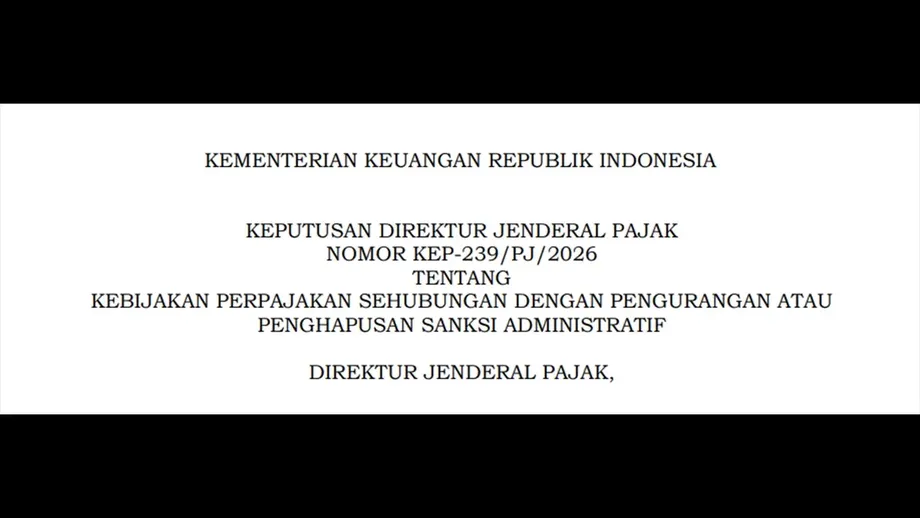
Indonesia's Directorate General of Taxes (DJP) is offering reductions of up to 100% on certain administrative tax penalties under Decision KEP-239/PJ/2026, effective from 8 October 2026. Taxpayers have until 1 October 2028 to apply, but the actions needed to qualify, including filing returns and paying tax, generally must happen much earlier.
Contents
- Taxpayers Face Separate Deadlines for Payments and Applications
- What the Relief Covers, and What Taxpayers Still Owe
- Three Categories Reward Earlier Filing and Payment
- Assessments and Bills Follow Different Rules
- Older Debts and Property Penalties Are Included
- A Longer Window for Certain PPS Assessments
- Applications Require Declarations and a Qualifying Legal Status
- Two Applications Are Allowed, With Three Fines Excluded
- How to Apply and Which Dates to Keep
- Key Points
For eligible late returns, voluntary corrections and late tax payments, the largest reduction applies during 8 October to 31 December 2026. Relief falls to 50% during January to March 2027 and 25% during April to June 2027. Other categories follow different schedules, including reductions of 90% or 75% that require taxpayers to pay part of the penalty.
Director General of Taxes Bimo Wijayanto signed the decision to implement a policy under Finance Minister Regulation 71/2026, which amended Regulation 118/2024. The decision states that the policy aims to improve tax compliance and support the national economy.
The Program Pengurangan atau Penghapusan Sanksi Administrasi, or PSA, reduces qualifying penalties while leaving the underlying tax payable. A taxpayer must still settle the tax itself and meet the conditions for the particular penalty category. Approval requires an application and a decision from DJP.
The practical challenge is keeping track of several clocks at once. The relevant tax period, the filing date, the date an assessment or bill was issued, and the payment date can all affect eligibility or the size of the reduction. The October 2028 application deadline comes after the main compliance windows have closed.
What the Relief Covers, and What Taxpayers Still Owe
DJP describes PSA as relief from specified administrative sanctions, rather than tax amnesty. Administrative sanctions are extra charges imposed for failures such as filing late, paying late or underpaying tax. The principal is the original tax amount that should have been paid.
A tax amnesty involves a different legal arrangement, including disclosure of assets and payment of a redemption amount under the relevant amnesty law. Under PSA, taxpayers pay the underlying tax and seek a reduction or removal of eligible penalties.
Only penalties that remain unpaid or unsettled qualify for relief. Where a category requires payment of a portion of the penalty, the taxpayer pays that required share and seeks relief on the eligible balance. Tax already owed must still be settled according to the applicable conditions.
The decision draws on Article 36(1)(a) of Indonesia's General Provisions and Tax Procedures Law, commonly called the KUP Law, and Article 20 of the Land and Building Tax Law. Its implementation also refers to Article 27A of Regulation 118/2024, as amended by Regulation 71/2026.
Three Categories Reward Earlier Filing and Payment
The first three categories concern late tax returns, voluntary corrections and late payment or remittance. They cover annual income tax returns through tax year 2025 and periodic returns through the September 2026 tax period, subject to the conditions for each category.
An annual return reports income tax for a year. A periodic return reports obligations for a particular tax period. The late filing and voluntary correction categories concern returns showing an underpayment, meaning tax remains due after amounts already paid are taken into account.
Eligible taxpayers receive a 100% penalty reduction for qualifying action during 8 October to 31 December 2026, 50% during 1 January to 31 March 2027, and 25% during 1 April to 30 June 2027. Voluntary correction and late payment cases also require the relevant tax to be paid or remitted within the prescribed window.
For a qualifying penalty, the schedule leaves none of the penalty payable at the 100% rate, half at the 50% rate, and three quarters at the 25% rate. The original tax remains payable in every case. Earlier compliance therefore affects the additional charge, rather than the amount of tax originally due.
Taxpayers correcting a return need to consider both the correction and the resulting payment. Filing a corrected return is one step; paying the additional tax is another condition that can determine access to relief.
Assessments and Bills Follow Different Rules
Three further categories cover penalties recorded in tax assessments and tax collection bills. A Surat Ketetapan Pajak (SKP) is a tax assessment that formally determines a tax position or amount due. A Surat Tagihan Pajak (STP) is a tax collection bill. The decision also covers specified documents for Land and Building Tax, known as PBB.
The fourth category concerns SKP, SKP PBB and STP arising from examinations and issued between 8 October 2026 and 30 June 2027. The related principal tax must be paid or remitted by 30 June 2027. For specified assessment penalties, the reduction depends on how quickly payment follows issuance.
Qualifying SKP and SKP PBB issued from 8 October to 31 December 2026 can receive 100% penalty relief when the principal is paid by 31 December 2026. Another route provides 100% relief when the principal is paid within one month of issuance, subject to the final cutoff of 30 June 2027.
Payment after one month but within two months qualifies for a 50% reduction under the relevant assessment schedule. Payment after two months qualifies for 25%. Both remain subject to payment by 30 June 2027, so an assessment issued near the end of the facility period leaves less time to act.
Specified STP arising from examinations have a different structure. A 90% reduction requires payment of 10% of the penalty. For eligible bills issued from 8 October to 31 December 2026, that payment can be made by 31 December 2026. The schedule also provides 90% relief for payment within one month of issuance, with a final cutoff of 30 June 2027.
A 75% reduction requires payment of 25% of the relevant STP penalty after one month from issuance, again by 30 June 2027. These arrangements make the document type important: some assessments tie relief to payment of principal, while specified collection bills require payment of a penalty share.
Older Debts and Property Penalties Are Included
The fifth category covers penalties in SKP, SKP PBB, STP or STP PBB issued before 8 October 2026. The relevant principal, tax debt and/or required portion of the penalty must be paid by 30 June 2027, according to the conditions applicable to the case.
The sixth category covers penalties in STP or STP PBB issued during 8 October 2026 to 30 June 2027. It also requires the applicable principal, tax debt and/or portion of the penalty to be paid by 30 June 2027. Administrative PBB fines are expressly included in these document categories and the examination category.
The range of potentially eligible sanctions extends beyond late returns. It includes qualifying fines for failures involving the creation or completion of tax invoices under Article 14(4) of the KUP Law, interest on underpayments established through assessments, and certain statutory increases following examinations.
For PBB, eligible sanctions can relate to the submission of a Surat Pemberitahuan Objek Pajak (SPOP), a declaration describing the taxable property, as well as examination findings and late payment. Eligibility and the percentage reduction depend on the relevant legal provision and the decision's conditions.
Taxpayers with older documents therefore need to identify the precise sanction and payment requirements. The 100%, 50% and 25% filing schedule applies to particular categories; other sanctions use their own percentage and timing rules.
A Longer Window for Certain PPS Assessments
The seventh category concerns assessments arising from examinations of assets that participants in the Voluntary Disclosure Program, known as PPS, failed to disclose or disclosed incompletely. The decision refers to Finance Minister Regulation 196/PMK.03/2021, which governs that program.
For this category, the assessment must be issued between 8 October 2026 and 31 December 2027. The related principal tax must also be paid or remitted by 31 December 2027. Those dates extend beyond the June 2027 cutoff used for most other categories.
DJP explains that this is a limited provision for penalties arising from examinations of previous PPS disclosures. Taxpayers remain responsible for the tax arising from the assets concerned.
The different deadlines make the basis of an assessment especially important. An ordinary examination assessment and an assessment concerning an incomplete PPS disclosure can have different qualifying windows, even though both use an SKP.
Applications Require Declarations and a Qualifying Legal Status
Applicants must satisfy Articles 23 and 24 of Regulation 118/2024, as amended by Regulation 71/2026. They must also meet requirements concerning legal proceedings, the reason the penalty arose and its unpaid status.
Taxpayers must have no relevant lawsuit or other legal action underway, or must have withdrawn it. The required evidence includes a declaration that no such action has been filed, or documentation requesting withdrawal where an action was brought.
Assessment objection rules also matter. The conditions address cases where an SKP was not challenged through an objection, where an objection was withdrawn with DJP approval, or where it was not considered. Related requests to reduce or cancel assessments and bills must also meet the applicable procedural conditions.
A separate declaration must state that the administrative sanction arose through oversight or without fault on the taxpayer's part. It must bear a duty stamp and be signed by the individual taxpayer or the representative of a corporate taxpayer. Annex G of KEP-239/PJ/2026 provides a sample format.
The format calls for 14 kinds of information, where applicable. These include the signer's name, taxpayer identification number (NPWP), position, address and telephone number; the represented taxpayer's name, NPWP and address; the assessment or bill number and issuance date; the sanction concerned; and the signature, name and duty stamp.
For applications involving PBB-P5L, the declaration also requires the tax object number (NOP) and the property's location address. A declaration signed by an authorised agent must be accompanied by a special power of attorney.
Two Applications Are Allowed, With Three Fines Excluded
A taxpayer may submit at most two applications for reduction or removal of the relevant administrative sanctions. Rejection of both applications leaves no third application under this procedure.
DJP stated the limit through its official tax assistance account, @kring_pajak. In its statement, translated from Indonesian, the authority explained:
Applications for the reduction or removal of administrative sanctions may be submitted a maximum of 2 times. So, a third application can no longer be submitted.
A second application generally must be filed within three months of the date DJP sends its decision on the first application. An exception applies where the taxpayer can prove that circumstances beyond their control caused the delay. The second request must concern an assessment or bill already covered by a DJP decision on penalty relief.
Article 21A of the amended regulation excludes three specified fines connected with tax disputes. They are a 30% fine for certain objections that are rejected or granted only in part, a 60% fine for certain appeals that are rejected or granted only in part, and a 60% fine following a judicial review decision that increases the tax still payable.
The calculations use the tax amount determined by the relevant decision, less qualifying tax payments made before the objection was submitted. For taxpayers weighing a dispute against an application for relief, the type of sanction and procedural status both affect the options available.
How to Apply and Which Dates to Keep
Applications can be submitted through Coretax DJP. A request must be written in Indonesian and include the taxpayer's calculation of the penalty amount and the reasons for seeking relief. Each request covers one STP or SKP.
The service path is Layanan WP, then Layanan Buat Permohonan Layanan Administrasi, followed by AS.26 Keberatan dan Non Keberatan. The specified subservice is AS.26-03 LA.26-03 Permohonan Pengurangan atau Penghapusan Sanksi Administratif. Applicants upload the required documents, including the stamped declaration and evidence of principal payment.
The main dates form a sequence, with payment and filing obligations preceding the final application deadline:
- 8 October 2026: KEP-239/PJ/2026 takes effect and the principal facility windows open.
- 31 December 2026: The first window for 100% relief on eligible filing, correction and payment sanctions closes; special conditions also apply to certain assessments and bills issued during this period.
- 1 January to 31 March 2027: The reduction for the first three categories falls to 50%.
- 1 April to 30 June 2027: The reduction for those categories falls to 25%, and the main payment and document windows close on 30 June.
- 31 December 2027: The issuance and principal payment window closes for qualifying assessments involving incomplete PPS asset disclosures.
- 1 October 2028: The deadline for submitting applications under the facility.
The 2028 date is the deadline to ask DJP for relief after completing the qualifying actions within their respective windows. Taxpayers need to retain the relevant returns, assessments, bills and payment records so the dates and amounts supporting their application can be checked.
Key Points
- DJP offers up to 100% relief on specified administrative tax penalties under KEP-239/PJ/2026.
- The underlying tax remains payable, and relief applies to qualifying penalties that remain unpaid.
- Seven categories cover late returns, voluntary corrections, late payments, assessments, collection bills and certain PPS findings.
- Relief rates depend on the sanction, document and timing; some categories require payment of 10% or 25% of the penalty.
- Most qualifying actions must be completed by 30 June 2027. Certain PPS cases have until 31 December 2027.
- Applications close on 1 October 2028, subject to eligibility and procedural requirements.
- Applications are limited to two, and three specified fines connected with tax disputes are excluded.