A sleeve with 5,184 pixels and touch controls
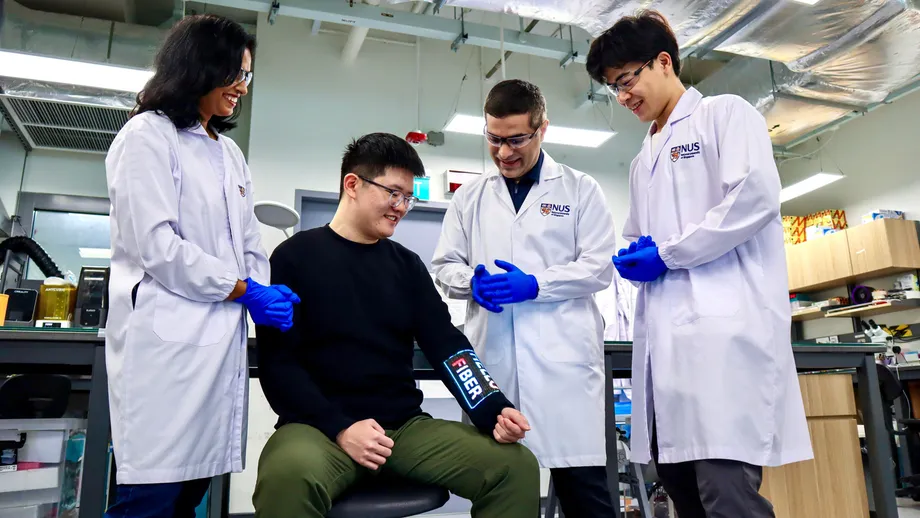
Researchers at the National University of Singapore (NUS) have threaded 54 electronic fibres into a garment sleeve to make a colour touchscreen that can play video, run a calculator and display body temperature. Each fibre carries 96 tiny light emitting diodes, giving the fabric screen 5,184 pixels, while a sensing layer lets it respond to a finger press.
Contents
- A sleeve with 5,184 pixels and touch controls
- The electronics are inside the thread
- How thousands of chips fit into a fibre
- What the screen can show
- A calculator, compass and voice controls
- What happened in washing and bending tests?
- Why healthcare is a target
- Sharper displays and standard textile machines
- From a working sleeve to clothing people can buy
- Key Points
The prototype combines a display measuring 168 millimetres by 105 millimetres with a microphone, speaker and sensors. Its light output and touch response remained nearly unchanged after 50 machine washes with detergent and 1,000 bends around a radius of just 5 millimetres, according to the university.
NUS describes the device as the world's first touchscreen built into a garment. In its research announcement, the university says the team published its findings in Nature on 21 October 2026. Assistant Professor Tural Khudiyev, from the Department of Materials Science and Engineering at NUS's College of Design and Engineering, led the work.
The electronics are inside the thread
The sleeve's screen is made from fibres containing both light producing components and touch sensors. Each multilayer thread is about 1 millimetre thick, and the researchers describe making a thread 10 metres long. The number 54 refers to the pixel fibres used in the sleeve, rather than their thickness.
Khudiyev said the advance depended on creating the building blocks of a graphical user interface, the visual controls people use to interact with a device, in fibre form. He explained how the researchers connected large numbers of electronic components along a narrow thread:
We overcame this limitation through a new interconnection architecture, which enables thousands of microelectronic devices to be integrated and interconnected along a fibre.
The result brings the display and its controls into the material of the clothing. A wearer can see information and press the same textile surface to interact with it.
How thousands of chips fit into a fibre
The researchers first developed a programmable way to make electrical connections along tiny insulated wires. A laser exposes the wires at selected points, creating places where individual microchips can be connected.
Molten solder, a metal used to join electronic components, is then guided to those exposed locations. By controlling how the liquid solder spreads across the surfaces, the team makes it bond at the intended points. The method connected more than 5,000 chips through over 20,000 electrical connections.
A thermal drawing process then incorporates the connected strip of digital LEDs into a multilayer fibre. This produces a thread with separate layers for displaying light and detecting touch, arranged together along its length.
The touch sensing layer sits beneath the LEDs. Pressing the fibre completes an electrical circuit, and the resulting signal identifies where the finger landed. The system can then light the nearest pixel. In simple terms, the thread both shows something and detects when someone presses it.
What the screen can show
The sleeve has a resolution of 96 by 54 pixels and refreshes 30 times per second. A pixel is one of the small points that make up an image; the refresh rate describes how often the display updates. NUS specifies an 8-bit colour depth, a measure of how colour information is represented.
The prototype can display photographs and play video at 30 frames per second, or 25 frames per second when the video includes synchronised audio. It can also receive images over Bluetooth, allowing another device to send visual content wirelessly to the garment.
The screen has far fewer pixels than a modern smartphone, so photographs, text and video have limited detail. Its present strength is demonstrating that a textile can combine a colour display with touch controls while remaining flexible enough to wear.
Each of the 54 display fibres has its own control channel. If one line develops a fault, neighbouring lines can continue working. The system also registers several touches at once, giving it more flexibility than a textile control that detects only a single press.
A calculator, compass and voice controls
Additional electronic fibres give the sleeve functions beyond displaying images. They carry a microphone, a speaker and sensors that detect movement, magnetic north, temperature and the brightness of the surroundings.
Together, these components let the prototype run a calculator, show a photo gallery, work as a compass and respond to voice commands. Movement and light sensing also allow the screen to rotate and adjust its brightness automatically.
The functions resemble some of those found in early smartphones, distributed through threads rather than concentrated in a rigid panel. For a wearer, that could mean checking a direction, viewing a received image or using a simple control directly on a sleeve.
Temperature sensing extends beyond the forearm display. When the temperature sensing fibre is placed under the arm, the garment can read body temperature and show the result on its screen. The sensor and the display can therefore occupy different parts of the clothing while working together.
What happened in washing and bending tests?
The garment went through 50 detergent washes in a typical washing machine. NUS says its light output and touch response were nearly unchanged afterwards. Those two measurements address whether the display still produces light and whether it still detects a user's input.
The researchers also subjected the textile to 1,000 bends around a radius of 5 millimetres, again finding little change in display and touch performance. Bending matters because a sleeve must move repeatedly as its wearer reaches, turns an arm or folds clothing.
NUS says the completed display is as breathable as cotton, polyester and denim. Breathability allows air and moisture to pass through clothing, helping explain why a textile filled with electronics might still feel suitable to wear.
The university also says the display stays within established safety limits for skin contact. Together, the washing, bending, breathability and safety results address several practical demands that ordinary clothing faces, alongside the separate task of making the electronics work.
Why healthcare is a target
Khudiyev identified healthcare as a promising use for garments that combine sensors, displays and controls. The prototype already brings together a body temperature reading and a way for the wearer to see it directly on the clothing.
He described a broader possibility in which the garment collects physiological information, meaning measurements related to how the body is functioning, and makes that information accessible through the textile:
A garment could continuously collect physiological information through fibre-based sensors and allow the wearer to access and interact with that information directly through their clothing. Combined with artificial intelligence (AI), this could enable personalised health monitoring, feedback and assistance.
The practical appeal is the connection between measurement and access. A sensor could gather a reading elsewhere in a garment, while a sleeve provides a visible place to check it and a touch surface for selecting information.
Continuous monitoring, personalised assistance and other health functions are development goals. The work described so far centres on a prototype that demonstrates how sensing, display and interaction can share a textile platform.
Sharper displays and standard textile machines
The NUS team plans to pursue higher resolution, more integrated sensing and artificial intelligence running on the device itself. Processing information locally would allow the textile system to handle some tasks within its own electronics.
Smaller microchips and thinner fibres offer a route to sharper and larger screens, according to the university. More closely spaced light producing elements would allow the display to show finer detail, addressing one of the current prototype's main limits.
The arrangement of components along the fibres also matters for manufacturing. NUS says thinner versions could be knitted, woven or embroidered using standard industrial machines. That would connect the electronic fibre technology with methods already used to make clothing.
The team also sees possible uses in tracking health signs and delivering feedback through touch. These would expand the garment's role from showing information to sensing the wearer and communicating in more than one way.
From a working sleeve to clothing people can buy
The researchers have brought several functions together in one garment: a colour screen, multiple touch inputs, wireless image reception, sound and environmental sensing. The durability tests add a practical dimension because the sleeve continues to work after repeated washing and bending.
A commercial release date and price have not been announced. The next stated steps focus on improving image detail and integrating sensing and AI more closely, rather than setting a date for touchscreen clothing to reach shops.
The prototype's most useful advance is the way those functions share the fabric. A reading can come from one part of the garment, appear on another and be selected through a finger press, while the material continues to bend and let air through. That combination gives the researchers a concrete platform to develop further.
Key Points
- NUS researchers integrated 54 electronic fibres into a sleeve to create a colour touchscreen with 5,184 pixels.
- The display measures 168 millimetres by 105 millimetres, supports multiple touches and refreshes 30 times per second.
- The prototype plays video, runs a calculator, receives Bluetooth images and displays body temperature.
- Light output and touch response were nearly unchanged after 50 machine washes and 1,000 tight bends.
- The team plans sharper displays, more integrated sensing and AI within the textile system.
- No commercial release date or price has been announced.