Food saved from tables can carry hidden risks
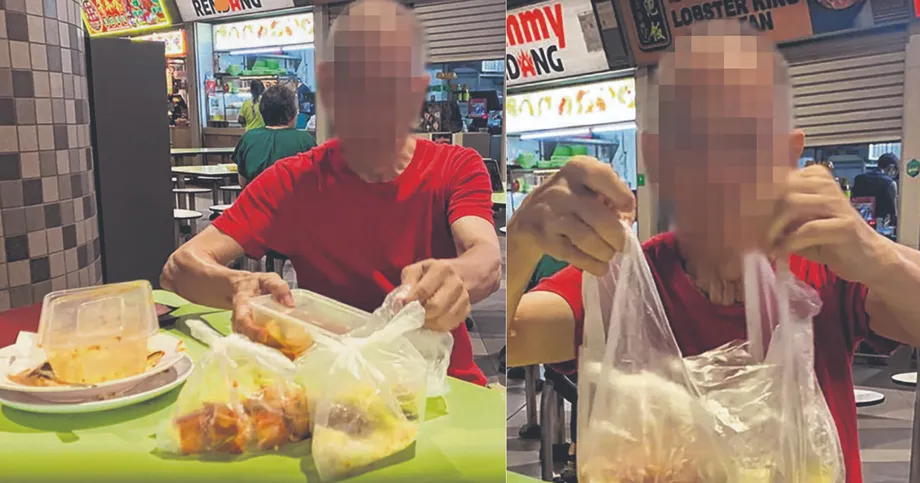
At Our Tampines Hub Hawker Centre, a man believed to be in his 60s or 70s has been collecting food left behind by diners each day and packing it to take home. He told a resident that he wanted to avoid waste and would eat the food for dinner.
Contents
- Food saved from tables can carry hidden risks
- A daily routine in Tampines
- Wang says waste, not money, drives his choice
- Different visits reveal different routines
- What the dated observations show
- Why time and temperature matter
- A food sharing advocate urges caution
- Assistance begins with understanding the person
- Key Points
Cleaners have described similar behaviour at People's Park Food Centre in Chinatown, where two or three elderly men repeatedly collect food from tables and tray return stations. An earlier account, published on November 3, 2022, described at least seven elderly people regularly collecting or eating leftovers there.
The accounts bring together two concerns: why people are eating food abandoned by strangers, and how to protect their health without overlooking their individual circumstances. One man, 84-year-old Wang from Pasir Ris, said he could afford meals but disliked seeing food thrown away. Other men have not explained their reasons.
The Singapore Food Agency (SFA), in its food safety guidance, says bacteria grow most rapidly between 5°C and 60°C. It advises keeping hot cooked food above 60°C until serving and storing chilled food at 4°C or below.
A plate left on a hawker centre table has usually moved outside those controlled conditions. Someone collecting it may know little about when it was cooked, how long it has stood there or what happened to it while the previous diner was eating.
A daily routine in Tampines
The resident at Our Tampines Hub described seeing the older man pack unfinished food from tables every day. Some hawker centre workers have also noticed him collecting food but have avoided intervening because they wanted to prevent conflict.
A cleaner described another elderly man who had been doing the same daily for four to five years. She said he also bought drinks at the centre. The duration suggests a longstanding routine for that individual, although the accounts do not give a starting date or explain his circumstances.
Taking food home for dinner adds another period between collection and eating. The man's account does not say how he transports, stores or reheats it. Those steps matter because bacteria can multiply while cooked food remains warm rather than properly hot or chilled.
The workers' reluctance to approach him also shows a practical difficulty. Cleaners and stall staff may see the same person repeatedly, yet an unsolicited question about food or money can lead to an uncomfortable encounter.
Wang says waste, not money, drives his choice
In Chinatown, Wang offered a direct explanation for his habit. The 84-year-old said he lived in Pasir Ris, had a family and children, and had begun visiting Chinatown a few months before he was interviewed because he enjoyed its lively atmosphere. He returned home in the evening.
Wang said he could afford food. What troubled him was seeing diners leave substantial portions behind, including fish and plates that appeared almost untouched.
Wang, an elderly diner who acknowledged eating other people's leftovers, described his reason this way:
The food is still warm," he said. "It's such a waste. That's why I eat them.
Warmth helps explain why the food may seem acceptable to him. SFA's guidance, however, sets a specific temperature for keeping cooked food hot: above 60°C. Food that feels warm may sit within the range in which bacteria grow rapidly.
Wang also said the people he had seen eating leftovers generally kept to themselves. His account describes his own choices; the reasons other individuals collect food require their own explanations.
Different visits reveal different routines
A 52-year-old vendor surnamed Du, who had operated a stall in the People's Park area for more than 10 years, described about three people coming daily to eat leftovers; another account put the number at three to four elderly people. Du said some appeared around 8pm or 9pm, while cleaner Ah Quan described regular visits beginning around 10am and other workers mentioned lunchtime.
A stall assistant surnamed Ma, 50, said she had seen a man start eating unfinished food almost immediately after diners left. Du said customers sometimes responded by buying meals for the people collecting leftovers.
The November 2022 account described a wider group of at least seven regulars, including a man who collected food in the morning and four other elderly men seen doing so in the afternoons and evenings. Some ate at the centre; one brought a box or bag to carry food away.
Those observations describe people seen at particular times, rather than a continuous count. They also show why a single response may not suit everyone: some people collect a meal to eat later, while others sit down at an uncleared table and eat immediately.
What the dated observations show
The clearest sequence comes from visits in October 2022 and the subsequent account of the Ministry of Social and Family Development's response. The Tampines observations and Wang's interview are not assigned a year here, so they sit outside this dated sequence.
- October 21, 2022: At about 10am, a man was observed eating food from a plate at a tray return area before finding leftover noodles at a table. Another regular was seen looking for food at about 1pm.
- October 22, 2022: A 68-year-old man identified as Mr Hong ate leftover noodles using the previous diners' cutlery while drinking beer.
- October 28, 2022: Another man whom a cleaner recognised as a regular collector of leftovers was seen buying three bottles of beer.
- November 3, 2022: An account of the incidents said the ministry was working with grassroots volunteers and hawkers to identify the elderly people and offer assistance where needed.
Drinks stall assistant Mr Zhang said Mr Hong had bought his beer. Cleaner Ah Quan also mentioned seeing a man who ate leftovers purchase drinks. Wang, meanwhile, explicitly said he had money for food.
Financial circumstances are more complicated than a single purchase. For outreach workers, the useful next step is to ask about a person's access to meals, living arrangements and willingness to accept support. Mr Hong declined to explain why he was eating leftovers.
Why time and temperature matter
A doctor commenting on the hawker centre behaviour warned that eating food left by strangers could increase the risk of food poisoning and infectious disease. The doctor said cooked food left out for more than two hours could spoil, with greater health risks for people whose immune systems are weakened.
SFA's advice explains the underlying process. Bacteria can multiply quickly between 5°C and 60°C, its temperature danger zone. Keeping food sufficiently hot or cold slows that process. Leaving a cooked meal at ordinary surrounding temperatures gives bacteria more opportunity to grow.
Collection time is only part of the calculation. A person picking up noodles just after a diner leaves may still have no idea how long those noodles were on the table before that moment. Packing them for dinner extends the interval further.
Food handling creates another route for contamination. Used utensils, hands and contact with a diner can transfer germs. SFA advises separating portions of stored cooked food onto a clean dish so that the remaining food is protected from contamination.
SFA recommends reheating stored cooked food to at least 75°C for at least two minutes and reheating it no more than once. Its storage advice also calls for clean, covered containers and refrigeration or freezing after cooked food has cooled. Someone retrieving an abandoned plate generally lacks the history needed to know how it has been handled.
A food sharing advocate urges caution
Daniel Tay, a co-founder of Freegan In Singapore, warned against eating strangers' discarded meals. Freegan practices include receiving unwanted food and other items for free, with an aim of reducing waste.
Tay said uncertainty about how long food had been left out was one reason he discouraged collecting leftovers:
"I don't encourage [eating leftovers], because we don't know for how long the food has been left out before eating it," Tay said.
Tay also warned about contamination by pests or by the previous diner, including someone who was ill. His concern covers both the time food spends unattended and the contact it has already had with other people.
He suggested speaking to diners while they were still at their table and asking about food they could not finish, rather than retrieving it after they left. He said that conversation could also make diners more conscious of the food they wasted.
SFA's handling and temperature guidance remains relevant to any food being shared. For diners who want to reduce waste, the agency's advice to buy only what they can consume offers a simpler starting point: avoid ordering more than they expect to eat.
Assistance begins with understanding the person
In its response described in November 2022, the Ministry of Social and Family Development said it was working with grassroots volunteers and hawkers to identify the elderly people involved. Financial assistance or food support could be provided if needed.
The ministry then directed members of the public to call 1800-222-0000, approach Family Service Centres or Social Service Offices, or use the Help Neighbour feature in the OneService App to connect someone with assistance. These were the contact routes given in that 2022 response.
No outcome of those individual assessments, or date for a further update, was given. The Tampines accounts likewise give no details of whether the men collecting food have been approached by social services.
Wang's explanation, the workers' observations and the ministry's response point to a practical approach: understand each person's reason for collecting food, offer help where it is needed and address the health risk directly. Reducing waste and ensuring older people have access to safely handled meals can be pursued together.
Key Points
- Elderly men have been seen collecting or eating diners' leftovers at Our Tampines Hub and People's Park Food Centre.
- Wang, 84, said he could afford meals and ate leftovers because he disliked food waste.
- A November 2022 account described at least seven regular collectors at People's Park and a ministry effort to identify them and offer support.
- SFA says bacteria grow most rapidly between 5°C and 60°C and advises keeping hot cooked food above 60°C until serving.
- Food left on tables carries uncertainty about storage time, handling and contamination, especially when it is taken home to eat later.