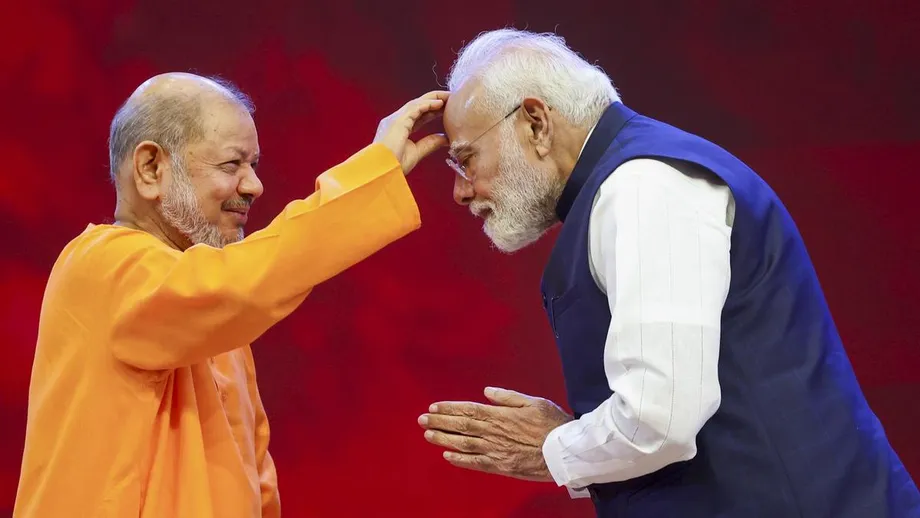
A digital encounter recalls a meeting in 1993
Prime Minister Narendra Modi sought blessings from a digital recreation of Swami Chinmayananda on October 23, 2026, opening a gathering at New Delhi's Bharat Mandapam that brought spiritual remembrance, artificial intelligence and a message about India's development onto the same stage.
Contents
- A digital encounter recalls a meeting in 1993
- What Modi remembered about Chinmayananda
- Why the Mission is marking 75 years
- What the Holobot brings together
- Why the blessings drew debate
- A gathering extending beyond the avatar
- A youth journey measured in kilometres and contacts
- Education and heritage enter the address
- Modi connects the anniversary to 2047
- Key Points
The Chinmaya Amrit Mahotsav Global Sammelan, scheduled for October 23 to 25, was expected to bring together more than 9,000 participants. Its most striking exchange involved a holographic avatar of the spiritual teacher, who died in San Diego on August 3, 1993.
Modi recalled meeting Chinmayananda that year and asked the recreation for blessings for his future work. The avatar responded with a personal message of support.
The digital avatar, described as the Swami Chinmayanand Holobot, addressed the prime minister directly:
India is with you, Narendra.
Modi described the encounter as deeply emotional. In the Prime Minister's Office's published inauguration address, he identified Vadodara as the location of their 1993 meeting and said the recreation brought back their conversation, Chinmayananda's affection and his blessings.
The event also presented the Mission's work beyond the stage: a journey connecting young people, more than 100 educational institutions and programmes bringing the Bhagavad Gita to audiences through music, chanting and selected verses.
What Modi remembered about Chinmayananda
Modi said he met Chinmayananda around February or March 1993 to invite him to the centenary celebrations of the Parliament of the World's Religions in Chicago. The anniversary marked 100 years since Swami Vivekananda's historic address there.
According to Modi, Chinmayananda accepted the invitation, travelled to the United States and encouraged participation through other programmes. He died a few weeks before the Chicago gathering. Modi said he attended the September 11 event and felt the teacher's absence.
The discussion in Vadodara, Modi recalled, centred on building the strength of young people and using it to create a capable India. He connected that conversation to his own subsequent career, saying he had served as a head of government for 25 years, beginning with his tenure as Gujarat's chief minister.
The key dates connect the personal recollection with the anniversary programme:
- 1951: Chinmayananda began delivering the discourses whose anniversary the Mission is celebrating.
- 1953: Chinmaya Mission was formally established.
- February or March 1993: Modi said he met Chinmayananda in Vadodara to discuss the Chicago centenary.
- August 3, 1993: Chinmayananda died in San Diego.
- September 11, 1993: Modi said he attended the gathering in Chicago.
- 2015: Modi released a commemorative coin honouring Chinmayananda during his birth centenary celebrations.
- October 23 to 25, 2026: The Global Sammelan takes place at Bharat Mandapam.
Why the Mission is marking 75 years
The anniversary counts from Chinmayananda's teaching work in 1951. Chinmaya Mission's formal establishment followed in 1953. Those two milestones explain why the gathering marks 75 years in 2026.
Born Balakrishna Menon in Kerala in 1916, Chinmayananda worked as a journalist and participated in India's freedom movement before pursuing spiritual study. He learned from Swami Sivananda in Rishikesh and later studied Vedanta under Swami Tapovan Maharaj.
Vedanta is a tradition of Hindu philosophy concerned with the self, reality and spiritual knowledge. Chinmayananda's public discourses sought to make its ideas, along with the teachings of the Bhagavad Gita, accessible to ordinary people.
His organisation subsequently expanded into education, study groups, youth activities and community service. Modi described Chinmaya Mission as an ideal extending beyond an institution, linking its teaching work with personal growth and service to the country.
Chinmaya means pure consciousness. In his address, Modi connected that idea with the anniversary's language of immortality, explaining it through the endurance of knowledge and awareness across generations.
What the Holobot brings together
The Holobot combines a visual recreation of Chinmayananda with a conversational interface. Put simply, one part presents the figure people see, while another handles the spoken exchange.
Descriptions of the demonstration refer to archival voices and images, recreated expressions and AI responses. One technical explanation describes speech recognition converting a question into text, followed by a generative language model drawing on Chinmayananda's ideas, writings and speeches to compose a reply. Other descriptions refer to recorded material combined with apparently immediate responses.
A generative language model is software that produces new wording using patterns learned from material it has processed. A voice model can turn that wording into speech resembling a particular person, while a visual system presents a corresponding face and figure.
Chinmaya Mission preserves photographs, letters, books, recorded talks and personal recollections in its archives. Such records provide material for recreating appearance and speech, as well as for presenting the teacher's ideas.
The organisers have not publicly detailed the complete technical setup, the division between prepared and generated responses, or how replies were checked. Descriptions mentioning lasers, cameras and projection therefore leave the precise display method unresolved.
Why the blessings drew debate
The avatar's personal address to Modi made the demonstration more emotionally charged than a recording of an old lecture. It used the likeness and voice of a deceased spiritual teacher to participate in a new conversation with a serving prime minister.
For followers, that format offers a way to revisit a familiar teacher through speech and imagery rather than only through books or recordings. Modi's account focused on this feeling of recognition and the memories the encounter brought back.
The recreated figure also referred to the responsibilities of younger people. In the exchange, the Holobot spoke in Chinmayananda's voice about age, illness and passing responsibility to Hindu youth:
This old and sick man couldn't shoulder such a huge responsibility. Now Hindu youth would have to take on this responsibility.
Social media reactions included praise for the technology and criticism of its use in a religious setting. Some users compared the demonstration with AI applications in China and questioned the priorities behind such projects. The comments reflected responses to the circulating clips; no measure of wider public opinion accompanied them.
The central issue is how faithfully a recreation carries a teacher's ideas into newly composed speech. When the output includes a personal blessing or political encouragement, editorial choices about wording become part of the encounter people experience.
A gathering extending beyond the avatar
Chinmaya Mission's official event programme describes the Sammelan as a reunion of devotees from India and more than 25 other countries. The gathering concludes a year of anniversary activities and brings together spiritual teachers, volunteers and followers.
The programme includes Vedic chanting by religious teachers and trainees, the Chinmaya Amrit Musical, a conclave on Non-Dualism for World Understanding and the Chinmaya Experience Exhibition.
Nondualism is the philosophical view that apparent differences between the individual self and ultimate reality conceal a deeper unity. Its place in the programme connects the Mission's philosophical teaching with discussion about understanding across communities.
The anniversary activities also reached audiences outside the Delhi venue. They included mass havans, or rituals involving offerings into a sacred fire, and the consecration of the Maa Soundarya Chinmayi Temple in Tripura.
Under Chinmaya Gita Samarpanam, more than 100,000 people worldwide joined online chanting of the Bhagavad Gita's 15th chapter. Another initiative, Gita Panchamrit, focused on five selected verses. The celebrations began the previous year with Modi releasing a Tamil versification of the Gita at Gangaikonda Cholapuram in Tamil Nadu, with music composed by Ilaiyaraaja.
A youth journey measured in kilometres and contacts
Fifteen members of Chinmaya Yuva Kendra, the Mission's youth wing, undertook the Chinmaya Amrit Yatra to carry the Gita's teachings to communities. Modi said the participants travelled 40,000 kilometres over nearly 300 days and contacted more than 100,000 young people.
The Mission's event announcement had described a planned journey of nearly 35,000 kilometres through India, Nepal and Sri Lanka. Modi's inauguration address gave the later distance as 40,000 kilometres, about 5,000 kilometres more than that advertised figure.
The difference matters because the Yatra was a central part of the anniversary, linking the large gathering in Delhi with activities in communities along the route. Its stated purpose was to take the teaching outward, rather than limit the celebration to those able to attend Bharat Mandapam.
Modi congratulated the team and connected its work to his recollection of Chinmayananda's concern for young people. The speech placed those volunteers alongside the Mission's educational network as practical expressions of its founder's teaching.
Education and heritage enter the address
Modi said Chinmaya Mission operates more than 100 educational institutions serving children and young people. He described their approach as combining modern education with Indian values, then linked that work to the government's National Education Policy.
His account of the policy highlighted learning in the mother tongue, Indian knowledge traditions, modern science and new technology. For the Mission's schools and colleges, the speech placed classroom education alongside spiritual instruction as a continuing responsibility.
Modi also recalled Chinmayananda's support for the Vivekananda Rock Memorial in Kanyakumari. He said the teacher backed Eknath Ranade's effort to build the memorial and made its first financial contribution.
The prime minister widened that discussion to government work on religious and cultural sites, naming Kashi Vishwanath Dham, the Ram temple in Ayodhya, Mahakal Mahalok in Ujjain, Kedarnath and Badrinath. He also said more than 650 stolen ancient statues had been brought back to India during the preceding 12 years.
Those examples formed part of his argument that preserving heritage and taking Indian traditions to international audiences belonged within the same national project. He cited International Yoga Day as another way India's traditions reach people abroad.
Modi connects the anniversary to 2047
Modi's closing appeal asked the Mission's followers to address new social challenges, promote self reliance and connect their work with the goal of a developed India by 2047, the centenary of independence.
Speaking as prime minister to the gathered religious teachers and followers, he called for collective action:
Today, we have to unite society against divisive forces, and make our fellow citizens aware of self-reliance.
He said Chinmaya Mission's approach towards its own centenary would run alongside the country's progress towards 2047. Counting from the 1951 teaching milestone, the Mission's centenary falls in 2051, four years after the independence centenary.
The appeal gave the anniversary a purpose beyond remembrance. Modi asked an organisation with schools, youth groups and an international network to connect its existing activities with national development goals. The holographic encounter supplied the event's most memorable image; the address directed attention towards what the living organisation and its members would do next.
Key Points
- Modi interacted with a Chinmayananda Holobot at Bharat Mandapam on October 23, 2026, and sought blessings for his future work.
- The three day gathering marks 75 years since Chinmayananda began his discourses in 1951. Chinmaya Mission was formally established in 1953.
- More than 9,000 participants were expected, with the Mission advertising attendance from India and over 25 other countries.
- Modi said the anniversary youth journey covered 40,000 kilometres in nearly 300 days and reached more than 100,000 young people.
- The avatar prompted both interest and criticism, while its complete technical setup and response checking process remained undisclosed.
- Modi linked the Mission's education, youth and cultural work to the goal of a developed India by 2047.