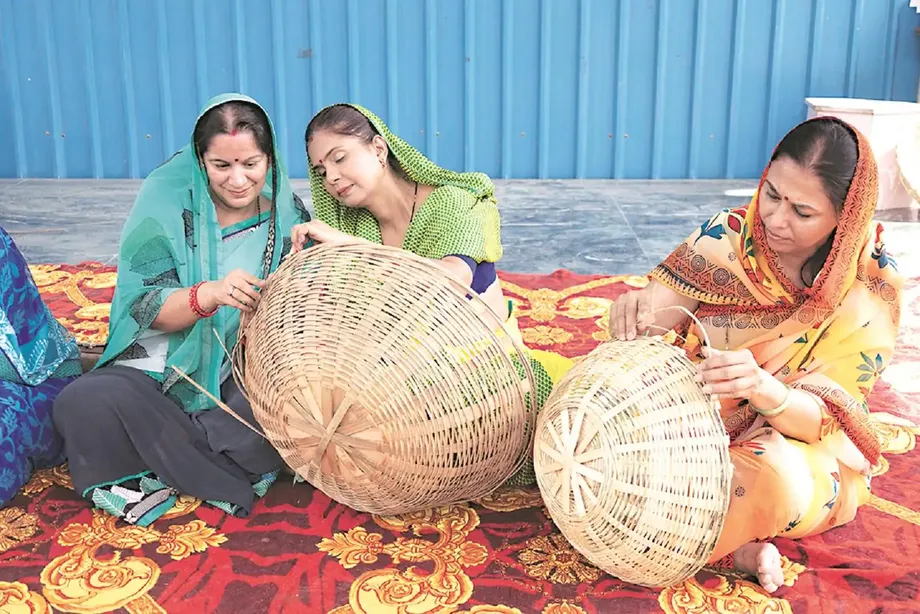
A surge in participation, without a matching rise in wages
Rural women's labour force participation in India rose from 24.6% in 2017-18 to 47.6% in 2023-24, an increase of 23 percentage points. Yet 59% of rural women classified as self-employed were unpaid helpers in family enterprises, according to an analysis by Oxfam researcher Diya Dutta. The central finding is that many more women are entering recorded employment without receiving a wage of their own.
Contents
- A surge in participation, without a matching rise in wages
- What the employment figures actually count
- A rural transformation within a national recovery
- Why agriculture is absorbing more women
- Earlier research found the same unpaid work pattern
- Better counting and financial pressure can happen together
- Uttar Pradesh shows where vulnerability is concentrated
- Household care continues alongside economic work
- Public employment and the meaning of low unemployment
- Key Points
Oxfam's India's Invisible Half, written by Dutta, argues that the increase reflects household financial pressure, better recognition of previously overlooked work and a shortage of suitable jobs outside agriculture. Women working on family farms can now appear in employment statistics even when their work brings no separate payment.
The shift is substantial. Self-employment accounted for 72.2% of rural women's employment in 2023-24, up from 57% in 2017-18. Over the same period, the share in regular salaried work fell from 11% to 8%, while casual labour fell from 32% to 20%.
For families, unpaid farm work can help sustain production and reduce the need to hire workers. For women, however, contributing to household income through a family enterprise is different from receiving earnings they can control. Oxfam places that difference at the centre of India's employment debate.
What the employment figures actually count
The labour force participation rate measures the share of people who are working or looking for work. The worker population ratio measures only those who are working. Neither measure requires every person counted as employed to receive a separate wage.
India's Periodic Labour Force Survey, or PLFS, divides self-employment into people working on their own account, employers and unpaid helpers in household enterprises. A woman running a business and a woman helping on a family farm without pay can therefore belong to the same broad employment category.
Using Oxfam's figures, 72.2% multiplied by 59% suggests that roughly 43% of all rural working women were unpaid family helpers. Another analysis of PLFS data puts the share at 42.3%, or more than two in five rural working women.
The falling shares of salaried and casual work describe a changing employment mix. As the total number of working women grows, a smaller percentage in a category can coexist with an increase in the number of people doing that work. The concern is that paid jobs are occupying less space in the expanding workforce.
A rural transformation within a national recovery
India's national female labour force participation rate rose from 23.3% in 2017-18 to 41.7% in 2023-24. The rural figures, 24.6% and 47.6%, show a much larger increase than the urban figures, which rose from 20.4% to 28%.
Rural participation therefore increased by 23 percentage points, compared with 7.6 points in cities. That is about three times the urban increase. Between 2022-23 and 2023-24 alone, rural female participation rose by 6.1 percentage points.
Oxfam places this recovery within a longer, uneven history. Its female worker population ratio series records 29.7% in 1977-78, a low of 16.5% in 2017-18 and 40.3% in 2023-24. The paper also cites a World Bank modelled female participation estimate of 16.1% in 2020, a separate statistical series.
The government's employment indicators release presents the past six years as a period of improvement in women's economic participation. Oxfam focuses on the composition of that improvement: how much work pays, where it happens and whether it comes with security.
The main milestones in the recent trend are:
- 2017-18: Rural female labour force participation stood at 24.6%, while the national rate was 23.3%.
- 2020: The World Bank's modelled female participation estimate fell to 16.1%, according to Oxfam.
- 2022-23: National female participation reached 37%, according to an Observer Research Foundation analysis of PLFS data.
- 2023-24: Rural female participation reached 47.6%, and the national rate reached 41.7%.
Why agriculture is absorbing more women
Agriculture is central to Oxfam's explanation. The paper says women now make up 55% of India's agricultural workforce. As men move into jobs outside farming, women take on more work on family land, often without a wage.
Among women working on their own account, the share engaged in agriculture and related activities rose from 62% to 70% between 2017-18 and 2023-24. Roughly 40% of rural working women who were unable to read or write were self-employed in agriculture.
Economist Sona Mitra interprets the rise as women crowding into agricultural self-employment because other suitable work is scarce. Economist Ashwini Deshpande's analysis focuses on demand for workers: economic growth has produced too few jobs outside farming to absorb women who want employment.
Oxfam argues that India's growth has favoured services requiring substantial skills while generating too little manufacturing employment that could absorb large numbers of workers. Women with limited schooling consequently face a narrow choice of nearby jobs.
Educated rural women face a related problem. Dutta's analysis describes rising unemployment among this group even as participation increases. More women are seeking work, but the jobs available do not necessarily match their qualifications or expectations.
Earlier research found the same unpaid work pattern
Nency Agrawal's Unequal Work analysis, published by the Foundation for Agrarian Studies on March 25, 2024, examined rural employment before the latest annual increase. It identified unpaid household work in agriculture as a major source of growth.
Agrawal's PLFS tabulation gives a rural female work participation rate of 24.8% in 2017-18 and 42.7% in 2022-23. These are work participation figures from that study, alongside the labour force participation series used in Oxfam's account.
In Agrawal's analysis, unpaid helpers in family enterprises rose from 9.6% to 17.7% of the rural female population covered by the tabulation. That is an increase of 8.1 percentage points. Salaried employment grew negligibly, while casual work rose from 8% to 11%.
Her study also found that 87% of unpaid women working in household enterprises were in agriculture and related sectors. It connects that concentration with limited rural livelihoods and the small landholdings available to many disadvantaged households.
The casual work figures illustrate why the denominator matters. Agrawal measures casual workers against the rural female population through 2022-23; Oxfam describes casual labour's share of employed women through 2023-24. One measures how widespread an activity is among women, while the other measures its place within women's employment.
Better counting and financial pressure can happen together
Survey practices are another part of the explanation. Work that families describe as helping, especially on farms or in household businesses, can be missed unless interviewers ask detailed questions about daily activities.
Oxfam identifies better statistical capture of informal and subsidiary work as one reason participation has risen. Subsidiary work means an additional economic activity alongside a person's main activity, such as helping with farming while being primarily responsible for the home.
Dutta's October 8, 2026 commentary also discusses suggestions that changes in instructions to PLFS interviewers contributed to the sharp increase in 2023-24. The size of any contribution from revised classification has not been established.
Sunaina Kumar, a senior fellow at the Observer Research Foundation, considered both improved measurement and economic pressure in her March 2024 analysis. She wrote that better recognition of unpaid economic activity could explain part of the rise, while financial stress after the pandemic could also push women into self-employment.
Kumar's analysis recorded an increase in unpaid workers from 31.7% of female workers in 2017-18 to 37% in 2022-23. It also described changes among younger, more educated women entering employment and considered easier access to credit as a possible support for small businesses. Different groups of women can experience the same expanding economy very differently.
Uttar Pradesh shows where vulnerability is concentrated
Uttar Pradesh accounts for roughly 17% of India's self-employed women, according to Dutta's analysis. Among those women in the state, 91% work in agriculture.
The disadvantages overlap. About 51% of self-employed women in Uttar Pradesh were unable to read or write, more than a quarter belonged to the poorest economic class, and 87% belonged to Other Backward Classes or Scheduled Castes, categories recognised in Indian public policy.
Many women working on family farms do not have land registered in their names. That restricts their access to credit, agricultural inputs and markets, even when they carry out much of the physical work.
Agrawal's research describes related pressures on Dalit and Adivasi households, which have historically faced exclusion from land ownership and often possess very small plots. For women in those households, more work in a family enterprise can reflect an urgent need to maintain a livelihood with the resources available.
Household care continues alongside economic work
Domestic responsibilities remain a major constraint. Agrawal found that roughly 43% of rural women in 2022-23 were engaged in activities classified as domestic and related household work.
Within the relevant group of women aged 15 to 65 outside the labour force, 88.2% cited childcare and household commitments as the main reason for not participating. Cooking, cleaning and caring for relatives continue to require time whether a woman also farms, runs a business or takes paid employment.
Figures attributed to the Time Use Survey 2024 put women's unpaid domestic and caregiving work at an average of 305 minutes a day, compared with about 163 minutes for men. The difference is 142 minutes, or two hours and 22 minutes daily. The same account gives participation in paid work during a day as 25% for women and 75% for men.
Kumar's earlier analysis cited a different time estimate: 7.2 hours of unpaid domestic work for women and 2.8 hours for men. Both comparisons describe a large gap, although they use different figures and coverage. Kumar calls for investment in care services and a more equal sharing of responsibilities at home alongside better employment opportunities.
Public employment and the meaning of low unemployment
Paid public employment matters because it can give rural women an alternative to unpaid family labour. Women accounted for 54% of person-days under the Mahatma Gandhi National Rural Employment Guarantee Act, known as MGNREGA, according to Dutta's commentary. A person-day means one person working for one day.
In her October 2026 commentary, Dutta describes MGNREGA's replacement by the Viksit Bharat-Guarantee for Rozgar and Ajeevika Mission Gramin Act, or VB-GRAM-G. She criticises provisions that restrict work to particular seasons, assign states 40% of the wage bill and require photographs marked with location data to be uploaded twice daily through a mobile application.
Dutta argues that those requirements can make access harder for women with limited access to phones or digital skills. Her commentary also cites campaigners Nikhil Dey and Aruna Roy as recording a 50% annual fall in rural work outside farming through the programme in July 2026.
The PLFS monthly bulletin released on October 15, 2026 put rural women's participation at 38.9% and unemployment at 3.9%. Urban women's participation was 25.9%, with unemployment at 9.2%. These monthly figures use a different reference period from the annual figures at the centre of Oxfam's study.
Unemployment counts people without work who are seeking or available for it. A woman classified as an unpaid family worker is counted as employed. A low unemployment rate can therefore exist alongside extensive unpaid work and limited personal earnings.
Oxfam's central concern is the quality of the work behind India's rising participation rate. More women are contributing to measured economic activity. The concrete gains that matter to their daily lives are separate earnings, secure employment, access to resources and time to take paid work without carrying the entire burden of care.
Key Points
- Rural female labour force participation rose from 24.6% in 2017-18 to 47.6% in 2023-24.
- Self-employment reached 72.2% of rural women's employment; 59% of that group were unpaid family helpers.
- Regular salaried work fell from 11% to 8% of rural women's employment, while casual labour fell from 32% to 20%.
- Oxfam attributes the rise to financial pressure, limited jobs outside farming and better recognition of previously overlooked work.
- Research identifies agriculture, unequal land ownership and household care responsibilities as major constraints on women's paid employment.
- Rising participation and low unemployment can coexist with widespread unpaid labour.