Four unfinished packages threaten the final push
Long Thanh International Airport in Vietnam's Dong Nai province faces a difficult final stretch toward its December 2026 opening, with four major construction packages falling behind despite substantial progress on runways, government buildings and air traffic facilities.
Contents
- Four unfinished packages threaten the final push
- How the opening timetable shifted
- The passenger terminal needs more than finishing work
- Specialist labor is holding up critical systems
- Roads, electricity and asphalt remain unfinished
- Cargo equipment will arrive after its contract deadline
- Unpaid work is restricting the construction effort
- Several other facilities are approaching readiness
- Opening depends on coordinated testing and enforcement
- Key Points
The Ministry of Construction has warned that the passenger terminal, internal roads and technical infrastructure, Cargo Terminal 1 and the car park are unlikely to meet their December completion targets. Its progress report puts completed work on component project 3, the essential airport facilities managed by Airports Corporation of Vietnam (ACV), at VND74.284 trillion out of VND86.349 trillion, or 86.03%.
That percentage measures the value of construction completed within that component. Getting passengers through the airport also requires equipment installation, safety checks and coordinated trials of systems that must work together, from electricity and baggage handling to aircraft guidance and fire protection.
December 2026 is itself a later target than the June 2026 commercial opening described in a January update. ACV subsequently committed to opening in December, with terminal technical readiness and integrated testing planned for September.
Deputy Prime Minister Pham Gia Tuc has instructed ministries, local authorities, ACV and contractors to complete phase 1 and open it in 2026, in line with the timetable approved by the National Assembly. Contractors have been directed to work in three shifts, add crews and concentrate resources on tasks whose delay would hold up the opening.
The immediate challenge is concentrated in a few connected areas: too few specialist workers, unfinished designs, equipment arriving late and more than VND10.43 trillion in completed work awaiting payment.
How the opening timetable shifted
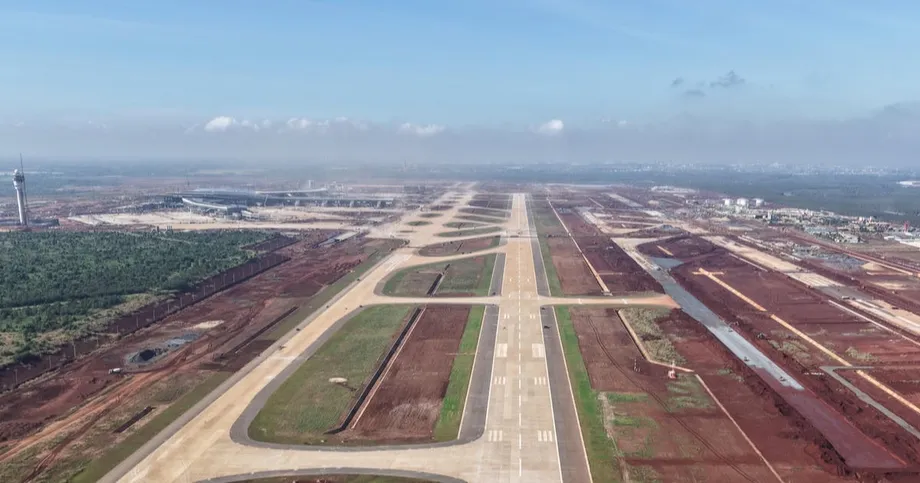
Long Thanh has already handled flights associated with preparations for operation. The first runway, taxiways and part of the apron were substantially complete when they served a flight on December 19, 2025. Air traffic equipment supported flights on December 15 and 19.
A January 20, 2026 update described a June commercial opening, with terminal finishing scheduled before June 30 and air traffic operational testing expected to finish in April. By June, ACV was setting out a different sequence: technical readiness in September, followed by commercial service in December.
- May 30, 2025: Construction began on the second runway.
- December 15 and 19, 2025: Air traffic systems supported flights; the first runway and associated facilities served the December 19 flight.
- January 20, 2026: A progress update described a June 2026 commercial opening target.
- June 9, 2026: Package 4.8 achieved an electricity connection milestone.
- June 27, 2026: ACV committed to completing the main construction packages for commercial operations in December.
- September 2026: ACV scheduled terminal technical readiness and integrated operational testing.
- December 2026: Commercial opening remains the target, with four major packages at risk.
Nguyen Duc Hung, ACV's acting general director, made the December commitment at the June 27 meeting of the state steering committee for major national projects. He said:
ACV commits to completing construction of all 13 main construction packages of the project, ensuring sufficient infrastructure for Long Thanh International Airport to begin safe commercial operations in December 2026.
The passenger terminal needs more than finishing work
Passenger terminal package 5.10 has reached 83.05% of its contract value, an increase of 5.68 percentage points from the September 5 progress report. The ministry nevertheless describes its condition as critical because extensive architectural finishing and equipment installation remain.
The terminal's main concrete structure, steel roof structure and roof layers were already complete in the January update. The pressure has since moved toward the machinery, wiring and safety systems needed to turn the building into a working airport terminal.
Installation figures show the remaining workload. The baggage handling system has 38 of 53 screening machines completed, while cabin baggage screening has 214 of 256 units. Aircraft docking guidance has 73 of 130 units, and aircraft ground power equipment has 36 of 68 units installed.
Those figures leave 15 baggage screening machines, 42 cabin baggage screening units, 57 docking guidance units and 32 ground power units still to be completed or installed. Docking guidance helps pilots position aircraft correctly at the gate. Ground power supplies electricity to parked aircraft.
The testing workload is also substantial. Sixteen of 51 integrated testing scenarios under load have not been approved, while major electrical, fire safety and air conditioning systems still await testing. Testing under load checks how systems behave when handling demands similar to real operations.
Specialist labor is holding up critical systems
The VIETUR consortium building the terminal faces a severe shortage of skilled workers, particularly specialist welders. The tunnel area has 17 welders and five welding robots. The energy center has only four welders for more than 640 specialist welds.
The energy center matters to the opening because it supports terminal operations. Its chillers and backup generators have not been fully installed or tested. Chillers provide cooling, while backup generators supply electricity when the normal supply fails.
Several foreign technical managers from main contractor IC Ictas have left the project without authorization, according to the ministry's account. The contractor has also failed to mobilize enough fire safety design experts, while consultant VNCC-PMI has been slow to assign personnel to resolve technical conflicts on site.
ACV had already identified labor and design shortages in June. It reported more than 7,300 direct workers across the site against a target approaching 9,000, with a shortfall of about 1,668 people concentrated in terminal package 5.10 and infrastructure package 4.8. More than 20,000 drawings were outstanding at that stage.
Adding general construction workers alone will not clear every delay. Specialized welding, fire safety design and decisions about conflicting technical plans require people with the right qualifications and authority to complete the work.
Roads, electricity and asphalt remain unfinished
Internal roads and technical infrastructure package 4.8 stands at 80.60% of its output value, up 5.31 percentage points from the previous report. It risks missing its November target, with 43 kilometers of level three roads and eight kilometers of main roads still unfinished.
The package has 1,440 workers against a commitment of 2,515. That leaves a gap of 1,075 workers, meaning staffing is only about 57% of the promised level. The ministry also warns that an asphalt shortage threatens supplies of the remaining 100,000 tonnes needed.
Electricity connections present another unresolved task. Installation of the 22 kilovolt cable linking component projects 1 and 4 has no confirmed completion date. Although package 4.8 achieved an electricity connection milestone on June 9, further cable installation and equipment work remain necessary.
ACV had earlier aimed to complete the main internal road before September 4. The later warning about November shows how pressure has continued to build around the infrastructure connecting the airport's separate facilities.
The ministry has asked the government to direct Dong Nai authorities to prioritize stone and asphalt supplies. Contractors had reported that most construction material prices rose by 5% to 10%, adding financial pressure alongside shortages.
Cargo equipment will arrive after its contract deadline
Cargo Terminal 1 package 7.8 is 47.04% complete, an increase of only 3.3 percentage points from the preceding report. Skilled labor shortages and reliance on imported equipment are slowing progress.
The sharpest timing problem concerns its automated storage and retrieval system. This equipment moves goods into storage and brings them back out for processing. It is not expected to arrive on site before February 2027, after the package's October 2026 contract deadline and the airport's December opening target.
Earlier in the year, the Ministry of Construction had asked ACV to complete procedures to change the use of four cargo warehouses and proceed with construction. The later equipment delivery forecast adds a specific obstacle to getting cargo facilities ready.
The car park is even less advanced by contract value. Package 11.5 has reached 42.93%, up just 1.63 percentage points from the previous report. The ministry says contractors Coteccons, CC1 and Fecon have failed for an extended period to provide adequate crews, with much finishing work still at the factory fabrication stage.
The cargo terminal and car park serve different users, but both are part of the airport's planned operation. Freight businesses need functioning cargo handling facilities, while passengers, staff and drivers need completed access and parking arrangements.
Unpaid work is restricting the construction effort
More than VND10.43 trillion of completed work in component project 3 remains unpaid. That is roughly 14% of the VND74.284 trillion in completed output recorded for the component.
The ministry identifies documentation, acceptance and payment procedures as major bottlenecks. Acceptance is the formal process of checking and approving completed work, allowing it to move through payment and handover procedures.
Contractors need cash to pay workers, purchase materials and bring in equipment. When completed work waits for approval and payment, firms have less money available to expand crews or speed up installation.
ACV's June figures showed disbursement of about VND43.542 trillion against VND86.348 trillion in signed contracts, or approximately 50%. At that time, it put overall project output at 77% of signed contracts and component project 3 at nearly 70%. The later 86.03% figure refers specifically to component project 3.
ACV has sought guidance on contract adjustments as material prices change. It also warned of potential delays of two to four months during the rainy season, drawing on the previous year's experience. Wet weather affects the scheduling and quality control of road foundations and concrete work, adding pressure to tasks already short of workers and materials.
Several other facilities are approaching readiness
Eight of the 12 construction packages covered in the ministry's latest component project 3 assessment are expected to finish in December. They include the first and second runways, the passenger terminal apron, the fuel supply system and the wastewater treatment facility.
Six government agency buildings under component project 1 have largely completed the technical connections needed for operation. Their progress is important because airport opening requires space and working infrastructure for authorities responsible for border procedures, security and inspections.
Vietnam Air Traffic Management Corporation, which leads component project 2, has completed construction and installation of electromechanical and air traffic management equipment. Technical cable laying and infrastructure connections are continuing.
Essential services under component project 4, including airline catering, aircraft maintenance and ground handling, are between 70% and 95% complete. Ground handling covers the work around aircraft on the ground, such as moving baggage and supporting arrivals and departures.
The airport's access network also has a longer construction horizon. Dong Nai approved more than VND37 trillion for three connecting transport projects in November 2025, comprising Cat Lai Bridge, Dong Nai 2 Bridge and the second phase of Huong Lo 2 Road. Those projects target substantial completion by 2028, so existing routes and other improvements will carry airport traffic during its initial operating period.
Opening depends on coordinated testing and enforcement
The Ministry of Construction has urged ACV to resolve payment problems urgently and replace contractors, or reassign their work, when they fail to meet staffing commitments. Deputy Prime Minister Pham Gia Tuc has also called for contract sanctions where contractors fall short on personnel, equipment, financing or schedule.
Ho Chi Minh City and Dong Nai have been instructed to coordinate with the project owner on land clearance, construction materials, electricity, water and technical infrastructure. Locally controlled work was directed to finish during October without disrupting the airport's opening schedule.
ACV's approach is to inspect and test completed sections while construction continues elsewhere. This allows some checks to proceed before every part of the airport is finished, but the final operating process still requires connected systems to work together.
The ministry has specifically called for faster completion of operational readiness and airport transfer testing, known as ORAT. These trials bring equipment, staff and procedures together to rehearse airport operations. For passengers, the practical result must be a complete journey through check in, security, boarding and baggage handling, supported by reliable electricity and emergency systems.
December remains the stated opening target. Meeting it now depends on clearing a concentrated set of unfinished installations, labor shortages, supply problems and approvals while completing the safety testing required for commercial service.
Key Points
- Long Thanh targets commercial operations in December 2026, later than the June target described in January.
- ACV's essential facilities component is 86.03% complete by output value, with four major packages behind schedule.
- The passenger terminal still needs equipment installation, specialist workers and major system tests.
- Internal infrastructure has only 1,440 of the 2,515 workers committed, with roads and electricity connections unfinished.
- Cargo Terminal 1's automated storage system is expected no earlier than February 2027.
- More than VND10.43 trillion in completed work remains unpaid, restricting contractors' cash flow.
- The government has ordered additional resources, faster payments and action against contractors that fail to meet requirements.