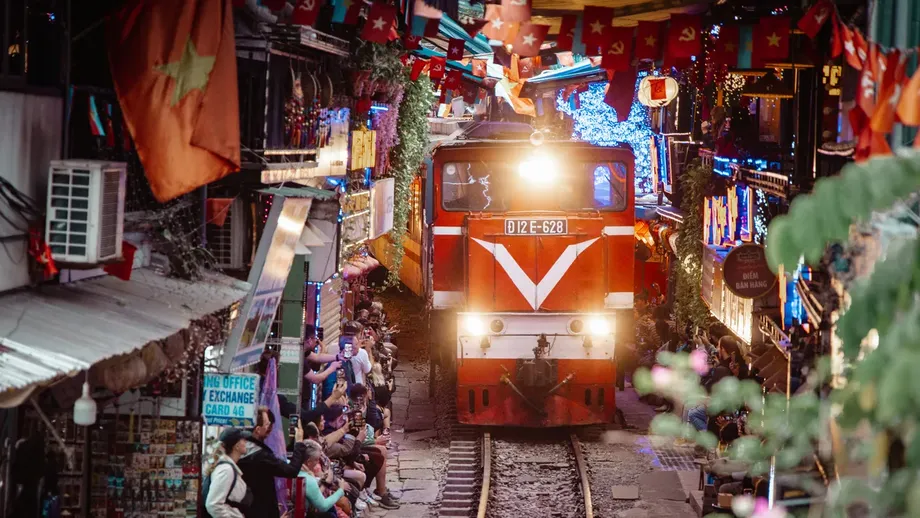
A railway overhaul could reshape Hanoi's most unusual attraction
Hanoi is moving to reduce rail traffic through its famous Train Street under a plan that reaches far beyond the cafes where visitors sit inches from passing carriages. A March 2, 2026 letter from Vietnam's Ministry of Construction outlines changes to passenger services, the removal of freight trains from a central railway corridor and preparations for transferring passengers between stations.
Contents
- A railway overhaul could reshape Hanoi's most unusual attraction
- What would change on the railway?
- Train Street is more than one location
- How coffee and social media changed the neighbourhood
- Why slow trains still create danger
- Years of restrictions have not stopped demand
- Passengers would bear part of the change
- Could trains and cafes coexist under stricter controls?
- What remains if the trains disappear?
- Key Points
The ministry asked Hanoi to complete the necessary work before July 2026. The changes include a transfer hub at Gia Lam Station, free shuttle services and an alternative route for freight. If fully implemented as proposed, passenger trains would stop passing through the cafe stretch between Hanoi Station and Long Bien Station.
The plan follows a February 27 agreement between the ministry and the Hanoi People's Committee to reduce passenger train frequency and suspend freight services through the Train Street area and Long Bien Bridge. The agreement and the March letter describe a transition requiring construction and operational changes. A confirmed date for the final passenger train through the cafe stretch has not been announced.
For cafe owners, the attraction's defining feature is at stake: an operating railway running through a narrow residential neighbourhood. For passengers, the concern is more practical. Vietnam Railways estimates that transferring to Gia Lam could mean an extra 10 kilometres by road and another 30 to 40 minutes of travel.
What would change on the railway?
Hanoi's January proposal would split passenger operations between two stations. Services heading south would terminate at Hanoi Station, while services heading north would use Gia Lam. Passengers connecting between the two networks would travel across the city rather than continue through its centre by rail.
The March 2 ministry letter sets out the suspension of freight services across the Hanoi Station–Long Bien Station–Gia Lam Station section, alongside reductions in passenger and tourist trains. The full proposed arrangement would remove passenger trains from the Hanoi Station to Long Bien stretch.
The corridor carries about 20 passenger trains and six freight trains daily, according to figures cited during discussion of the proposal. A more specific service breakdown lists four daily train pairs between Hanoi and Hai Phong and two between Hanoi and Lao Cai. Those six pairs amount to 12 individual train movements on those two routes, within the wider corridor total.
Freight would be redirected to the Bac Hong–Van Dien western ring railway after repairs and upgrades. Vietnam Railways would also work with Hanoi on a freight yard and access road at Ha Dong Station and a transfer point near Gia Lam. Removing trains from the centre therefore depends on providing other routes and facilities for the people and goods they carry.
Train Street is more than one location
Hanoi's Train Street name covers two commonly visited areas. The best known runs around Phung Hung and Tran Phu near the Old Quarter. Another lies farther south near Le Duan. Visitors often encounter different crowd levels, access restrictions and cafe arrangements at each.
The tourism activity that drew official attention in early 2018 occupied a precisely identified section north of Hanoi Station: kilometre 0+595 to kilometre 0+840 on the Hanoi–Dong Dang railway. That is a stretch of approximately 245 metres, showing how a relatively small piece of working infrastructure became an international attraction.
The railway itself is much older. Vietnam's first railway opened between Saigon and My Tho in 1885, while the line associated with Hanoi's attraction was built during the early 1900s. After war damage and national division, the restored north–south railway reopened on December 31, 1976.
Homes accumulated beside the tracks as Hanoi grew and housing became scarce. Railway workers and families with low incomes adapted daily routines to passing trains. The setting visitors now photograph began as a place to live, rather than a purpose built tourism district.
How coffee and social media changed the neighbourhood
Cafe owner Shark Drung opened her first cafe in 2018 and later added a second. More than 30 competing businesses eventually operated along the Tran Phu–Phung Hung stretch. Drinks, meals and a view of the railway turned residential frontage into a source of income.
Drung described the neighbourhood before its tourism boom:
Before this area was very poor. There were no business licences and barely anybody lived here, but then the tourists started coming.
Google search data described in November 2025 showed interest surging from 2022 as TikTok and Instagram videos spread. The attraction offered a ready made sequence for a short clip: coffee beside the rails, a warning from staff, furniture being moved and a train filling the narrow space.
Visitors also came for Vietnamese coffee, including egg coffee, and the appearance of ordinary homes beside an active line. British traveller Josephine Richardson discovered the area through Instagram. Having visited Thailand's Maeklong railway market, she was attracted by Hanoi's older buildings and coffee culture.
An unidentified cafe owner described tourism as making the neighbourhood a "cleaner, nicer and safer place". His argument concerned improvements to the area and its livelihoods. Railway authorities have focused on keeping the operational corridor clear as businesses and crowds expanded.
Why slow trains still create danger
Trains have been observed passing the cafes at about 10 kilometres an hour. At that speed, a train covers roughly 2.8 metres every second. Visitors standing beside it have little room to correct a misplaced step, outstretched arm or chair positioned too close to the carriage.
Cafe staff commonly warn customers, move tables and direct people inside before trains arrive. Kathryn Frazer, a US content creator who visited in 2023, described staff at the southern stretch positioning visitors and turning furniture as the train approached.
Frazer recalled the sudden change from a quiet cafe visit to a tightly managed passage:
One second, it was calm, and then she's barking orders, spinning tables so the edges wouldn't get clipped. You could tell she'd done this hundreds of times. She wasn't panicking — she was managing it.
In June 2025, a widely shared video showed a tourist narrowly escaping an approaching train after misjudging its proximity. Another video in October showed a train striking tables and chairs placed too close to the track. Both incidents illustrate how quickly the space occupied by visitors and furniture can overlap with the space a train needs.
Vietnam's railway rules require a protected safety corridor beside the tracks. Its width varies with the railway and its setting. Authorities have repeatedly identified trading, photography and crowding within that corridor as reasons for intervention.
Years of restrictions have not stopped demand
Hanoi has repeatedly tried to control the attraction through closures, barriers and warnings to tourism businesses. Access and enforcement have fluctuated, while cafes and visitors have returned.
The main developments show how the current transport plan follows years of attempts to regulate activity beside the railway:
- Early 2018: Railway authorities identified growing visitor activity on the section north of Hanoi Station.
- October 2019: Hanoi ordered commercial activities along Train Street to stop and erected barriers.
- March 2022: Businesses began reopening after pandemic restrictions eased.
- September 14, 2022: Hoan Kiem district authorities announced temporary cafe closures and the withdrawal of licences from businesses violating railway safety rules.
- 2023 and March 2025: Tourism authorities instructed or advised travel companies against organising Train Street visits.
- February 27 and March 2, 2026: The city and ministry advanced plans to reduce central rail operations and prepare alternative arrangements.
Vietnam Railways had sought action from Hanoi and the Vietnam Railway Authority two days before the September 2022 closure announcement. Its concern was the effect of trading and photography on railway safety.
Restrictions also created uncertainty for households dependent on visitors. Frazer found the familiar Old Quarter section barricaded during her 2023 visit and went instead to the southern stretch. Closing one entrance or section could redirect demand while leaving the wider attraction popular online.
Passengers would bear part of the change
Gia Lam Station is central to the proposed solution, but railway authorities have warned that its platforms and passenger facilities may be insufficient for a sharp increase in services. A transfer hub and shuttle operation would need to support the change.
Vietnam Railways estimates an additional road journey of 10 kilometres and 30 to 40 minutes for affected passengers. Free shuttles would address the fare for that connection, while travellers would still need time to leave one train, board road transport and reach the next station.
Families with children, older passengers and people carrying heavy luggage would face particular inconvenience. Passengers arriving from the south and continuing towards northern destinations could have to make the same transfer across Hanoi.
The Vietnam Railway Authority has warned that longer journeys could make some services less competitive and encourage passengers to choose road transport. It is working with Vietnam Railways to assess the proposal before giving feedback to city authorities.
Could trains and cafes coexist under stricter controls?
Nguyen Tien Dat, vice chairman of the Hanoi Tourism Association, has argued for managed tourism if bans continue to fail. He describes current cafe activity as violating safety rules, while proposing a designated attraction with enforceable controls.
His suggestions include warning lights, loudspeakers, trained staff, clearly defined safe areas and announcements in Vietnamese and English. Businesses would contribute fees to pay for the measures. Such an arrangement would move responsibility beyond individual cafe workers deciding when to clear customers from the track.
Architect Truong Ngoc Lan, deputy head of the Architecture and Planning Faculty at Hanoi University of Civil Engineering, proposed physical changes in 2022. These included barriers combined with greenery, a cleared railway safety corridor, a pedestrian path and businesses offering views from upper floor balconies. He said further surveys would be needed before selecting a design.
Tourism worker Pham Hoai Nam also proposed bilingual signs, train schedules, speed warnings and staff to monitor safety. The proposals share a practical aim: give visitors a place to watch without occupying the railway's operating space.
Taiwan's Shifen has been cited as a possible comparison because tourism takes place around an active line under arrangements involving fixed schedules, designated activity periods, licensed vendors and staff clearing the tracks. Hanoi would still need a plan fitted to its own buildings, passenger services and available space.
What remains if the trains disappear?
Hanoi's redevelopment ambitions include cultural, service and tourism spaces around 131 stone railway arches between Hanoi Station and Long Bien. Some arches have already been partly adapted for art spaces and cafes.
The city also links the railway changes to conservation around the western edge of the Old Quarter, the Imperial Citadel of Thang Long and Long Bien Bridge. These plans would shift the attraction towards buildings, heritage and public space rather than the close passage of trains.
Nguyen Van Quyen, chairman of the Vietnam Automobile Transport Association, has urged Hanoi to retain passenger rail while improving safety at crossings and reducing congestion. He argues that working trains are part of the capital's cultural identity and contribute to the appeal of Long Bien Bridge and the railway cafe area.
Hanoi already has one officially sanctioned alternative. Hoa Xa cafe opened inside Long Bien Railway Station in 2023, with visitors observing railway safety rules from a regulated distance. It offers a railway setting, although a single venue serves a different purpose from an entire neighbourhood of small businesses.
Vietnam's planned $67 billion railway connecting north and south belongs to a much larger programme of transport investment. Train Street's immediate future rests on the existing network: where its services terminate, how freight is rerouted and whether passengers can transfer conveniently.
Cafe owners face a similarly concrete change. Fewer trains mean fewer opportunities for the spectacle that fills social media feeds. A heritage district could retain coffee shops and visitors, but businesses built around a passing locomotive would need a reason for people to stay after that locomotive is gone.
Key Points
- A March 2, 2026 ministry letter advances reductions in passenger services and the removal of freight trains from Hanoi's central railway corridor.
- The full proposal would end passenger trains through the cafe stretch between Hanoi Station and Long Bien Station.
- Hanoi is expected to prepare a Gia Lam transfer hub and free shuttles, with necessary work requested before July 2026.
- Vietnam Railways estimates affected passengers could face an extra 10 kilometres and 30 to 40 minutes of travel.
- Repeated restrictions since 2019 have failed to end demand for cafes beside the active tracks.
- Proposed alternatives include stricter visitor controls, protected viewing areas and cultural spaces around 131 railway arches.