A recovery measured in numbers and returning herds
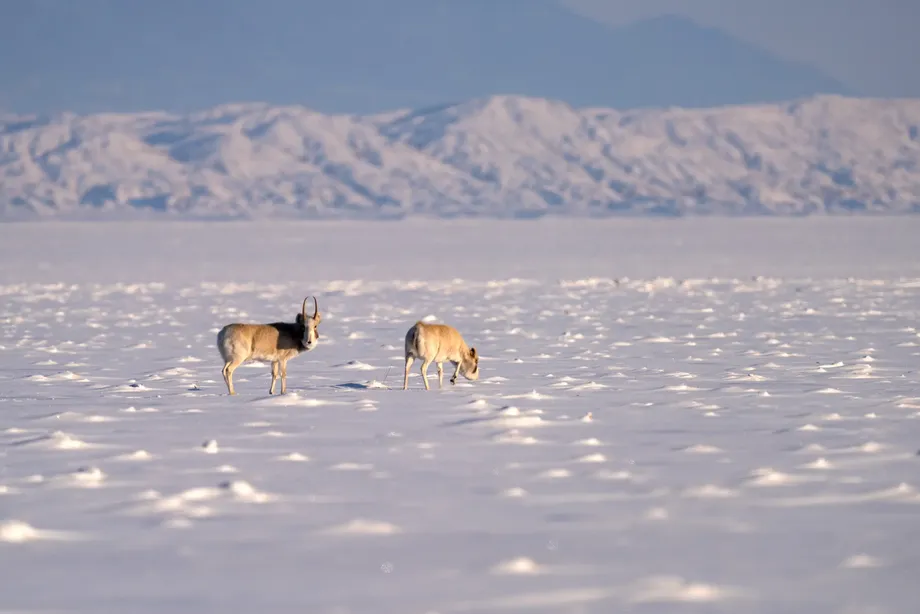
Mongolia's saiga population reached an estimated 28,857 in October 2025, up from 23,215 a year earlier, according to WWF-Mongolia. The increase of 5,642 animals, or about 24%, comes alongside another important development: saiga are again occupying parts of their historic range, including the Khyargas Lake basin, through natural movement rather than deliberate relocation.
Contents
- A recovery measured in numbers and returning herds
- How the population was measured
- Why the return to former habitat matters
- A history of gains and sudden losses
- What conservation work changed
- Local communities protect water and pasture
- Why a larger population still needs protection
- An animal that helps shape the Gobi steppe
- Key Points
The recovery follows decades of conservation work and several severe population crashes. Just 750 Mongolian saiga remained in 2003 after drought and a harsh winter. A later outbreak of infectious disease brought another collapse, with about 3,000 counted in autumn 2017.
WWF-Mongolia's 2025 survey findings put the number returning to historical habitat at 1,659. The return to the Khyargas Lake basin shows that protecting animals and their habitat can allow herds to spread into places where they once lived, without conservation teams moving them there.
The latest increase also builds on a strong previous year. The population rose from 15,540 in 2023 to 23,215 in 2024, before reaching 28,857 in 2025. Across those two years, the estimated population grew by 13,317 animals, or roughly 86%.
WWF-Mongolia attributes the recovery to sustained protection, cooperation with communities and partner organisations, and favourable natural and weather conditions. Its conservation managers also warn that infectious disease, damaged pasture, illegal hunting, infrastructure and climate change continue to threaten the animals. The work now involves protecting a larger population while keeping the places it needs accessible and healthy.
How the population was measured
WWF-Mongolia specialists and members of the Saiga Conservation Network carried out the latest field survey in October 2025. They covered Sharga Gobi, Khuisiin Gobi, Durgun's Khuren steppe, the Khyargas Lake basin, Altan Teel Valley and Khomyn Tal.
The teams used the internationally recognised line transect method. In simple terms, researchers follow survey routes and record animals seen along them, using those observations to estimate the population across the area being studied. The resulting figure is a population estimate rather than a roll call of every animal.
Fieldwork also recorded where saiga were living, the condition of their habitat and information about disease. Specialists said they encountered no sick or dead saiga during the October 2025 survey. Health monitoring remains part of the conservation effort because disease has previously caused heavy losses.
The previous survey, conducted in late October 2024, covered approximately 40,006 square kilometres across 18 soums, or districts, in four aimags, or provinces. The Saiga Conservation Alliance's 2024 survey account, published on January 23, 2025, recorded 23,215 animals, a rise of about 49% from the previous year's 15,540.
Why the return to former habitat matters
The Khyargas Lake basin is part of the saiga's historical range. Its renewed occupation gives the recovery a geographical dimension: more animals are surviving, and herds are using territory from which they had disappeared for years.
WWF-Mongolia describes the return as a result of improved protection and management that allowed saiga to migrate and spread naturally. Deliberate reintroduction usually involves people transporting animals to a chosen location. Here, the animals themselves moved into former habitat as conditions allowed.
The 2025 account places 1,659 animals in returning historical populations, with the Khyargas Lake basin highlighted as a recovery area. The 2024 account recorded 1,660 across three isolated groups in historical habitat, compared with 405 in 2021. The accounts do not give a matching breakdown for each location, leaving the precise annual change within the Khyargas basin unclear.
The longer comparison is striking: the 2024 total in those historical groups was more than four times the 2021 figure. Keeping routes between usable habitats open is therefore a practical part of protecting the recovery, alongside preventing animals from being killed.
A history of gains and sudden losses
Mongolian saiga have recovered before, only to suffer sharp reversals. Their history explains why conservation organisations continue to call for sustained protection even as the latest figures rise.
Natural disasters and disease have both reduced the population to a small fraction of its current size. A dzud is a severe winter disaster in which snow, ice or extreme cold can prevent grazing animals from reaching enough food. Drought can worsen the danger by leaving animals with less food before winter begins.
- 1981: Just over 1,000 saiga remained in Sharga Gobi after a prolonged decline and contraction of their range.
- 1997: WWF-Mongolia began its continuing conservation programme with partner organisations and communities.
- 1998: A survey recorded about 3,000 saiga.
- 2003: Drought and dzud helped drive the population down to 750.
- 2014: The population reached 14,000, while its range expanded by 13%, according to Gobi-Altai Environment Department head D. Batmagnai.
- Late 2016 to 2017: An outbreak of peste des petits ruminants caused severe losses; about 3,000 animals were counted in autumn 2017.
- 2023 to 2025: Annual estimates rose from 15,540 to 23,215 and then 28,857.
Batmagnai said 53% of the population was lost during the outbreak beginning in late 2016. The conservation account published in January 2025 describes the disease disaster as occurring in 2017. Together, the dates place the crisis across that period.
Peste des petits ruminants, often shortened to PPR, is an infectious viral disease best known for affecting sheep and goats. Its impact on saiga makes disease prevention an essential part of wildlife protection, alongside patrols and habitat management.
What conservation work changed
WWF-Mongolia's programme has combined legal protection, action against illegal hunting and improvements to habitat. Measures have included bringing saiga range under local and national protection, improving the legal framework and establishing a network of people responsible for protecting the animals.
Water access has been another focus. Conservation teams and communities have protected spring sources used by saiga, including by fencing the sources against damage. Protecting those water supplies helps preserve an essential resource in the dry landscapes where the animals live.
WWF-Mongolia has also identified law enforcement, disease prevention and community participation as contributors to the recovery. These activities address different needs: preventing deaths, maintaining food and water, and helping people living within saiga habitat take part in its protection.
B. Chimeddorj, WWF-Mongolia's conservation director, described the contribution of these measures in the statement accompanying the 2024 survey results:
Recent conservation initiatives focused on strengthening law enforcement, improving habitat management, and engaging local communities have played a significant role in supporting the recovery of the Mongolian saiga population.
The organisation also credits favourable weather and cooperation with donors and other partners. Conservation work has continued for nearly three decades, spanning both years of population growth and periods of severe loss.
Local communities protect water and pasture
Gobi-Altai province contains about 70% to 80% of the Mongolian saiga's range, according to its Environment Department. The animals occur in Gobi-Altai, Khovd and Uvs provinces, making decisions about pasture, water and protection in western Mongolia especially important.
In Gobi-Altai, core areas include Sharga, Darvi, Khukhmorit, Bayan-Uul, Tonkhil, Tugrug and Khaliun districts, as well as Bigeriin Khooloi. Protecting the population involves work across this broad landscape rather than at a single reserve.
April 23 is observed annually as Mongolian Saiga Conservation Day. Activities described around the April 2026 observance included working with student Eco Clubs to protect spring sources, installing automatic cameras to monitor animal movements and explaining relevant legislation to residents.
The Environment Department also advises herders on rotational pasture use. This means changing where livestock graze over time so that previously used ground has an opportunity to recover. For herders and wildlife sharing the same landscape, the condition of pasture affects the food available to both.
Student participation links public education to practical work. Protecting a spring preserves water, while cameras supply information about where saiga move. These local activities support the broader surveys used to plan conservation.
Why a larger population still needs protection
B. Gantulga, a manager at WWF-Mongolia who holds a doctorate, welcomed the latest population growth while warning that the main threats remain. He identified infectious disease, infrastructure unfriendly to wildlife, pasture degradation, illegal hunting and climate change.
Linear infrastructure means developments that extend across a landscape, such as roads, railways and fences. Where these obstruct movement, animals can find it harder to reach grazing areas, water or other habitat. That concern is particularly relevant as saiga spread back into former territory.
Pasture damage presents another challenge. A growing population needs usable feeding areas, while drought and severe winter conditions can place additional pressure on food supplies. The collapse to 750 animals in 2003 shows how sharply adverse natural conditions have affected saiga in the past.
Mongolian saiga are listed in Mongolia's Red Book and classified as critically rare under the 1995 Law on Fauna. Their recovery makes continued monitoring valuable: surveys track abundance and distribution, while field observations help conservation teams identify emerging problems.
Chimeddorj's statement paired the population gains with a direct call for continuing action:
Urgent and sustained conservation actions are essential to secure the future of this endangered species and to prevent its extinction.
An animal that helps shape the Gobi steppe
Mongolian saiga feed on about 30 plant species, including feather grass, wild onion, shrubs and wormwood. Their grazing forms part of the movement of nutrients through the Gobi steppe, the dry grassland landscape they inhabit.
The animals also loosen soil through trampling and return nutrients to the ground through their droppings. These processes contribute to vegetation cycling and plant productivity, connecting the fate of the herds with the condition of their habitat.
The saiga's distinctive bulbous nose helps warm and filter cold air before it reaches the lungs while the animal runs. This unusual feature is one of the adaptations of an animal that has survived in Mongolia since the Ice Age.
The current recovery brings together several measurable changes: a larger national population, renewed occupation of historical habitat and continued community involvement in protecting water and pasture. Maintaining those gains means continuing the work that supports the animals through disease risks and difficult weather, as well as favourable years.
Key Points
- Mongolia's October 2025 survey estimated 28,857 saiga, up about 24% from 23,215 in 2024.
- The population increased by roughly 86% between 2023 and 2025.
- Saiga have returned naturally to historical habitat, including the Khyargas Lake basin.
- Protection has combined action against illegal hunting, habitat management, water access, disease prevention and community participation.
- Gobi-Altai contains about 70% to 80% of the animal's Mongolian range.
- Disease, damaged pasture, obstructed movement, illegal hunting and climate change remain conservation priorities.