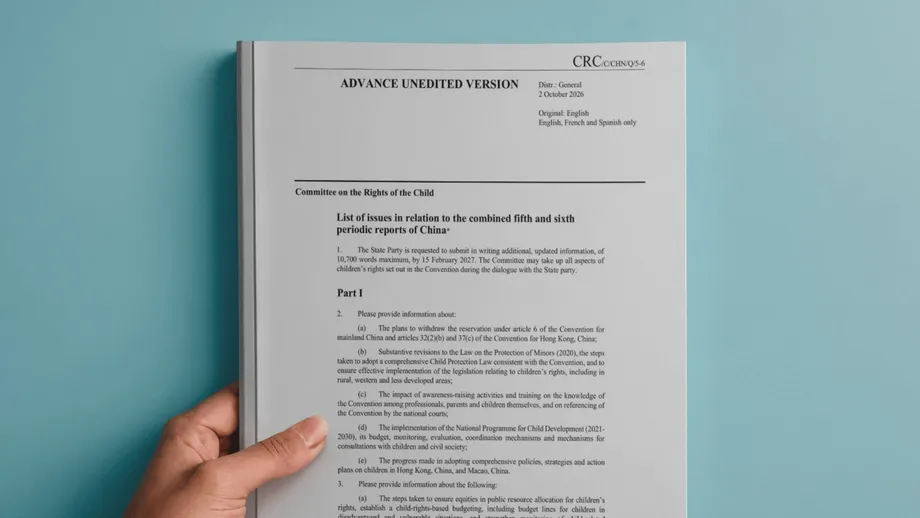
China faces a February deadline to answer UN questions
China must answer questions about Hong Kong's national security laws, minority language education and the separation of children from their families by 15 February 2027, ahead of its first review by the UN Committee on the Rights of the Child since 2013.
Contents
- China faces a February deadline to answer UN questions
- What China's government says it has achieved
- Why the ethnic unity law is under scrutiny
- What changes in classrooms and at home?
- Boarding schools, religious teaching and family contact
- Hong Kong's security laws and children's speech
- Separation, genetic data and pressure on families abroad
- Can children report abuse without fear?
- More explicit scrutiny of harm to LGBTI children
- The dates that shape the review
- Key Points
The committee's List of Issues, adopted on 2 October 2026, contains 28 numbered paragraphs covering mainland China, Hong Kong and Macao. It asks how national security measures affect children's speech, education, privacy and family life, and how children can report abuse safely in boarding schools, institutions and detention facilities.
A central concern is the Law on Promoting Ethnic Unity and Progress, adopted by China's National People's Congress on 12 March 2026 and brought into force on 1 July. Its provisions reach into classrooms, religious institutions, online platforms and conversations between parents and children.
The review will examine China's compliance with the Convention on the Rights of the Child, a binding international treaty protecting children's survival, development, safety and participation in decisions affecting them. The committee is the body of independent experts that checks how governments carry out those promises.
China's government says its laws protect children's religious freedom, privacy, education and right to express their views. The committee is requesting details about how those protections operate, particularly for Tibetan, Uyghur and other minority children and for children affected by security prosecutions in Hong Kong.
The next stage is expected in 2027 at the earliest. China's written answers will inform a dialogue with the committee, followed by recommendations on changes to laws and practices.
What China's government says it has achieved
China's combined fifth and sixth reports, submitted in December 2022 and published by the Ministry of Foreign Affairs, cover developments from 2010 to 2022. The government cites the 2020 census count of 297,655,944 children aged zero to 17, representing 21.11% of the population, or roughly one person in five.
The report describes revisions to the Law on the Protection of Minors, measures against domestic violence and sexual abuse, and expanded education and legal services. It says more than 95% of children with disabilities of compulsory school age were enrolled in compulsory education in 2021.
Chinese authorities also report providing legal aid to more than 805,000 minors between 2015 and 2020. By the end of 2021, 2,207 procuratorates, the offices responsible for public prosecution, had dedicated juvenile prosecution bodies or case teams.
The government acknowledges uneven child protection between rural and urban areas and between regions. It says minority children are free to learn and use their own languages, while describing the national common language as the basic language of school instruction.
Hong Kong and Macao prepared their own sections of the submission. Those sections are omitted from the version published on the ministry's website. The central government's account provides the review's starting point, while the committee's questions extend to legal changes and concerns arising after its reporting period.
Why the ethnic unity law is under scrutiny
Eight UN human rights experts sent China a letter dated 16 April 2026 questioning whether the ethnic unity law is compatible with international rights obligations and existing Chinese legal protections. Their communication to China examines specific provisions governing language, parental guidance, religion and expression.
The experts warned that the nationwide legislation could extend policies previously applied in particular regions. They described the risk in these terms:
transform temporary or experimental regional measures into binding nationwide obligations
The law states goals of national unity, shared identity and common development. Article 5 provides for equality among ethnic groups and prohibits ethnic discrimination and oppression. The experts focus on how other provisions define and enforce acceptable speech and cultural activity.
Article 6 prohibits acts that undermine ethnic unity and create ethnic division. The experts ask China to define that conduct precisely, so people can understand which actions may bring punishment. Their concern reaches ordinary activities such as teaching a language, discussing history or practising a religion.
What changes in classrooms and at home?
Article 15 makes Mandarin the basic language of education and teaching. It promotes Mandarin learning among preschool children and calls for graduates of compulsory education to have a basic understanding of the national common language and script. Article 16 requires unified national teaching materials and places the prescribed theme of a shared Chinese national community throughout education.
The April letter connects those requirements to a December 2025 revision of China's language law, which deleted a provision allowing exceptions to Mandarin as the medium of school instruction. Together, the measures make the legal space for teaching through minority languages a central issue in the review.
The experts ask how articles 15 and 16 fit with article 4 of China's Constitution, which protects ethnic groups' freedom to use and develop their languages, and article 37 of the Law on Regional Ethnic Autonomy, which provides for minority language textbooks and instruction.
Article 20 brings the law into family life. It requires parents and guardians to guide minors to love the Communist Party, the motherland, the people and the Chinese nation. It also prohibits sharing ideas considered harmful to ethnic unity and progress. The experts request definitions and safeguards for parents teaching children their own language, culture or religion.
The Convention on the Rights of the Child supplies two specific standards. Article 30 protects minority children's use of their language and practice of their religion. Article 29(1)(c) requires education to respect a child's cultural identity, language and values. The practical issue for families is whether children can learn Mandarin while retaining meaningful education in the language they use with parents and grandparents.
Boarding schools, religious teaching and family contact
The committee asks China about reports that children face pressure to speak only Mandarin from preschool, that schools teaching in Tibetan, Uyghur and other languages have been forcibly closed, and that parents have been punished for teaching language, culture or religion.
Its questions seek measures ensuring quality education close to children's families and communities. Boarding schools should be used only where objective circumstances, such as distance, make daily attendance difficult, the committee says. It also requests safeguards for family contact, wellbeing, language, culture and safety.
UN treaty committees addressing women's rights and economic, social and cultural rights had already called in 2023 for an end to coerced residential schooling for Tibetan children. Their recommendations included allowing private Tibetan schools, securing instruction in mother tongues and reversing closures of schools teaching through minority languages.
The children's rights committee now also asks about investigations and prosecutions concerning reported deaths, torture and ill treatment in state boarding schools and preschools in Tibet.
Religious education faces a related legal issue. Article 46 of the ethnic unity law requires religious groups, schools and activity sites to follow Sinicization, a policy directing religion toward a Chinese identity and alignment with state requirements. The April experts' letter asks how religious communities can retain control over their teachings and institutions under that obligation.
Hong Kong's security laws and children's speech
Hong Kong's national security legislation brings another set of questions about how children can speak, participate in public life and obtain information. The committee asks how authorities ensure children can express views freely without fear of prosecution and protect people defending children's rights from retaliation.
The committee raises police violence, arrests and rioting charges involving more than 1,700 students during the 2019 protests against proposed extradition legislation. It seeks information about the treatment of young people alongside the effects of later security laws.
Online protections are also under examination. Authorities must protect children from harmful content while respecting access to varied information suited to their age. The committee asks how that balance works in light of prosecutions and imprisonment involving children and caregivers under Hong Kong's National Security Law.
Mainland provisions create related concerns about online expression. Article 31 of the ethnic unity law requires network operators to stop transmission, remove content, preserve records and report information considered harmful to ethnic unity. The April experts' letter warns that broad wording could restrict minority cultural expression.
The committee also asks about obstacles facing journalists, human rights defenders and nongovernmental organisations documenting violations and seeking justice in mainland China. For children dependent on adults to raise concerns, the ability of those advocates to work safely is part of access to protection.
Separation, genetic data and pressure on families abroad
Children whose parents are detained, interned, forcibly disappeared, sentenced to death or executed feature prominently in the committee's questions. It asks how authorities prevent separation that conflicts with children's best interests, including separation associated with domestic labour migration and forced labour transfers.
The government's 2022 report describes laws protecting family care, temporary guardianship during emergencies and family reunification. The committee seeks details about children affected by security measures, particularly in Tibet and the Uyghur region.
Privacy questions concern the collection of children's genetic data in Tibet without consent and monitoring programmes in Uyghur and other households described as home stays or becoming family. Genetic data contain biological information that can identify someone and reveal family relationships. The committee requests the scope, legal basis and purpose of the collection and monitoring.
China's government report cites the Personal Information Protection Law, which requires parental or guardian consent when processing personal information belonging to children under 14. The review asks how children's privacy is protected in the specific practices under scrutiny.
Travel restrictions affecting Tibetan, Uyghur and other children, and pressure campaigns against families abroad, are also on the agenda. Article 63 of the ethnic unity law provides for legal responsibility for people and organisations outside mainland China over acts deemed to undermine ethnic unity or create ethnic division. The April experts warn that this could extend pressure beyond China's borders.
Can children report abuse without fear?
The committee asks for independent, confidential complaints systems that children can reach and understand, particularly inside institutions, boarding schools and correctional facilities in Tibet, the Uyghur region, Hong Kong and Macao.
Those systems should allow children to report discrimination, ill treatment, deprivation of liberty, sexual exploitation and abuse. A child living away from home needs a way to contact someone able to act, including when the complaint concerns an adult responsible for their care.
China's government describes several existing channels. Its report cites a legal requirement for child protection hotlines and services through the 12309 procuratorial platform, the 12355 youth service and the 12338 hotline for women and children.
The committee's questions focus on independence, confidentiality and access within closed settings. It also asks how children are protected from punishment or unequal treatment because of their parents' ethnicity, religion, political beliefs or activities, profession, language, marital status or economic circumstances.
More explicit scrutiny of harm to LGBTI children
The committee addresses discrimination against lesbian, gay, bisexual, transgender and intersex children more explicitly than in its 2013 review. It asks about bullying, violence, discriminatory policies and the treatment of children born to parents of the same sex.
Its questions include efforts to end conversion therapy targeting children and adolescents. The term describes practices intended to change a person's sexual orientation or gender identity. The committee also asks about removing the category of gender diversity disorder from the Chinese Classification of Mental Disorders, citing the stigma and harmful practices that such a label can support.
Intersex children, who are born with sex characteristics that do not fit typical definitions of male or female bodies, are the focus of questions about unnecessary and irreversible surgery and treatment, particularly in Hong Kong.
The requests bring medical decision making into the same review as schooling, security laws and family life. Across those settings, the committee is asking authorities to explain how children receive protection from harm and discrimination.
The dates that shape the review
The review brings together recommendations dating from 2013, a government report submitted in 2022 and legislation enacted in 2026. The main milestones are:
- 2013: The committee conducted its previous review of China.
- December 2022: China submitted its combined fifth and sixth periodic reports, covering 2010 to 2022.
- December 2025: A language law revision removed an exception allowing minority languages as the medium of instruction.
- 12 March 2026: The National People's Congress adopted the ethnic unity law.
- 16 April 2026: Eight UN human rights experts sent China their concerns about the law.
- 1 July 2026: The ethnic unity law entered into force.
- 2 October 2026: The children's rights committee adopted its List of Issues.
- 15 February 2027: China's written responses are due.
The International Service for Human Rights submitted information to the committee in August 2026 on national security legislation, fundamental freedoms, family separation and education. In its April statement on the law, the organisation had urged governments to press China to suspend implementation and repeal or amend provisions inconsistent with international rights standards. That statement accompanied a European Parliament debate scheduled for 29 April and an expected vote on 30 April.
The committee's dialogue with Chinese authorities has no confirmed date. Nongovernmental organisations can submit updated information no later than two to three weeks before the review session. China's answers and that evidence will help the committee assess implementation of earlier recommendations and formulate its next conclusions.
Key Points
- China must answer the committee's questions by 15 February 2027.
- The review covers mainland China, Hong Kong and Macao and will be the first since 2013.
- The ethnic unity law faces scrutiny over school language, parental guidance, religion and online expression.
- The committee asks about Hong Kong security prosecutions, family separation, genetic data collection and safe complaints systems.
- China's government cites expanded education, legal aid and child protection laws in its report covering 2010 to 2022.
- The review also addresses conversion therapy, discrimination and unnecessary medical interventions on intersex children.