Baku Sets Out a Route to Investment
Azerbaijan is targeting 2029 for a final investment decision on the Caspian-Black Sea-Europe Green Energy Corridor, a proposed electricity connection stretching nearly 3,000 kilometers and designed to carry 4 gigawatts of power. Energy Minister Parviz Shahbazov outlined the timetable at a forum that opened in Baku on October 22, 2026, bringing governments, development banks and energy companies into discussions about financing and construction.
Contents
- Baku Sets Out a Route to Investment
- What the 2029 Decision Would Mean
- From the 2022 Agreement to Power Deliveries
- What 4 GW of Transmission Can Carry
- A Deep Black Sea Crossing
- How the Corridor Could Earn Revenue
- Banks Examine Who Would Carry the Risk
- European Planning and Political Support
- China Datang Explores Generation and Corridor Participation
- Key Points
A feasibility study completed in July 2026 found the project technically feasible and economically attractive, Shahbazov said. The corridor would include a submarine cable crossing the Black Sea at depths of up to 2,200 meters, with operations expected to begin in stages from 2032.
By 2040, the project is projected to deliver approximately 20 billion kilowatt-hours of renewable electricity to Europe each year and reduce annual carbon emissions by up to 3.6 million tonnes. The study also anticipates that the connection could support the development of at least 8 GW of renewable generation capacity in the region.
Azerbaijan and its partners now face the task of turning those projections into contracts, investment commitments and an agreed ownership structure. The proposed business model combines long term electricity purchase agreements, private investment and electricity trading across national borders.
For electricity producers, the corridor would provide a route to buyers beyond their domestic markets. For participating European countries, it would add another source of renewable power. Both depend on coordinating new generation, transmission infrastructure and commercial agreements across several countries.
What the 2029 Decision Would Mean
A final investment decision, often shortened to FID, is the point at which a project's backers formally agree to commit the money needed to proceed. Shahbazov presented 2029 as the target for that decision, with a reliable business model, participation by international financial institutions and private investors, and long term commercial agreements among the requirements.
The financing structure, ownership arrangements and opportunities for investors remain under discussion. No total construction cost or completed financing package was announced in the forum accounts.
Shahbazov, Azerbaijan's energy minister, described the objective in his opening remarks:
Our objective is to transform the Green Energy Corridor into a regional infrastructure project with a clear business model, a sustainable financial structure and attractive conditions for investors.
The Baku forum was organized around six thematic sessions intended to move the project from feasibility work toward investment and implementation. Participants included potential electricity buyers, transmission system operators, cable manufacturers, engineering firms and insurers, alongside governments and financial institutions.
From the 2022 Agreement to Power Deliveries
Azerbaijan, Georgia, Romania and Hungary launched the project through a Strategic Partnership Agreement signed in Bucharest in 2022. That agreement established the political partnership behind the proposed connection between the Caspian region and Europe through the Black Sea.
The timetable outlined in Baku stretches across almost two decades from that agreement to the projected electricity deliveries in 2040:
- 2022: Azerbaijan, Georgia, Romania and Hungary sign the Strategic Partnership Agreement in Bucharest.
- July 2026: The feasibility study is completed, finding the project technically feasible and economically attractive.
- October 22, 2026: The Baku forum opens, with discussions on investment, financing and the commercial model.
- 2029: The partners aim to reach a final investment decision.
- From 2032: The corridor is expected to enter operation in stages.
- By 2040: Annual renewable electricity deliveries to Europe are projected to reach approximately 20 billion kilowatt-hours.
The staged schedule means the connection would begin operating before reaching its projected annual delivery level. The minister's timetable places the first commissioning phase three years after the intended investment decision.
What 4 GW of Transmission Can Carry
The corridor's proposed 4 GW capacity describes how much power it could carry at a given moment. The projected 20 billion kilowatt-hours describes the quantity of electricity delivered over an entire year. Capacity is comparable to the width of a water pipe, while annual electricity delivery is comparable to the amount of water that passes through it.
A connection operating continuously at 4 GW for a standard year of 8,760 hours would carry about 35 billion kilowatt-hours. The projected annual deliveries of 20 billion kilowatt-hours equal roughly 57 percent of that theoretical amount. The comparison helps explain why a transmission rating and an annual supply forecast are different measures.
The feasibility study's projection of at least 8 GW of renewable generation capacity is twice the corridor's proposed transmission capacity. Wind and solar installations produce different amounts of electricity as conditions change, so their rated generating capacity and the amount flowing through an export connection vary over time.
The study also projects annual carbon reductions of up to 3.6 million tonnes. That is a forecast associated with the planned renewable electricity deliveries. The forum accounts did not set out the detailed calculation behind the emissions estimate.
A Deep Black Sea Crossing
The submarine cable is a central engineering component of the nearly 3,000 kilometer corridor. Parts of the Black Sea crossing would reach depths of up to 2,200 meters, requiring technology suited to installing electricity infrastructure far below the surface.
The feasibility study's positive assessment gives the partners a basis for moving into the next development stages. Construction planning still has to connect the engineering design with the commercial timetable, equipment supply and financing arrangements.
Cable manufacturers and marine engineering businesses were among the organizations represented at the forum. Participants included Prysmian, NKT, Hellenic Cables, ZTT, Hengtong, Orient Cable and Jan De Nul. Technology companies included Siemens Energy, ABB and Hitachi Energy.
Their presence placed equipment and construction capability alongside financing in the discussions. A project of this scale needs both: money to pay for the infrastructure and suppliers able to manufacture, install and support it.
How the Corridor Could Earn Revenue
The proposed hybrid business model combines regulated and commercial components. Some parts of the project would operate under rules governing electricity networks, while commercial arrangements would cover activities such as purchasing and selling power across borders.
Long term power purchase agreements, known as PPAs, are one proposed foundation. Under a PPA, a buyer agrees to purchase electricity over an agreed period using specified pricing arrangements. Such contracts can give investors a clearer picture of future revenue before they commit capital.
Private equity participation would bring investors into the project's ownership. Electricity trading across borders would provide another part of the commercial structure, connecting renewable generators with buyers in other markets.
A business model panel examined governance, ownership, participation mechanisms, the development timetable and opportunities for strategic equity partners. Andrea Meola, CESI's Global Markets and Business Development Director, moderated the session.
Participants included Elmir Musayev, General Director of SOCAR Green; James Humfrey, Chief Executive Officer of Xlinks; Michele Vadora, Managing Director of Zhero; and Mohammed Atif, an area manager at AFRY–DNV Global. Their discussion focused on private sector participation and the arrangements needed to sustain the project commercially over many years.
Banks Examine Who Would Carry the Risk
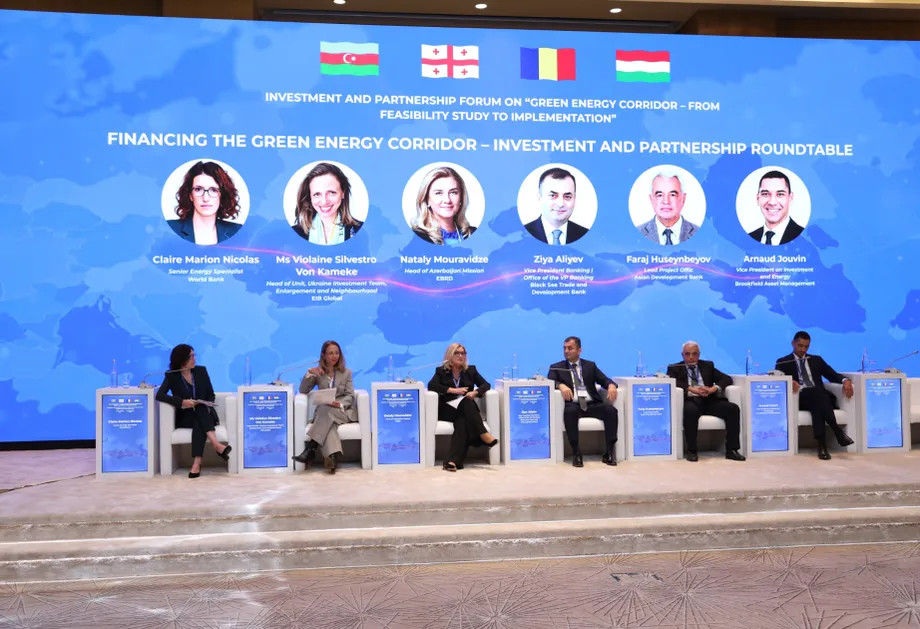
A financing roundtable on October 22 was moderated by Claire Nicolas, Senior Energy Economist at the World Bank. It examined potential financing structures, the allocation of risks, participation by public and private capital, blended finance and bankability.
Bankability means whether a project's expected revenues, contracts and management of risks make it suitable for lending. Blended finance combines different sources of money, often including public or development funding alongside private investment, to help a project attract sufficient backing.
The discussion brought together Violaine Silvestro Von Kameke of EIB Global, Nataly Mouravidze of the European Bank for Reconstruction and Development, Ziya Aliyev of the Black Sea Trade and Development Bank, Faraj Huseynbeyov of the Asian Development Bank and Arnaud Jouvin of Brookfield Asset Management.
Risk allocation determines which participant takes responsibility when costs rise, construction is delayed or revenues fall short. Those arrangements affect the terms lenders and investors will accept. The roundtable addressed how states, international financial institutions and private investors could share the financial responsibilities of a connection spanning several jurisdictions.
European Planning and Political Support
The corridor has been included in the draft Ten-Year Network Development Plan 2026, known as TYNDP 2026, according to the presentation in Baku. The plan is a framework for considering future electricity network development in Europe.
The partners are also seeking Project of Mutual Interest status. That designation concerns energy infrastructure linking the European Union with countries outside it. Shahbazov presented the planning process and the pursuit of that status as steps supporting the corridor's investment prospects.
Shahbazov said political support had been reaffirmed during European Commission President Ursula von der Leyen's most recent visit to Baku. He also placed the corridor within President Ilham Aliyev's policy of developing Azerbaijan as a regional center for renewable electricity generation, transmission and exports.
European planning and political backing are part of the preparation for the 2029 decision. The financing and business model sessions addressed the accompanying commercial work: securing revenue, agreeing ownership and attracting investors willing to commit money.
China Datang Explores Generation and Corridor Participation
China Datang Overseas Investment Co., Ltd. discussed possible participation in the corridor during a meeting between its chairman and Shahbazov at the forum. Azerbaijan's Energy Ministry said the talks also covered progress on a 100 MW solar power plant project in Azerbaijan and the possibility of an offshore wind plant with an initial capacity of 200 MW.
China Datang expressed readiness to advance the solar and offshore wind projects and explore opportunities in the corridor. The meeting also considered continued cooperation on personnel training and the exchange of technical expertise in the energy sector.
The solar project and proposed initial wind installation together amount to 300 MW, or 0.3 GW. That equals 3.75 percent of the feasibility study's minimum projection of 8 GW of renewable generation capacity supported by the corridor. The comparison shows the scale of generation development envisaged beyond these individual discussions.
The meeting connected two parts of Azerbaijan's export plans: developing renewable power plants and building a route to overseas customers. The next major investment milestone for the corridor remains the targeted decision in 2029, followed by the planned start of phased operation in 2032.
Key Points
- Azerbaijan is targeting a final investment decision in 2029 for the Caspian-Black Sea-Europe Green Energy Corridor.
- The nearly 3,000 kilometer connection would have 4 GW of transmission capacity and a Black Sea cable reaching depths of up to 2,200 meters.
- A feasibility study completed in July 2026 found the project technically feasible and economically attractive.
- Operations are expected to begin in stages from 2032, with annual electricity deliveries projected at approximately 20 billion kilowatt-hours by 2040.
- The study projects support for at least 8 GW of renewable generation and annual carbon reductions of up to 3.6 million tonnes.
- Financing, ownership and revenue arrangements remain under discussion, including long term electricity contracts and private investment.
- China Datang is exploring corridor participation alongside discussions about solar and offshore wind projects in Azerbaijan.