A film hub ambition meets a national legal overhaul
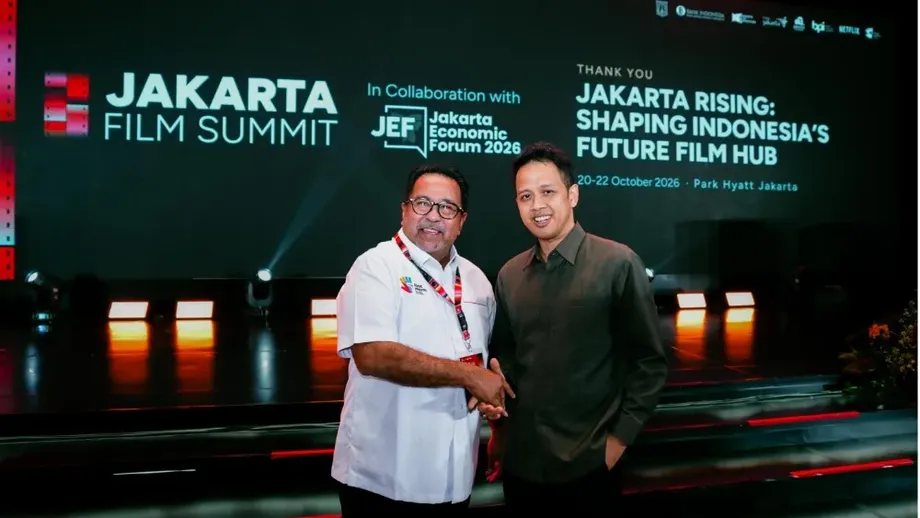
Indonesia is preparing a revision of its Film Law for proposal in 2027 as Jakarta courts international productions, with Vice Governor Rano Karno saying Netflix now has four titles in production through the city's Filming in Jakarta service. The combined push reaches beyond attracting cameras: it seeks to change how films are financed, how workers are protected and how Indonesian cinema is preserved.
Contents
- A film hub ambition meets a national legal overhaul
- What the revised law would change
- Why film rights still struggle to secure loans
- Jakarta brings productions through one doorway
- Studios and incentives are the next test
- The summit puts locations and finance together
- Getting Indonesian films beyond the domestic market
- Workers and film heritage enter the reform
- Making the benefits reach audiences and regions
- Key Points
The Coordinating Ministry for Human Development and Cultural Affairs, known as Kemenko PMK, set out the legislative target in its Film Law revision statement. At an April 7, 2026 coordination meeting, the ministry said the Ministry of Culture and Ministry of Creative Economy were preparing a draft bill and its supporting academic paper for proposal in 2027.
Fauzan Zidni, chair of the Indonesian Film Agency (BPI), wants that revision to give his organisation powers established in law and funding reserved for its work. Jakarta, meanwhile, is offering cheaper access to some locations, developing international partnerships and planning studios and other facilities over the next three to five years.
Indonesian productions already command a large domestic audience. Zidni says they took roughly 67% of the country's box office in 2025, about two thirds of the total. Growth in 2026 is tracking more slowly amid global economic pressures. The challenge now is to turn that audience strength into reliable financing, durable careers and wider international distribution.
What the revised law would change
Law No. 33 of 2009 on Film remains the foundation of Indonesia's film regulation. It replaced Law No. 8 of 1992, which was enacted in March 1992. Renewed revision efforts were announced in October 2025, with intensive drafting involving BPI, the Film Censorship Institute and Kemenko PMK underway since early 2026.
Ahmad Saufi, Kemenko PMK's assistant deputy for cultural advancement and preservation, said the revision should balance culture and the creative economy. The ministry's stated priorities include simpler permits, stronger data and financing, and rules adapted to the industry's growing use of digital technology.
BPI currently brings organisations together, advocates for the industry and coordinates activity. According to Zidni, it cannot independently fund films or require policy changes. He wants an institution with dependable resources and clearer authority, comparable in function to film support bodies such as France's CNC, South Korea's KOFIC and Singapore's IMDA.
Two ministries oversee film, and Zidni says BPI is not seeking to replace either. He describes coordination as part of the reform itself:
That coordination problem is as much political as it is institutional, and solving it is part of the work.
The government's 2027 target concerns proposing the legislation. No date has been given for parliamentary passage. Meanwhile, Culture Ministry official Judi Wahjudin has described the drafting process as participatory, with industry members and other stakeholders contributing after more than a decade of experience under the current law.
Why film rights still struggle to secure loans
Government Regulation No. 24 of 2022 already permits financing based on intellectual property. For filmmakers, intellectual property includes copyright and rights to broadcast or distribute a film. Those rights can generate income when a film reaches cinemas, television or streaming services.
Banks, however, commonly lend against physical assets such as land, buildings and machinery. Collateral is something a lender can claim if a borrower fails to repay. A production company may hold valuable film rights while owning little property that a bank will accept.
Zidni says the missing pieces are a valuation method accepted by banks and the Financial Services Authority (OJK), technical guidance from OJK, and a revision of OJK Regulation No. 40 of 2019 on asset quality. Valuation means estimating how much an asset is worth, a difficult task when future income depends on audiences and sales agreements.
The Jakarta Film Summit is bringing together OJK, the Ministry of Creative Economy, the Directorate General of Intellectual Property, banks and the Indonesian Appraisers Association. Their proposed work covers a standard method for valuing film rights, a pilot financing scheme and the regulatory changes needed to put it into practice.
For a producer, the practical prize would be access to borrowing backed by the rights the company owns. Getting there requires lenders, appraisers and regulators to agree on how to assess those rights and the risks attached to them.
Jakarta brings productions through one doorway
The Jakarta Film Commission launched in June alongside Filming in Jakarta, a service designed to bring production permissions and assistance into one place. Karno says companies from Malaysia and India have since come to the capital to shoot films and series.
Netflix's four productions follow Tygo, a spinoff from its Extraction franchise. Karno also says a memorandum of understanding tied to the inaugural Jakarta Film Summit includes Netflix support for developing local film talent.
Governor Pramono Anung has made Busan the benchmark for Jakarta's ambitions. The South Korean city combines a prominent international film festival with industry institutions and production activity. Jakarta is seeking a similar connection between filmmaking, financing and access to buyers.
At the summit opening, Pramono described the standing he wants Jakarta to achieve:
I place great hope in our team to take real and meaningful action. Hopefully, one day, mentioning Jakarta will evoke the same cinematic stature as Busan.
Busan is already a working partner. Karno credits the Busan Film Commission with helping Jakarta's commission gain official membership in AFCNet, the Asian Film Commissions Network. Jakarta is also pursuing cooperation with Turkish delegates and the British Council, widening its contacts beyond streaming companies.
Studios and incentives are the next test
Jakarta has reduced certain location fees by 50% and introduced a 50% tax concession on cinema admissions for qualifying Indonesian films. These measures address different costs: one helps productions using eligible locations, while the other concerns the tax attached to eligible cinema admissions.
Karno says production incentives are still at an early stage, with Jakarta studying approaches in Thailand and Malaysia. Over five years, the city wants to strengthen the whole chain from production to financing and market access. Its largest physical gaps are studios, soundstages and facilities for postproduction, which it aims to address within three to five years.
A soundstage is an enclosed space where filmmakers can control lighting, sound and sets. Postproduction covers work after filming, including editing, sound and visual effects. Those facilities help determine how much of a production's spending and skilled work can stay in the city.
Pramono used Jakarta's broader economy and transport network to support his pitch to producers. He cited economic growth of 5.52%, inflation of 2.7% and public transport coverage of 93%. He also cited a rise from 17th to 15th place for public transportation in the Oxford Economics Global Cities Index 2026.
Bank Indonesia official Iwan Setiawan linked film production to opportunities for local businesses, hotels and logistics providers. A visiting production needs much more than actors and cameras: it also needs accommodation, transport, food and services that connect filming activity to other parts of the economy.
The summit puts locations and finance together
The Jakarta Film Summit 2026 runs from October 20 to 22, with more than 500 attendees from 10 countries and 40 speakers. Hosted by the Jakarta Film Commission with BPI, it also involves the provincial government and Bank Indonesia. Its programme brings public officials and financial institutions together with investors, streaming platforms and film professionals.
Sessions cover production policy, permits, incentives, investment and cooperation across Southeast Asia. The October 21 programme turns to preparing projects for funding, the role of banks and the use of audience data to assess investment risk.
Jakarta Scouting Day on October 22 takes film commissioners and production companies to Pasar Rumput, Muara Angke Harbor, Kota Tua and the Bundaran HI Skydeck. A session pairing Jakarta with Hong Kong is also scheduled to explore cooperation between the cities.
The policy and industry milestones span several years:
- 2022: Government Regulation No. 24 permits financing based on intellectual property.
- 2024: Indonesia signs its first audiovisual coproduction agreement, with the Netherlands, at JAFF Market.
- October 2025: Renewed efforts to revise the 2009 Film Law are announced.
- April 7, 2026: Kemenko PMK holds a coordination meeting on the revision and identifies 2027 as the proposal target.
- October 20 to 22, 2026: The Jakarta Film Summit addresses policy, financing and locations.
- 2030: Zidni's BPI mandate ends, providing a deadline for his institutional goals.
Getting Indonesian films beyond the domestic market
Indonesia's approximately 67% domestic box office share gives local films a strong position at home. Zidni's concern is how those films reach audiences elsewhere. BPI is pursuing closer relationships with international sales agents, wider distribution within Southeast Asia and a possible shared presence for Indonesian producers at major film markets.
The Ministry of Culture announced a new international coproduction fund at the Lumière Summit, developed with support from France's CNC. It is open to filmmakers worldwide working with Indonesian partners. Coproduction allows partners from different countries to combine money, talent and other resources on a project.
A separate matching fund contributes government money, up to a ceiling for each project, when producers secure international financing. Zidni acknowledges that producers without overseas contacts still face difficulty reaching that starting point. His argument is that a concrete government contribution gives them a stronger reason to build those relationships.
Indonesia's 2024 audiovisual agreement with the Netherlands provides an existing partnership to build on, while talks with France remain active. Zidni also sees interest from Korean producers looking towards Southeast Asia.
Streaming investment remains welcome, but BPI wants more routes to audiences. Zidni, who previously worked at Disney, points to the retreat from Southeast Asian original productions by global platforms after 2023:
A platform can change its content strategy, exit a market, or deprioritize Indonesian content, and we have no recourse.
His response is to develop a broader set of buyers and distribution relationships so that Indonesian producers have more places to take their films.
Workers and film heritage enter the reform
Indonesia has film programmes across 27 campuses producing around 1,200 graduates annually, according to Zidni. He says most graduates are not absorbed by the industry and puts industry turnover at about 60%. Training more people is therefore only part of the task; retaining them and connecting education to employment also matter.
The draft revision would establish basic employer obligations and strengthen education, skills development and protections for vulnerable workers, including child performers. Zidni says the law would provide a framework rather than set crew pay rates, leaving detailed commercial terms to negotiation between businesses and professionals.
Indonesia's National Work Competency Standards already cover professions including directing, acting and art direction. Those standards describe the skills required for a job. The proposed worker provisions would address responsibilities within employment relationships, alongside professional competence.
Film preservation is another central issue in the drafting. During a discussion marking 101 years since the birth of filmmaker and writer Asrul Sani, Zidni called for a preservation institution to help safeguard Indonesian filmmakers' work. He pointed to the difficulty of introducing young people to major cultural figures when their films are inaccessible.
Judi Wahjudin, a Culture Ministry official, has placed film within the framework of Law No. 5 of 2017 on Cultural Advancement. His position connects film to cultural expression, diplomacy and national identity. That broadens the revision's purpose beyond the commercial success of new releases to include the survival and accessibility of older works.
Making the benefits reach audiences and regions
Jakarta's Jaksinema initiative brings cinemas into public markets, offering cheaper tickets aimed at people on lower and middle incomes. Alongside the effort to attract productions, it addresses a different part of the industry: whether residents can afford to watch films.
Karno also wants Jakarta to act as a gateway to filming elsewhere in Indonesia. Speaking after the summit on October 20, he said nearly 91 sultans and royal representatives from across the country had visited and expressed interest in the Jakarta Film Commission, including the prospect of attracting shoots to their regions.
The city's cooperation with Bank Indonesia's Jakarta representative office and its invitations to filmmakers from outside the capital fit that wider ambition. Production spending could reach more communities if Jakarta's international connections lead to filming, services and partnerships in other places.
Zidni has set three goals for the end of his mandate in 2030: at least two bilateral coproduction treaties in force, a financing system with a record of completed activity, and Indonesian producers attending major international markets regularly. He describes the standard he wants BPI's work to meet:
When the system works routinely, not heroically, that is when I will know we have built something that lasts.
Key Points
- The government is preparing a revised Film Law for proposal in 2027, with no parliamentary passage date announced.
- BPI seeks clearer legal powers and dedicated funding, while the draft also addresses workers and film preservation.
- Jakarta says four Netflix titles are in production through Filming in Jakarta.
- The city aims to address gaps in studios, soundstages and postproduction facilities within three to five years.
- Film financing discussions focus on accepted valuations of intellectual property, OJK guidance and regulatory changes.
- International funds, distribution partnerships and coproduction agreements aim to expand Indonesian cinema's reach beyond its strong domestic audience.