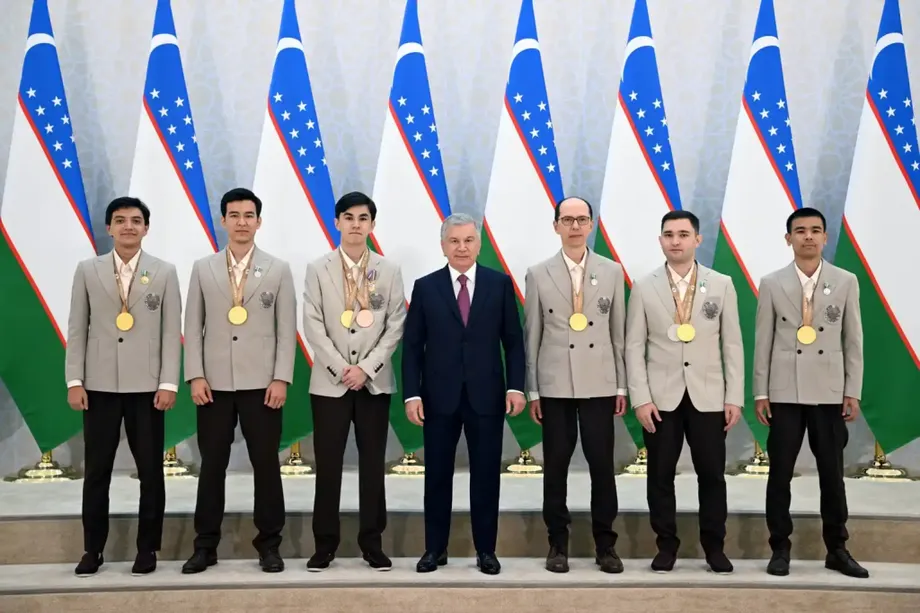
Two titles in four years, with a world crown next
Uzbekistan finished the 2026 Chess Olympiad in Samarkand with 20 of a possible 22 match points, beating Ukraine 2.5–1.5 in the final round to secure its second Open title after Chennai in 2022. India and Germany finished two points behind, taking silver and bronze respectively.
Contents
- Two titles in four years, with a world crown next
- How Uzbekistan secured gold
- A young team with proven depth
- India takes silver as Germany returns to the podium
- China wins the women's event as new talent emerges
- Sindarov's route from Goa to Geneva
- Why the title match may be closer than the ratings
- A library and museum will host the contest
- What Uzbekistan's success changes at home
- Key Points
The decisive victory came from reserve player Mukhiddin Madaminov, 19, who defeated Ukraine's European champion Roman Dehtiarov while the other three games ended in draws. On the top board, Nodirbek Abdusattorov completed all 11 rounds unbeaten and won individual gold with a tournament performance rating of 2869.
Uzbekistan now turns from a team triumph to an individual championship. Javokhir Sindarov, a member of both its Olympic gold teams, will challenge India's reigning world champion, Gukesh Dommaraju, at the Fondation Martin Bodmer in Cologny, near Geneva. The event runs from November 22 to December 12, with the first game scheduled for November 24.
Both players will be 20 when the match begins, making it the youngest pairing in world championship match history. Sindarov arrives with team gold, an unbeaten Candidates Tournament victory and a higher rating than the champion. Gukesh brings the experience of winning the title against Ding Liren in 2024.
The coming contest gives Uzbekistan a chance to add the undisputed individual world championship to its team success. Its Olympiad victory also showed how much strength sits around Sindarov: the final result depended on contributions across the lineup, rather than on one star.
How Uzbekistan secured gold
Uzbekistan won ten matches and lost only once, against Germany in round eight. A 3.5–0.5 victory over Armenia in the penultimate round put the hosts in a commanding position before their meeting with Ukraine.
FIDE's official Olympiad report records Madaminov's decisive final victory and his unbeaten individual score of 5.5 points from seven games. Against Dehtiarov, he converted an ending involving rooks and pawns, where precise king movement and careful calculation eventually settled the game.
Abdusattorov drew with Igor Kovalenko, Sindarov with Vasyl Ivanchuk, and Nodirbek Yakubboev with Ihor Samunenkov. Those three draws, worth half a game point apiece, combined with Madaminov's win to produce the 2.5–1.5 result.
The Olympiad uses two related scoring systems. Each individual game gives one point for a win and half a point for a draw. Four games determine the team match result, which awards two match points for victory and one for a draw. Uzbekistan's ten victories therefore produced 20 match points across 11 rounds.
The hosts collected about 91 percent of the maximum 22 match points. India and Germany each earned 18, equivalent to nine match victories. Uzbekistan's two point margin was therefore the value of one complete team win.
A young team with proven depth
Four members of the five player squad, Abdusattorov, Sindarov, Yakubboev and Shamsiddin Vokhidov, had already won gold in Chennai. All five players in Samarkand were aged between 19 and 24. Coach Rustam Kasimdzhanov, himself a former FIDE world champion, guided a group combining youth with experience of winning together.
Abdusattorov scored 8.5 points from 11 games on board one, where he faced the leading player in each opposing lineup. His individual gold followed silver medals on the top board at the 2022 and 2024 Olympiads. He gained 18 rating points in Samarkand.
A performance rating estimates the playing strength shown during a particular tournament, using results and the strength of opponents. Abdusattorov's 2869 performance was the highest of the event. His regular rating placed him fifth in the live world rankings after the competition.
Abdusattorov described the achievement after the victory:
This is the proudest moment in my life. It's been a tremendous achievement for our team, for Uzbekistan. I'm truly happy.
Sindarov won individual bronze on board two, while Yakubboev took silver on board three. Yakubboev also gained 14.4 rating points, reaching 2712 and entering the group of players rated above 2700. Madaminov's contribution ensured that the reserve position was another source of winning points.
India takes silver as Germany returns to the podium
India secured second place after drawing 2–2 with Hungary in the final round. Arjun Erigaisi defeated Peter Leko, balancing Gleb Dudin's victory over Gukesh. The other two games were drawn.
Gukesh entered that round with 8.5 points from ten games. His defeat left him with individual silver on board four, while Dudin earned gold for the first reserve position. Gukesh still gained 7.1 rating points across the Olympiad, although his final loss cost him 6.9 points that day.
Germany beat the Netherlands 2.5–1.5, with Matthias Bluebaum defeating Jorden van Foreest for the decisive point. Bronze was Germany's first Open team medal since its silver in Istanbul in 2000, ending a wait of 26 years.
Frederik Svane played all 11 rounds unbeaten, scoring 8.5 points and winning board three gold with a performance rating of 2796. Germany recorded nine match victories and two defeats, against China and India, and was the only team to beat Uzbekistan.
The United States, Azerbaijan, Armenia and Hungary finished on 17 match points, with the Americans fourth after the additional calculations used to separate tied teams. China finished eighth. England placed 12th with 16 points.
China wins the women's event as new talent emerges
China won the Women's section by beating Vietnam 3–1 in the final round. Kazakhstan took silver after a 2–2 draw with Poland, while India claimed bronze on tiebreak after drawing 2–2 with Georgia.
Zhu Jiner led China on board one, finishing unbeaten with seven points from nine games and individual gold. Lu Miaoyi, 16, also remained unbeaten, scoring 9.5 points from 11 games and winning gold on board three.
China achieved those results without several of its most established players, including world champion Ju Wenjun, Hou Yifan, Lei Tingjie and Tan Zhongyi. Its younger lineup supplied the results needed to finish first.
England's Bodhana Sivanandan, 11, scored eight points from 11 games and set a world age record for becoming a woman grandmaster, surpassing Hou's 2006 mark. She also earned her second qualifying performance, known as a norm, toward the international master title. She still needed a third norm and a rating of 2400; her rating including the Olympiad stood at 2382.
The Samarkand event was described as the largest Olympiad, with 397 teams across both sections representing 205 federations. The Open competition had 206 teams. Those totals reflect the tournament's scale, while the individual results showed young players advancing across several countries.
Sindarov's route from Goa to Geneva
Sindarov earned his championship opportunity through two major tournament victories. In 2025, he won the FIDE World Cup in Goa at 19, becoming the event's youngest winner. He defeated China's Wei Yi in the final tiebreak.
Wei had played 27 games without defeat during that World Cup before losing to Sindarov in the deciding stage. Both players qualified for the Candidates Tournament, the competition that selects the challenger to the reigning world champion.
In Cyprus in spring 2026, Sindarov finished the Candidates unbeaten with ten points from 14 games. He secured first place with a round remaining by drawing with Anish Giri. That result turned his World Cup breakthrough into a place in the title match.
The main steps in his progress are:
- 2022: Sindarov helps Uzbekistan win its first Open Olympiad title in Chennai.
- 2025: He wins the FIDE World Cup in Goa, defeating Wei Yi in the final.
- Spring 2026: He wins the Candidates Tournament in Cyprus, unbeaten on 10/14.
- September 2026: He helps Uzbekistan win a second Olympiad gold in Samarkand.
- November 24, 2026: His first world championship game against Gukesh is scheduled near Geneva.
- December 12, 2026: A tiebreak is scheduled if the classical match finishes level.
Why the title match may be closer than the ratings
Sindarov left Samarkand rated 2782, fourth in the live rankings and 72 points ahead of Gukesh, who stood 29th. Magnus Carlsen, the world's highest rated player, has called Sindarov the favourite, pointing to the champion's uneven recent results.
Gukesh's strongest advantage is direct experience of a world championship match. He defeated Ding 7.5–6.5 over 14 games in Singapore in 2024, becoming the youngest undisputed world champion at 18. Geneva will be his first title defence.
Wei Yi, the Chinese grandmaster who lost to Sindarov in Goa and helped Ding prepare for his successful 2023 championship match, expects a close contest. He said Sindarov had improved considerably and become a more complete player, helped by government support.
Wei also pointed to Gukesh's experience under championship pressure:
And Gukesh has the experience of playing a World championship match. I think many players feel Sindarov will win easily, but I don't think so.
The contrast is between Sindarov's sustained run of tournament success and Gukesh's experience of preparing for, adjusting during and winning a long match against one opponent. Their Olympiad results provide a recent measure of form; Geneva will require a different rhythm, with repeated preparation against the same rival.
A library and museum will host the contest
The Fondation Martin Bodmer in Cologny will provide an unusual setting for the championship. The institution, near Geneva, combines a library and museum and holds more than 150,000 documents, including ancient papyri, medieval manuscripts and rare books.
Its library, the Bibliotheca Bodmeriana, is listed on UNESCO's Memory of the World Register. Collector Martin Bodmer established the collection, and the museum building designed by Swiss architect Mario Botta opened in 2003. The foundation helped finance that building by selling a Michelangelo drawing.
The championship is scheduled for a maximum of 14 classical games. Classical chess gives players substantially more thinking time than rapid or blitz formats. If the score is tied after those games, the scheduled December 12 tiebreak will decide the winner.
The prize fund is $2.5 million. The announced payment structure awards each player $200,000 for every game won, with the remaining money divided equally. Drawn games therefore leave more of the fund in the portion shared between the players.
What Uzbekistan's success changes at home
President Shavkat Mirziyoyev celebrated the team as a golden generation and highlighted its victories over India, China and the top seeded United States. He also referred to a new presidential decree intended to support further chess development. The specific measures and implementation timetable were not detailed.
The five players were reportedly rewarded with $200,000, a house and a Volkswagen each, while Kasimdzhanov received $50,000. The cash awards for the players alone total $1 million, rising to $1.05 million when the coach's payment is included, before the value of the homes and cars.
FIDE also named Uzbekistan's chess federation its best federation of 2026 and selected Sindarov as best male player. Those awards accompany achievements at both levels of the sport: a team championship and qualification for its leading individual match.
Uzbekistan has already produced a FIDE world champion in Kasimdzhanov, who won in 2004 during the period when rival world titles existed. Sindarov will become the country's first player to contest a match for the undisputed world championship.
Samarkand showed that Uzbekistan can win through an entire squad, from Abdusattorov on the top board to Madaminov in reserve. Geneva will concentrate that national expectation on Sindarov, facing a champion of the same age who has already won the prize both now seek.
Key Points
- Uzbekistan won the Open Olympiad with 20/22 match points, ahead of India and Germany on 18.
- Madaminov's victory over Dehtiarov secured the final 2.5–1.5 win against Ukraine.
- Abdusattorov finished unbeaten on 8.5/11 and won individual gold on board one.
- China won the Women's section, followed by Kazakhstan and India.
- Sindarov will challenge Gukesh near Geneva, with the first game scheduled for November 24.
- Both players will be 20, the youngest pairing in world championship match history.
- The match has a $2.5 million prize fund and a possible tiebreak on December 12.