A new framework for workers abroad and families at home
Tajikistan's lower house of parliament, the Majlisi Namoyandagon, has unanimously approved a migration bill intended to replace the Law on Migration adopted on December 11, 1999. The proposed legislation would strengthen protection for migrant workers and their families, regulate private agencies recruiting people for jobs abroad, and bring migration services into digital systems.
Contents
- A new framework for workers abroad and families at home
- Why lawmakers want to replace the 1999 law
- Protection would extend from recruitment to return
- What digital migration services would involve
- Returning migrants and people moving within Tajikistan
- Russia's tighter controls add pressure for change
- More destinations are entering the picture
- The government links migration to jobs and skills
- Key Points
The vote comes as Russia, the main destination for Tajik workers, applies tighter migration controls and Tajik citizens increasingly seek employment in other countries. The bill also reaches beyond overseas employment, covering people returning home, relocation within Tajikistan, environmental migration and the needs of vulnerable groups.
Minister of Labor, Migration and Employment of the Population Soliha Kholmahmadzoda told lawmakers that the existing legislation no longer meets modern requirements. She presented the replacement as a way to improve migration management, make better use of workers' skills at home and abroad, and protect the domestic labor market.
The legislation still needs approval from the Majlisi Milli, parliament's upper chamber, followed by the president's signature and official publication. The ministry says the existing law will cease to apply once those steps are completed.
Why lawmakers want to replace the 1999 law
Mujibakhon Javhari, chair of the lower house Committee on Social Affairs, Family and Health, linked the proposed changes to demographic shifts, labor market conditions and the need to move migration procedures into digital systems. She described migration policy as entering a new stage.
Javhari explained why she supported replacing the legislation:
"The demands of the modern era, demographic changes, the state of the labor market and the need to digitalize migration processes have made the adoption of a new version of the law inevitable," Javhari said.
Deputies asked no additional questions during the session and approved the bill unanimously. Alongside new policy areas, the proposal updates migration concepts and terminology. Those definitions matter because they give government agencies a common legal vocabulary when deciding which rules and services apply to different groups of people.
Protection would extend from recruitment to return
Private employment agencies that recruit Tajik citizens for work abroad are a central target of the proposed regulation. These companies sit between workers seeking jobs and employers seeking staff, making recruitment an important stage in a migrant's journey.
The bill pairs regulation of those agencies with stronger protection for migrants and their family members. Its scope therefore reaches beyond the worker who crosses a border. Family members are expressly included among the people whose rights the legislation aims to protect.
Kholmahmadzoda also identified reducing irregular migration as an expected outcome. Irregular migration means entering, staying or working in a country outside its migration rules. For someone seeking a job abroad, recruitment procedures and access to the correct documents can affect whether their employment follows those rules.
The ministry did not release the bill's full text, leaving the precise recruitment duties, enforcement measures, protections and service arrangements unclear. No dates were given for upper house approval, presidential signature or publication.
What digital migration services would involve
Government agencies would share information through a unified migration information system under the proposal. The bill also calls for better statistical records and the use of digital technology to deliver public services.
A unified system means agencies would work through a common information framework instead of relying entirely on separate records. Better statistics would give officials a clearer picture of migration patterns, while digital services are intended to change how people complete migration procedures.
Kholmahmadzoda said these measures were intended to make public administration more transparent and efficient. The proposed shift connects two tasks: handling individual people's migration needs and gathering information that helps the government plan its policies.
For workers and families, the practical value will depend on how those services operate. The announced framework puts digital administration at the center of the reform, alongside rights protection and regulation of recruitment.
Returning migrants and people moving within Tajikistan
Returning workers would receive a clearer place in migration legislation through provisions on reintegration. Reintegration means helping people settle back into economic and social life after living elsewhere, including reconnecting with employment at home.
The bill also covers repatriation and resettlement. Repatriation concerns bringing people back to their home country, while resettlement concerns establishing them in a place to live. Treating these subjects separately allows migration policy to address different stages of a person's move.
Internal migration and environmental migration are included as well. Internal migration takes place within a country's borders. Environmental migration concerns movement connected to environmental conditions that affect where people can live or earn a living.
Gender considerations and the needs of vulnerable groups form another part of the proposal. Together, these provisions broaden the law's focus from managing overseas workers to addressing several kinds of movement and the different needs of the people involved.
Russia's tighter controls add pressure for change
Russia remains the principal destination for Tajik labor migrants, but its requirements for foreign workers have become stricter in recent years. Controls tightened further after the 2024 terrorist attack at Crocus City Hall.
Russian measures include a register of controlled persons covering foreign nationals who violate migration rules or otherwise come within the relevant legal provisions. Additional requirements and restrictions have made compliance with migration procedures a more demanding part of working there.
Tajikistan's proposed law addresses how its own authorities manage migration, recruitment and support. Workers going to Russia will also need to meet Russian entry, residence and employment requirements. Their experience therefore depends on rules in both the country they leave and the country where they work.
The sequence behind the proposed reform spans several stages:
- December 11, 1999: Tajikistan adopted the existing Law on Migration.
- 2024: The Crocus City Hall attack was followed by tighter Russian migration controls.
- Latest parliamentary step: The Majlisi Namoyandagon unanimously approved the replacement bill.
- Next stages: Upper house approval, presidential signature and official publication are required before the existing law ceases to apply.
More destinations are entering the picture
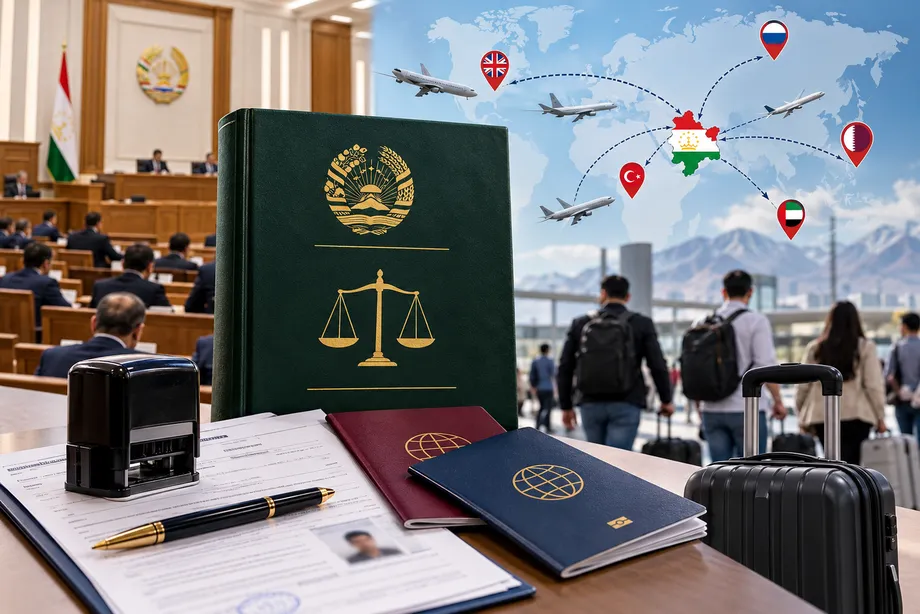
Tajik citizens have increasingly been looking for work in Kazakhstan, Belarus, the United Arab Emirates, Qatar, Kuwait, South Korea, Japan and the United Kingdom. Diversifying destinations for labor migration is an explicit objective of the bill.
That objective connects the legislation's recruitment, protection and administrative provisions. Managing migration across a wider range of countries requires attention to different employment systems and migration procedures, while workers still need reliable recruitment arrangements and protection for their rights.
The list of destinations stretches across Central Asia, Europe, the Gulf and East Asia. Russia continues to occupy the leading position, while the proposed framework seeks to accommodate a wider range of employment routes.
The government links migration to jobs and skills
Kholmahmadzoda presented the bill as part of a broader effort to use Tajikistan's workforce more effectively, both domestically and overseas. Protecting the domestic labor market is one of its stated aims, alongside supporting citizens who leave to work.
The minister also identified international cooperation, investment, technology transfer and human capital development as expected benefits. Technology transfer means bringing knowledge or methods into use elsewhere. Human capital refers to the skills, education and experience people can apply in their working lives.
Reintegration provisions connect those economic goals with returning migrants. The government wants migration policy to cover departure, employment abroad and life after return, while digital records and cooperation between agencies would support the administration of that wider remit.
Key Points
- Tajikistan's lower house unanimously approved a bill to replace the migration law adopted on December 11, 1999.
- The proposal covers migrant and family rights, recruitment agencies, digital services, return and resettlement.
- A unified information system would support data sharing between government agencies and better migration statistics.
- Russia remains the main destination for Tajik workers, while interest in other employment destinations is growing.
- The bill still requires upper house approval, the president's signature and official publication.
- The full legislative text has not been released, leaving implementation details unclear.