A larger population estimate, but slower growth
Laos has an estimated 7.24 million usual residents after a follow-up survey identified about 497,000 people missed in the initial count of its 2025 Population and Housing Census. The findings show a country still growing, but with fewer births relative to its population, an older population and sharp differences between provinces.
Contents
- A larger population estimate, but slower growth
- How Laos counted its residents
- From a March plan to November fieldwork
- Fewer births for every 1,000 residents
- A growing share of people of working age
- An older population changes spending needs
- Population growth varies sharply by province
- Rural access remains a major planning issue
- How the findings will shape national plans
- Key Points
The Lao Statistics Bureau directly counted 6.74 million residents during nationwide fieldwork from 3 November to 28 December 2025. The adjustment adds roughly half a million people, equivalent to about 7 percent of the estimated resident population. That difference matters when authorities calculate how many people need classrooms, clinics, roads and other public services.
The census findings put annual population growth at 1.1 percent in 2025, compared with a peak of 2.5 percent during 1985 to 1995. A further published account of the results gives average annual growth over the past decade as 0.8 percent, following 1.4 percent during 2005 to 2015 and 2.1 percent during 1995 to 2005. The calculation linking the current figure and the decade average was not explained.
The birth rate fell from 28 births per 1,000 people in 2015 to 18.1 in 2025. Meanwhile, the median age reached 27, up from 18.5 in 2005. Median age is the point at which half the population is younger and half is older.
Deputy Minister of Finance Phetsamone Sone expressed confidence in the findings at the launch of the census results:
We are 95 percent confident in the results.
The central planning challenge is now twofold: responding to a changing national age structure while reaching communities whose population trends and access to services differ greatly from those of the capital.
How Laos counted its residents
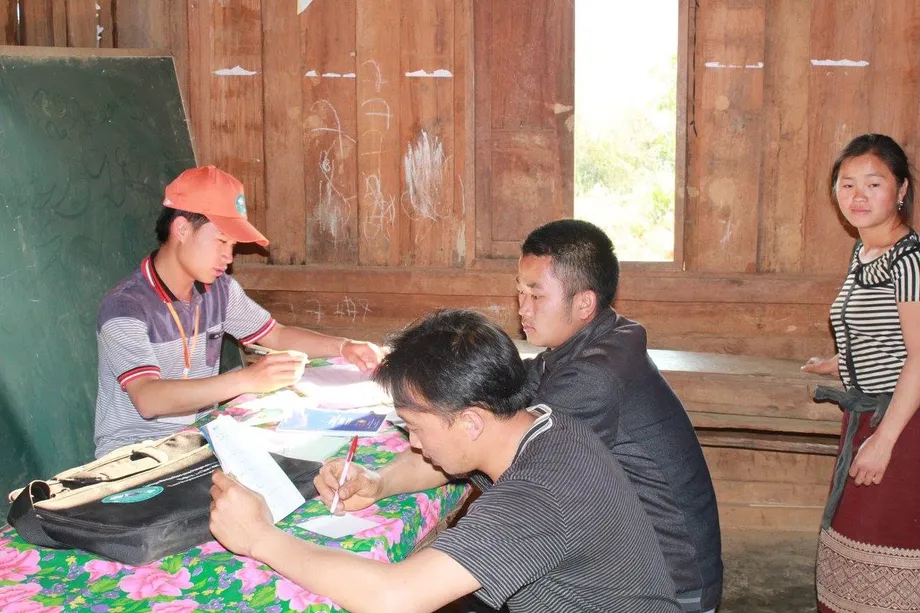
The fifth census was the first in Laos to collect information digitally. Preparation began at the end of 2021, bringing together the Lao Statistics Bureau, UNFPA and other development partners for an operation involving 12,000 enumerators and 12,000 tablets.
Finance Minister Santiphab Phomvihane and UNFPA Representative Bakhtiyor Kadyrov described the operation in a joint census statement published by the Lao Statistics Bureau. Enumerators conducted interviews face to face, entering responses through Computer-Assisted Personal Interviewing, or CAPI. Geographic Information System technology, known as GIS, helped map buildings, dwellings and the areas assigned to census workers.
The operation covered private households, collective households and Special Economic Zones, from remote mountainous communities to cities. Interviews included foreign residents. The directly counted population of 6.74 million was described as people who had lived in a household for at least six months or intended to remain for that period.
District authorities and supervisors monitored collection, while the central census office, statistics bureau and Ministry of Finance followed progress through a dashboard. UNFPA observers also supported monitoring in the field.
The follow-up exercise, called a Post Enumeration Survey, was designed to assess coverage and quality after the main count. It provides a way to estimate how many residents the initial operation missed and adjust the population total.
From a March plan to November fieldwork
Laos has held a population and housing census every 10 years since 1985. The previous census took place in March 2015, but the timetable for the fifth census changed during preparation.
A 2022 census brief, published on 19 December by the statistics bureau and UNFPA Lao PDR, initially scheduled the operation for March 2025. It set the reference moment at midnight between 1 and 2 March. The later official fieldwork schedule placed nationwide interviews in November and December.
- 1985: Laos conducted its first Population and Housing Census.
- March 2015: The fourth census took place.
- Late 2021: Preparation began for the fifth census.
- 19 December 2022: The census brief outlined a planned March 2025 operation.
- 3 November to 28 December 2025: Nationwide digital census fieldwork took place.
- 21 January to 21 February 2026: The official schedule set this period for the Post Enumeration Survey.
The preparation involved technical as well as financial support. The 2022 brief recorded a USAID commitment to long term technical assistance and identified the World Bank as a confirmed partner for electronic mapping.
Fewer births for every 1,000 residents
Laos recorded 122,043 births and 23,806 deaths in the 12 months before the census. The recorded births exceeded deaths by 98,237. Population change also depends on migration, which the census was designed to examine.
The fall in the birth rate from 28 to 18.1 per 1,000 residents amounts to a decrease of 9.9 births per 1,000, or about 35 percent, over a decade. This measure counts births against the whole population. It differs from the average number of children a woman has during her lifetime.
Women also became mothers at different average ages depending on where they lived. The national average was 23.5 years, compared with 25.4 in urban areas and 21.2 in rural communities without road access. The urban figure was 4.2 years higher than the figure for rural areas without roads.
Later marriage and a preference for smaller families have been cited as factors behind slower population growth. Further research is needed to establish why birth rates are falling and how much different social and economic changes contribute.
For planners, the figures point toward changing demand rather than a uniform reduction in need. A smaller share of children can change the balance of spending between services, while the location of births still matters for maternity care, vaccination and school places.
A growing share of people of working age
Laos had 53.8 children and older people for every 100 people of working age in 2025, down from 76.4 in 2005. This dependency ratio compares age groups that commonly need support with the population in the ages most associated with employment.
The decline amounts to 22.6 fewer dependants for every 100 people of working age, a reduction of nearly 30 percent over 20 years. It gives a clearer picture of the changing population balance than the total headcount alone.
A lower ratio can create what population specialists call a demographic dividend: an opportunity for economic growth when a larger share of residents can work. Turning that opportunity into higher incomes requires jobs, skills and earnings sufficient to support households.
The ratio groups people by age, while employment and family responsibilities vary within those groups. Its practical value is to help authorities judge the scale of services and economic opportunities needed as the population changes.
An older population changes spending needs
The rise in median age from 18.5 in 2005 to 27 in 2025 means the midpoint of the population moved upward by 8.5 years in two decades. Together with the lower birth rate and dependency ratio, it marks a substantial shift in the age structure.
Bakhtiyor Kadyrov, UNFPA Representative to Laos, described how those changes can guide decisions about public investment:
Knowing these changes in the population age structure can create opportunities for economic growth, and estimate how much they require to invest in education, health, skills, employment, and social protection,
Education spending will need to consider both the number of children and their location. Health planning must respond to births, the needs of adults and a growing older population. Training and employment policies will help determine whether more people of working age can earn stable incomes.
The census therefore gives the government a basis for connecting population numbers with budgets. A falling national growth rate still leaves decisions about where to build, which services to expand and how to reach people already underserved.
Population growth varies sharply by province
Savannakhet, Vientiane Capital, Champasak and Luang Prabang together account for more than 40 percent of the population. Savannakhet and Vientiane Capital each hold about 13 percent, putting roughly a quarter of residents in those two areas alone.
Attapeu and Sekong recorded the fastest population growth, at close to 3 percent a year. Champasak and Savannakhet experienced little growth. The contrast shows why a large population and rapid population growth require separate attention: an area can contain many residents while adding relatively few.
Population density is similarly uneven. Vientiane Capital has 228 people per square kilometre, compared with 12 in Phongsaly. Using those figures, the capital is 19 times as densely populated.
Dense settlements and scattered communities create different service needs. A clinic in the capital may serve many people within a small area, while a clinic in a sparsely populated province must reach households spread across much greater distances. Provincial and district figures are therefore central to making the national count useful.
Rural access remains a major planning issue
About two-thirds of people in Laos live in rural areas. Around 301,500 rural residents lack road access, and nearly 30 percent of that group live in Houaphanh Province.
That share represents roughly 90,000 people in Houaphanh, calculated from the rounded national figures. It concentrates a substantial part of the country's rural road access challenge in one province.
Road access affects how residents travel to schools, clinics, markets and workplaces. The census also found the lowest average age of motherhood in rural communities without roads, giving planners another reason to examine access to maternal and child health services in those locations.
The geographic detail collected through the census can help authorities identify villages where needs overlap. Population totals, ages, housing conditions and access to infrastructure can be considered together when deciding where limited public money should go.
How the findings will shape national plans
The Lao Statistics Bureau and UNFPA intend the census to support development planning, population policy and monitoring of the Sustainable Development Goals, the United Nations targets covering areas such as health, education and living conditions.
The launch statement says the census will inform monitoring of 107 of 232 indicators. The 2022 planning brief also identifies 107 indicators requiring population data, using a total of 231. Both documents place population information at the centre of measuring progress.
The 2022 brief connects census preparation with assessment of the Ninth National Socio-Economic Development Plan for 2021 to 2025 and formulation of the Tenth Plan for 2026 to 2030. The later statement describes census data as a reference for allocating budgets and tracking development over a longer period.
The planned analysis covers fertility, deaths, migration, urbanisation, education, work, disability, housing, gender, ethnicity and language. Authorities also aim to connect the census database with civil registration, which records events such as births and deaths between censuses.
For Laos, the immediate value lies in matching decisions to a more accurate count. The revised population estimate changes the scale of need, while falling births, an older population and uneven access to roads change where and how services must be delivered.
Key Points
- Laos estimates 7.24 million usual residents after adjusting an initial census count of 6.74 million.
- The birth rate fell from 28 per 1,000 people in 2015 to 18.1 in 2025.
- Median age rose from 18.5 in 2005 to 27 in 2025.
- The dependency ratio fell to 53.8 children and older people per 100 people of working age, from 76.4 in 2005.
- Attapeu and Sekong grew fastest, while Champasak and Savannakhet recorded little growth.
- About 301,500 rural residents lack road access, nearly 30 percent of them in Houaphanh.
- The first digital census will guide budgets, public services and national development planning.