Pollution restrictions take effect across the capital region
Delhi activated the first stage of its emergency pollution response across the National Capital Region on October 21, 2026, after its Air Quality Index rose from 179 a day earlier to 244 at 2 pm. The change took the capital from the moderate category into poor air quality, prompting restrictions on polluting fuels, tighter vehicle checks and stronger controls on dust and waste burning.
Contents
- Pollution restrictions take effect across the capital region
- What Stage 1 requires
- How the pollution response can escalate
- Night readings reveal a sharper pollution surge
- A cleaner start to October gives way to rising particles
- Weak winds leave pollution lingering
- Farm fires are lower, with the busiest period still ahead
- Why the response reaches beyond farm smoke
- Winter measures add duties for drivers and employers
- Key Points
The Commission for Air Quality Management (CAQM) ordered immediate implementation after reviewing pollution readings and forecasts from the India Meteorological Department (IMD) and the Indian Institute of Tropical Meteorology (IITM). Those forecasts indicated that poor air would persist in the coming days.
The commission's GRAP subcommittee described the change in its order:
The Air Quality Index (AQI) of Delhi which was observed 179 (Moderate Category) on 20.10.2026, has exhibited a sharp rise with AQI of 244 at 02:00 PM on 21.10.2026 (Poor Category).
The order went to the relevant authorities in Delhi, Haryana, Uttar Pradesh and Rajasthan. Its geographical reach matters because the National Capital Region extends beyond Delhi's administrative boundary, and pollution moves between the capital and surrounding towns.
Restaurants using coal or wood in tandoors, construction operators, drivers and municipal cleaning teams face immediate changes. Agencies have been told to intensify enforcement, monitor conditions and review whether further action becomes necessary.
Delhi's AQI increased by 65 points between October 20 and the following afternoon. Separate readings showed the deterioration extending beyond the capital: Gurugram recorded an AQI of 313 on Wednesday evening, placing it in the very poor category.
What Stage 1 requires
The Graded Response Action Plan, known as GRAP, is a ladder of emergency measures. Each stage brings stronger action as the pollution category worsens. Stage 1 applies when Delhi's AQI enters the poor range of 201 to 300.
Hotels, restaurants and roadside eateries must stop using coal and firewood in tandoors and use electricity, gas or other cleaner fuels. Diesel generators face restrictions, with essential and emergency uses governed by the exemptions specified in the plan.
Open burning of garbage, plastics, leaves and other municipal waste is prohibited. Agencies are also expected to act against industrial emissions and other activities that breach pollution rules.
The main measures affecting daily activity include:
- Stronger checks of Pollution Under Control certificates and action against vehicles that visibly pollute.
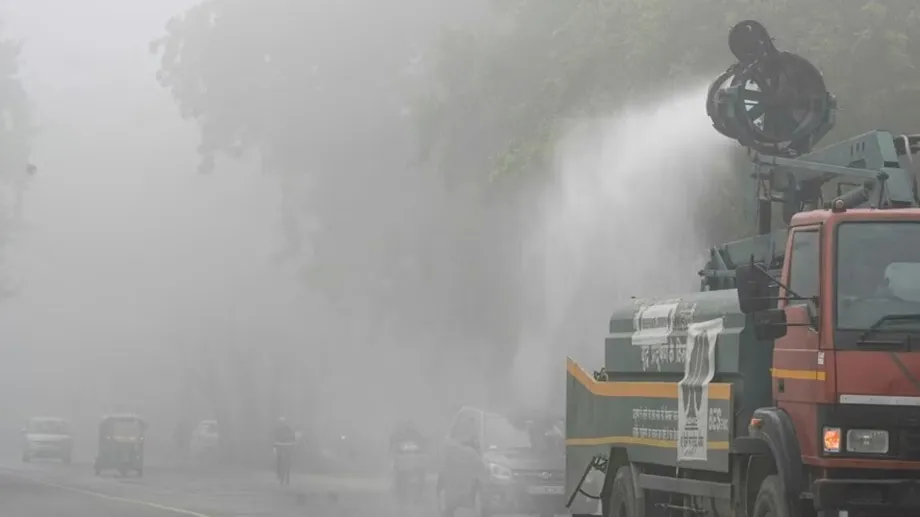
- Dust suppression at construction and demolition sites, including water spraying where needed.
- Checks on the transport of construction materials to reduce dust escaping onto roads.
- Mechanical road sweeping and regular water sprinkling.
- Traffic police deployment at important intersections to reduce congestion and unnecessary engine idling.
Construction projects larger than 500 square metres are required to have an approved dust management plan. For smaller sites, dust control duties still apply. The immediate focus is on controlling emissions and dust while work takes place, alongside enforcement against violations.
How the pollution response can escalate
CAQM uses Delhi's AQI and weather forecasts to decide which GRAP measures to activate across the region. AQI is an index that translates pollution measurements into a scale the public can follow: higher numbers mean worse air.
The four GRAP thresholds are:
- Stage 1: poor air, with AQI from 201 to 300.
- Stage 2: very poor air, with AQI from 301 to 400.
- Stage 3: AQI from 401 to 450.
- Stage 4: AQI above 450.
The subcommittee said agencies must implement, monitor and review Stage 1 measures throughout the NCR. It will continue assessing Delhi's air and the IMD and IITM forecasts before deciding on further action. No fixed date was given for lifting the restrictions.
Gurugram's evening reading of 313 illustrates how conditions can vary within the same region. Residents of neighbouring cities can experience different pollution levels even while a common regional response is in force.
Night readings reveal a sharper pollution surge
Delhi's average PM2.5 concentration reached 191.2 micrograms per cubic metre at 1 am on October 21, according to Central Pollution Control Board (CPCB) measurements. At that hour, 45 of 53 monitors recorded pollution corresponding to poor conditions or worse, about 85 percent of those monitors.
PM2.5 consists of particles measuring no more than 2.5 micrometres across. These particles are small enough to travel deep into the lungs. Their concentration measures how much fine particle pollution is present in a given volume of air.
India's national standard for PM2.5 is 60 micrograms per cubic metre averaged over 24 hours. The overnight reading captures a single hour; the daily standard assesses exposure across a full day. Both time scales help explain what people encounter, especially those working or travelling overnight.
An analysis of hourly CPCB measurements during the week ending at 1 am on October 21 found that 24.9 percent of PM2.5 readings fell in bands corresponding to poor air or worse. Nearly two thirds of the readings in the very poor or severe bands occurred between 9 pm and 6 am.
Delhi's daily AQI of 179 on October 20 therefore sat alongside much sharper episodes during particular hours. For delivery workers, security guards, drivers and people leaving home before sunrise, the timing of those episodes is directly relevant to time spent outdoors.
A cleaner start to October gives way to rising particles
Delhi's average AQI from October 1 to 20 was 154.6, compared with 178.7 during the same period in 2025. That was a reduction of 24.1 index points, or about 13.5 percent.
Fine particle measurements showed conditions worsening within the month. The average PM2.5 concentration rose from 59.3 micrograms per cubic metre in the first week of October to 71.2 in the seven days ending October 20, an increase of about 20 percent.
Hourly patterns were also pronounced. Since October 1, the average concentration at midnight was 80.4 micrograms per cubic metre, compared with 44.4 at 3 pm. Concentrations between midnight and 6 am averaged 1.6 times those recorded between noon and 6 pm.
Delhi Environment Minister Manjinder Singh Sirsa said the city had recorded 214 days of good or moderate air during the year. He described that as the highest count in 12 years when the year affected by COVID-19 was excluded. The October deterioration now places the government's winter preparations under immediate pressure.
Weak winds leave pollution lingering
Low wind speeds formed part of the conditions surrounding the deterioration. When air moves slowly, smoke and fine particles can remain concentrated near the places where people live and work instead of dispersing quickly.
CPCB measurements showed average wind speeds around midnight of 0.6 metres per second, compared with 1 metre per second at 3 pm. On October 15, a much cleaner afternoon coincided with stronger winds: at 2 pm, wind speed reached 2.3 metres per second and the city's average PM2.5 concentration fell to 9 micrograms per cubic metre.
IITM's Air Quality Early Warning System forecast in its October 20 bulletin that Delhi would experience poor air from October 21 to 23. It expected poor conditions to continue during the subsequent six days.
The main developments unfolded as follows:
- October 20: Delhi recorded a daily AQI of 179, while IITM forecast poor conditions ahead.
- October 21, 1 am: Average PM2.5 reached 191.2 micrograms per cubic metre.
- October 21, 9 am: CPCB recorded Delhi's AQI at 233.
- October 21, 2 pm: AQI reached 244; CAQM activated Stage 1 across the NCR with immediate effect.
- October 21 evening: Gurugram recorded an AQI of 313.
Farm fires are lower, with the busiest period still ahead
The Indian Agricultural Research Institute recorded 506 crop residue burning incidents in Punjab, Uttar Pradesh and Haryana between October 1 and 20. Punjab accounted for 345, Uttar Pradesh for 155 and Haryana for six.
The total was below the 817 incidents recorded during the same period a year earlier, a decline of about 38 percent. During the corresponding periods from 2018 to 2024, counts ranged from 2,031 to 9,722.
Historical timing remains a concern. Between 83.6 percent and 94.5 percent of seasonal burning incidents in those three states occurred after October 20 during 2018 to 2024. The approaching weeks have usually accounted for most of the season's fires.
Firecracker use around Dussehra was also cited as a contributor to the latest deterioration, with further concern ahead of Diwali on November 8. Traffic, industry, dust and burning within the region continue to add pollution while seasonal smoke can place further pressure on the air.
Why the response reaches beyond farm smoke
A study by The Energy and Resources Institute and the Automotive Research Association of India examined Delhi's PM2.5 sources during the winter of 2016 to 2017. It estimated contributions of 23 percent from vehicles, 22 percent from crop residue and household burning combined, 15 percent from road and construction dust, and 10 percent from industry.
Another 26 percent came from particles formed when gases reacted in the atmosphere. Pollution can therefore develop after gases leave an exhaust pipe or industrial source, as well as arriving directly as smoke or dust.
An IITM model examining October and November 2021 estimated that sources within Delhi contributed 34.4 percent of the city's PM2.5, while the rest of the NCR contributed 31 percent. Crop residue burning contributed an average of 7.3 percent during that period.
Those historical estimates explain the range of activities covered by GRAP. Road cleaning, vehicle enforcement, controls on commercial fuels and action against open burning address different parts of the pollution burden. Regional enforcement also reaches sources outside Delhi that affect air inside the capital.
Winter measures add duties for drivers and employers
Delhi's winter action plan is scheduled to run from November 1 to February 28. Announced measures include restrictions on entry by vehicles registered outside Delhi that fail to meet BS-VI emission standards. BS-VI is India's vehicle emission standard governing pollutants released through exhaust.
The government has also announced a No PUC, No Fuel policy, under which vehicles without a valid Pollution Under Control certificate would be refused fuel at petrol pumps. A PUC certificate records whether a vehicle passed the prescribed emissions check.
Sirsa also said government and private offices were required to implement a policy under which 50 percent of staff work from home. The practical details of that requirement, including its start date and exemptions, were not specified in his reported announcement.
The minister's longer term proposals include removing road dust, paving roads from edge to edge and moving from vehicles with combustion engines to electric vehicles. The winter programme also includes promoting public transport and electric buses.
Residents have been urged to use public transport, maintain vehicles, avoid burning waste and report pollution. Drivers are being asked to switch off engines at red lights. For businesses and agencies, the immediate task is more specific: change prohibited fuels, control dust, stop open burning and enforce the Stage 1 rules already activated.
Key Points
- CAQM activated GRAP Stage 1 across the NCR on October 21, 2026, after Delhi's AQI reached 244.
- Restrictions cover coal and wood in commercial tandoors, diesel generators, waste burning, vehicle pollution and dust.
- Overnight PM2.5 reached 191.2 micrograms per cubic metre, with 45 of 53 monitors recording poor conditions or worse.
- IITM forecast poor air for October 21 to 23 and the following six days.
- Farm fires were below the previous year's count through October 20, but historical records place most seasonal burning after that date.
- Delhi's winter action plan is scheduled to begin November 1, with Diwali falling on November 8.