A bigger hatchback at a lower starting price
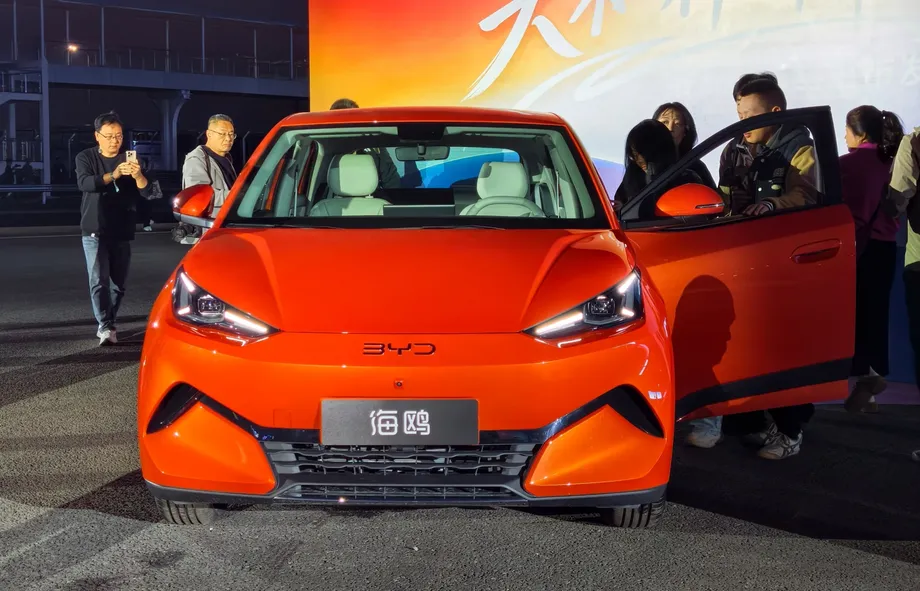
BYD launched its second generation Seagull at Zhengzhou International Circuit in Henan, China, on October 20, 2026, with prices starting at 65,900 yuan, about $9,800. The hatchback gains a fifth seat, grows by 425 millimeters and offers charging from 10% to 70% in five minutes on three of its five versions.
Contents
- A bigger hatchback at a lower starting price
- What each version costs
- What five minutes of charging means
- Free charging depends on the version
- More room for passengers and luggage
- A new motor layout and suspension
- A central screen takes over driving information
- LiDAR assistance comes with driver supervision
- A sales recovery is the central test
- Key Points
The starting price is 4,000 yuan below the outgoing model's 69,900 yuan launch price. Eligible buyers can receive a further 3,000 yuan trade-in discount, bringing the new entry price to 62,900 yuan. Flash Charging starts at 75,900 yuan before that discount, rather than at the cheapest version's price.
BYD is making the changes as one of its biggest electric models loses ground. Company figures put Seagull sales at 265,901 worldwide in the first nine months of 2026, down 33.2% from 398,200 a year earlier. In China, sales fell roughly 66% to about 83,600, while the competing Geely EX2, known domestically as Xingyuan, reached around 310,000.
The response goes beyond a new screen or fresh styling. BYD has moved the motor to the rear, changed which wheels it drives, replaced the rear suspension and expanded both passenger and luggage space. Optional LiDAR adds more advanced driving assistance.
For buyers, the practical choice is between two versions built around a smaller battery and home charging, and three more expensive versions combining a larger battery with very short charging stops at compatible stations. The price list makes that divide central to understanding the new car.
What each version costs
BYD offers five trims, with the two cheapest using a 30.1 kWh battery and the upper three using a 39.2 kWh battery. The versions are listed below using the Ease and Flight English names; other translations call them Comfort and Flying.
- Vitality: 65,900 yuan, or 62,900 yuan with the trade-in offer; 320 km CLTC range, without Flash Charging.
- Freedom: 72,900 yuan, or 69,900 yuan with the offer; 320 km CLTC range, without Flash Charging.
- Ease: 75,900 yuan, or 72,900 yuan with the offer; 420 km CLTC range and Flash Charging.
- Flight: 82,900 yuan, or 79,900 yuan with the offer; 420 km CLTC range and Flash Charging.
- Smart: 99,900 yuan, or 96,900 yuan with the offer; 420 km CLTC range and Flash Charging.
The Ease costs 10,000 yuan more than the entry version, but only 3,000 yuan more than the Freedom. That smaller step buys an additional 100 km of rated range and access to the fastest charging technology.
The new starting price is about 5.7% below the outgoing model's 69,900 yuan launch price and 7,900 yuan below the original Seagull's 73,800 yuan price in April 2023. Discounts have also pushed earlier cars lower: a May 2025 discount campaign brought the previous Seagull's advertised entry price to 55,800 yuan. The latest reduction is therefore a comparison between launch prices, with promotional offers forming a separate part of the pricing history.
What five minutes of charging means
BYD says the three versions with the 39.2 kWh battery can charge from 10% to 70% in five minutes at dedicated Flash Charging stations. Its longer charging claim is 10% to 97% in nine minutes. At minus 30 degrees Celsius, the company gives a time of 12 minutes for a different interval, from 20% to 97%.
A five minute stop adds 60 percentage points of charge. Applying that share to the advertised 420 km range gives about 252 km under China's CLTC test conditions. Actual driving distance depends on speed, weather, heating or air conditioning, and other conditions.
The battery's capacity also helps explain the power involved. Adding 60% of 39.2 kWh means storing approximately 23.5 kWh in five minutes, equivalent to average power of about 282 kW before accounting for charging losses. The nine minute claim implies about 227 kW on the same simplified basis.
Kilowatt hours, or kWh, measure how much energy the battery stores. Kilowatts, or kW, measure how quickly energy moves into it. A smaller battery needs less energy than a larger one to gain the same percentage of charge.
BYD's compatible charging equipment can deliver up to 1,500 kW, while the power a connected car accepts depends on its battery and electrical system. The Seagull's maximum charging power and battery voltage remain unconfirmed. Performance on charging equipment operated by other companies also awaits confirmation.
Free charging depends on the version
BYD is pairing the faster charging versions with an introductory benefit: eligible buyers using the vehicles for noncommercial purposes receive 12 months of free charging at its Flash Charging stations, beginning at delivery.
Zhang Zhuo, general manager of BYD's Ocean Network sales division, described the offer at the launch:
Starting today, every purchase comes with 12 months of free flash charging, with no limit on electricity,
Buyers of the Vitality and Freedom versions instead receive a 7 kW home charger, with free installation available within two years of delivery. Their smaller batteries provide the lower purchase price, while the home charger supports regular charging where the vehicle is parked.
Zhang said BYD had built 12,165 Flash Charging stations by October 20 and planned to reach 20,000 by the end of 2026. That target requires another 7,835 stations, an increase of about 64% over the stated network.
The network's location matters as much as its total size for a driver planning a trip. The advertised five minute stop relies on reaching compatible equipment and having suitable charging conditions. Home charging offers a different routine, with the car replenishing its battery over hours rather than during a brief roadside stop.
More room for passengers and luggage
The new Seagull measures 4,205 mm long, 1,810 mm wide and 1,570 mm high. Its wheelbase, the distance between the front and rear axles, is 2,650 mm. Compared with the outgoing Chinese model, it is 425 mm longer, 95 mm wider and 30 mm taller, with an additional 150 mm between the axles.
The body is roughly 11% longer than before. Seating increases from four places to five, and BYD gives a rear seating width at hip level of 1,242 mm. That extra seat broadens its use for households that sometimes need to carry three people in the back.
The rear boot holds 380 liters with the seats upright and expands to 1,380 liters when the rear seats are folded. A new 94 liter compartment under the bonnet adds storage at the front. BYD also describes storage beneath the rear seats, including two concealed compartments with a combined capacity of 24 liters.
The larger body brings the Seagull closer in size to other BYD hatchbacks. At 4.205 meters, it is about 215 mm longer than the current European Dolphin Surf and only about 85 mm shorter than the European Dolphin. Those dimensions make the new generation a broader proposition than the earlier Chinese city car.
A new motor layout and suspension
BYD has switched from a motor at the front driving the front wheels to a motor at the rear driving the rear wheels. The two versions with the smaller battery produce 85 kW, while the three with the larger battery produce 95 kW. Both outputs exceed the previous model's 55 kW.
The 95 kW motor is roughly 73% more powerful than the outgoing unit. BYD lists torque at 130 newton meters and a maximum speed of 150 km/h, compared with 130 km/h for the earlier car.
The rear suspension changes from a torsion beam to an independent system using multiple links. This arrangement gives each rear wheel more freedom to respond to uneven roads, with the aim of improving comfort and control. Despite the longer body, the stated turning radius remains 4.95 meters.
The battery choices provide 320 km or 420 km of range under CLTC, China's vehicle testing cycle. European WLTP certification figures have not been announced. Published conversions give different estimates, so the Chinese ratings remain the relevant stated figures for this launch.
BYD also gives minimum energy consumption of 9.0 kWh per 100 km and a drag coefficient of 0.28, a measure of how easily the body moves through air. Driving speed and conditions will affect the energy drivers actually use.
A central screen takes over driving information
The cabin replaces the separate instrument display with a 15.6 inch central screen running BYD's DiLink 150 system. The screen combines entertainment and navigation with essential information such as speed, battery charge, gear selection and indicators.
When the driver selects the forward gear, key driving information appears in the left portion of a split display. BYD describes several screen layouts and a simplified mode that activates if the tablet system experiences a communication delay, keeping core driving information visible.
The cockpit includes DeepSeek artificial intelligence integration. Available comfort equipment includes power adjustment in six directions for the driver and four for the front passenger, three heating and ventilation settings for both front seats, and several massage modes for the driver.
Automatic climate control is standard across the range. Other advertised equipment includes wireless phone charging at 50 W, ambient lighting with 127 colors and an audio system with eight speakers. Equipment varies by version.
Six exterior colors are offered: Lime Green, Berry Pink, Cream White, Mango Orange, Ice Coconut Blue and Sesame Grey. Interior choices are Shell White, Clear Sky Pink and Polar Star Grey. The exterior retains BYD's Marine Aesthetics design theme, with new trident shaped lights.
LiDAR assistance comes with driver supervision
God's Eye C driving assistance is standard across the range. Higher specifications offer God's Eye B, also called DiPilot 300, with a LiDAR sensor mounted on the roof. LiDAR uses laser pulses to measure distances to surrounding objects.
The more advanced system supports navigation assistance in cities and on highways, traffic light recognition with countdowns, movement around obstacles, roundabout driving and automated parking. BYD also describes parking that can be completed after occupants leave the vehicle.
Drivers must supervise the driving assistance features. BYD offers accident compensation commitments covering smart parking and, for one year, city navigation assistance, subject to the applicable terms.
Safety equipment includes automatic emergency braking, parking surveillance, up to six airbags and a reinforced body structure. BYD says its tire blowout stabilization system is standard, with a stated operating range of 60 to 140 km/h. The system is intended to help maintain stability if a tire suddenly loses pressure.
A sales recovery is the central test
September brought an improvement for the Seagull: sales reached 38,650, up 11.75% from a year earlier and 7.05% from August. It was the second consecutive month of annual growth, although the total for January through September remained far below the previous year.
The decline has changed the Seagull's weight within BYD. It accounted for 16.3% of the company's battery electric passenger vehicle sales in the first nine months of 2026, down from 24.8% a year earlier. BYD's battery electric passenger sales rose 1.5% to 1,629,957 over that period; excluding the Seagull, they rose 12.9% to 1,364,056.
Competition in China is particularly sharp. The Geely EX2's roughly 310,000 sales in January through September were about 3.7 times the Seagull's approximately 83,600 domestic sales. The Tesla Model Y followed the Geely in the broader ranking with about 277,000.
BYD itself faced domestic retail sales falling 28.9% to 246,816 in September, according to China Passenger Car Association figures, while retaining a 22.8% share of the new energy vehicle retail market. Earlier in the year, falling sales and shares had already exposed pressure from discounts, weaker demand and rising costs.
The Seagull has accumulated about 1.55 million sales since its April 2023 debut. Its latest development followed this sequence:
- September 30, 2026: cabin and equipment details emerged ahead of the sales launch.
- October 9: BYD opened advance orders without announcing prices.
- October 20: the five versions went on sale at the Zhengzhou launch.
- End of 2026: BYD targets 20,000 Flash Charging stations.
The launch covers China. BYD has not announced a confirmed overseas timetable, export specifications or overseas prices for this generation. Related versions of the earlier car carry names including Dolphin Surf, Dolphin Mini and Atto 1 in different markets.
Key Points
- The new Seagull starts at 65,900 yuan, or 62,900 yuan for eligible buyers using the trade-in offer.
- Flash Charging starts with the 75,900 yuan Ease version and is available on three trims.
- BYD claims 10% to 70% charging in five minutes and 10% to 97% in nine minutes at compatible stations.
- The body grows by 425 mm, seating rises to five, and the car gains a 94 liter front storage compartment.
- The new layout combines a rear motor, drive to the rear wheels and independent rear suspension.
- Global Seagull sales fell 33.2% in the first nine months of 2026, despite growth in August and September.
- BYD has not confirmed when this generation will reach overseas markets.