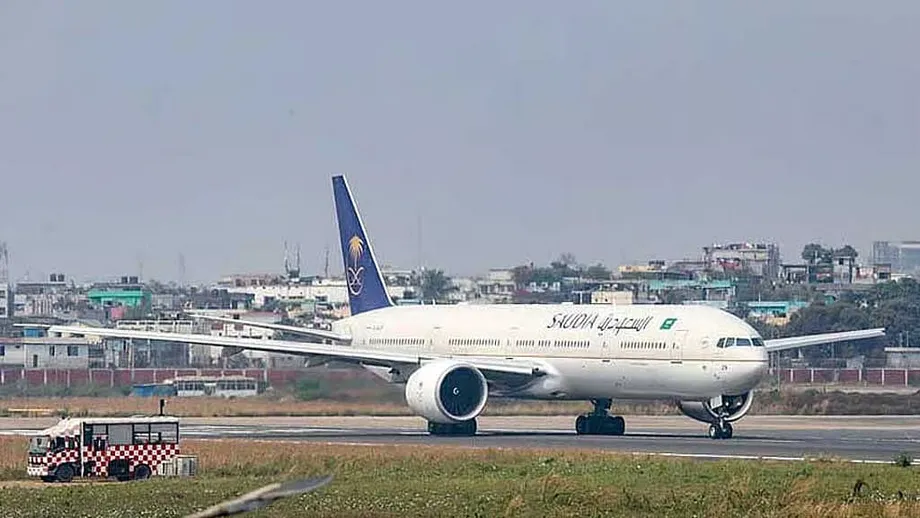
Workers and pilgrims face cancelled journeys and rising costs
Attacks on Saudi airports have forced the cancellation or suspension of 126 flights from Dhaka, affecting 19,377 passengers over nine days, according to Bangladesh aviation authorities. The disruption has left migrant workers struggling to return to their jobs, pilgrims paying more for replacement tickets and families waiting to bring home two Bangladeshis killed in Riyadh.
Contents
- Workers and pilgrims face cancelled journeys and rising costs
- How quickly did the disruption grow?
- Which airlines have been affected?
- What happened at the Saudi airports?
- Alternative airports offer a route, at a price
- Workers are paying more as leave and visas run short
- Pilgrims face doubled fares and hotel bills
- What assistance must airlines provide?
- Families await the return of those killed
- A regional defence response preceded the airport crisis
- Key Points
Kawsar Mahmud, assistant director of public relations at the Civil Aviation Authority of Bangladesh (CAAB), gave the latest figures at about 7:30pm on Monday, October 19. Airport authorities counted 59 direct flights and 67 transit flights affected by restrictions following repeated Houthi attacks on Riyadh and Dammam.
Biman Bangladesh Airlines has suspended its Riyadh service indefinitely. It plans to resume Dammam flights on October 21 after reviewing the security situation, while US-Bangla Airlines has cancelled its Riyadh services through October 21. Biman's proposed Dammam restart depends on that review.
The consequences stretch beyond missed departures. Workers face approaching visa deadlines and the end of approved leave. Travellers trying to reach Saudi Arabia through Jeddah or Madinah have faced extra ticket costs, while some pilgrims have needed accommodation after learning at the airport that their flights were cancelled.
CAAB has instructed airlines to provide flight updates, help with refunds and replacement bookings, and supply basic assistance to people already at Dhaka's Hazrat Shahjalal International Airport. Passenger accounts describe difficulties obtaining information and arranging another journey.
How quickly did the disruption grow?
CAAB's figures show the disruption spreading across both direct services and connecting journeys. By October 14, 100 flights and 15,393 passengers had been affected. The October 19 total represents another 26 flights and 3,984 passengers, increases of 26% in each case when rounded to the nearest whole percentage.
The changing totals track successive updates as airlines cancelled departures or extended suspensions. The main developments were:
- October 10: An attack on King Khalid International Airport in Riyadh killed 13 people and injured 308. Flight disruptions began that day.
- October 11: Saudi authorities said another projectile struck the airport, killing one person and injuring 11.
- October 12: Biman announced an initial suspension through October 17. An early CAAB update counted 62 affected flights and 9,674 passengers, excluding Riyadh Air passengers from the passenger total.
- October 14: CAAB counted 89 affected flights and 14,655 passengers in an afternoon update, rising to 100 flights and 15,393 passengers by 6:30pm.
- October 15: The total reached 103 flights and 15,779 passengers. Biman announced additional capacity through Jeddah and Madinah.
- October 17: CAAB's ASM Flight Management figures recorded 114 disrupted flights and 17,701 affected passengers.
- October 19: Authorities announced 126 affected flights and 19,377 passengers. October 21 became the next date to watch for Biman's proposed Dammam restart and the end of US-Bangla's announced Riyadh cancellation period.
Biman's initial suspension was extended through October 18 before the later decisions separating its Riyadh and Dammam services. Passengers therefore face different arrangements depending on their airline and destination, even when their original journeys were disrupted by the same attacks.
Which airlines have been affected?
Biman accounted for 20 of the 59 affected direct flights in the latest tally. Saudia accounted for 19, while US-Bangla and Riyadh Air each accounted for 10. Together, Biman and Saudia represented 39 of the 59 direct flights, or about two thirds.
IndiGo had the largest number of affected transit flights, with 24 of the 67. Emirates accounted for 14, Qatar Airways nine, SalamAir seven, flydubai six, Air India six and EgyptAir one.
A direct flight carries passengers between their departure city and destination without changing aircraft along the way. A transit journey involves a connection through another airport. Restrictions at the destination can disrupt either type of booking, including journeys whose first flight leaves Dhaka for a connecting hub outside Saudi Arabia.
The figures also show how the disruption developed. Between the October 14 evening update and October 19, affected direct flights increased from 41 to 59, while transit flights rose from 59 to 67. Eighteen of the additional 26 affected services were therefore direct flights.
What happened at the Saudi airports?
Yemen's Houthi movement launched repeated attacks on Riyadh and Dammam from October 10. The attack on Riyadh's King Khalid International Airport that afternoon killed 13 people of different nationalities and injured 308, including two Bangladeshis killed and 27 wounded.
Saudi authorities said a further projectile struck a passenger terminal on October 11, causing a fire and killing one person while injuring 11. Saudi coalition forces also reported intercepting a cruise missile near the airport during the escalation.
By Monday, Saudi authorities put the toll from recent Houthi missile and drone attacks across the kingdom at 19 dead and more than 350 injured. That broader figure covers attacks beyond the October 10 airport strike. Saudi Civil Defense issued further danger alerts across parts of the country on Monday.
The Iran backed Houthis claimed six operations on Monday targeting Saudi oil infrastructure, airports and military sites. The group has threatened further attacks on airports and oil facilities, describing its campaign as retaliation for Saudi military operations in Yemen.
The violence also continued inside Yemen. Shabwa's provincial government said Houthi ballistic missile strikes on the al-Alam military camp killed at least 53 soldiers and wounded 200 recruits on Monday. The parallel attacks show that the airport emergency is unfolding alongside renewed fighting between the Houthis and forces supported by Saudi Arabia.
Alternative airports offer a route, at a price
Biman has directed passengers with urgent travel needs toward Jeddah and Madinah, also commonly written as Medina. These airports provide another way into Saudi Arabia for people originally booked to Riyadh or Dammam, although travellers still need to arrange onward journeys to their final destinations.
The airline arranged three additional flights to Jeddah. On its Madinah route, it replaced Boeing 787 aircraft with Boeing 777s, adding 148 seats per flight. Biman advised passengers to contact its ticket sales offices for booking information.
Passengers have sought these alternatives to reach jobs or continue religious travel. Abu Taher, travelling to Saudi Arabia for the first time to work in a Riyadh shop, changed his cancelled Riyadh ticket for a Jeddah flight. Mokhlesur Rahman sought a Madinah ticket after his Biman flight scheduled for October 18 was cancelled.
Jeddah services have also experienced disruption. A Flynas departure scheduled for 5:30pm on October 14 appeared as cancelled on Dhaka airport's flight display. Travellers therefore need confirmation of the specific replacement flight before making another trip to the airport.
CAAB and airport authorities could not give a total for passengers who had successfully travelled through alternative routes. Some people counted as affected may subsequently have secured another flight, while others were still trying to arrange travel.
Workers are paying more as leave and visas run short
Zakir Hossain, a factory labourer in Riyadh from Katiadi in Kishoreganj, was due to leave Dhaka on a Biman flight on October 13. His three months of leave ended that day. After the cancellation, he paid another Tk16,000 for a flight to Madinah scheduled for the following evening.
Zakir said his employer had told him to use an alternative route. Describing the additional payment and the pressure to return, he said:
Biman told me the route had changed, so I would have to pay another Tk 16,000. I paid and got the ticket. I have to get there somehow.
Anwar Hossain, from Bogura, faced a different problem. He was preparing to leave Bangladesh for the first time on a work visa when his IndiGo flight was cancelled. After waiting at the airport until night, he stayed with a relative and tried unsuccessfully to reach both his travel agency and employer.
Anwar described his uncertainty after the cancelled journey:
I waited all day on Tuesday but couldn't leave. I've been calling everyone since this morning, but no one is answering. This is my first time going abroad, and I don't understand what I'm supposed to do. I don't even know how I'll get there now,
State Minister for Expatriates' Welfare and Overseas Employment Md Nurul Haque said Bangladesh was pursuing talks with Saudi Arabia to extend visas for stranded workers. Those talks were aimed at helping people whose permission to travel was nearing expiry while flights remained disrupted.
No agreement granting those extensions had been announced. CAAB instructed airlines to refer passengers needing visa or immigration assistance to Saudi authorities, the Saudi Embassy in Dhaka and the relevant agencies.
Pilgrims face doubled fares and hotel bills
Umrah travellers have also been caught in the cancellations. Umrah is a pilgrimage to Makkah that Muslims can undertake at different times of the year, unlike the annual Hajj pilgrimage, which follows fixed dates.
Agency owner Akbar Ali said at least 200 pilgrims booked through his agencies had been affected. Forty who were supposed to return on October 11 on Riyadh Air were rebooked on SalamAir, with ticket prices rising from Tk30,000 to Tk60,000.
That change doubled the ticket price, adding Tk30,000 per person. For the 40 pilgrims described by Ali, the difference amounts to Tk1.2 million in additional fares. The increase illustrates how a cancelled journey can become a substantial financial burden even when another flight is available.
Atiar Rahman and Sujauddin were part of another group of 40 pilgrims due to leave on an Air Arabia flight on October 14. After arriving in the morning, they learned that their flight had been cancelled and faced the cost of staying in a hotel.
For these travellers, the expense extends beyond a replacement ticket. A delayed departure can require accommodation and meals, while a different arrival airport can add another journey inside Saudi Arabia.
What assistance must airlines provide?
CAAB issued seven directives in a letter signed by Group Captain SM Ragib Samad, executive director of Hazrat Shahjalal International Airport. The instructions require airlines operating direct and transit services to Saudi Arabia to provide accurate information and practical help until operations return to normal.
Airlines must notify passengers of cancellations, delays and schedule changes through channels such as text messages, telephone calls, email, websites and social media. They must explain revised schedules, replacement bookings, refunds and other applicable arrangements, and advise passengers to stay away from the airport until their flight is confirmed.
For people who have already arrived, the directives require seating, drinking water and light refreshments. Airlines must give particular attention to older people, children, people with disabilities and other vulnerable travellers.
Each airline must also appoint a representative and provide that person's contact details to the airport's Flight Management Department. The representative must remain in contact with airport authorities to coordinate information and passenger assistance.
Passenger accounts from October 14 described people arriving without knowing their flights had been cancelled, waiting for information and struggling to reach agencies. Those experiences put prompt notification and access to airline staff at the centre of the response, alongside the search for replacement seats.
Families await the return of those killed
Bangladesh has sought Saudi assistance to bring home the two Bangladeshis killed in the Riyadh airport attack. State Minister for Foreign Affairs Shama Obaed Islam raised the request with Saudi Ambassador Abdullah bin Zafer Abiyah in Dhaka.
Expatriates' Welfare and Overseas Employment Minister Ariful Haque Choudhury said on October 19 that returning their bodies would receive priority once air connections and the wider situation returned to normal. He made the remarks after an event at Shahjalal airport.
Bangladesh Embassy officials have been monitoring injured nationals. Md Nurul Haque said the ambassador and senior officials had visited hospitals, while medical treatment and repatriation arrangements were being coordinated with assistance from Saudi Arabia and other countries in the region.
The state minister also said families of deceased workers registered with the Bureau of Manpower, Employment and Training receive around Tk1.35 million in government assistance. Compensation from employers depends on the applicable company arrangements and agreements.
A regional defence response preceded the airport crisis
The attacks followed the activation of the Makkah pact by Saudi Arabia, Pakistan and Türkiye. The three countries agreed to begin implementing their joint defence commitments after an emergency meeting in Riyadh on October 5, before the October 10 airport attack.
The agreement commits members to respond collectively to an armed attack on any one of them. Pakistan's Defence Minister Khawaja Asif said Pakistani and Turkish forces were playing supporting roles, with Saudi forces conducting combat operations. He described Pakistan's work as including reconnaissance, the collection of information used to assess threats.
For Bangladesh, the immediate priorities are narrower and concrete: restoring safe travel, helping workers facing visa deadlines, securing treatment for injured citizens and returning the dead. October 21 is the next announced operational milestone, while Biman's Riyadh suspension continues without a restart date.
Key Points
- Authorities counted 126 cancelled or suspended Dhaka flights affecting 19,377 passengers by October 19.
- The total comprises 59 direct flights and 67 transit flights.
- Biman has suspended Riyadh flights indefinitely and plans a conditional Dammam restart on October 21.
- US-Bangla's announced Riyadh cancellations run through October 21.
- Biman added three Jeddah flights and 148 seats per flight on its Madinah service.
- Workers and pilgrims face additional fares, accommodation costs and uncertainty over visas.
- CAAB has ordered airlines to provide updates, booking assistance, refunds where applicable and basic airport support.
- Two Bangladeshis were killed and 27 injured in the October 10 Riyadh airport attack.