An Official Offering Draws a Diplomatic Protest
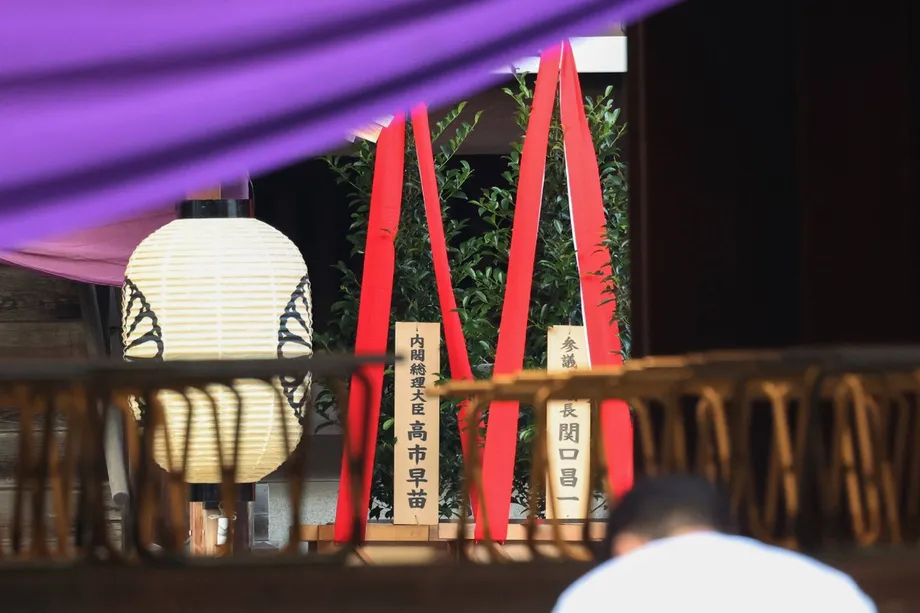
Japanese Prime Minister Sanae Takaichi sent a ritual evergreen offering to Yasukuni Shrine in Tokyo on October 17, 2026, prompting South Korea to express "deep disappointment and regret" even as she was expected to stay away from the shrine's autumn festival.
Contents
- An Official Offering Draws a Diplomatic Protest
- What Did Takaichi Send?
- South Korea Calls for Remorse Through Action
- Kiuchi Visits as Other Leaders Send Offerings
- Why the Shrine's Honorees Are Central to the Dispute
- How Takaichi's Practice Has Changed
- China Tensions Add to the Diplomatic Calculation
- Remembrance and Japan's Debate About Military Power
- Key Points
The offering, called masakaki, was presented under her title as prime minister at the start of the festival, which runs through Monday, October 19. Cabinet minister Minoru Kiuchi visited the shrine on Saturday morning, while senior parliamentary figures and Health, Labour and Welfare Minister Kenichiro Ueno also sent offerings.
Yasukuni honors about 2.46 million Japanese war dead, including 14 convicted Class-A war criminals. Their inclusion makes gestures by Japanese leaders especially sensitive in China and South Korea, where memories of Japanese invasion and colonial rule remain central to relations with Tokyo.
Takaichi's decision preserves a connection to a shrine she regularly visited before becoming prime minister, while avoiding the more visible act of attending in person. South Korea's response shows that an offering made under the prime minister's title still carries diplomatic weight.
The episode comes almost a year after Takaichi took office on October 21, 2025. Relations with China remain strained over her remarks about a possible conflict involving Taiwan, while Japan and South Korea have been rebuilding ties after years of disputes over wartime history.
What Did Takaichi Send?
Masakaki is a ritual arrangement of evergreen branches displayed on a stand at a Shinto shrine. Takaichi's offering bore her name and official position, identifying it with the head of Japan's government rather than simply with a private visitor.
Takaichi has also made private cash offerings during the autumn festival last year, the spring festival this April and the August 15 anniversary of Japan's surrender in World War II. Her participation has therefore continued through offerings even while she has avoided visiting as prime minister.
The form of participation matters politically. A visit puts a leader physically at the shrine, often before cameras. A ritual offering allows participation from elsewhere. Seoul's protest addressed both practices, making clear that its objection concerns official recognition of Yasukuni as well as attendance.
A person close to Takaichi said she was unlikely to visit during the current festival. Her circle declined to say whether she had prayed toward the shrine from another location for the autumn observance. Monday's final day remains the next scheduled occasion for political activity there, with a group of lawmakers from different parties planning a visit.
South Korea Calls for Remorse Through Action
South Korea's Ministry of Foreign Affairs issued a spokesperson's commentary on October 17 criticizing repeated visits and offerings by Japanese leaders. The ministry described Yasukuni as a shrine that glorifies Japan's past war of aggression and enshrines war criminals.
The ministry urged Japanese leaders to demonstrate their approach to history through their conduct:
face history squarely and demonstrate humble reflection on and sincere remorse for the past through action.
Seoul connected that demand directly to the relationship between the two countries. Its statement said reflection and remorse were a foundation for building trust between their governments and peoples.
Japan colonized the Korean Peninsula from 1910 to 1945. For South Korea, ceremonies honoring leaders responsible for Japan's wartime conduct touch on the history of colonial rule and the treatment of Koreans during that period. This explains why a ritual in Tokyo can quickly become a matter for foreign ministries.
Tokyo and Seoul have nevertheless improved relations in recent years following progress on disputes concerning wartime forced labor. Their leaders resumed reciprocal visits in 2023. Saturday's protest places the shrine dispute alongside that diplomatic recovery: cooperation has grown, while disagreement over how Japan commemorates the war continues.
Kiuchi Visits as Other Leaders Send Offerings
Minoru Kiuchi was the first member of Takaichi's cabinet reported to have visited Yasukuni during this year's autumn festival. Kiuchi, whose responsibilities include growth strategy and economic and fiscal policy, paid for a tamagushi cash offering himself. He was also reported to have made a masakaki offering.
Kiuchi told reporters after the visit that he had honored those who died and renewed his commitment against war:
I offered my heartfelt condolences and paid homage to the spirits of heroes who gave their precious lives for the nation and renewed my pledge to renounce war,
House of Representatives Speaker Eisuke Mori and House of Councillors President Masakazu Sekiguchi sent masakaki offerings. Ueno, the health, labour and welfare minister, also sent a ritual tree arrangement.
The participation of cabinet members and the heads of both parliamentary chambers gives the festival a political presence beyond the prime minister. Kiuchi framed his visit as mourning accompanied by a pledge to renounce war. South Korea framed official participation as honoring a shrine that glorifies aggression. Those statements show the competing meanings attached to the same ceremonies.
Why the Shrine's Honorees Are Central to the Dispute
Yasukuni stands in Tokyo's Chiyoda Ward. Its approximately 2.46 million honorees include ordinary members of Japan's armed forces as well as people convicted of war crimes after World War II. The most politically contentious group is the 14 Class-A war criminals enshrined in 1978.
Class-A refers to prosecutions for crimes against peace, including responsibility for planning or waging aggressive war. Class-B and Class-C categories concerned conventional war crimes and crimes against humanity. These legal labels describe categories of offenses rather than a simple ranking of how serious an individual's actions were.
Among the 14 was wartime Prime Minister Hideki Tojo, who was executed in 1948 after his conviction. The shrine also honors more than 1,000 people convicted in the Class-B and Class-C categories.
Recent broadcasts in Japan have brought renewed attention to the 1978 decision through internal meeting records and audio recordings. Nagayoshi Matsudaira, the shrine's chief priest at the time, opposed the Tokyo Trial and supported enshrining the convicted leaders as people who had died for their country.
The inclusion of those leaders gives official visits a meaning that extends beyond family mourning. China and South Korea associate Yasukuni with Japan's past militarism because people responsible for aggression are honored alongside other war dead. Japan invaded large parts of China before and during World War II, while colonial rule shaped Korea's experience of the same era.
How Takaichi's Practice Has Changed
Takaichi regularly visited Yasukuni during its spring and autumn festivals and on August 15 before becoming prime minister, including while serving as a cabinet minister. She has refrained from visiting since taking office in October 2025.
Her observances have continued in other forms. At this year's national ceremony for the war dead, she prayed toward Yasukuni from the parking area of the nearby Nippon Budokan arena. She bowed twice, clapped twice and bowed once, a sequence associated with Shinto worship.
The recent sequence shows how she has maintained religious observances while changing where and how she participates:
- October 21, 2025: Takaichi became prime minister.
- April 2026: She stayed away from Yasukuni's spring festival and made offerings.
- August 15, 2026: She attended the national war memorial ceremony at Nippon Budokan, prayed toward Yasukuni from nearby and made a private cash offering.
- October 17, 2026: She sent masakaki under her title as prime minister as the autumn festival opened.
- October 19, 2026: The festival is scheduled to end, and a group of lawmakers from different parties plans to visit.
Shinzo Abe, Takaichi's political mentor, was the last sitting Japanese prime minister to visit Yasukuni, in December 2013. By sending a ritual offering without attending, Takaichi is following a practice used by subsequent prime ministers.
China Tensions Add to the Diplomatic Calculation
Takaichi's restraint on a personal visit comes during a continuing confrontation with China over Taiwan. In November 2025, she said that an attack on Taiwan could create circumstances in which Japan's Self-Defense Forces might act in support of the United States.
Taiwan governs itself, while China claims it as its territory. Takaichi's remarks brought Japan's possible military response into an already sensitive dispute. Beijing demanded that she retract them, and relations deteriorated across diplomacy, trade and travel.
The economic consequences were visible during the dispute over Taiwan remarks: Chinese tourist arrivals in Japan fell 45 percent in December from a year earlier, to about 330,000. The confrontation also involved export controls, seafood restrictions and reported military encounters.
Yasukuni adds a historical dispute to that security confrontation. An appearance by the prime minister would create another prominent point of contention at a time when Tokyo and Beijing are already struggling over Japan's possible role in a regional conflict.
South Korea presents a different diplomatic setting. Relations have been improving rather than deteriorating, giving Tokyo an interest in preserving the exchanges restored since 2023. Seoul's statement nevertheless makes its position explicit: better present relations must be accompanied by conduct it regards as sincere reflection on the past.
Remembrance and Japan's Debate About Military Power
Takaichi's shrine offering also takes place amid a domestic debate over Japan's military role. Her government has pursued changes to arms export policy and constitutional revision, prompting demonstrations by people who fear that Japan could move away from the restraints adopted after World War II.
An estimated 50,000 people gathered in Tokyo on May 3 during protests over military policy. Demonstrators challenged the government's direction on weapons exports and Article 9, the constitutional provision that renounces war.
The Yasukuni dispute concerns commemoration, while the constitutional debate concerns the rules governing military power. Both involve a question running through Japanese politics: how the country's experience of war should guide the choices its leaders make today.
Kiuchi's pledge to renounce war and South Korea's demand for remorse express different judgments about what responsible remembrance requires. Takaichi has continued to honor Yasukuni through offerings while avoiding a visit as prime minister. The immediate result is a narrower public gesture than a personal appearance, but one that has still drawn a formal diplomatic protest.
The next scheduled development is the lawmakers' planned visit on October 19. Their participation will extend political attention to the festival's final day, even if Takaichi continues to stay away.
Key Points
- Takaichi sent a masakaki offering to Yasukuni Shrine under her title as prime minister on October 17, 2026.
- She is expected to avoid visiting during the autumn festival, which ends October 19.
- South Korea expressed deep disappointment and regret and urged Japanese leaders to show remorse through action.
- Cabinet minister Minoru Kiuchi visited, while parliamentary leaders and Health Minister Kenichiro Ueno sent offerings.
- Yasukuni honors about 2.46 million war dead, including 14 convicted Class-A war criminals enshrined in 1978.
- A group of lawmakers from different parties plans to visit on the festival's final day.