New transport links lead a wider infrastructure push
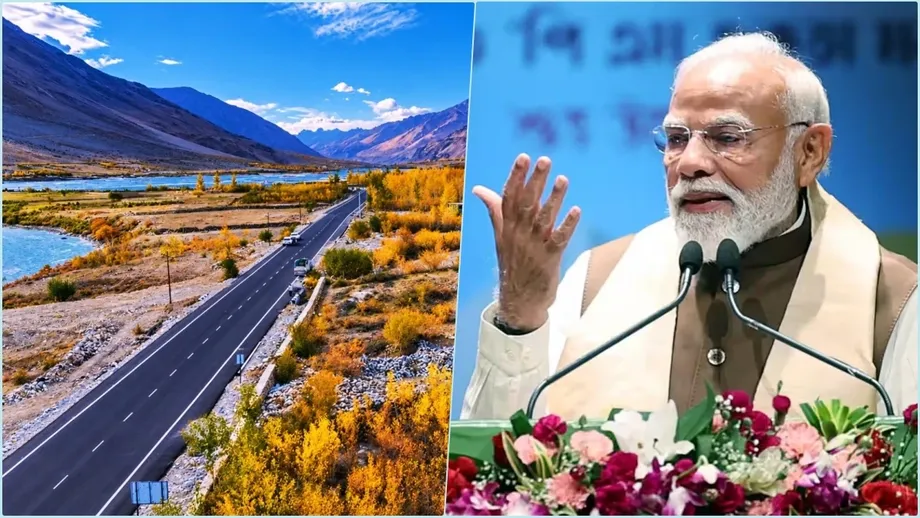
Prime Minister Narendra Modi inaugurated and dedicated five development initiatives worth around Rs 3,350 crore in Ladakh on October 15, 2026, including a road that he said cuts a journey from 12 hours to three and an airport terminal designed to handle 3.5 million passengers a year.
Contents
- New transport links lead a wider infrastructure push
- Leh airport capacity rises to 3.5 million passengers
- A 298 km route through Zanskar
- Hanu links electricity generation with delivery
- Forty reservoirs target the farming calendar
- Ancient rock art gets a dedicated conservation park
- What the government says has changed since 2019
- Tourism and local producers gain new connections
- Education, justice and sports plans accompany the launches
- Key Points
Modi joined the ceremony by video conference. The package covers the new terminal at Kushok Bakula Rimpochee Airport in Leh, the 298 km Nimmu-Padum-Darcha Road, hydropower and electricity transmission facilities, a park protecting ancient rock carvings, and 40 reservoirs across 40 villages.
The Prime Minister's Office, in its project announcement, put the road's cost at Rs 2,500 crore and the airport terminal's cost at Rs 650 crore. Officials describing the terminal separately gave a cost of Rs 640 crore.
Transport accounts for most of the announced spending. Using the Prime Minister's Office figures, the road and terminal together cost Rs 3,150 crore, about 94 percent of the Rs 3,350 crore package. The smaller initiatives address electricity delivery, the timing of irrigation water and the protection of Ladakh's archaeological heritage.
Ladakh's difficult terrain connects these needs. A road can help a village reach a hospital or market, while dependable electricity supports the services at the destination. Stored water can help farmers plant when natural runoff is insufficient, and heritage protection can give visitors access to the region's history alongside its mountain scenery.
Modi thanked the engineers, workers, local personnel and Border Roads Organisation teams involved in construction, presenting the projects as improvements to daily services as well as strategic infrastructure.
Leh airport capacity rises to 3.5 million passengers
The new passenger terminal in Leh covers 23,800 square metres and combines modern passenger facilities with architectural elements reflecting Ladakh's cultural heritage. Its annual handling capacity rises from 10 lakh passengers to 35 lakh, or from one million to 3.5 million.
Those figures represent an increase of 2.5 million passengers in annual capacity, making the new capacity 3.5 times the previous level. Modi separately said flight capacity could increase up to threefold. Passenger handling capacity describes how many people the terminal is designed to serve, while flight capacity concerns aircraft movements.
The terminal uses geothermal heating and solar energy. Geothermal heating draws on heat from the ground to help warm a building, an approach suited to reducing heating needs in a harsh climate. Solar energy provides another renewable energy source for the facility.
Modi described it as India's first airport terminal with geothermal heating. Explaining the environmental aim of the project, the prime minister said:
Our effort is to develop modern infrastructure in Ladakh while taking full care of the local environment,
The larger terminal is intended to improve passenger convenience and strengthen connections with the rest of India. Its design brings together two priorities in the announcement: accommodating more travellers and reducing the environmental burden of operating a large building in Ladakh.
A 298 km route through Zanskar
The Nimmu-Padum-Darcha Road links Nimmu in Leh with Darcha in Himachal Pradesh through the remote Zanskar Valley. Built by the Border Roads Organisation, it provides another corridor into Ladakh alongside the Srinagar-Leh and Manali-Leh highways.
Modi said the Rs 2,500 crore road reduces travel time from 12 hours to three hours. That is a saving of nine hours, or 75 percent of the earlier journey time.
The route crosses demanding Himalayan terrain, including Shinkun La Pass. For the armed forces, the additional corridor is expected to improve the movement of personnel and supplies. For Zanskar residents, its practical value lies in easier access to healthcare, schools, markets and other essential services.
Farmers and businesses could benefit from shorter journeys to buyers and suppliers. Motorists and motorcycle travellers also gain another route through the region, adding options beyond the two established highways.
The ceremony included the road's formal dedication to the nation. Modi also pointed to continuing work on the Zojila Tunnel, which the government intends to improve connectivity throughout the year.
Hanu links electricity generation with delivery
The electricity initiative combines the 9 MW Hanu Small Hydroelectric Project with the 66 kV double circuit Dah-Hanu-Khaltsi transmission line. They serve different parts of the same task: producing power and carrying it to the wider network.
Hydroelectric generation uses moving water to drive turbines that produce electricity. The Hanu project's 9 MW rating describes its generating capacity. The transmission line's 66 kV rating describes its operating voltage, rather than the amount of electricity generated.
A double circuit line carries two electrical circuits along the route. The new line is intended to strengthen the infrastructure that moves locally generated electricity into the network, often called power evacuation, and improve supply reliability.
Modi linked dependable electricity to lighting homes, helping children study, supporting healthcare and allowing small businesses to operate. He also referred to continuing power generation initiatives in Puga Valley and his earlier inauguration of the Srinagar-Leh transmission line.
The Prime Minister's Office gave no separate cost breakdown for the Hanu plant and its associated transmission infrastructure. Together, the two facilities form the power component of the five announced development initiatives.
Forty reservoirs target the farming calendar
The water initiative provides 40 reservoirs across 40 villages. The Prime Minister's Office calls it Project Amrit Him Sarovar; project descriptions also use the shorter name Project Him Sarovar and connect its objectives with Mission Amrit Sarovar, which promotes water conservation through the development and restoration of water bodies.
Ladakh's farmers face a problem of timing. Snowmelt and glacial runoff can supply substantial water during some periods, yet fields can run short during sowing, when water is needed to establish crops.
The reservoirs are intended to store water when it is available and release it when cultivation requires it. Their purpose is to bridge the gap between the natural flow of water and the agricultural calendar, supporting irrigation and farm livelihoods.
Modi, describing the benefit for farmers, said:
These will help in providing water for irrigation to farmers at the time of need,
The initiative complements the promotion of greenhouse cultivation. Modi said 11,000 greenhouses were operational across Ladakh. Greenhouses provide a protected environment for crops, while irrigation storage addresses the separate need to have water available when planting and growth require it.
Ancient rock art gets a dedicated conservation park
At Sindhu Ghat in Leh, Modi inaugurated what the government describes as India's first Petroglyph Conservation Park. A petroglyph is an image carved or pecked into a rock surface.
Ladakh has hundreds of prehistoric rock art sites featuring wildlife, human figures and symbolic designs. These carvings offer clues about the lives, beliefs and cultural practices of people who inhabited the region thousands of years ago.
The park is intended to protect vulnerable archaeological remains, build public awareness and encourage responsible heritage tourism. It adds a dedicated place for learning about Ladakh's ancient history to a visitor economy also associated with monasteries, mountain journeys and winter activities.
Modi connected the park with the preservation of Ladakh's wider cultural heritage, including Buddhist traditions and festivals. The aim is to make the region's history accessible to visitors while preserving it for future generations.
What the government says has changed since 2019
Modi placed the new projects within a broader account of infrastructure growth since Ladakh became a Union Territory in 2019. According to the figures he cited, the road network expanded from about 1,800 km to more than 4,000 km, an increase of over 2,200 km.
Major bridges increased from 19 to nearly 75, while helipads rose from seven to more than 40. Hospital beds doubled, according to the prime minister. These measures cover different kinds of access, from routine road travel to air links and the capacity of medical services.
Household tap water coverage rose from 3.5 percent to nearly 99 percent, Modi said. That is an increase of about 95.5 percentage points. The irrigation reservoirs address a different need: storing water for cultivation at the right point in the season.
The announcement also set out a short sequence of institutional and infrastructure developments:
- 2019: Ladakh became a Union Territory, the starting point for the infrastructure comparisons in Modi's address.
- August 2026: The government approved a High Court Bench for Ladakh, according to the prime minister.
- October 15, 2026: Modi inaugurated and dedicated the five development initiatives through video conference.
The government presented the new transport, energy and water projects as the next additions to that expansion of basic services.
Tourism and local producers gain new connections
More than 40 border settlements are being upgraded under the Vibrant Villages programme, Modi said. He linked the work with employment in remote villages and the promotion of winter and adventure tourism.
Local homestays increased from roughly 150 to 3,000, according to the prime minister. That is about 20 times the earlier number. The new airport terminal and road provide additional transport capacity for a visitor economy in which more households now offer accommodation.
BharatNet and expanding internet access were another part of Modi's account. He said digital connectivity supports hotels, restaurants, homestays and craft businesses, as well as online education and access to government services. Transport connects people and goods physically, while internet access helps businesses reach customers and manage transactions.
Modi highlighted sea buckthorn, handicrafts, apricots with a Geographical Indication tag, commercial flower cultivation and Pashmina made by the Changpa community. A Geographical Indication identifies a product whose qualities or reputation are linked to its place of origin.
The prime minister said he had given Ladakhi products to the German Chancellor, Swedish Prime Minister and President of Kyrgyzstan. He presented better branding and access to markets as ways to bring more income directly to local producers.
Education, justice and sports plans accompany the launches
A Centre of Excellence is being built in Leh to expand opportunities for education and technology training, Modi said. Proposals are also advancing for satellite campuses of IIT Jammu and IIM Jammu, which would bring additional engineering, research and management education opportunities into Ladakh.
Modi said the aim was to help young people gain skills without having to depend on institutions in other cities. He also highlighted Ladakh's new sports policy and efforts to improve training and facilities, referring to local participation in ice hockey, winter sports and mountaineering.
The High Court Bench approved in August is intended to bring judicial services closer to residents. The announcement gave no opening date for the bench or the proposed satellite campuses, and no completion date for the Zojila Tunnel.
The five inaugurated initiatives have concrete locations and capacities: a larger terminal in Leh, another road through Zanskar, power generation at Hanu, stored water in 40 villages and a conservation park at Sindhu Ghat. Their intended benefits reach beyond construction, to the journeys residents make, the services they use and the livelihoods they maintain.
Key Points
- Modi launched five development initiatives worth around Rs 3,350 crore in Ladakh on October 15, 2026.
- Leh airport's new terminal raises annual passenger handling capacity from one million to 3.5 million and uses geothermal heating and solar energy.
- The 298 km Nimmu-Padum-Darcha Road provides an additional route into Ladakh. Modi said it cuts travel time from 12 hours to three.
- The electricity initiative combines the 9 MW Hanu hydropower project with the 66 kV Dah-Hanu-Khaltsi transmission line.
- Forty reservoirs across 40 villages aim to store water for irrigation when farmers need it.
- The Petroglyph Conservation Park at Sindhu Ghat in Leh is intended to protect ancient rock carvings and support heritage awareness.