Growth has returned, but household recovery is incomplete
Sri Lanka recorded real economic growth of 5% in both 2024 and 2025, followed by 4.7% in the first half of 2026. Yet about two thirds of workers remain in informal employment, and poverty was estimated at 16.9% in 2025. Those figures frame the central challenge in the Institute of Policy Studies of Sri Lanka's annual report: turning restored economic stability into lasting improvements in incomes, employment and resilience.
Contents
- Growth has returned, but household recovery is incomplete
- A different growth model within tight financial limits
- Export growth has relied heavily on existing products
- Higher revenue has not prevented an investment squeeze
- Informal employment limits the reach of recovery
- Agribusiness connects jobs, exports and food security
- Climate protection and energy security belong in investment planning
- Social assistance misses some households most exposed to shocks
- Regional planning must match economic and population changes
- Key Points
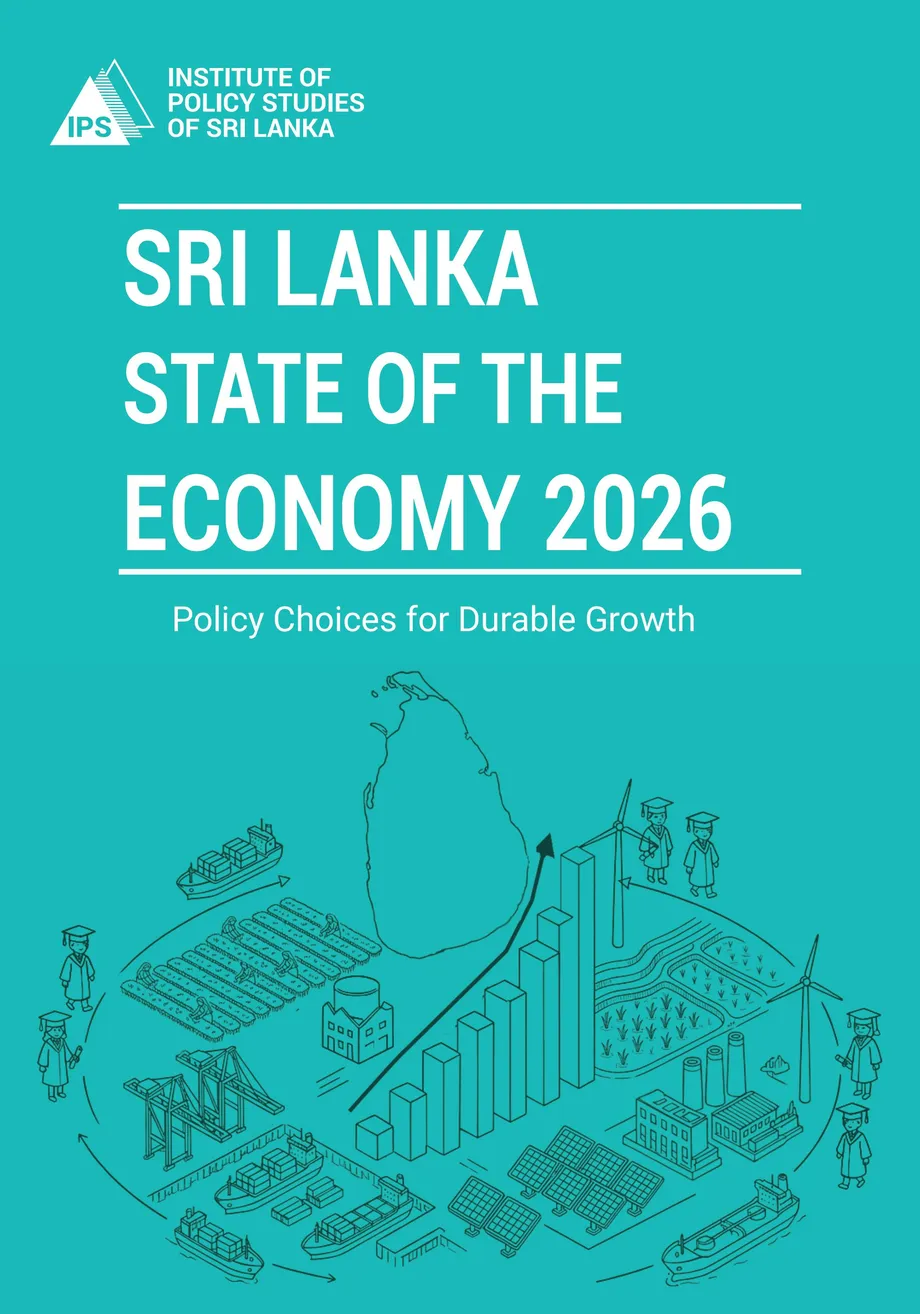
The institute's flagship report, Sri Lanka: State of the Economy 2026: Policy Choices for Durable Growth, argues that the country cannot return to the spending patterns that left it vulnerable before the 2022 crisis. With limited room for additional government spending or pressure on foreign currency resources, it calls for greater private investment, higher productivity and more competitive exports.
The World Bank's October 2026 Sri Lanka Development Update, titled From Recovery to Transformation, provides a parallel assessment. It says real gross domestic product has returned to its level before the crisis after twelve consecutive quarters of growth. Strong industrial activity, investment growth and resilient services have supported the recovery.
However, the World Bank describes that recovery as incomplete and uneven. Labour market indicators continue to lag, poverty remains above its level before the crisis, and renewed inflationary pressures have partly eroded household welfare gains. Returning national output to its earlier level does not mean that families have regained their earlier purchasing power or employment security.
Read together, the two assessments point to a distinction between recovering lost production and building an economy capable of sustaining better living standards. The next phase requires changes in what Sri Lanka produces, how businesses invest and how workers and households are protected when disruptions occur.
A different growth model within tight financial limits
IPS says inflation has moderated substantially from its 2022 peak, external debt restructuring has advanced and foreign reserves have recovered to more comfortable levels. These gains provide a stronger starting point, but they do not remove the need to protect public finances and the country's ability to pay for imports and external obligations.
In its statement announcing the report, IPS, an economic policy research institute, set out the limits of the previous approach:
Sri Lanka can no longer rely on debt-financed spending, tax concessions or import-intensive consumption as drivers of growth.
The alternative is to increase productivity, meaning the amount of output produced with a given amount of labour, capital and other resources. Better skills, more reliable infrastructure and more efficient businesses can support that change without depending on a continuing expansion of borrowing.
The distinction matters for an economy with limited fiscal and external space. Fiscal space is the government's capacity to spend without undermining debt sustainability. External space concerns the foreign currency resources needed to finance imports and meet obligations abroad. Growth that rapidly increases both borrowing and import demand could put the recovery under renewed pressure.
The World Bank projects growth of 4.4% in 2026 and 4.2% in 2027. These are forecasts for full calendar years, unlike the recorded 4.7% expansion in the first half of 2026. They also fall below the 7% medium term growth goal discussed in IPS research.
- 2022: The economic crisis exposed fiscal and external vulnerabilities.
- 2024 and 2025: Real GDP expanded by 5% in each year.
- First half of 2026: Output grew by 4.7%, reaching twelve consecutive quarters of expansion.
- October 2026: The IPS annual report and World Bank update put investment, exports and productivity at the centre of the next phase.
- 2027: The World Bank projects growth of 4.2%, while the current IMF programme is scheduled to end.
Export growth has relied heavily on existing products
IPS research estimates that nearly 95% of Sri Lanka's export growth since 2008 has come from selling more of products already in its export basket. Of nearly 1,000 new products introduced during that period, only 43 became competitive.
That is roughly 4% of the new products, using the approximate total given in the research. The figures show why export diversification requires more than launching products: businesses also need to establish a lasting ability to compete in overseas markets.
The research recommends trade agreements and domestic tariff reform. It identifies risks in relying on preferential market access that can be withdrawn because of changes in income status or compliance with conditions. However, it does not establish a timetable for new agreements or guarantee that negotiations would secure favourable terms.
One proposed reform is the removal of para tariffs, additional charges imposed on imports alongside ordinary customs duties. IPS research says these charges increase the base on which import VAT is calculated, making the effective burden greater than the statutory 18% VAT rate.
Simplifying those charges could reduce costs and make trade rules easier to navigate. The revenue loss would need to be included in budget estimates, and businesses facing greater import competition would need support during the transition. The research recommends trade adjustment assistance because changes to import charges can put jobs and incomes at risk in smaller domestic firms.
Higher revenue has not prevented an investment squeeze
Government revenue increased from 8.2% of GDP in 2022 to 16.6% in 2025, according to the figures discussed in IPS research. That is a rise of 8.4 percentage points, taking the revenue share to slightly more than twice its earlier level.
Public investment, however, fell from 5% to 3% of GDP during fiscal adjustment. The two percentage point decline represents a 40% reduction in its share of the economy. The contrast shows why stronger revenue collection alone does not ensure that enough funding reaches infrastructure and other investments that support productivity.
The research does not recommend further tax rate increases, but it also describes tax cuts as premature because of uneven compliance, informality and exemptions. It puts the ratio of direct to indirect taxes at 40:60. Direct taxes are generally charged on income or wealth, while indirect taxes are collected through spending on goods and services.
For the period after the IMF programme ends in 2027, the proposals favour broadening the tax base, reducing exemptions, improving compliance among people who work for themselves and those with high incomes, and using digital tax administration. These are policy recommendations, not an announced government tax package.
Public investment quality is another priority. Credible project appraisal, transparent procurement, effective implementation and measurable outcomes are needed to make scarce funds count. Spending more without improving project selection and delivery would not necessarily produce better infrastructure or stronger growth.
Informal employment limits the reach of recovery
The broad estimate that two thirds of workers are informally employed is supported by a more precise IPS research figure of 66.5% of total employment in 2024. The two descriptions are consistent: one is rounded, while the other identifies a year and percentage.
IPS describes informal workers as lacking formal contracts or social security coverage. Such employment can leave people earning an income without the protections associated with formal jobs. National output can therefore rise while many workers remain exposed to interrupted earnings and limited support.
The problem is particularly concentrated in very small workplaces. Around 60% of informal wage employees work in establishments with fewer than five regular employees, according to the research. Weak administrative capacity and limited compliance with labour and social security obligations make reform difficult at that scale.
Proposals include simpler taxes, digital registration, contribution rules suited to small firms, better access to credit and stronger penalties for noncompliance. Their shared aim is to make formal employment easier to establish while making the protections attached to it more reliable.
Skills are a separate constraint. IPS estimates using the Labour Force Survey 2024 indicate that only 34.1% of knowledge workers have tertiary qualifications. The recommended response includes shorter tertiary programmes for technical workers, science and technology education, financial support for students and incentives for skilled workers to remain in Sri Lanka.
Agribusiness connects jobs, exports and food security
The World Bank identifies agribusiness as a potential driver of growth, employment, exports and poverty reduction. Its figures show why the sector matters beyond farming: primary agriculture accounts for 8% of GDP, while the broader agrifood system contributes about one sixth of output, over 40% of employment and nearly one third of merchandise exports.
The agrifood system includes activity beyond production on farms, such as processing, storage, transport and distribution. Its output share is roughly twice that of primary agriculture, illustrating how much economic activity depends on what happens between production and final sale.
The World Bank identifies policy distortions, weak investment incentives, limited value addition, infrastructure gaps and restricted access to land and finance as constraints. It also points to successes in tea, coconut, cinnamon, seafood and manufacturing based on rubber.
Value addition means processing or otherwise improving a product so that it earns more than the basic raw material. Moving further into such activities can support higher earnings, but businesses need investment, reliable infrastructure and access to markets to make that shift.
IPS research estimates that agricultural total factor productivity grew by only 0.3% annually over the past decade, compared with 1.6% across South Asia. This measure tracks how efficiently labour, land, capital and other inputs are used together. Sri Lanka's rate was 1.3 percentage points lower, indicating a sizeable gap in efficiency growth.
Resilient farming, water management, storage and distribution address both production losses and the movement of food to consumers. These investments connect the productivity agenda with protection against climate disruptions, rather than treating agricultural reform and disaster preparedness as separate tasks.
Climate protection and energy security belong in investment planning
IPS cites Cyclone Ditwah and global energy shocks as reminders that economic stability can be undermined by events beyond domestic financial policy. Disaster damage can interrupt production and transport, reduce agricultural output and divert public money from development priorities to emergency recovery.
The institute identifies renewable energy, food systems, infrastructure and disaster preparedness as investment priorities. Greater renewable energy capacity could reduce exposure to international fuel price volatility. Reliable and affordable energy also matters for manufacturers, farms, tourism businesses and exporters deciding whether to invest.
Renewable generation alone is not the full task. IPS research also recommends protecting transmission investment within the energy transition. Transmission networks carry electricity from generating facilities to the places where it is used, making them necessary for additional capacity to serve households and businesses.
These proposals do not establish a funded construction schedule, procurement timetable or date for completing specific projects. Their practical test is whether project selection, financing and delivery address the weaknesses that leave production and household incomes exposed to shocks.
Social assistance misses some households most exposed to shocks
IPS research identifies a mismatch in the reach of Aswesuma, Sri Lanka's social assistance programme. Among the poorest fifth of households, coverage is 55% for those most exposed to shocks, compared with 63% for those least exposed.
That eight percentage point gap means the more exposed group has lower coverage despite its greater vulnerability. It gives a concrete reason to improve targeting rather than assuming that poverty status alone captures the likelihood of disaster losses.
The proposals include strengthening the Integrated Welfare Management System and creating a comprehensive, regularly updated social registry. Linking household information with disaster risk and climate data could help identify people needing assistance when a shock occurs.
IPS research also recommends financing arranged in advance, with triggers and procedures for expanding benefits during emergencies. The purpose is to make assistance available promptly rather than requiring every response to begin with a new funding decision after damage has occurred.
This matters alongside labour reform. Workers with limited employment protection and households affected by disasters can face overlapping losses. Better targeting and faster assistance would support household security without treating social protection as separate from the growth strategy.
Regional planning must match economic and population changes
The IPS report examines infrastructure investment, regional development, urbanisation and changing population dynamics as parts of a more inclusive growth strategy. Coordinated planning is needed so that employment opportunities, transport and essential services respond to where people live and work.
IPS estimates the Western Province's urban share at nearly 61%, using population density and infrastructure access measures from the 2024 census. This is a research estimate based on those measures, rather than a figure that should automatically be treated as the province's official urban classification.
Among the proposals discussed is congestion pricing in Colombo using automatic number plate recognition and digital payments. Such a system would charge vehicles for using designated congested roads or areas. It is a recommendation, not an announced charging scheme with agreed boundaries, fees or a start date.
The annual report's recommendations span trade, fiscal management, labour markets, urbanisation, energy, agriculture, social protection and human capital development. Their common purpose is to improve productive capacity while reducing the risk that another shock reverses the gains since 2022.
What is not yet established is how the recommendations will translate into funded programmes, enacted reforms or implementation deadlines. The next dated markers are the World Bank's 2027 growth outlook and the scheduled end of the current IMF programme that year. They provide a planning horizon, not a timetable for adopting the IPS agenda.
Key Points
- Real GDP grew by 5% in both 2024 and 2025 and by 4.7% in the first half of 2026.
- The World Bank projects growth of 4.4% in 2026 and 4.2% in 2027, with poverty estimated at 16.9% in 2025.
- IPS recommends private investment, productivity gains and competitive exports rather than renewed dependence on borrowing and import demand.
- Informal employment accounted for 66.5% of jobs in 2024, limiting employment security and social protection.
- Nearly 95% of export growth since 2008 came from existing products, according to IPS research.
- The broader agrifood system supports over 40% of employment and nearly one third of merchandise exports.
- Climate preparation, energy investment and better targeted assistance are central recommendations, but implementation dates have not been established.