Trade accelerates, with advanced manufacturing driving the gains
China's goods imports and exports reached 39.94 trillion yuan in the first three quarters of 2026, an increase of 18.8% from a year earlier, according to customs figures presented at an October 14 briefing. Products including industrial robots, electronic components, computer parts and electrical equipment accounted for more than 10 trillion yuan of that trade and contributed 11.3 percentage points to its growth.
Contents
- Trade accelerates, with advanced manufacturing driving the gains
- September delivers a stronger finish to the quarter
- How close is the surplus to another annual record?
- Technology trade accounts for much of the expansion
- Chip export values rise much faster than unit shipments
- Vehicles face strong demand and tighter European limits
- Imports reveal a more uneven picture
- Trade talks create a crowded calendar
- Strong exports do not settle the domestic growth challenge
- Key Points
Exports totaled 23.2 trillion yuan, up 16.4%, while imports rose faster, increasing 22.3% to 16.74 trillion yuan. Subtracting imports from exports gives a goods trade surplus of 6.46 trillion yuan for January through September.
The pace strengthened through the year. Trade grew 15.3% in the first quarter, 18.3% in the second and 22.3% in the third. September trade reached 5.16 trillion yuan, up 27.5%, as monthly growth stayed in double digits for a sixth consecutive month.
The expansion points to strong overseas demand for Chinese manufactured goods, particularly technology products and vehicles. It also comes as trading partners press Beijing to reduce trade imbalances and as weakness in Chinese consumption, investment and property continues to weigh on the economy.
Several figures require caution. Reports differ on dollar trade balances, semiconductor growth and the International Monetary Fund's economic forecast. The yuan figures and dollar growth rates also use different currency bases. Those series should not be treated as interchangeable, and the conflicting dollar accounts cannot be combined into a single consistent dataset.
September delivers a stronger finish to the quarter
In yuan terms, September exports reached 3.03 trillion yuan, up 29.6%, and imports totaled 2.13 trillion yuan, up 24.6%. The difference was a monthly goods surplus of 900 billion yuan.
Dollar figures described in most reports show exports rising 36.3% and imports increasing 31%. Export growth accelerated from 25% in August, while import growth strengthened from 28.2%. Against economist forecasts of 25.5% and 24.5%, respectively, those September results were higher by 10.8 and 6.5 percentage points.
One account gives September exports of $447.18 billion and imports of $313.65 billion. Their difference, $133.53 billion, is consistent with the roughly $133.5 billion monthly surplus described in most reports. Export growth was described as the fastest since February, when it reached 39.6%.
Currency conversion can produce different growth rates for the same trade flows when the yuan's exchange rate changes between reporting periods. That helps explain why yuan and dollar measures need separate labels, but it does not establish why every discrepancy exists. One conflicting account puts September import growth at 20.4%, rather than 31%, and gives substantially smaller dollar surpluses.
How close is the surplus to another annual record?
Most reports put China's January through September goods surplus at about $938 billion, with one giving the more precise figure of $938.11 billion. They compare that with a record $1.2 trillion for the whole of the previous year.
On those figures, the surplus had reached about 78.2% of the previous annual record after nine months. Exceeding $1.2 trillion would require more than roughly $261.9 billion in the final quarter, or an average above $87.3 billion a month. That is a calculation, not a forecast, and assumes the figures are comparable.
The conflicting account instead gives a September surplus of $90.45 billion, an August surplus of $76.5 billion and a January through September balance of $875 billion. It compares the latter with a previous annual record of $992.1 billion. Most other reports give September and August balances of $133.5 billion and $119.1 billion.
Both accounts describe a widening surplus, but they differ materially on its size and the record it might surpass. No reconciliation is established. Using the more widely reported monthly figures, the surplus increased by $14.4 billion, or about 12.1%, between August and September.
Technology trade accounts for much of the expansion
The October 14 State Council Information Office briefing described the first nine months as China's fastest comparable period of trade growth in five years. Its most revealing detail was the concentration of growth in a group of advanced manufacturing products.
Combined imports and exports of industrial robots, electronic components, computer parts and electrical equipment exceeded 10 trillion yuan, increasing 58.9%. Their contribution of 11.3 percentage points amounted to about 60% of the 18.8% rise in total goods trade. Their trade value represented more than one quarter of the 39.94 trillion yuan total.
Those are measures of combined imports and exports, not exports alone. They show that technology demand is moving goods in both directions, including components used by manufacturers as well as finished products sold overseas.
Most reports put January through September semiconductor export growth at 108.1% by value, with automatic data processing equipment and parts up 54.6% and auto exports up 54.3%. A conflicting account gives much lower increases of 24%, 23.5% and 23.2%, respectively. The direction is consistent, but the scale is unresolved.
China's own brands also gained ground. Their exports rose 26.7% and accounted for 24.8% of total exports, an increase of two percentage points. That puts their share a year earlier at 22.8%, showing that branded exports grew faster than exports as a whole.
Chip export values rise much faster than unit shipments
September's semiconductor figures illustrate why rising trade values do not necessarily mean a comparable increase in physical shipments. One account describes a 136% rise in the value of integrated circuit board exports alongside only a 1% increase in exported units. Another reports integrated circuit exports of $44.95 billion, also up 136%.
The category descriptions differ, so they should not automatically be treated as identical. Even so, the large gap between value and unit growth is a warning against reading the headline percentage as a measure of production volume. Changes in prices and the mix of products sold can both raise export receipts.
Demand associated with artificial intelligence infrastructure has supported Chinese technology shipments. Rising semiconductor prices have also contributed to export values. The trade figures do not isolate how much of the increase came from higher prices, more expensive products or additional units.
Related corporate developments point to the money flowing into this market. ChangXin Memory Technologies, or CXMT, was reported to have raised at least $8.6 billion before its Shanghai stock market debut, with shares rising 466% on the first trading day. Its reported share of global DRAM shipments was roughly 9% in the first quarter. DRAM is memory used to hold data temporarily while computing systems operate.
Tencent was also reported to have agreed to a roughly $7 billion deal over five years to lease access to about 100,000 AI chips through Oracle data centers in Southeast Asia. Such an arrangement concerns computing capacity abroad, not chips physically imported into China. Neither that transaction nor a stock market debut can be counted directly as goods exports.
Vehicles face strong demand and tighter European limits
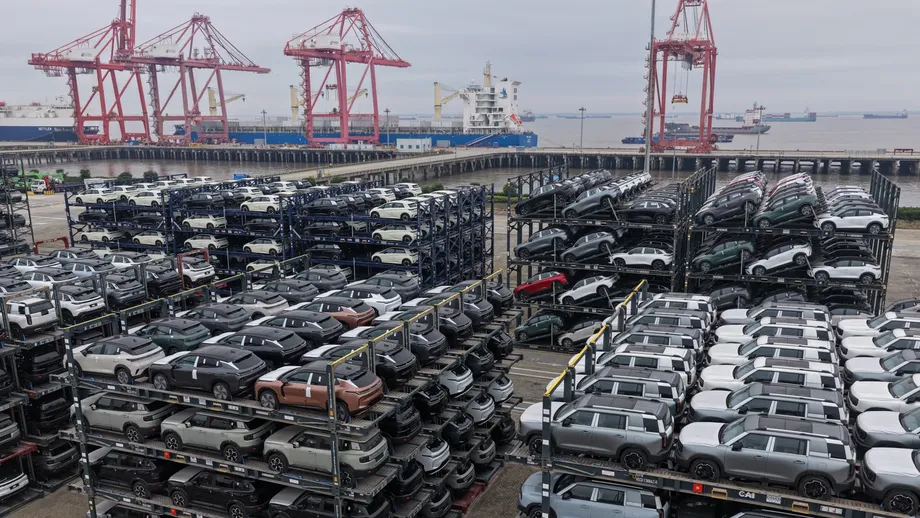
China's vehicle exports rose 56.3% in September to 1.18 million vehicles, while their value increased 62%. Passenger car exports were separately reported to have risen 64%. Those measures cover different categories and should not be substituted for one another.
The faster increase in export value than vehicle numbers suggests a rise in average receipts per vehicle, although the figures alone cannot distinguish price changes from a shift toward more expensive models. Electric vehicles and hybrids were identified as contributors to demand.
European Union trade chief Maroš Šefčovič said an agreement with Beijing included halving Chinese hybrid car imports into the bloc over the next few years, following talks with Chinese Commerce Minister Wang Wentao. Details of the measures were expected in December. The precise timetable, enforcement rules and basis for measuring the reduction were not established.
That timing could encourage exporters to bring shipments forward before restrictions take effect. It also means a strong month would not necessarily demonstrate that demand could continue at the same pace after new limits begin.
Ecaterina Bigos, a senior market strategist at BNP Paribas Asset Management, said efforts to rebalance European trade directly target valuable Chinese exports. She also warned that expanding sales in Southeast Asia and Latin America could not fully replace Western demand. A conflicting account attributes a similar assessment to Catherine Gigas of Pictet Asset Management and identifies U.S. measures as the direct pressure.
Imports reveal a more uneven picture
Imports grew faster than exports over the first nine months in yuan terms, but that does not mean demand strengthened evenly across products or trading partners. China recorded increases in both imports and exports with more than 120 countries and regions. Among partners with Chinese free trade agreements, more than 70% registered growth in both directions.
Exports rose to every major country tracked by customs, according to the reports, while imports from Malaysia, Germany and the United Kingdom fell. September exports to the United States were reported to have increased nearly 39.6%, faster than total dollar exports. A separate account describes U.S. shipments as under pressure without giving a comparable monthly figure, so it does not establish a September decline.
Energy purchases were weaker in physical terms. Crude oil import volumes fell by double digits for a sixth consecutive month, even as their value rose for the first time since May. Both crude oil and natural gas import volumes were reported to have declined since the beginning of the year.
Rare earth and fertilizer export volumes also fell over the first three quarters, while fertilizer imports surged. Export controls and stockpiling were identified as factors. Taken together, these movements show why a large increase in total import value is not sufficient evidence of a broad recovery in domestic demand.
Transport patterns changed too. Road transport's share of goods trade increased by 3.4 percentage points, while air freight trade rose 37.2%. The briefing connected those shifts with closer regional trade and growing shipments of technology products, valuable goods and fresh agricultural products.
Trade talks create a crowded calendar
Diplomatic agreements are shaping the conditions for the final quarter. Reports describe a September summit in Washington between Presidents Xi Jinping and Donald Trump that extended a tariff truce and agreed tariff cuts on $30 billion of goods from each side. That is $60 billion combined. One conflicting account describes only $30 billion without establishing whether it means one side or the total.
The sequence of reported developments is:
- September: Xi and Trump agreed to extend the tariff truce and reduce tariffs on selected goods.
- Early October: European talks with Beijing produced an announced agreement concerning Chinese hybrid vehicle exports.
- October 14: China presented its first three quarters of goods trade figures.
- October 15: The Canton Fair was scheduled to open for manufacturers and overseas buyers.
- The following week: China was expected to release economic growth figures for July through September.
- December: Details of European measures on hybrid vehicle trade were expected.
- January: One account identified this as the endpoint of the extended broader tariff truce.
The United States was also conducting an investigation into excess industrial capacity involving China and other trading partners. That issue concerns whether production capacity exceeds sustainable demand and pushes unusually large volumes of goods into foreign markets.
Exchange rates remain another point of dispute. China's central bank rejected claims that it deliberately kept the yuan weak to secure a trade advantage. Critics argue that a weaker currency makes Chinese products cheaper abroad. The trade totals alone cannot determine how much currency movements contributed to export growth.
Strong exports do not settle the domestic growth challenge
Exports have supported economic activity while consumption and investment remained subdued and the property downturn continued. Strong overseas orders can sustain factories, but the goods trade figures do not measure household spending or establish that domestic weakness has ended.
Most reports give China's 2026 economic growth target as 4.5% to 5% and say the International Monetary Fund lowered its forecast by 0.1 percentage point to 4.5%. A conflicting account gives an IMF forecast of 4.8% and an internally unclear target of 5% to 5%. Those differences remain unresolved and should not be presented as a single confirmed forecast.
Measures described as supporting domestic demand included subsidies for mortgage interest payments for homebuyers. The forthcoming quarterly economic release was expected to provide a broader assessment of growth than customs figures alone.
Max Zenglein, Asia Pacific senior economist at The Conference Board, identified global investment in artificial intelligence as a major source of uncertainty for the export sector:
"A slowdown in the global AI investment cycle could pose a greater threat to China's export growth than trade restrictions imposed by other countries," said Max Zenglein.
The central tension is measurable: technology products contributed about 60% of the increase in total goods trade, yet that concentration also ties growth closely to investment decisions abroad. December's vehicle measures and the next economic release were the clearest scheduled tests of whether external strength could continue alongside a domestic recovery.
Key Points
- China reported 39.94 trillion yuan in goods trade for January through September 2026, up 18.8%.
- Exports reached 23.2 trillion yuan and imports 16.74 trillion yuan, producing a calculated surplus of 6.46 trillion yuan.
- Advanced manufacturing product groups contributed 11.3 percentage points to total trade growth.
- September trade reached 5.16 trillion yuan, with dollar exports reported up 36.3%.
- Reports conflict on dollar surpluses, semiconductor growth and the IMF forecast.
- European hybrid vehicle measures were expected to be detailed in December.