VAT misses its target despite near complete revenue collection
Kazakhstan collected 5.921 trillion tenge in value added tax during January through September 2026, falling 685.8 billion tenge short of its target even as total republican budget revenue came within 6 billion tenge of plan. The figures present two different measures of fiscal performance: revenue collection was close to expectations in aggregate, while one of the largest taxes missed its forecast by more than 10%.
Contents
- VAT misses its target despite near complete revenue collection
- Where the VAT shortfall is concentrated
- Foreign digital businesses exceeded expectations
- How total tax revenue still met the plan
- What Zhumangarin says the reform has delivered
- Republican and state budgets tell different stories
- A smaller headline deficit, a larger gap without oil
- Social spending and debt service dominate expenditure
- What the final quarter must clarify
- Key Points
The republican budget execution figures as of October 1 put the deficit at 2.904 trillion tenge, below the 3.005 trillion tenge planned for the period. Revenue reached 16.528 trillion tenge and spending totaled 18.744 trillion tenge. The deficit excluding oil revenue, however, exceeded its target, reaching 7.261 trillion tenge against a planned 7.031 trillion tenge.
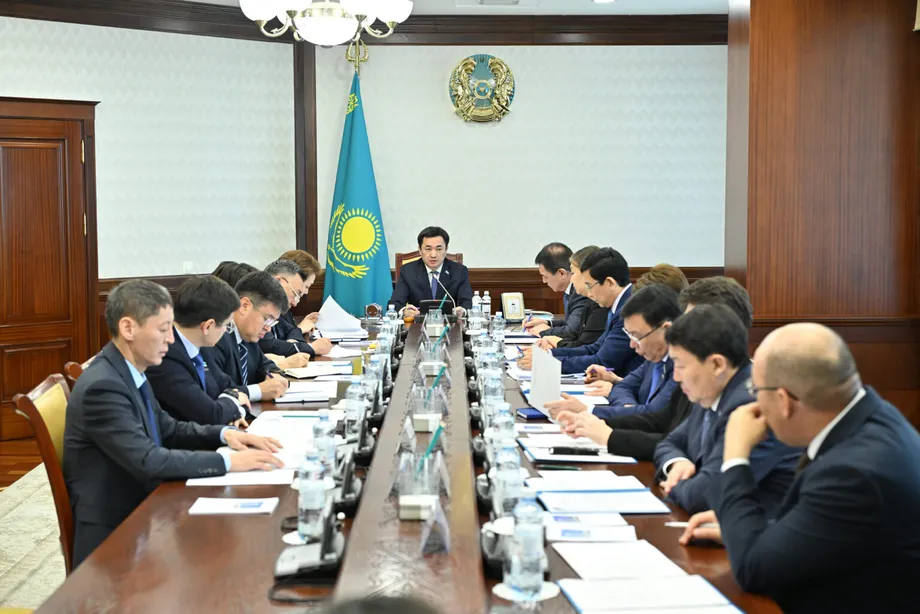
The VAT shortfall comes as Deputy Prime Minister and National Economy Minister Serik Zhumangarin defends a tax reform that raised the VAT rate to 16%. He said the reform had generated an additional 3 trillion tenge over nine months and forecast at least 3.6 trillion tenge in revenue growth by the end of the year.
Those statements do not necessarily contradict the missed VAT target. Revenue can rise compared with the previous year while still falling below an ambitious budget forecast. The distinction matters here: the collection figures measure performance against a plan, while the minister's argument centers on growth and the reform's contribution.
Where the VAT shortfall is concentrated
VAT is a tax on consumption collected through businesses selling goods and services. Kazakhstan's budget separates receipts into several categories, including domestic activity, imports and payments connected with foreign businesses. The three largest categories all fell below their targets.
VAT on goods produced in Kazakhstan, work performed and services provided brought in 2.694 trillion tenge, meeting 92.35% of plan. A separate budget classification for imported goods generated 1.740 trillion tenge, equivalent to 86.27% of its target.
Goods imported from Eurasian Economic Union member states generated another 1.172 trillion tenge in VAT. That category achieved 83.78% of plan, the weakest performance among the three largest categories. Its shortfall was 16.22% of the expected amount, compared with 13.73% for the separate import category and 7.65% for domestic goods and services.
The two import categories together brought in 2.912 trillion tenge, slightly more than the 2.694 trillion tenge collected from domestic goods and services. Their weaker performance therefore affected a large portion of VAT revenue, rather than a small segment of the tax base.
The figures identify where receipts missed expectations, but they do not establish why. They do not separate the effects of import volumes, prices, exchange rates, refunds, payment timing or tax compliance. A missed collection target alone is not evidence that taxable activity fell by the same percentage.
Foreign digital businesses exceeded expectations
Some smaller VAT categories performed better than planned. Payments associated with nonresidents generated 239.6 billion tenge, meeting 109.96% of the target. Foreign internet companies selling goods electronically or providing electronic services to individuals paid 70.1 billion tenge, reaching 172.06% of plan.
The digital business category exceeded its target by 72.06%, making it a strong performer in percentage terms. Its scale was much smaller, however. The entire 70.1 billion tenge collected represented about 1.2% of total VAT receipts and roughly one tenth of the 685.8 billion tenge shortfall.
Another 5.4 billion tenge came from recovering previously reimbursed excess VAT that was not confirmed by a tax audit, together with related penalties. These payments concern earlier reimbursements and subsequent checks, rather than simply tax collected on current sales.
The contrast shows why strong results in a smaller category could not offset missed targets in the main domestic and import categories. The largest flows still determined the aggregate result: VAT collection reached 89.62% of the planned 6.607 trillion tenge.
How total tax revenue still met the plan
Despite the VAT gap, total republican tax receipts reached 12.972 trillion tenge, slightly above the 12.966 trillion tenge target. Using those rounded totals and the stated VAT shortfall, taxes other than VAT collectively exceeded their combined plan by approximately 692 billion tenge.
That calculation explains how the tax budget could meet its aggregate target despite a large miss in VAT. It does not identify which other taxes supplied the offset. The detailed performance of those taxes is not specified in the reported figures.
Other revenue categories moved in opposite directions. Nontax receipts totaled 245 billion tenge against a planned 276 billion tenge, achieving 88.77% of the target. Incoming transfers reached 3.304 trillion tenge, above the planned 3.277 trillion tenge by 27 billion tenge.
Total revenue was consequently close to plan, at 16.528 trillion tenge versus 16.534 trillion tenge. That is roughly 99.96% execution. It is a much stronger aggregate result than the VAT performance alone suggests, although it leaves the government dependent on other receipts to compensate for the consumption tax shortfall.
What Zhumangarin says the reform has delivered
Zhumangarin, who serves as deputy prime minister and national economy minister, said the tax reform's effect had initially been estimated at 4 trillion tenge. He put the additional amount generated over nine months at 3 trillion tenge and forecast at least 3.6 trillion tenge in revenue growth by December.
At a briefing following a government meeting, he defended the reform's contribution. In translation, he said:
At present, tax reform is the only source of cash in the economy.
The minister said economic growth reached 4.2% despite oil production being 6 million tonnes lower, a stronger tenge and cooling consumer lending. Those were factors he cited in assessing the economy. His comments did not provide a numerical breakdown of their effects on VAT collection.
He also said the number of legal entities registered for VAT had increased by 37,000, compared with typical annual increases of 4,000 to 6,000. The reported increase is therefore more than six times the upper end of that usual range. A larger registration base can widen the pool of taxpayers, but registration numbers alone do not show how much each business pays.
Zhumangarin put VAT at more than 37% of budget revenue. In the republican figures, 5.921 trillion tenge of VAT divided by total revenue of 16.528 trillion tenge gives about 35.8%. His stated share cannot be reconciled precisely with that calculation without knowing the budget scope and revenue denominator he used.
Republican and state budgets tell different stories
The republican budget is the central government budget. The broader state budget includes republican and local budgets, so its revenue and spending figures should not be treated as interchangeable with the central figures.
For January through September, the broader state budget figures put revenue at 22.94 trillion tenge, spending at about 25 trillion tenge and the deficit at 3.1 trillion tenge. Tax receipts reached 19.28 trillion tenge, while transfers totaled 2.77 trillion tenge, including transfers from the National Fund.
The account of Zhumangarin's briefing separately gives state budget receipts of 19.3 trillion tenge and says revenue increased by 3 trillion tenge compared with the previous year. That 19.3 trillion tenge figure is close to the separately reported 19.28 trillion tenge in state tax receipts, but it is not the same as total state revenue of 22.94 trillion tenge. The descriptions differ, and there is no detailed reconciliation.
Official deficit calculations also include budget lending and transactions in financial assets. This explains why simply subtracting the reported revenue from spending does not reproduce the headline deficit. For the republican budget, that subtraction gives 2.216 trillion tenge, rather than the stated deficit of 2.904 trillion tenge. The individual adjustments needed to bridge the difference are not itemized here.
A smaller headline deficit, a larger gap without oil
The republican deficit was 101 billion tenge below its target for the nine month period. Spending also came in below plan, at 18.744 trillion tenge against 18.813 trillion tenge, a difference of 69 billion tenge. Revenue was only slightly below its target.
The deficit excluding oil revenue moved in the opposite direction. At 7.261 trillion tenge, it exceeded the period target by 230 billion tenge. This measure shows the budget gap without oil related revenue and helps distinguish the fiscal position supported by that revenue from the position without it.
The adjusted annual republican deficit target is 4.595 trillion tenge. The annual target for the deficit excluding oil is 9.060 trillion tenge, of which about 80.1% had already been reached by October 1. That compares with about 63.2% of the annual headline deficit target.
At the broader state budget level, the deficit excluding oil reached 7.46 trillion tenge. The difference from the republican figure reflects the different budget scope. Both measures show a gap substantially larger than their respective headline deficits.
Social spending and debt service dominate expenditure
Social assistance and social security were the largest republican spending category, at 5.042 trillion tenge. Transfers accounted for 4.136 trillion tenge and debt servicing for 2.734 trillion tenge. Together, those three categories represented about 63.6% of the reported 18.744 trillion tenge in spending.
Healthcare received 1.361 trillion tenge and general public services 1.124 trillion tenge. Public order, security, legal, judicial and correctional activities accounted for 1.040 trillion tenge, while defense received 1.014 trillion tenge.
Other allocations included 677 billion tenge for transport and communications, 572 billion tenge for education, and 351 billion tenge for agriculture, water, forestry, fisheries and protected natural areas. Culture, sports, tourism and information accounted for 241 billion tenge.
The broader state budget shows why central spending alone cannot describe expenditure across the country. State education spending was 4.98 trillion tenge, compared with 572 billion tenge in the republican budget. State social assistance and social security spending reached 5.59 trillion tenge.
State interest payments on government debt totaled 2.8 trillion tenge, compared with 1.57 trillion tenge for healthcare, 1.68 trillion tenge for transport and communications, and 1.77 trillion tenge for housing and utilities. Interest costs were approximately 1.8 times healthcare spending. New borrowing reached 7.29 trillion tenge, while repayments of existing debt totaled 3.92 trillion tenge. Their difference, 3.37 trillion tenge, is not itself the official budget deficit.
What the final quarter must clarify
The adjusted annual republican revenue plan is 22.889 trillion tenge. After receipts of 16.528 trillion tenge through September, another 6.361 trillion tenge would be needed to reach that target. The adjusted annual spending budget is 26.229 trillion tenge, with 71.46% spent by October 1.
That leaves 7.485 trillion tenge between expenditure through September and the annual allocation. These differences are remaining amounts against the annual plans, not forecasts of what the government will collect or spend.
The sequence of reporting and targets is:
- January through September 2026: the period covered by the budget execution figures and the minister's nine month assessment.
- October 1, 2026: the reporting date for the budget execution snapshot.
- October 12, 2026: the reported publication date of the Finance Ministry's execution report.
- End of 2026: the deadline for annual budget targets and Zhumangarin's forecast of at least 3.6 trillion tenge in additional revenue growth.
No specific date for the next release or a revision to the VAT target is given. The unresolved issues are the causes of the VAT shortfall, the precise contribution of the reform to revenue growth, and whether final quarter collections will close the remaining annual revenue gap.
Key Points
- Republican VAT receipts reached 5.921 trillion tenge, missing the nine month target by 685.8 billion tenge.
- Total republican tax receipts slightly exceeded plan, indicating that other taxes offset the VAT gap.
- The republican deficit was 2.904 trillion tenge, below plan, while the deficit excluding oil exceeded its target by 230 billion tenge.
- Zhumangarin credited tax reform with 3 trillion tenge in additional revenue and forecast at least 3.6 trillion tenge by December.
- The broader state budget recorded a 3.1 trillion tenge deficit and 2.8 trillion tenge in debt interest payments.
- Republican and state budget figures use different scopes and cannot be compared as equivalent totals.