A former penguin stronghold loses its lead
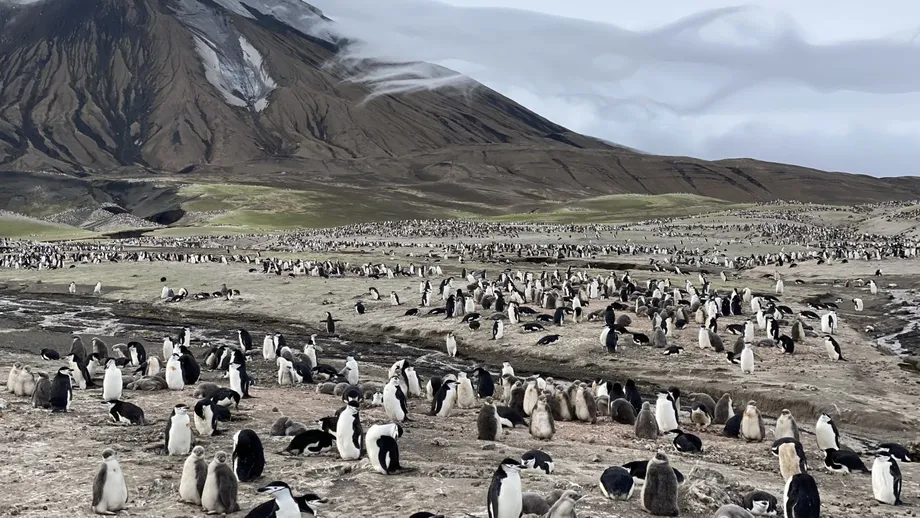
The number of occupied chinstrap penguin nests on Zavodovski Island fell by 63% between 2011 and 2025, according to research led by the British Antarctic Survey (BAS). The remote volcanic island in the South Sandwich Islands, once considered the world's largest penguin colony, has suffered a sustained decline that researchers link most plausibly to warming seas and changes in the availability of krill, the birds' main food.
Contents
- A former penguin stronghold loses its lead
- What the population figures actually measure
- How scientists surveyed an island that is difficult to reach
- The sequence from apparent stability to steep decline
- Why moving krill leaves chinstraps stranded
- Why the volcano and local fishing do not explain the trend
- Macaroni gains reveal a changing penguin community
- A conservation warning, with causes still under investigation
- Key Points
One detailed population estimate puts the island's breeding chinstraps at about 1.09 million in January 2011 and 402,000 in 2025, a loss of approximately 688,000 birds. Macaroni penguins moved in the opposite direction, increasing from about 338,000 to 433,000 over the same period. They now outnumber chinstraps on the island.
The findings, published in Current Biology, point to more than a shrinking colony. Two species sharing the same island are responding differently to a changing ocean. Chinstraps depend heavily on krill and particular feeding conditions, while macaroni penguins can eat a wider range of prey.
Norman Ratcliffe, the BAS penguin ecologist who led the research, described the scale of the loss:
It is an enormous population crash, equivalent to half a million breeding individuals being lost from that island.
Researchers say Cape Adare in Antarctica's Ross Sea now holds the largest colony, with more than one million breeding Adélie penguins counted there as of 2018. Some accounts describe that transfer more cautiously as likely. Either way, Zavodovski's decline challenges the earlier view that this isolated island offered chinstraps a refuge from losses occurring elsewhere.
What the population figures actually measure
The most consistent finding is the 63% reduction in occupied chinstrap nest sites. Nest occupancy measures breeding activity, rather than counting every bird of every age. Estimates of breeding individuals and occupied nests therefore should not be treated as interchangeable.
Reports differ on the starting population and the number lost. Several give a 2011 estimate of 600,000 chinstraps and 90,000 macaroni penguins, while another gives approximately 1.09 million breeding chinstraps and 338,000 breeding macaronis. Losses are variously described as more than half a million birds, about half a million breeding individuals, or more than 680,000 chinstraps. One quoted description refers instead to more than half a million nests.
Those differences cannot be resolved simply by applying the 63% decline to every reported figure. The distinction between nests and individuals accounts for some possible variation, but the reports do not establish a common basis for all the estimates. The nest decline is consequently the clearest headline measure.
The more detailed breeding population figures also show why describing the chinstrap loss as roughly a quarter of all the island's penguins understates the total change. Adding 1.09 million chinstraps and 338,000 macaronis gives approximately 1.428 million breeding birds in 2011. The reported 2025 figures sum to 835,000, a decline of about 593,000, or 42%, after the macaroni increase is included.
A separate estimate places the current total at about 838,000 breeding penguins and likewise reports a decline exceeding 40%. Its macaroni estimate is approximately 430,000. These recent totals are close, although the historical population figures vary much more widely.
How scientists surveyed an island that is difficult to reach
Zavodovski lies at the northern end of the South Sandwich Islands, roughly 2,500 kilometers east of Argentina. Its steep coast, rough seas and active volcano make repeat surveys difficult. The BAS expedition in December 2023 reached the island after about 15 days at sea, having departed from the Falkland Islands.
The team combined drone surveys, aerial photography, satellite imagery and tracking devices. A Royal Air Force cargo aircraft helped obtain photographs, while satellite images allowed researchers to estimate changes across years beyond the expedition itself. Together, these methods provided a longer population record than a single visit could establish.
Researchers fitted tracking devices to 20 penguins: 12 chinstraps and eight macaronis. Those records helped identify where the species fed and whether they were using the same waters. This mattered because the explanation for the decline depended on conditions offshore, not simply on how many birds could fit onto the island.
Field conditions also underline why the colony's decline could escape notice. Storms limited work ashore, strong winds damaged tents, and the team carried gas monitors and masks because volcanic fumes could be dangerous. Earlier assumptions of stability were being tested at a place where collecting fresh evidence requires a substantial expedition.
The sequence from apparent stability to steep decline
The research brings together observations spanning more than a decade. Its chronology is central to the conclusion that the decline was sustained, rather than the result of one disaster.
- 1997: An early visual survey estimated about two million chinstrap penguins on Zavodovski. A later survey using satellite imagery revised the estimate to about 1.2 million.
- 2011: Surveys supported Zavodovski's standing as the world's largest penguin colony and the view that South Sandwich Islands chinstrap populations were stable.
- 2011 to 2016: Occupied macaroni penguin nest sites increased by approximately 28%, while chinstrap numbers declined.
- 2016: Mount Curry erupted, raising concern about damage to the island's penguins.
- December 2023: BAS researchers conducted field surveys and tracked the feeding movements of both species.
- 2025: The reconstructed population record showed 63% fewer occupied chinstrap nests than in 2011. Macaroni numbers had remained broadly stable after their earlier increase.
The early revision from two million to 1.2 million chinstraps should not itself be read as a measured population crash. It reflected a revised estimate using different survey methods. The new study's central comparison is the change in occupied nests between 2011 and 2025.
Researchers estimate that Zavodovski's chinstraps have been declining at around 7% a year, roughly two to three times the rate reported elsewhere. They describe it as the fastest observed decline for a chinstrap population, making the former stronghold a particular conservation concern.
Why moving krill leaves chinstraps stranded
Chinstrap penguins are feeding specialists. They rely heavily on Antarctic krill, small crustaceans that form a major connection between marine plants and larger animals such as penguins and whales. Krill depend on sea ice for food and shelter during important parts of their life cycle.
Researchers suspect warmer water and declining sea ice have changed where krill are available, pushing their distribution south toward the Weddell Sea. Tracking showed chinstraps feeding in cooler waters northwest of Zavodovski, while macaronis used warmer waters northeast of the island.
Ratcliffe explained why the chinstraps cannot simply follow their food into more southerly waters:
"Sea-ice cover to the south and a lack of suitable islands for nesting prevents chinstraps from following the food," he said.
This is a geographical constraint as well as a feeding problem. A breeding penguin needs a suitable place to nest and access to food from that colony. Colder water farther south does not automatically provide both. Sea ice conditions can restrict access, while the absence of suitable nesting islands limits where a new colony could form.
Peter Fretwell, a BAS researcher specializing in remote sensing and a study coauthor, also pointed to the birds' attachment to breeding locations:
"A lot of people think that animals move south, but generally penguins are quite site-faithful, and they stay where they are," Fretwell said.
The proposed explanation is therefore not that warming directly killed every missing bird. It is that changing ocean conditions reduced access to prey, leaving a species with a narrow diet and restricted breeding options less able to sustain its population.
Why the volcano and local fishing do not explain the trend
Mount Curry's 2016 eruption was an obvious suspect. The penguins nest around an active volcano, and ash, lava and fumes can threaten wildlife. The population record, however, showed chinstrap losses beginning before the eruption and continuing steadily afterward.
Researchers also found that the principal ash deposition did not overlap the main chinstrap habitat. The timing and distribution of the eruption's effects did not match the sustained decline. This does not require assuming that no individual bird was harmed; it means the eruption does not explain the population pattern.
Competition from the growing macaroni population was another possibility. The island had sufficient nesting space, and the tracking data showed that the two species largely fed in different places. Those observations weakened the argument that macaronis were displacing chinstraps from nests or directly taking their food.
Local krill fishing is prohibited within the island's Marine Protected Area. Researchers found no evidence that regional krill fisheries were driving the decline. Fishing farther away, along connected ocean currents, remains a question rather than an established explanation. Protection from extraction close to the colony also cannot prevent warming from changing the surrounding ocean.
The team considered other consumers of krill, including humpback whales. Although whales eat large quantities, their waste can also supply nutrients that support the marine plants on which krill feed. The research did not establish whale competition as the cause of the losses.
Macaroni gains reveal a changing penguin community
Macaroni penguins provide a useful comparison because they experienced the same island's volcanic activity and nesting conditions without following the chinstrap decline. Their occupied nest sites increased by 28% between 2011 and 2016, then remained broadly stable. Some accounts round that increase to 30%.
The detailed population estimates show a rise from approximately 338,000 to 433,000 breeding birds, an increase of about 95,000. That gain offsets only around 14% of the approximately 688,000 chinstraps lost under the same set of estimates. A thriving second species has therefore not prevented a large reduction in the colony's total breeding population.
Macaronis have a broader diet that includes fish and other crustaceans as well as krill. Their tracked use of warmer waters northeast of Zavodovski is consistent with access to different prey. Researchers consider that flexibility a likely reason they have fared better, although the tracking results do not establish everything the birds ate.
Ratcliffe described the contrast between the species:
"Our data shows that the cold-adapted Antarctic chinstrap species are no longer thriving beside their sub-Antarctic neighbours," he said.
The change is consequently more than a reduction in abundance. Macaronis now make up slightly more than half of the breeding penguins in the detailed 2025 estimate, compared with roughly a quarter in 2011. The island's penguin community has shifted toward a species better able to use warmer waters and alternative food.
A conservation warning, with causes still under investigation
Chinstrap penguins are currently described in the reports as classified as least concern on the International Union for Conservation of Nature's Red List. Researchers suggest that the Zavodovski decline, together with losses elsewhere, should prompt reassessment, potentially including endangered status. That is a recommendation, not a completed classification change.
The colony's importance makes the result difficult to dismiss as an isolated local problem. One estimate assigns 38% of the global chinstrap population to the South Sandwich Islands. Seabird ecologist Lucas Krüger García, who was not involved in the study, described Zavodovski itself as having represented 30% of the global population. Another account puts the archipelago's share at almost a third. These estimates differ in geography and possibly reference period, so they should not be combined into a single figure.
What they share is the conclusion that this region supports a substantial fraction of the species. Earlier surveys suggesting stability there offered reassurance while chinstrap colonies elsewhere were declining. The new evidence weakens that reassurance, although a Zavodovski survey does not establish the current population trend on every island in the archipelago.
The climate explanation is strongly supported by the contrasting species trends and the elimination of several alternatives, but important details remain uncertain. Alvaro Soutullo, an ecologist at the University of the Republic who was not involved in the research, cautioned:
the causes of the decline are far from being properly understood.
The study does not settle the precise contribution of krill redistribution, breeding success or changes in adult survival. It also provides no scheduled date for a Red List decision. The immediate result is a documented collapse in breeding activity at a major colony, accompanied by a plausible food supply explanation that still requires further testing.
Key Points
- Occupied chinstrap penguin nests on Zavodovski Island fell 63% between 2011 and 2025.
- One detailed estimate shows breeding chinstraps falling from about 1.09 million to 402,000, although reported historical counts differ.
- Macaroni penguins increased by about 28% before stabilizing and now outnumber chinstraps on the island.
- The island's total breeding penguin population has fallen by more than 40%, to roughly 835,000 to 838,000.
- Researchers identify warming seas and reduced access to krill as the most plausible explanation, rather than the 2016 eruption.
- Cape Adare is now identified as the largest colony, while researchers recommend reassessing chinstrap conservation status.