A persistent cancer burden in Sarawak
A study of 3,643 nasopharyngeal cancer cases recorded in Sarawak between 1996 and 2015 found incidence among Bidayuh men reached 27.8 per 100,000 people, compared with 13.2 across the state. Among Bidayuh women, the rate was 11.6 per 100,000, against a state average of 5.3. Both figures put the community among the populations with the highest recorded rates worldwide.
Contents
- A persistent cancer burden in Sarawak
- How exceptional are the Bidayuh rates?
- What the changing figures actually show
- Declining incidence, but uneven progress
- Malaysia records more cases despite a lower rate
- What is known about the causes?
- Late diagnosis remains a major concern
- Who could benefit from screening?
- Earlier detection changes treatment prospects
- Key Points
The findings show why a decline in incidence does not mean the threat has passed. Bidayuh rates remained more than twice the Sarawak average across the study period, while Malaysian figures show that roughly three quarters of patients with this cancer are diagnosed at stages three or four.
Nasopharyngeal cancer, or NPC, develops in the upper part of the throat behind the nose. Its location makes a small tumour difficult to notice, and early symptoms can be mild. A neck lump, changes in hearing or nasal bleeding may be the first signs that prompt medical attention.
Published in August 2023 in the Asian Pacific Journal of Cancer Prevention, the Sarawak registry study found falling incidence in several groups but a continuing concentration of risk among Bidayuh people. Its authors called for closer attention to early screening and prevention.
How exceptional are the Bidayuh rates?
The strongest comparisons use figures from the same period and account for differences in population age. An age adjusted rate estimates what incidence would look like if each population had the same age distribution. That helps researchers compare communities without mistaking an older population for one with greater underlying cancer risk.
For 2008 to 2012, the Sarawak researchers calculated Bidayuh rates of 23.8 per 100,000 men and 9.0 per 100,000 women. The corresponding figures for the general Sarawak population were 11.8 and 4.5. The male rate was just over twice the state average; the female rate was exactly twice it.
The study compared these figures with international cancer registry data and found Bidayuh incidence closely matched that of Zhongshan and Zhuhai in southern China, regions known for unusually high NPC rates.
This pattern had already appeared in a 2004 incidence study by Beena C. R. Devi, Paola Pisani, Tieng Swee Tang and D. Maxwell Parkin. Examining diagnoses from 1996 to 1998, they calculated Bidayuh rates of 31.5 per 100,000 males and 11.8 per 100,000 females, respectively 2.3 and 1.9 times the Sarawak average. Those rates were about 50 per cent higher than Hong Kong figures for the same period.
What the changing figures actually show
The different estimates describe different periods, rather than a single current rate. The 1996 to 1998 study recorded 392 cases confirmed through tissue examination and added 42 cases identified only through death certificates. Excluding those additional cases lowered Bidayuh rates to 29.4 per 100,000 males and 10.6 per 100,000 females, still exceptionally high.
Another estimate for 2007 to 2011 placed Bidayuh incidence at 24.6 per 100,000 males and 9.3 per 100,000 females. Those figures are close to, but not identical with, the published study's estimates for 2008 to 2012. The periods overlap but differ, so the figures should not be treated as competing measurements of the same years.
Unpublished Sarawak health department figures also indicate a decline from 39 per 100,000 in 1996 to 2000 to 22 in 2011 to 2015. Without the same detail about sex and calculation methods, that series cannot be directly equated with the published estimates.
The research and reporting milestones span several decades:
- 1996: The Sarawak Cancer Registry began operating.
- 1996 to 1998: Diagnoses formed the basis of the study published in March 2004.
- 1996 to 2015: The registry recorded the 3,643 cases examined in the later analysis.
- August 2023: The analysis of those 20 years was published.
- 19 July 2024: Malaysia announced publication of its national cancer registry summary for 2017 to 2021.
Declining incidence, but uneven progress
The 2023 analysis found a statistically significant annual reduction of 3.9 per cent in Sarawak NPC incidence between 1996 and 2003. From 2003 to 2015, the estimated annual change was a decline of 0.17 per cent, which was not statistically significant. The early improvement therefore did not continue at the same measurable pace.
Trends were broadly downward across ethnic groups. One exception was an estimated annual increase of 5.48 per cent among Iban males between 2009 and 2015. That increase was not statistically significant, meaning the analysis could not confidently distinguish it from chance variation.
The full registry analysis, another version of the same 2023 study, also shows why the highest rate and the greatest number of cases are different measures. Bidayuh patients accounted for 629 cases, or 17.3 per cent of the total. Iban patients accounted for 1,169 and Chinese patients for 1,022, reflecting the burden in larger populations.
Most patients were aged 40 to 59, accounting for 1,908 cases, or 52.4 per cent. Samarahan had the highest division rates, at 21.1 per 100,000 men and 8.0 per 100,000 women. Kuching recorded the largest number of cases, 877, but did not have the highest rate.
Malaysia records more cases despite a lower rate
National cancer registry figures recorded 5,186 NPC cases in 2017 to 2021, up from 4,597 in 2012 to 2016. That is an increase of 589 cases, or about 12.8 per cent. Over the same periods, the reported incidence rate fell from 4.0 to 3.1 per 100,000 people, a reduction of 22.5 per cent.
A rising count and a falling rate are not necessarily contradictory. Counts measure how many people were diagnosed, while rates relate diagnoses to a population denominator and may adjust for age. Changes in population and reporting can affect the relationship between them.
The Ministry of Health's announcement of the Summary of the Malaysia National Cancer Registry Report 2017 to 2021 said online reporting began in 2018 and a circular mandated online notifications in 2020. These changes contributed to an increase in reported cancer cases. They do not establish how much of the NPC increase came from better reporting rather than other changes.
NPC ranked eighth among cancers diagnosed nationally in 2017 to 2021 and sixth among males. Earlier registry reports had ranked it fifth across Malaysians. These rankings use different periods or population groups and should not be presented as interchangeable.
Sarawak remains the state with the highest reported NPC incidence, at 10.6 per 100,000 males and 3.9 per 100,000 females. These figures describe a different reporting window from the 1996 to 2015 research averages.
What is known about the causes?
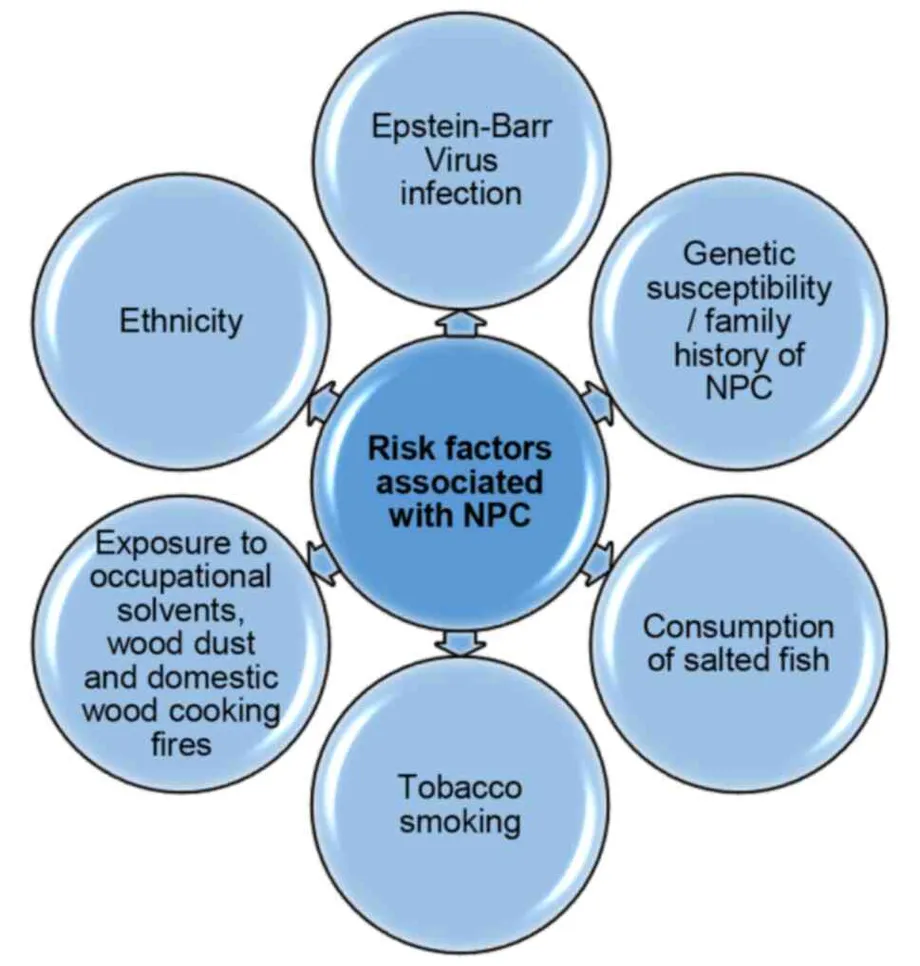
NPC risk involves several factors, including genetic susceptibility, family history, EBV infection, tobacco smoking and environmental or dietary exposures. EBV is associated with more than 95 per cent of endemic NPC cases, meaning cases arising where the disease occurs persistently at high rates. Infection alone does not explain why some communities experience much higher incidence than others.
The 2004 study identified EBV, tobacco smoking and Chinese style salted fish as established causes. It also made a crucial distinction: evidence linking salted fish to NPC in Malaysian Chinese people did not demonstrate that particular Bidayuh dietary practices explained the community's excess risk.
Preserved fish, meat and vegetables may contain carcinogenic nitrosamines. Hazardous chemical exposures, including those involving wood solvents, have also been raised as possible contributors. The registry studies did not measure individual exposures closely enough to assign a share of Bidayuh cases to any one factor.
The authors of the 2004 study, Devi, Pisani, Tang and Parkin, explained in their epidemiological research paper which questions required further investigation:
Local dietary habits, environmental exposures, and genetic susceptibility deserve investigation in this population.
The later Sarawak study likewise proposed closer investigation of genetics, diet, smoking and environmental exposures. Ethnicity identifies a population with higher observed risk; it does not by itself identify a biological cause or justify blaming a community's customs.
Late diagnosis remains a major concern
The 1996 to 1998 Sarawak study found that 88 per cent of patients presented at stage three or four. National NPC figures put the corresponding proportions at 76.2 per cent for males and 72.6 per cent for females. These are different populations and periods, so the comparison cannot establish how much diagnosis has improved specifically among Bidayuh people.
The national problem also extends beyond NPC. Across cancers, the share detected at stages three and four rose from 63.7 per cent in 2012 to 2016 to 65.1 per cent in 2017 to 2021, according to the national registry summary. That is a rise of 1.4 percentage points.
For NPC, warning signs include a painless neck lump, nosebleeds, blocked nostrils, excessive mucus or blood in saliva. Ear symptoms can include blockage on one side, hearing loss or tinnitus, a ringing or buzzing sound. Headaches, facial numbness and problems involving nerves that control functions in the head can also occur.
These symptoms can have causes other than cancer. Persistent or unexplained symptoms nevertheless warrant medical assessment, especially in someone with a family history or from a population with high incidence. Waiting for severe symptoms can delay diagnosis of a tumour hidden behind the nose.
Who could benefit from screening?
The evidence supports directing screening efforts toward people with a family history of NPC and populations with unusually high incidence. Malaysia's estimated lifetime risk is one in 167 for males, rising to one in 100 among Chinese and Other Bumiputera males. For females, the estimated risk is one in 500, rising to one in 250 among Other Bumiputera.
Other Bumiputera is a broad registry category covering indigenous peoples apart from Malays, including Orang Asli and native groups in Sabah and Sarawak. Those lifetime estimates are not specific Bidayuh risk calculations.
Blood tests used in NPC screening include VCA IgA and EA IgA antibody tests, which look for aspects of the immune response to EBV, and EBV DNA tests, which detect viral genetic material. Nasoendoscopy allows a clinician to inspect the nasopharynx with a thin viewing instrument. MRI and PET scans may help investigate suspected disease and assess its extent.
These methods serve different purposes and are not interchangeable. Some blood tests can produce nonspecific results, while imaging can be costly. A screening result is not itself a confirmed cancer diagnosis. The research calls for greater screening attention but does not specify a new programme, a universal testing interval or a start date.
Earlier detection changes treatment prospects
Treatment depends on stage and whether the cancer has spread. Early disease may be treated with radiotherapy alone, while later disease generally requires radiotherapy with chemotherapy. Radiotherapy directs radiation at the tumour, and chemotherapy uses medicines to attack cancer cells.
Intensity modulated radiotherapy shapes the radiation dose to reduce exposure to nearby critical structures. Surgery is generally reserved for recurrence rather than used as the first treatment. Options for recurrent disease can include nasopharyngectomy, surgery to remove affected tissue, or another course of radiotherapy.
Malaysian survival figures show a substantial difference by stage. Relative survival at five years was 63.7 per cent for stage one, 59.1 per cent for stage two, 50.2 per cent for stage three and 26.9 per cent for stage four. The gap between stages one and four was 36.8 percentage points.
Relative survival compares survival among people with cancer with expected survival in a comparable general population. It describes groups, not a prediction for an individual patient. Across stages, the reported figures were 49.2 per cent for women and 44.8 per cent for men.
The Sarawak registry study lacked complete information on symptoms, time to diagnosis, stage, treatment and survival. It therefore cannot establish current Bidayuh survival or explain precisely where delays occur. Its data also end in 2015, leaving a need for more recent measurements of the community's burden.
The Ministry of Health has expressed an intention to publish national registry reports more frequently, potentially every two years and eventually annually. No firm release deadline was given. Better incidence data, together with complete stage and treatment records, would help determine whether targeted detection efforts are reaching people before disease becomes advanced.
Key Points
- Bidayuh NPC incidence in the 1996 to 2015 study was more than twice the Sarawak average for both sexes.
- Comparisons for 2008 to 2012 placed Bidayuh rates alongside high incidence regions of southern China.
- Sarawak incidence fell sharply from 1996 to 2003, but the later decline was not statistically significant.
- Malaysia recorded 5,186 NPC cases in 2017 to 2021, up from 4,597 in the preceding five years.
- Roughly three quarters of Malaysian NPC patients were diagnosed at stages three or four.
- Genetic susceptibility, EBV, smoking and dietary or environmental exposures require attention without assuming one cause explains Bidayuh risk.
- Screening for groups with greater risk and prompt assessment of persistent symptoms are priorities; no new screening timetable was announced.