
Fourteen registration cases suspended as scrutiny expands
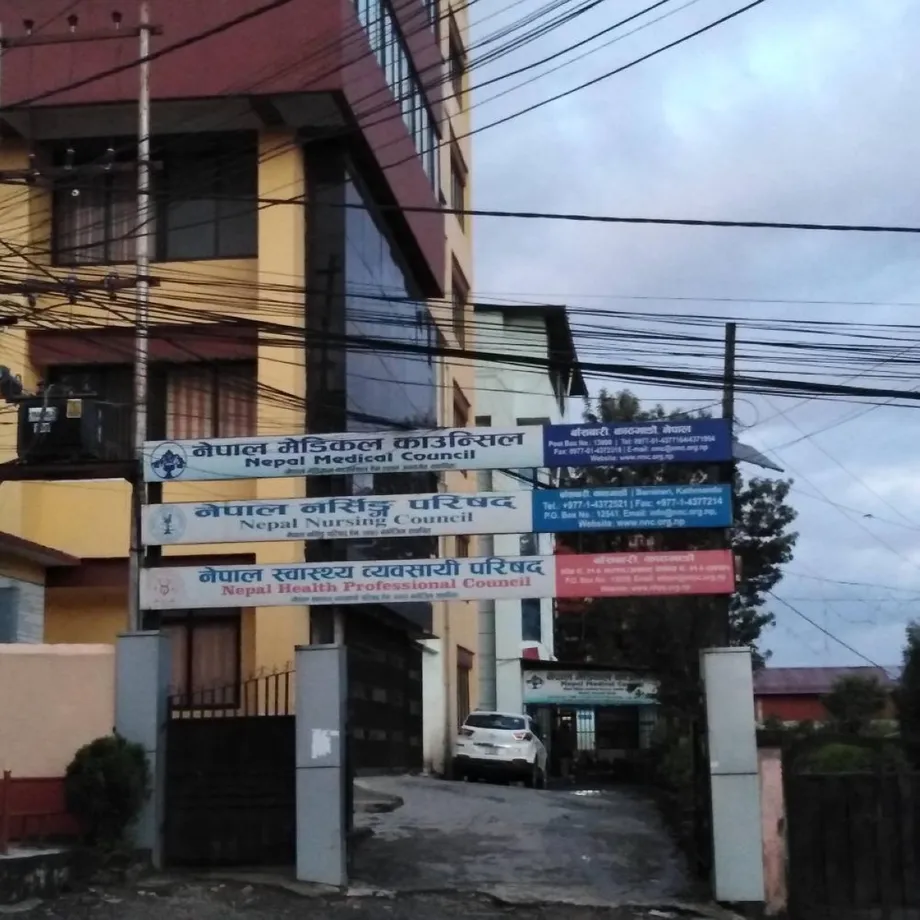
Nepal Medical Council is examining 283 files involving foreign doctors from 12 countries after suspending registration processing for 14 doctors over questionable certificates. The investigation also targets a separate concern: whether medical colleges list doctors as teaching staff even when they work elsewhere and do not teach students in Nepal.
Contents
- Fourteen registration cases suspended as scrutiny expands
- What the certificate checks have established
- How absent teachers could affect student admissions
- Students and institutions face separate checks
- Inspection arrangements come under scrutiny
- Earlier allegations show why staffing claims matter
- Seat increases sharpen the debate over teaching capacity
- The timeline spans old warnings and new action
- Foreign verification remains the main unfinished task
- Key Points
The inquiry began after the council found that a doctor authorised to serve in Nepal was also working in his home country. Verification of some documents with Indian regulatory authorities then revealed that certificates submitted for registration in Nepal had not been issued by the authorities named on them.
The council, which regulates medical doctors and dentists, has formed an investigation committee led by council member Dr Chhabi Panthi. Its remit covers registration records, employment status and professional activities, extending beyond medical colleges to private hospitals, nongovernmental organisations and international nongovernmental organisations.
The figures describe different stages and scopes of the investigation. Initial estimates put the foreign doctor workforce at between 300 and 500, mostly from India. Another account described plans to examine around 500 files. The latest update identifies 283 files actually taken up for review, not 283 confirmed cases of wrongdoing.
Acting registrar Dr Dipendra Pandey described the concern about college staffing when announcing the inquiry:
We have formed a committee to examine documents submitted by all foreign doctors seeking to serve in Nepal. We suspect that private medical colleges bring in foreign doctors only to present them during our monitoring visits.
That suspicion connects the document investigation to decisions about how many medical students colleges may admit. Regulators must establish both whether a doctor holds genuine credentials and whether that doctor actually performs the teaching role claimed by an institution.
What the certificate checks have established
A central concern involves Good Standing Certificates. These documents confirm that a doctor is registered with the relevant medical regulator in their home country and is in good professional standing. They are distinct from academic qualifications and help another regulator assess an application to practise.
The council said in its public notice that some submitted certificates had not been issued by the relevant authorities, while some documents had been officially confirmed as forged. It temporarily stopped registration processing for doctors with forged documents and others whose documents remained under examination.
The distinction matters. Pandey explained that a certificate being fabricated does not necessarily mean the doctor is unregistered in India. A doctor may hold a valid medical registration while submitting an invalid document to obtain permission elsewhere.
Pandey described why the council halted the applications:
We suspended the registration process after receiving a response that the certificates had not been issued by the concerned council.
The reported total of 14 suspended cases is therefore not a count of doctors proven to lack medical qualifications. Nor is a suspension of registration processing the same as cancellation of an existing licence. Those outcomes require separate findings and decisions.
How absent teachers could affect student admissions
The Medical Education Commission determines student places using criteria that include physical infrastructure, faculty numbers and qualifications, hospital patient volume and other requirements. Faculty strength matters because approved student numbers are supposed to reflect an institution's capacity to teach them.
Council officials suspect some colleges temporarily bring foreign doctors into Nepal before inspections, present them as faculty and allow them to return to their usual jobs afterward. Such arrangements are described as ghost or dummy faculty: doctors counted as teachers without carrying out the corresponding academic duties.
The alleged practice could make a college appear better staffed than it is throughout the academic year. Officials say it may be used to increase or retain places in MBBS programmes, which award the Bachelor of Medicine, Bachelor of Surgery degree. The wider account also identifies seat decisions for MD, MS and other medical programmes.
The inquiry must distinguish genuine visiting or foreign faculty from misleading employment claims. Nationality alone does not establish wrongdoing. The relevant questions are whether the doctor is properly registered, whether the employment record is accurate and whether the promised teaching actually takes place.
Students and institutions face separate checks
Students have complained that certain doctors appear on college faculty lists but do not teach them, according to council officials. Those complaints address the reality of instruction, which cannot be established through certificate checks alone.
The Education Ministry has separately begun studying faculty records and information supplied by students, including photographs, videos and other evidence. That examination could help establish whether staff named in institutional records were actually present and carrying out teaching duties.
The council has requested written explanations from medical and dental colleges, health science institutions and hospitals that recommended foreign doctors without verifying their documents. Institutional representatives have been summoned for inquiry. Applicants and Nepali doctors who supported applications have also been asked to explain their involvement and appear when required.
Institutions may be required to bring the doctors before the council so their identities and documents can be checked. The public notice places responsibility on recommending organisations to verify authenticity rather than simply forward an application.
The ministry has said those proven to have used false faculty arrangements to affect college seats or recognition would be held accountable. Possible proceedings against doctors include licence suspension or cancellation, but the reported inquiry has not established how many people might face those measures.
Inspection arrangements come under scrutiny
Council officials say representatives of the Nepal Medical Council previously joined teams inspecting colleges and assessing student places. They say the Medical Education Commission no longer includes a council representative on its monitoring teams. The council has informed the commission about the investigation.
One council official also suspects colleges receive advance warning of inspection visits. That could allow an institution to assemble temporary faculty and bring in additional patients to create the appearance of a busy teaching hospital.
These are allegations, not established findings against identified institutions in the current inquiry. They nevertheless explain why checking certificates alone would not settle the matter: an inspection can record who is present on a particular day without proving who teaches regularly.
Patient volume is another part of the same concern. A medical college needs clinical activity through which students can learn. An unusually busy inspection day would not, by itself, demonstrate that comparable clinical learning opportunities exist throughout the year.
Earlier allegations show why staffing claims matter
The current investigation follows a longer history of reported stand-in faculty in Nepal. Historical figures attributed to a 2015 Nepal Medical Council list identified 212 doctors as stand-in instructors. The reported breakdown included 71 at College of Medical Sciences in Bharatpur, 46 at Nobel Medical College in Biratnagar and 36 at Universal Medical College in Bhairahawa.
Those three figures total 153, or about 72 percent of the reported 212. They describe historical allegations and should not be treated as findings about the institutions' present staffing or as part of the current 14 registration cases.
A related investigation by the Punjab Medical Council reportedly identified more than 400 fake teachers across four private colleges in Punjab, Haryana and Himachal Pradesh. At Maharishi Markandeshwar Medical College in Solan, 74 of 155 listed faculty members were identified as ghost members, approximately 48 percent.
The regional comparison illustrates the distinction at the centre of Nepal's inquiry. A person may be a qualified doctor yet be inaccurately presented as a regular teacher at a particular college. Reports have also described doctors listed as faculty in Nepal while working in Bhutan, the Caribbean, the United Arab Emirates or India, alongside allegations of phantom faculty in dental colleges.
Seat increases sharpen the debate over teaching capacity
A reported decision by the Medical Education Commission to raise MBBS places from 100 to 130 and BDS places from 50 to 60 prompted an August 2025 ultimatum from medical education campaigner Dr Gobinda KC. BDS stands for Bachelor of Dental Surgery.
The changes amount to increases of 30 percent for MBBS and 20 percent for BDS at the stated limits. KC, a senior orthopaedic surgeon associated with Tribhuvan University Teaching Hospital, demanded that the government reverse the decision within a week.
His objection focused on whether expansion was supported by adequate teaching capacity. That debate is directly relevant to the current allegations: if faculty totals are inaccurate, decisions based on those totals may overstate how many students a college can responsibly train.
Reported licensing examination results also provide context, but not proof of a connection. The cited pass rate was 31 percent in January 2025, compared with 42 percent in September 2022, a difference of 11 percentage points. Those figures alone cannot establish that missing faculty caused examination failures, or determine which colleges were responsible.
Employment pressures complicate the picture further. The Institute of Medicine reportedly received more than 600 applications for a small number of medical officer vacancies, with 40 to 80 applications per position. That competition makes claims of absent teaching staff especially consequential, although the inquiry has not determined whether ghost appointments displaced qualified applicants.
The timeline spans old warnings and new action
The reported developments stretch from earlier staffing investigations to the present verification exercise. Publication dates establish when the latest actions became public, but do not necessarily identify the date of every underlying decision.
- 2015: A Nepal Medical Council list reportedly identified 212 stand-in faculty members at medical colleges.
- August 2025: Dr Gobinda KC issued a one week ultimatum against reported increases in MBBS and BDS places.
- August 19, 2026: The council's temporary suspension of registration processing and requests for explanations were publicly reported.
- August 20, 2026: Details emerged about the committee investigating credentials, employment and suspected ghost faculty.
- A subsequent update dated 23 Bhadau: The review was described as covering 283 files from 12 countries, with completion intended after Tihar.
The date of 23 Bhadau is given in the Nepali calendar without an explicit year in that update. It should not be converted into a precise Gregorian date without that information. Likewise, the council's target of completing work after Tihar does not provide a fixed deadline.
Foreign verification remains the main unfinished task
Panthi says the council has contacted medical regulators abroad to verify qualifications and certificates, but most responses remain outstanding. Some replies have arrived. Until the remaining authorities respond, the council cannot complete the same level of verification across all files.
The council also says changes in its leadership and membership, together with the limited availability of some committee members, have slowed the work. It intends to finish after Tihar, though no exact completion date has been announced.
Several central questions remain unresolved: how many additional documents will be found invalid, which institutions knew about any false claims, whether faculty records affected seat allocations and what action will follow. The reports do not establish a final count of ghost faculty or identify a completed set of sanctions against colleges.
Panthi has stressed that the investigation should not be read as an accusation against every foreign doctor working in Nepal:
We are not saying that all foreign doctors' credentials are fake or suspicious. We will investigate whether colleges have misused their credentials for their benefit.
The decisive findings will therefore need to address two separate issues: the authenticity of professional documents and the accuracy of institutional staffing claims. Genuine certificates would not resolve an allegation of absent teaching, just as an invalid certificate would not alone prove that a college manipulated its student allocation.
Key Points
- The council is reviewing 283 foreign doctor files involving 12 countries.
- Registration processing for 14 doctors has been suspended over certificate concerns.
- The investigation covers employment and teaching duties as well as credentials.
- The Education Ministry is separately examining faculty records and student evidence.
- Most replies from foreign medical regulators remain outstanding.
- The council aims to finish after Tihar, without a fixed public deadline.
- No final total of ghost faculty or completed sanctions against colleges has been established.